- 128 pages
- English
- ePUB (mobile friendly)
- Available on iOS & Android
eBook - ePub
The Black Colleges of Atlanta
About this book
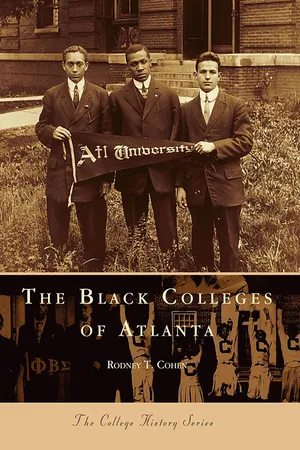
Join Author Rodney T. Cohen as he reveals the history & beginnings of the Black Colleges of Atlanta and the distinguished alumni they shaped.
By 1865, although Atlanta and the Confederacy still lay wounded in the wake of the Union victory, black higher education began its thrust for recognition. Some of the first of the American colleges formed specifically for the education of black students were founded in Atlanta, Georgia. These schools continue, over a century later, to educate, train and inspire. Through an engaging collection of images and informative captions, their story begins to unfold. Atlanta University was the pioneer college for blacks in the state of Georgia. Founded in 1865, it was followed by Morehouse College in 1867, Clark University in 1869, and Spelman and Morris Brown Colleges in 1881. By 1929, Atlanta University discontinued undergraduate work and affiliated with Morehouse and Spelman in a plan known as the "Atlanta University System." A formal agreement of cooperation including all of the Atlanta colleges occurred in 1957, solidifying the common goal and principles each school was founded upon-to make literate the black youth of America. Today, the shared resources of each institution provide a unique and challenging experience for young African Americans seeking higher education. The schools boast a long and distinguished list of alumni and scholars, including W.E.B. DuBois, James Weldon Johnson, Martin Luther King, Henry O. Tanner, and C. Eric Lincoln.
Information
One
CAMPUS SCENES AND LANDMARKS
South of the North, yet north of the South, lies the City of a Hundred Hills, peering out from the shadows of the past into the promise of the future. I have seen her in the morning, when the first flush of day had half-roused her; she lay gray and still on the crimson soil of Georgia.
—W.E.B. DuBois

It was not until 1949, 17 years after its construction, that the administration building of Atlanta University received its name. Called Harkness Hall, it was named after the great benefactor Edward S. Harkness. It is pictured here, c.1940.

Shown on a typical school day, c.1950, are students from Clark College as they enjoy an autumn walk through the beautifully landscaped Thayer Quadrangle. The quadrangle takes its name from

Thayer Hall, shown in the background. James P. Brawley compared the cultural atmosphere and elegance of Thayer Hall to the Commons of Christ College at Oxford in England.

One of the most significant and progressive changes in the history of the Atlanta School of Social Work was when it affiliated with Atlanta University in 1938, thus becoming officially known as the Atlanta University School of Social Work.

In 1929, Atlanta University, Morehouse, and Spelman were formally affiliated in a university plan to become the Atlanta University System. As a result of this affiliation, the book collections of the three institutions were brought together to form the new Atlanta University Library. Shown is the University Library, c.1935, which was made possible by a gift from the General Education Board.

For years Graves Hall has served as the cultural, moral, and intellectual hub of Morehouse College. Named after President Samuel Graves, the structure was erected in 1889 on a historic plot of land. This land was marked by the Confederate Army, which offered stubborn resistance to the Union forces during the siege on Atlanta (Brawley, 1917).

This volleyball contest between the coeds of Clark College took place around 1950.

During the first eight years following Clark’s relocation in 1941, there were only two dormi...
Table of contents
- Title Page
- Copyright Page
- Dedication
- Table of Contents
- AKNOWLEDGMENTS
- INTRODUCTION
- One - CAMPUS SCENES AND LANDMARKS
- Two - ADMINISTRATORS AND SCHOLARS
- Three - ALUMNI
- Four - FRATERNITIES AND SORORITIES
- Five - CAMPUS CULTURE
- Six - POMP AND CIRCUMSTANCE
- Seven - ATHLETICS
- Eight - ACADEMIC LIFE
- BIBLIOGRAPHY
Trusted by 375,005 students
Access to over 1.5 million titles for a fair monthly price.
Study more efficiently using our study tools.
Frequently asked questions
Yes, you can cancel anytime from the Subscription tab in your account settings on the Perlego website. Your subscription will stay active until the end of your current billing period. Learn how to cancel your subscription
No, books cannot be downloaded as external files, such as PDFs, for use outside of Perlego. However, you can download books within the Perlego app for offline reading on mobile or tablet. Learn how to download books offline
Perlego offers two plans: Essential and Complete
- Essential is ideal for learners and professionals who enjoy exploring a wide range of subjects. Access the Essential Library with 800,000+ trusted titles and best-sellers across business, personal growth, and the humanities. Includes unlimited reading time and Standard Read Aloud voice.
- Complete: Perfect for advanced learners and researchers needing full, unrestricted access. Unlock 1.5M+ books across hundreds of subjects, including academic and specialized titles. The Complete Plan also includes advanced features like Premium Read Aloud and Research Assistant.
We are an online textbook subscription service, where you can get access to an entire online library for less than the price of a single book per month. With over 1.5 million books across 990+ topics, we’ve got you covered! Learn about our mission
Look out for the read-aloud symbol on your next book to see if you can listen to it. The read-aloud tool reads text aloud for you, highlighting the text as it is being read. You can pause it, speed it up and slow it down. Learn more about Read Aloud
Yes! You can use the Perlego app on both iOS and Android devices to read anytime, anywhere — even offline. Perfect for commutes or when you’re on the go.
Please note we cannot support devices running on iOS 13 and Android 7 or earlier. Learn more about using the app
Please note we cannot support devices running on iOS 13 and Android 7 or earlier. Learn more about using the app
Yes, you can access The Black Colleges of Atlanta by Rodney T. Cohen in PDF and/or ePUB format, as well as other popular books in History & Education General. We have over 1.5 million books available in our catalogue for you to explore.