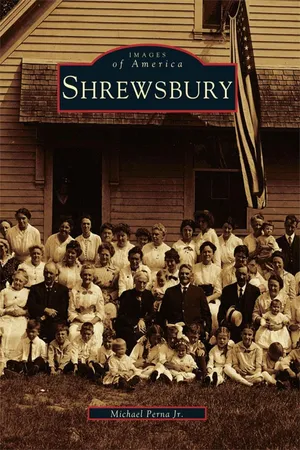
Discover the history of Shrewsbury, Massachusetts. Incorporated in 1727, this once small farming town has transformed itself into a successful business and residential community. Meet the "Father of the Stages, " nicknamed for his stagecoach line, and the many other inventive citizens of Shrewsbury. Experience the fun of the White City Amusement Park. From the days of Maj. Gen. Artemas Ward, the first commander in chief of the Revolutionary army, to the social days around Lake Quinsigamond, Shrewsbury takes you through these dramatic changes. Using exciting vintage photographs and postcards, Shrewsbury provides the first comprehensive photographic account of how the town once looked. Readers will learn about Balance Rock, the old town hall, and one-room schoolhouses. They will see stately mansions, the many attractions Lake Quinsigamond once had, and parts of the town that exist only in memory, such as South Shrewsbury and the Lower Village. Shrewsbury will allow all the town's citizens, past and present, to see and enjoy its history firsthand.
- 128 pages
- English
- ePUB (mobile friendly)
- Available on iOS & Android
eBook - ePub
Shrewsbury
About this book
Information
Five
WHITE CITY, EDGEMERE, AND THE LAKE

The section of Shrewsbury now known as Edgemere was once known as Quinsigamond Park. In 1886, Horace H. Bigelow purchased much of this area, about 100 acres. He developed the picnic groves and an old horse-racing track into private house lots. An account published in 1888 describes his efforts: “Trees have been set out, streets opened, drives completed, the old grove and grounds improved and repaired. All looks ready for the arrival of the village with its cottages, gardens, flowers, children and schools.” Bigelow’s vision of a little village of homes came true and Edgemere became just such a neighborhood.

The Tidex filling station was located at the intersection of Edgemere Boulevard and the Hartford Pike. The little station received a great boost in business when Route 20 was built, finding itself on a major highway between Boston and New York. Two members of the Ljunggren family are shown standing on the left and the right. The price of gasoline at this time was a whopping 163/10¢ per gallon. (Courtesy Robert and Brenda Ljunggren.)

This view looks southeast toward the road that later became Route 20. The intersection with Edgemere Boulevard is just out of sight on the left. The road was much lower at this time and had a fence installed to keep people from driving off the road into Half Moon Cove. (Courtesy Robert and Brenda Ljunggren.)

The name of Horace H. Bigelow is one that few local people would recognize today. This was not the case c. 1900. Bigelow was a wealthy industrialist who had made his fortune in the shoemaking industry, inventing, and real estate. In his later years, Bigelow turned to other pursuits. He began to develop property around Lake Quinsigamond. He owned the land at the corner of Route 9 and South Quinsigamond Avenue, which he called Quinsigamond Forest. Along with a Mr. Davis, he gave land to the city of Worcester that was made into Lake Park. He became involved in running steamboats on the lake and operation of the Worcester and Shrewsbury Railroad, which ran from Union Station to Lake Quinsigamond. He also bought up large tracts of land in Edgemere, where a picnic grove, hotel, and horse-racing track were located. It was not until 1905 that the crown jewel of Bigelow’s lake developments was built—the White City Amusement Park. Bigelow died in 1911, only six years after the White City Amusement Park opened.

When it opened in 1905, the White City Amusement Park was immediately a huge success. Everyone asks where the White City Amusement Park got its name. It was named after a popular exhibit at the Colombian Exposition in 1895. At that time, the electric light bulb was still somewhat of a novelty. When the park opened, it was advertised as having “50,000 electric lights.” Although the number of bulbs was probably inflated, the effect of many white lights reflected by the white paint used on park buildings must have been impressive in 1905.

This postcard shows the boardwalk area at White City Amusement Park as it appeared in its early years. The boardwalk surrounded the man-made pool that was used for the Shoot the Chutes ride. This pool and the ramp-shaped structure used for the chutes can be seen in the center background of this view. Just to the right of the ramp is the building that housed the famous White City Amusement Park carousel. The buildings to the left and right housed various attractions and games of chance. The White City Bandstand is partially visible at the far right.

The Shoot the Chutes was the centerpiece of the White City Amusement Park. The ride is shown shortly after the park opened in 1905. Flat-bottomed boats full of people would roar down the chutes until hitting the surface of a man-made pond with a huge splash. This ride was a predecessor of the log flume rides that exist at many amusement parks today. The Shoot the Chutes was removed in the 1920s, and the pond was made into a swimming pool.

King Dodo’s Palace was one of the main attractions when the spectacular White City Amusement Park opened in 1905. This was an early version of a fun house. King Dodo stood watch over the park until a major renovation took place in the 1920s. The booth on the right would produce an early version of an instant photograph—quite a novelty for its time.

When the Boston and Worcester Turnpike was built in the early 1800s, the road spanned Lake Quinsigamond on a floating bridge. The bridge was located in the same place as where the Route 9 bridge stands today. A few years later, a plan to build a bridge on wooden piers ended in a complete failure, when the lumber used in construction proved to be too buoyant. Another floating bridge was then put in place. During the Civil War, it was decided to replace the floating bridge system with a dirt causeway. Later on, the trolleys, as seen here, traveled along the north side of the causeway. The causeway was replaced when a concrete bridge was built on the site after World War I.

Table of contents
- Dedication
- Title Page
- Copyright Page
- Table of Contents
- INTRODUCTION
- One - THE CENTER
- Two - SCHOOLS
- Three - THE LOWER VILLAGE
- Four - SOUTH SHREWSBURY AND THE TURNPIKE
- Five - WHITE CITY, EDGEMERE, AND THE LAKE
- Six - PEOPLE AND PLACES
Trusted by 375,005 students
Access to over 1.5 million titles for a fair monthly price.
Study more efficiently using our study tools.
Frequently asked questions
Yes, you can cancel anytime from the Subscription tab in your account settings on the Perlego website. Your subscription will stay active until the end of your current billing period. Learn how to cancel your subscription
No, books cannot be downloaded as external files, such as PDFs, for use outside of Perlego. However, you can download books within the Perlego app for offline reading on mobile or tablet. Learn how to download books offline
We are an online textbook subscription service, where you can get access to an entire online library for less than the price of a single book per month. With over 1.5 million books across 990+ topics, we’ve got you covered! Learn about our mission
Look out for the read-aloud symbol on your next book to see if you can listen to it. The read-aloud tool reads text aloud for you, highlighting the text as it is being read. You can pause it, speed it up and slow it down. Learn more about Read Aloud
Yes! You can use the Perlego app on both iOS and Android devices to read anytime, anywhere — even offline. Perfect for commutes or when you’re on the go.
Please note we cannot support devices running on iOS 13 and Android 7 or earlier. Learn more about using the app
Please note we cannot support devices running on iOS 13 and Android 7 or earlier. Learn more about using the app
Yes, you can access Shrewsbury by Michael Perna Jr. in PDF and/or ePUB format, as well as other popular books in History & North American History. We have over 1.5 million books available in our catalogue for you to explore.