eBook - ePub
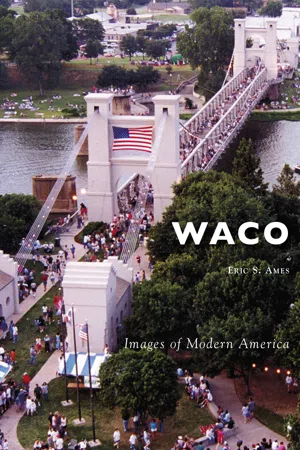
Waco
About this book
The story of Waco's modern era starts with a disaster and ends with rebirth. In 1953, a record-setting tornado swept through the city's downtown, killing 114 people and destroying a century's worth of original buildings. From the devastation came an ambitious urban renewal project, an explosion in suburban developments, and several cycles of waning and revitalization in the downtown area. Baylor University's steady growth in academic excellence and national exposure kept the city on the map. The images in this book detail the milestones and memories of a proud city founded in the 1840s, and they highlight achievements both personal and civic.
Information
Topic
HistoriaSubtopic
Historia de NorteaméricaOne
BEFORE AND AFTER
THE TORNADO OF 1953
THE TORNADO OF 1953

A note on this photograph, taken around 1943, says, “When the name Bill Smith is called at Blackland Army Flying School, Waco, Texas, eleven men snap to attention. In self defense they formed a ‘Bill Smith’ club.” Eight of the “Bills” are in this photograph from the Office of War Information. (Library of Congress.)

Waco photographer Jimmie Willis caught this photograph of Harry Truman (center) and his entourage as they made their way down the hall of the McLennan County Courthouse. Truman visited Waco in March 1947, the first sitting US president to do so, and received an honorary degree from Baylor University. He was quoted as saying, “It is with a real sense of gratification that I meet with you today on the beautiful campus of Baylor University in Waco. I congratulate you on the outstanding achievements of this great university during the one hundred and one years of its existence. I am sincerely grateful for the degree of Doctor of Laws that you have bestowed upon me, and I am honored to become a fellow alumnus of the distinguished men and women of this institution who have contributed so much to make our country great.” (BFPA.)

The Texas Electric Railway played a major part in the transportation of Wacoans seeking to travel to the cities of Dallas, Corsicana, and Denison. This is a rare color image of a Waco-bound car involved in an accident with a local line near the Hotel Jefferson in Dallas. The image is notable for capturing the Waco car’s distinctive red-and-cream color scheme. (RMML.)

In the early 1950s, voters approved a bond to build an events center for Waco, and construction on the Heart o’ Texas Coliseum was underway by 1952. This aerial photograph, probably taken in early 1953, shows the completed main building, a ticket building, and a parking lot. Later, additional show barns and livestock pens would be added. (RMML.)

Traffic moves around the Waco traffic circle, long home to some of the city’s most famous and enduring landmarks. This 1951 aerial photograph shows several of them, including Elite Cafe, built in 1941, at the top right. A young Elvis Presley ate at this location during his time in the Army when he was stationed at nearby Fort Hood in Killeen. The Elite remains open to this day, serving many of the same foods it has since its opening. At bottom is the Circle Lumber Co., still in operation today as Circle Hardware. The large complex at the left is a motor inn called the Tam O’ Shanter Hotel Courts. Between the hotel and the circle is Bill Wood’s XXX Famous Foods, remembered chiefly for a unique architectural detail: the large barrel that stuck up through its roof. (RMML.)

One of the defining moments in Waco’s history came on May 11, 1953, when an F5 tornado leveled significant portions of downtown and killed 114 people. The Waco tornado delineates two distinct periods of the city’s history: before and after. The street view of the destruction shows a block of businesses with extensive damage, including some that had been in Waco since the late 1800s. The aerial shot depicts just how extensive the tornado’s swath of destruction was, demolishing entire blocks from downtown to the Brazos River. In all, almost 200 businesses were destroyed, and more than $400 million in damages were recorded. (Both, GWCOC.)
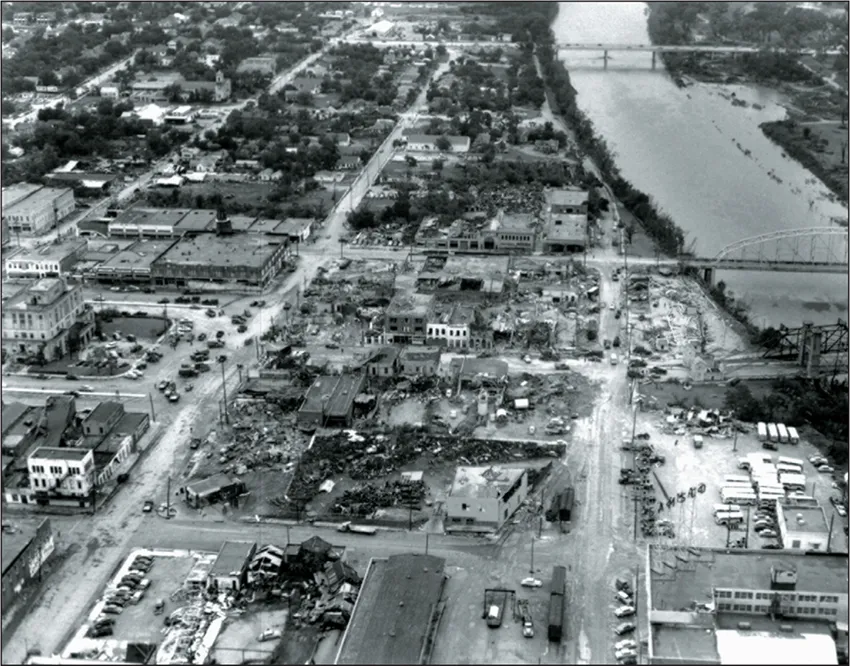

One building that sustained major damage was the headquarters of the Artesian Manufacturing and Bottling Co., home to Dr Pepper. Seen in the middle ground in this photograph, the building’s upper floors were severely impacted by the storm’s winds. The damage would be repaired, but visitors to the Dr Pepper Museum and Free Enterprise Institute can see the scar in the masonry that outlines the half-circle chunk revealed here. Other buildings in this photograph such as the Armour and Swift building, the Crawford-Austin Manufacturing building, and a block of commercial structures near the silos in the middle background were either damaged or later demolished. Note also the damage to the church in the upper left, which saw over half of its roof sheared off. (Dr Pepper Museum and Free Enterprise Institute.)

Baylor’s core campus buildings are pictured here around 1954 as well as an area known today as Founders Mall. Pat Neff Hall, the main administration building, is seen at left. Old Main—with the years of recent graduating classes painted on its roof—and Burleson Hall are in the upper center, flanked at either end by Carroll Library (left) and Carroll Science (right). The white building at middle left once housed the art and home economics departments; the building with the number 53 on its roof was the band practice hall. Both have long since been demolished. Also gone are the houses at the upper right. Once used for student housing, they were demolished not long after this photograph was taken in order to make room for Morrison Constitution Hall (home to the Baylor Law School) and the Hankamer School of Business. (RMML.)

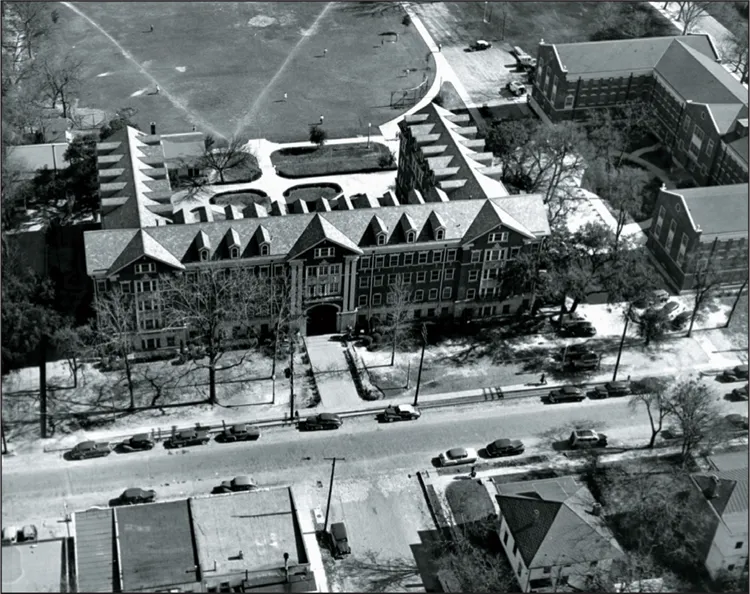
This 1954 aerial reveals some long-lost details about two areas of the Baylor University campus and its surroundings. The photograph above shows the nearly completed Allen and Dawson residence halls, situated behind two older dormitories, Memorial Hall (left) and Alexander Hall (right). What is notable about this photograph is the still-intact nature of the neighborhood behind the dormitories; single-family houses stretch for blocks off to the south of campus. Today, many of these homes have been demolished and replaced by multi-tenant condos and apartments. The image below shows Brooks Hall, named after legendary Baylor president Samuel Palmer Brooks. This photograph was taken around the time the 30-year-old structure was renovated to include air conditioning; it was demolished in 2006. (Both, RMML.)

The downtown Waco scene of the 1950s is captured in vivid color in this photograph from the collection of Bill Foster. Members of the Foster family are gathered in front of the office of the Waco Citizen, the newspaper founded by Foster’s father in 1944. The Citizen would continue to operate under the leadership of the Foster family for seven decades. (BFPA.)
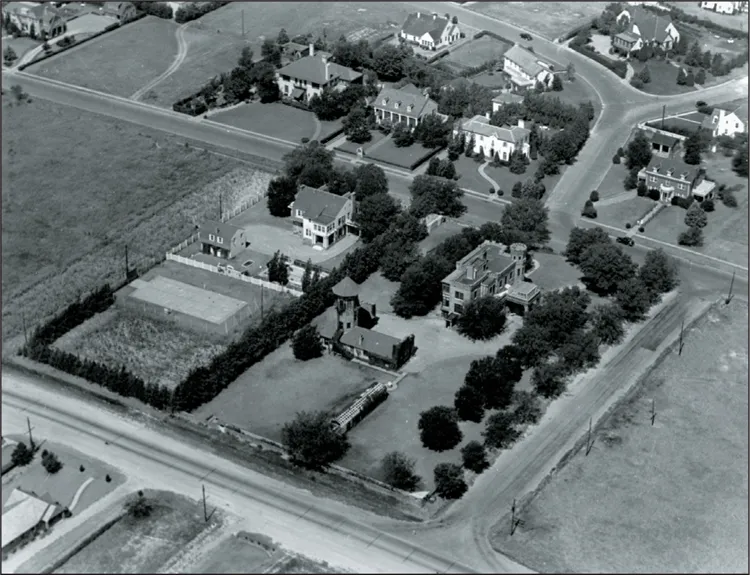
The iconic structure known as the Cottonland Castle—which gave the surrounding area its name, Castle Heights—is front and center in this c. 1955 aerial photograph. The castle was built over the course of two decades beginning in the 1890s; today, a scholar from Oxford University owns...
Table of contents
- Cover Page
- Title Page
- Copyright Page
- Dedication
- Table of Contents
- Acknowledgments
- Introduction
- 1. Before and After the Tornado of 1953
- 2. The 1960s and Urban Renewal
- 3. The 1970s and 1980s
- 4. The 1990s to 2015
Trusted by 375,005 students
Access to over 1.5 million titles for a fair monthly price.
Study more efficiently using our study tools.
Frequently asked questions
Yes, you can cancel anytime from the Subscription tab in your account settings on the Perlego website. Your subscription will stay active until the end of your current billing period. Learn how to cancel your subscription
No, books cannot be downloaded as external files, such as PDFs, for use outside of Perlego. However, you can download books within the Perlego app for offline reading on mobile or tablet. Learn how to download books offline
Perlego offers two plans: Essential and Complete
- Essential is ideal for learners and professionals who enjoy exploring a wide range of subjects. Access the Essential Library with 800,000+ trusted titles and best-sellers across business, personal growth, and the humanities. Includes unlimited reading time and Standard Read Aloud voice.
- Complete: Perfect for advanced learners and researchers needing full, unrestricted access. Unlock 1.5M+ books across hundreds of subjects, including academic and specialized titles. The Complete Plan also includes advanced features like Premium Read Aloud and Research Assistant.
We are an online textbook subscription service, where you can get access to an entire online library for less than the price of a single book per month. With over 1.5 million books across 990+ topics, we’ve got you covered! Learn about our mission
Look out for the read-aloud symbol on your next book to see if you can listen to it. The read-aloud tool reads text aloud for you, highlighting the text as it is being read. You can pause it, speed it up and slow it down. Learn more about Read Aloud
Yes! You can use the Perlego app on both iOS and Android devices to read anytime, anywhere — even offline. Perfect for commutes or when you’re on the go.
Please note we cannot support devices running on iOS 13 and Android 7 or earlier. Learn more about using the app
Please note we cannot support devices running on iOS 13 and Android 7 or earlier. Learn more about using the app
Yes, you can access Waco by Eric Ames in PDF and/or ePUB format, as well as other popular books in Historia & Historia de Norteamérica. We have over 1.5 million books available in our catalogue for you to explore.