![]()
PART I
SECRETS AND MYSTERIES
![]()
Going Underground
There are mysteries that man may only guess at, which age by age they may solve only in part.
–Bram Stoker
A proliferation of rumors and secrets lurk beneath the streets of Asheville. While I’d be interested in hearing what the walls have to say in Asheville’s historic buildings, I’d be more engaged listening to the whispers emanating from underground about what went on there in years past, as well as hearing about how all the tunnels are connected and who used them. Tales emerging from underground probably wouldn’t be for the faint of heart—it was a place for the illegal smuggling of liquor during the Prohibition years, drug deals, prostitution and other sordid happenings.
If you’ve been around town long enough, more than likely you’ve heard some of the tales of underground tunnels. In 2010, famed paranormal investigator, prolific author and Asheville native Joshua Warren offered an “Underground Asheville” tour, but it was short-lived. “The bits and pieces of the tunnels that still exist are strewn beneath a variety of businesses,” said Warren. “Coordinating with all those businesses to access their property was stressful, and by the time everyone got a cut of the money it wasn’t a very profitable endeavor. We might have given this tour three or four times and that was it.” The tour he developed with historian Vance Pollock included the entrance tunnel in the basement of Pack’s Tavern, Rat Alley (between Patton and Wall Street) and a building across from Vance Monument that once held Sisters McMullen Cupcake Corner. “In 2010, you could go into the bathroom at Sisters McMullen and find a door on the floor,” said Warren. “If you lifted it and climbed down a ladder, you would find yourself in a sizable chunk of the underground system. They were using it as storage at the time.”
Warren, who continues to operate Haunted Asheville Tours, said that the network of Asheville tunnels is now a hodgepodge of disconnected spaces. “Most have been filled in or sealed off,” Warren said. “Many sections have just been assimilated into basement space by present-day businesses. There are stories about these sections being used for various purposes over the years. For example, at Vincenzo’s [this restaurant at 10 North Market Street closed in February 2015 after a twenty-four-year run], they claim their section was used to store excess corpses during the Spanish flu epidemic of 1918.”
“It is my opinion that the network downtown had a rough V-shape,” explained Warren.
As to speculation that the tunnels led from Asheville’s Masonic Temple to the Vance Monument (built by the Masons), Warren offered little confirmation. “As the owner of the Asheville Mystery Museum in the basement of that building, and as a Mason myself, I can neither confirm nor deny the truth of that rumor,” he said. However, he alluded to the possibility of an underground tunnel between the two when he mentioned Tressa’s nightclub, which is located on Broadway between the temple and the monument. Warren told me, “If you walk the streets of Asheville, you will occasionally see little glass squares embedded in the sidewalk—like outside of Tressa’s. When you are under the street, these are like little skylights. I have been told they were used for lighting at chutes where coal was once dumped below for businesses to burn.”
During his research, Warren commonly heard explanations that original maintenance and drainage tunnels were expanded into experimental tunnels for a subway. “We never found an official document to say this, but it would make sense considering the streetcars were viewed as a nuisance in those days when the lanes of Asheville were packed with pedestrians,” said Warren. “During the prohibition, it would make sense that the status of those tunnels, or any extra storage space, would become privileged information. It is also a shady secret that a tunnel used to lead to a brothel below the Langren Hotel. When the hotel was demolished, so were the tunnel spaces.” The Langren Hotel he referred to was built in 1912 at the corner of Broadway and College Street, where the brand-new AC Hotel stands today.
Getting confirmation of the tunnels from city officials proved difficult. Warren said:
PACK’S TAVERN
Pack’s Tavern was one of the places on Warren’s tour that has substantial evidence of underground tunnels. It’s actually two buildings—workers constructed the north building in 1907 and the south building in 1912. It formerly served as a lumber mill, a barbecue restaurant and an automotive store before becoming a tavern restaurant. Developer Stewart Coleman originally planned to demolish the building and put condominiums on the site, but when that plan fell through, he and his partners entered the restaurant business. That decision also preserved a bit of Asheville’s history. The basement features an entrance, with two heavy iron doors, leading to a tunnel system. Coleman died in 2012, but in September 2011, he spoke with UNC-TV; the segment is archived on YouTube. Regarding the extent of the tunnels, Coleman said, “They run even under the Masonic Temple and in front of the Biltmore Building. They discovered them in the park during revitalization. There was a series of four tunnels that crossed over each other.” Running illegal liquor was thought to be the tunnel’s primary usage. “It’s the federal boys who were required to do raids,” Coleman said. “They announced their presence, and it would allow the buildings to empty through those tunnels.”
Warren pointed out another mystery found in the door leading to the tunnel at Pack’s Tavern. There’s a letter G on the left side and an R on the right side, but so far no one has figured out what they mean. “Could they be a reference to Gallatin Roberts, the mayor of Asheville who committed suicide in 1931?” asked Warren. Roberts was facing trial for banking law violations but adamantly denied involvement. In an article on the blog of the North Carolina Room at Pack Library, it was mentioned that a typed letter was found after his suicide. The last portion read, “I am guilty of no crime. I have done no wrong. My hands are clean. I look the whole world squarely in the face and defy any person anywhere to prove that a single cent of corrupt money or any other thing ever dishonestly touched my hands. I shall demand an immediate trial.”
UNDERGROUND BATHROOMS
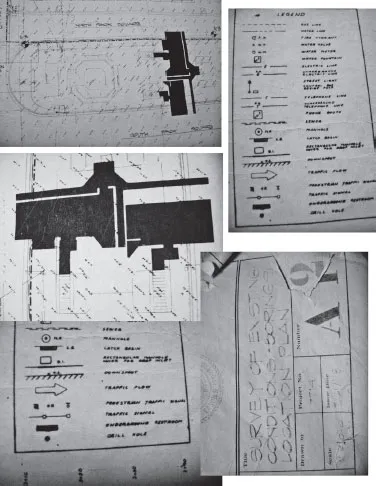
Many people who grew up in Asheville in the ’60s can recall the underground bathrooms that Warren mentioned around the Vance Monument area. Racial division was in full swing, with signs denoting bathrooms for “Whites” and another sign reading, “Coloreds.” I scoured through comments on the “You know you grew up in Asheville, North Carolina if…” group page on Facebook and found several threads recalling these bathrooms. One person detailed wide marble stairs leading underground, while another remembered having to put a dime in the slot on the doors or use a free one on the end that was much less desirable. Warren e-mailed some of the actual blueprints of the underground space at the Vance Monument, saying, “I can’t say where I got them, but I doubt it has ever been published.”
Blueprint of the underground bathrooms at Vance Monument. Joshua Warren.
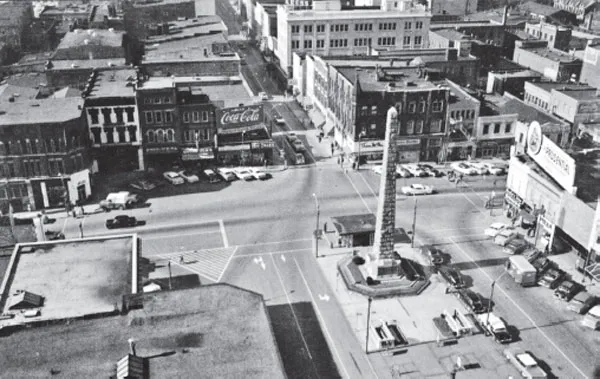
A vintage view of Vance Monument in downtown. Look closely to see the entrances to the underground bathrooms. North Carolina Collection, Pack Memorial Library, Asheville, North Carolina.
Asheville historian and author Kevan Frazier remembers going down into the underground bathroom area when his uncle was working as superintendent of the I.M. Pei building (also known as the Biltmore Building). “When they dug down for the parking deck during construction, they hit against the edge of those bathrooms,” said Frazier. “They were using it for their planning room. I remember going down there, and that room was open. What I’ve always heard is that the bathrooms are still there. There was no reason to spend money to fill it in.”
Frazier said he’s heard that there’s access under the block of buildings that house Posana, Rhubarb and The Noodle Shop restaurants that connect into those underground bathrooms.
As owner of Asheville by the Foot Tours, he’s also well aware of the many legends surrounding the tunnels. “There’s always been a legend of a tunnel between the Masonic Temple and city hall. I think that was a euphemism—that all the guys in power were part of Mount Herman Lodge, and people would say, ‘It’s like there’s a tunnel between the Masonic Temple and city hall.’”
He also referred to Rat Alley, which ironically is a stone’s throw from his latest business venture. In March 2017, Frazier and Cortland Mercer opened Well Played, a board game café, at 58 Wall Street.
RAT ALLEY
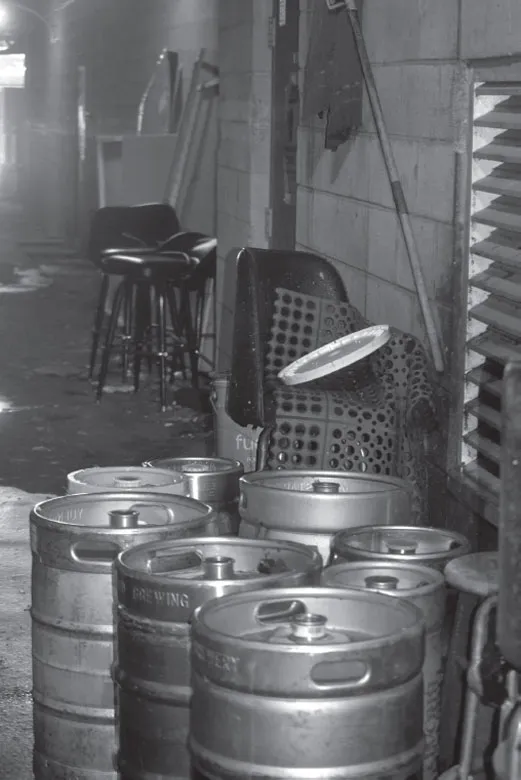
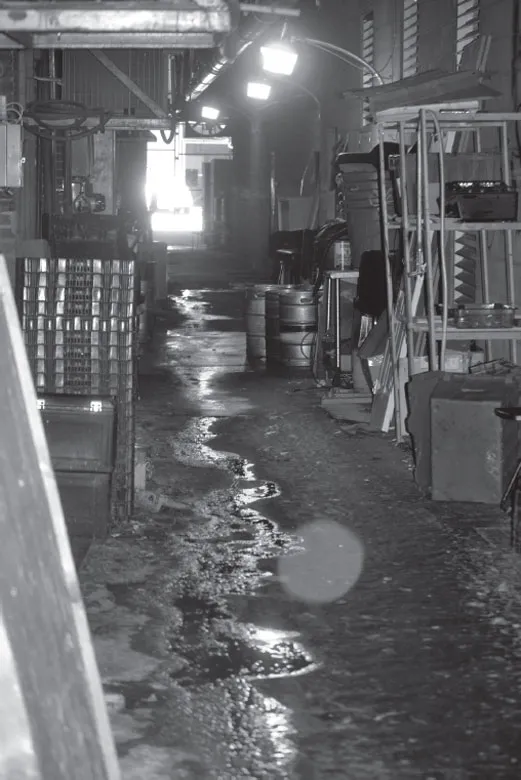
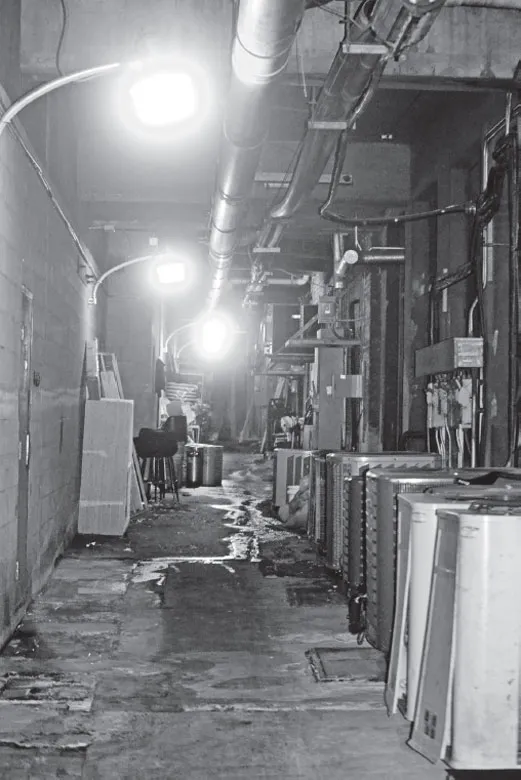
I began my own exploration of Asheville’s underground on a sunny October day. My partner in crime, Suzie Heinmiller Boatright, and I ventured into the area known as Rat Alley. It was noted as a site on Warren’s Underground Asheville tour and something I’d never seen before. It’s located directly under Wall Street and behind some of the shops and restaurants on Patton Avenue. I wasn’t quite sure how to access it, but as we walked into a parking lot past Jack of the Wood, I spotted the chain-link fence covering the entrance to Rat Alley. The doorway, propped open by an orange traffic cone, seemed to beckon us inside. We inched into the darkness, glancing over our shoulders and giggling at our willingness to venture into an area we weren’t sure if we should enter. Dim overhead lighting cast an eerie shadow over the chaotic assembly of trashcans, mops and empty beer kegs.
We sidestepped a stream of unknown liquid running down the path; some spots, although dry, were very sticky to walk on. A few workers came out of the back door of Jack of the Wood. They didn’t seem surprised to find us there snapping away with our cameras. Farther down the path, we met Drew, the sous chef at Blue Dream Curry House, as he emerged from the back door of the restaurant. He told us to check out the original cobblestones in this area, apparently from a bygone era when it served as a street. The path ended not too far from the back door of Blue Dream Curry. While I wish I could say it was more exotic in nature, Rat Alley is primarily a dingy storage area. While it does run underneath Wall Street, it’s really not an underground tunnel. It is as its name reveals: an alley.
Empty beer kegs and other random clutter in Rat Alley. Photo by Marla Milling.
A stream of sticky, unknown liquid snaking its way through Rat Alley. Photo by Marla Milling.
A somewhat eerie sight in Rat Alley. Photo by Marla Milling.
JACKSON UNDERGROUND CAFÉ
Another stop was the Jackson Underground Café in the historic Jackson Building, where I stopped with my son for a quick lunch. The Jackson Building is just a stone’s throw from Pack’s Tavern and also the Vance Monument. Since Pack’s has a verified entrance to a tunnel system and Vance Monument once had underground bathrooms, it seems practical to believe that the tunnels might have connected to this building. We descended the steps to the café entrance at the front of the building and went into the cozy but fairly plain space. One wall had been painted black, with the words “Jackson Underground Café” painted in red. Blaine Cone told me he had just bought the business in the summer of 2016 and was still finding out more about the space. He left the corporate world in Atlanta to chase a new career dream in Asheville. When I inquired about tunnels, he said, “Well, there’s a basement beneath the café.” He offered to go and explore it while we ate, explaining that he wasn’t allowed to let guests go down there because it serves as storage for old equipment. After investigating, he told me that the basement area is about the same footprint as the café space. He found one door leading out to a space underneath the sidewalk—he said he could look up and see the grate above—but no tunnel. It’s at least fun to have lunch below street level in Asheville and check out the smattering of historic photos of Pack Square on the walls.
ZAMBRA
Warren told a spooky tale that intertwined one of his experiences with the underground tunnels and some unexplained happenings in the old Asheville Hotel building on Haywood Street. Around 1996, he got a call from his friend Mark-Ellis Bennett, who is the historian at the Asheville Masonic Temple and a restoration artist. Bennett told him that he was doing ...