- 176 pages
- English
- ePUB (mobile friendly)
- Available on iOS & Android
eBook - ePub
Historic Bay Area Visionaries
About this book
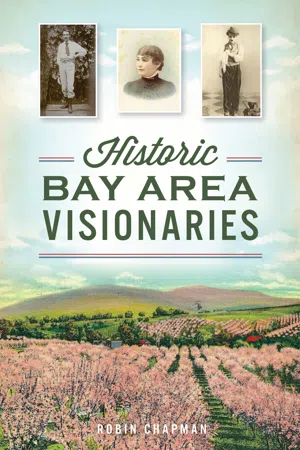
For centuries, California's environment has nurtured remarkable people. Ohlone Lope Inigo found a way to protect his family in troubled times on the shores of San Francisco Bay. Pioneer Juana Briones made a fortune from her rancho yet took the time to care for those in need. Innovator Thomas Foon Chew discovered a climate for success, in spite of the obstacles. Around the region that became Silicon Valley, filmmaker Charlie Chaplin found inspiration, poet Robert Louis Stevenson uncovered adventure and Sarah Winchester built a house that would intrigue people long after she was gone. Author Robin Chapman shares fascinating tales of those who exemplify the enterprising spirit of the Golden State.
Information
Subtopic
Business HistoryIndex
History1
LOPE INIGO
THE VISION TO SURVIVE DISRUPTION
Lope Inigo witnessed the disappearance of a world, and found a place in a new one.
—Sally Salzman Morgan
—Sally Salzman Morgan
The region around San Francisco Bay was home to indigenous people for many thousands of years before the Spanish rode into California from Mexico in 1769. Children who walk local creeks are sometimes lucky enough to find one of their arrowheads after a winter downpour. There are ghostly clues everywhere—for those who would look—to the lives of the people who once inhabited the land that became Silicon Valley.
This is the story of one man of the valley whose life began in the ancient world and ended in the early days of modern America. That he survived the trials of his era made him a rarity. Yet he accomplished more than just survival. He helped others survive as well. His baptismal name was Lope Inigo.1 His ancient name is lost to history.
In truth, we do not even know what his people, the coastal Indians2 of this region of California, called their native group. Their villages and campfires once dotted the landscape from the Golden Gate to the Salinas River and beyond. Robert Heizer of the University of California has called them the least known of California’s indigenous people. Only glimpses of their culture—as it existed at the time of first contact with Spanish-speaking settlers and Franciscan fathers—were recorded. “The priests were saving souls and not writing history,” was the dry observation of one Berkeley scholar a century ago.3
When the Spanish first encountered the people of the region, many of the interactions were recorded in diaries and journals still available to us today. Franciscan Pedro Font wrote from Palo Alto in March 1776: “As soon as we halted, thirty-eight Indians came to us unarmed, peaceful, and very happy to see us…[T]hey go naked like all the rest.” Later, from another spot along the bay, he wrote: “We were welcomed by the Indians in their village, whom I estimated at some four hundred persons, with singular demonstrations of joy, singing, and dancing.”4 The Spanish noted many of the villages seemed related by shared customs and languages. The newcomers called the natives Costaños, or “people of the coast,” a Spanish name that evolved in English to Costanoan.5
Cultural anthropologist A.L. Kroeber of Berkeley, who befriended and studied Ishi, one of the last of the independent Yahi in California, used the name Costanoan in the early twentieth century to identify these California coastal Indians in his groundbreaking Handbook of the Indians of California, the first scholarly book on California’s original residents. Linguist Richard Levy, later in the twentieth century, identified eight Costanoan dialects, from Karkin in Contra Costa County to Ramaytush in San Mateo, Awaswas in Santa Cruz and Rumsien near Carmel. Tamien—sometimes spelled Thamien or Tamyen—is identified as the indigenous language of the Santa Clara Valley. Priests at Mission Santa Clara de Asís were the first to record the word when Antonio Murguía and Tomás de la Peña wrote to Father Junípero Serra from Mission Santa Clara that the “place of the mission is called Thamien in the language of the natives.”6
These Tamien-speaking people of the coast were Lope Inigo’s people.
The name Ohlone has come into use in recent years to replace Costanoan. The origins of this name are obscure. But the word is indigenous and has a sound both “sweet and strong,” to paraphrase Felipe Arroyo de la Cuesta, a Franciscan who studied California Indian languages in the early mission period. Descendants prefer Ohlone to Costanoan, a name of Spanish and Anglo-American origin.7
The Tamien Ohlone were Lope Inigo’s ancestors.
His records had long been gathering dust in the archives of Mission Santa Clara and the Pueblo of San Jose, both established in Ohlone territory in 1777, when an issue related to twentieth-century transportation created an opportunity to bring them to light. In the 1990s, the Santa Clara County Transportation Agency—now called the Valley Transportation Authority (VTA)—planned a light-rail extension to run through a Mountain View–Sunnyvale area called the Inigo Mounds, a prehistoric archaeological site adjacent to Moffett Field. Oral tradition and records from the Spanish and Mexican eras said the mounds marked Inigo’s ancestral village as well as the place he was buried.

Louis (sometimes identified as Ludwig) Choris was one of the few artists to document the lives of the indigenous people of the San Francisco Bay Area while a few were still living in their traditional way. Bateau du Port de San Francisco shows Ohlone on the bay in 1815. Courtesy of the Bancroft Library, University of California–Berkeley.
The site was eligible for listing in the National Register of Historic Places, so state and federal law required what is known as mitigation. The compromise was to commission a series of scholarly papers telling Lope Inigo’s story and the story of the Tamien Ohlone. The county hired historians Laurence H. Shoup, Randall T. Milliken and Alan K. Brown, along with several Ohlone descendants, to complete the reports, which were presented to the county in May 1995. Slightly more than a century after Lope Inigo’s death, these works, said the project’s manager, “provoke much thought about the ways in which cultures clash and intermingle, and in which survivors, in the face of all odds, adapt to change.”8
The research also produced something unique in California history—the biography of an individual California Indian—one of the very few ever written. It was certainly the only one ever drafted for a light-rail line with the help of California tax dollars. Though Lope Inigo’s name had long been known, most of the details of his life come to us as a result of this project.

For thousands of years, acorns were a staple of the Ohlone diet. They were finely ground by women working together. Grinding stones were common tools in Lope Inigo’s world. Photo by the author.
His father’s Ohlone name was Samis, and his mother was called Temnem. They were born in the 1750s and thus were young adults when the Spanish came to the Santa Clara Valley in the years after 1769. Protected by deserts to the south, the Sierras to the east and the Pacific to the west, California and its indigenous people had been isolated for thousands of years. Samis and Temnem would have understood encounters like one recorded by Pedro Font with an Ohlone near what became San Mateo: “As soon as he saw us, he manifested the greatest possible fright that it is possible to describe. He could do nothing but throw himself full length on the ground, hiding himself in the grass in order that we might not see him, raising his head only enough to peep at us with one eye.”9
We identify the strangers who rode into California then as Spanish, but that name, like Ohlone, is not an exact one. It is true they were the cultural heirs of the Spanish soldiers who had conquered the Aztecs in Mexico in 1521. Yet after two and a half centuries in Mexico, only some of them now came from Spain. The majority represented a new American amalgam. By the eighteenth century, though citizens of a Spanish colony, they were a modern mixture of African, Anglo, Portuguese, Italian, Arab, Aztec and Southwestern Indian—and probably other cultures, as well. What they had in common was the king of Spain, to whom they pledged their allegiance; the Church of Rome, to which they entrusted their souls; and the Spanish language, in which they conducted their business. Once they came to California, they would call Mexico “New Spain” for just fifty years more before they tossed aside Spanish rule for Mexican independence. Soon afterward, Mexican rule would itself be supplanted in California by American statehood.
Lope Inigo was born in 1781, four years after the founding of Mission Santa Clara, in the year Father Junípero Serra laid the cornerstone of a new mission church. “The construction of this new church over the following three years must have been an amazing thing for the local native people, for its size was impressive for its time and place.”10 Inigo’s family came from a village about six miles north of the mission, which the priests called San Bernardino, near present-day Mountain View. By the time Inigo was eight, his mother had died and his father had taken a new wife called Giguam. In June 1789, Giguam gave birth to a daughter, and on July 13, 1789, the family came to Mission Santa Clara, where the baby was baptized with the name Justa.
A few months later, on the day after Christmas, Samis and Giguam presented their eight-year-old son for baptism. Though the mission archives do not record his Ohlone name, he was christened Inigo, a name taken from Saint Ignatius, the Bishop of Antioch, a first-century Christian martyr. His given name, Lope, can be a variation of the Spanish word lobo, meaning wolf, the name of a strong and independent boy. Inigo’s fifteen-year-old sister, Ronsom, was baptized not long afterward and given the baptismal name Emerenciana. It would be five years more before his parents agreed to baptism for themselves.

Father Junípero Serra walked from his headquarters near Monterey to lay the cornerstone of a new Mission Santa Clara in 1781, the year Lope Inigo was born. This Serra statue is from the isolated Mission San Antonio de Padua. Photo by the author.
Why did the Ohlone leave their villages and come to the mission to be baptized? Malcolm Margolin, in his book The Ohlone Way, speculates it was the attraction of so many new things that intrigued the Ohlone in these early years: “For a people so thoroughly familiar with their own environment the appearance of something new—a color, a texture, a geometrical shape, a whole new concept of what matter could be—was utterly astounding.”11 By 1793, Mission Santa Clara, the cathedral on the Guadalupe River, had brought in 1,062 Indians to be baptized, an enormous number, considering there were only about half a dozen soldiers and two priests stationed at the mission. By 1795, the number of Ohlone at the mission had reached 1,541, which “depopulated all the Indian villages for miles around the mission.”12
Many of the early converts were children. The adults may have felt having their children baptized gave them “a foot in both camps.”13 But with Spanish cattle and other livestock now grazing on traditional land and the newcomers discouraging the Ohlone from the fires they had long used to clear the fields for acorn gathering, this may have been a survival strategy. In the winter of 1794–95, the trickle of Ohlone into the mission became a flood, as adults and village leaders began to be baptized in groups of forty and fifty. Inigo’s parents, Samis and Giguam, were baptized too. It is not clear if all the new converts understood how this decision would change their lives: once the sacrament had taken place, most were required to live at the mission and much of their freedom came to an end.
Franciscan father Magín de Catala began several big construction projects at Mission Santa Clara in the 1790s. One was a system of aqueducts to bring in water for cooking, washing and irrigation, ensuring there would be enough food for the growing population at the mission. He also ordered construction of a special road, or alameda, between the Pueblo of San Jose and Mission Santa Clara—a strong hint to the civilian community to remember to attend mass. Though the willows along the Alameda later brought fame for their beauty, the trees were originally planted as a barrier to protect people from the longhorn cattle grazing along the route. The priests also enlisted Indian workers to plant the mission orchards. An Ohlone born in 1819 at Mission Santa Cruz said his father recalled seeing the first seedlings arrive, “very small, in barrels, so that the roots were kept damp. My father told me,” he said, “they had been brought from New Spain.”14 Shoup and his colleagues believe Inigo and his father worked on these and similar projects in the early days of Mission Santa Clara.

Mission Santa Clara, where Lope Inigo was baptized, began its life in 1777 and was moved and rebuilt many times. This James Long photograph shows the last sanctuary Inigo would have known, which burned to...
Table of contents
- Front Cover
- Half-Title
- Title Page
- Copyright
- Contents
- Introduction: Redwoods, Soil, Ocean and Bay
- 1. Lope Inigo: The Vision to Survive Disruption
- 2. Juana Briones: The Vision of Compassion
- 3. Robert Louis Stevenson: The Vision of Adventure
- 4. Sarah Winchester: The Vision to be Different
- 5. Thomas Foon Chew: The Vision of the Entrepreneur
- 6. Charlie Chaplin: The Vision of Artistic Innovation
- 7. On the Trail of the California Visionaries
- Acknowledgements
- Notes
- Selected Bibliography
- About the Author
Trusted by 375,005 students
Access to over 1.5 million titles for a fair monthly price.
Study more efficiently using our study tools.
Frequently asked questions
Yes, you can cancel anytime from the Subscription tab in your account settings on the Perlego website. Your subscription will stay active until the end of your current billing period. Learn how to cancel your subscription
No, books cannot be downloaded as external files, such as PDFs, for use outside of Perlego. However, you can download books within the Perlego app for offline reading on mobile or tablet. Learn how to download books offline
Perlego offers two plans: Essential and Complete
- Essential is ideal for learners and professionals who enjoy exploring a wide range of subjects. Access the Essential Library with 800,000+ trusted titles and best-sellers across business, personal growth, and the humanities. Includes unlimited reading time and Standard Read Aloud voice.
- Complete: Perfect for advanced learners and researchers needing full, unrestricted access. Unlock 1.5M+ books across hundreds of subjects, including academic and specialized titles. The Complete Plan also includes advanced features like Premium Read Aloud and Research Assistant.
We are an online textbook subscription service, where you can get access to an entire online library for less than the price of a single book per month. With over 1.5 million books across 990+ topics, we’ve got you covered! Learn about our mission
Look out for the read-aloud symbol on your next book to see if you can listen to it. The read-aloud tool reads text aloud for you, highlighting the text as it is being read. You can pause it, speed it up and slow it down. Learn more about Read Aloud
Yes! You can use the Perlego app on both iOS and Android devices to read anytime, anywhere — even offline. Perfect for commutes or when you’re on the go.
Please note we cannot support devices running on iOS 13 and Android 7 or earlier. Learn more about using the app
Please note we cannot support devices running on iOS 13 and Android 7 or earlier. Learn more about using the app
Yes, you can access Historic Bay Area Visionaries by Robin Chapman in PDF and/or ePUB format, as well as other popular books in History & Business History. We have over 1.5 million books available in our catalogue for you to explore.