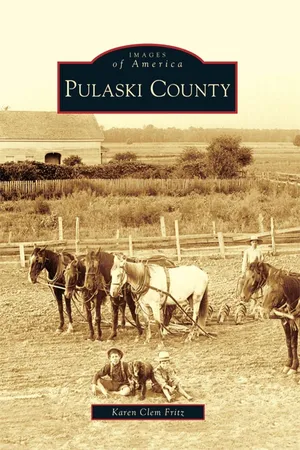
For centuries the shimmering waters of the historic Tippecanoe River have quietly marked the history of rural Pulaski County as the stream winds through the heart of the countys landscape, its banks lined with lush woods and rich farmlands. The river was the lifeblood of the Potawatomi Indians who fished its waters and canoed home to camps along the shores. They were followed by pioneer hunters and trappers lured by plentiful wildlife. Early settlers harnessed the rivers energy to run saw- and gristmills. Later the Tippecanoe attracted weekend and summer visitors from the city looking for some quiet fishing and peaceful reflection. Pulaski County was established in 1839. Dotted with quaint towns, family farms, and locally owned businesses and light industry, the county has been shaped by a heritage of hard work, simple pleasures, neighborliness, and a determined self-sufficiency that comes of relative isolation. It is a rich and increasingly rare bucolic prospectnourished by a vigilant river.
- 128 pages
- English
- ePUB (mobile friendly)
- Available on iOS & Android
eBook - ePub
Pulaski County
About this book
Information
Three
GOING ABOUT BUSINESS
By the time he was six years old in 1921, young William L. Starr, whose father operated a grain elevator in Winamac, began spending his boyhood days wandering the brick streets of town visiting the various shops and merchants. The practice of everyday trade left a lasting impression on his young mind. “Growing up in a small town [I] was free of the cares and problems a child faces these days,” he recalled decades later. “I knew no restrictions, nor felt any limitations since nearly everyone knew me and my family. My mother did not worry about where I was, knowing full well that when I got hungry I would show up. There were so many places of interest to a small boy, and I was welcomed nearly everywhere.”
Dressed in his summer wardrobe of denim overalls, a blue chambray shirt (and one-piece BVD underwear), barefoot, young Starr stopped by Felker’s Blacksmith Shop on Monticello Street where he was excited by the sights, smells, and noises of the coal fires, hot metals, glowing forge, roaring bellows, and the pounding hammers on the anvils. He was impressed by the muscular, sweaty workmen dressed in their leather aprons and a little frightened of the powerful horses. Other favorite destinations were John H. Kelly’s Hardware Store and the Big Garage next door, operated by Fred Borders and Chester Blinn. Here two fire trucks were kept, one for the county and one for the town. And here also, young Starr was allowed a credit account to pay for the pop and candy he snacked on nearly every afternoon.
Two of Starr’s contemporaries, Herb Hoch and Jim Freeman, also remembered that the Winamac streets of their boyhoods in the World War I era were filled with popcorn vendors; numerous groceries; meat markets and dry goods stores; a magnificent hotel; doctors, dentists, and law offices on the second floors of the downtown buildings; an ethnic mix of shopkeepers; summer band concerts; and passenger trains that arrived and departed several times a day.
These same enterprises were booming in the neighboring county towns of Francesville, Medaryville, Monterey, and Star City. Many continued to thrive through the 1960s. Eventually, school consolidation left several of the towns without the bustle of school activities, and the variety of the big shopping malls and the volume discounts of the big box stores began to lure shoppers away from their hometown merchants.

Henry Penry (center), proprietor of Penry Hardware store in Medaryville visits with his father, Eli (left), and older brother Charles. Penry purchased the hardware stock in December 1901 from P. M. Querry of Medaryville. The Penry family moved from Star City to Medaryville in 1902. Their hardware store is believed to have been located on Main Street between a drugstore and a confectionery. The store was sold in December 1907 to a Mr. Darrow and soon resold to the Marbaugh brothers of Monterey. (PCHS Museum.)

Young Cleo Shank feeds chickens at her home in Pulaski in this undated photograph from the early 1900s. She was the daughter of Agideon and Susannah Weaver Shank and the sister of Rosa Shank Gilsinger. Lucile Degner Roth, who grew up on a nearby farm at about the same time, remembered a “big, black snake” that was allowed to reside in her family’s chicken house because it protected the fowl from raccoons and weasels. (Brenda Gilsinger.)

The workmen in this photograph are believed to be laying pipe for the Indiana National Gas and Oil Company. The original line was placed in 1891 but proved to be too small at only eight inches. It was replaced by a 10-inch line in the summer of 1899. This line was supposed to meet up with one running from Greentown. The trench was dug about four feet deep by a crew of 50 or 60 Italians from Chicago. Then the crew pictured here laid the pipe. A handwritten notation on the back of this photograph reads, “the ‘X’ indicates my brother Chauncey R. Bader, then aged 17 and deceased in 1902.” (PCHS Museum, donated by Elmore Jackson.)

Star City barber Ola (Ollie) Heward shaves customer Skeet Baker in this photograph believed to date to around 1915. Heward was born in 1892 and eventually moved to Michigan. (PCHS Museum.)

Students at Francesville High School work on a chemistry experiment in this pho...
Table of contents
- Title Page
- Copyright Page
- Dedication
- Table of Contents
- FOREWORD
- ACKNOWLEDGMENTS
- INTRODUCTION
- One - HOW IT ONCE LOOKED
- Two - PEOPLE MET ALONG THE WAY
- Three - GOING ABOUT BUSINESS
- Four - PUTTING TIME OFF TO GOOD USE
Trusted by 375,005 students
Access to over 1.5 million titles for a fair monthly price.
Study more efficiently using our study tools.
Frequently asked questions
Yes, you can cancel anytime from the Subscription tab in your account settings on the Perlego website. Your subscription will stay active until the end of your current billing period. Learn how to cancel your subscription
No, books cannot be downloaded as external files, such as PDFs, for use outside of Perlego. However, you can download books within the Perlego app for offline reading on mobile or tablet. Learn how to download books offline
Perlego offers two plans: Essential and Complete
- Essential is ideal for learners and professionals who enjoy exploring a wide range of subjects. Access the Essential Library with 800,000+ trusted titles and best-sellers across business, personal growth, and the humanities. Includes unlimited reading time and Standard Read Aloud voice.
- Complete: Perfect for advanced learners and researchers needing full, unrestricted access. Unlock 1.5M+ books across hundreds of subjects, including academic and specialized titles. The Complete Plan also includes advanced features like Premium Read Aloud and Research Assistant.
We are an online textbook subscription service, where you can get access to an entire online library for less than the price of a single book per month. With over 1.5 million books across 990+ topics, we’ve got you covered! Learn about our mission
Look out for the read-aloud symbol on your next book to see if you can listen to it. The read-aloud tool reads text aloud for you, highlighting the text as it is being read. You can pause it, speed it up and slow it down. Learn more about Read Aloud
Yes! You can use the Perlego app on both iOS and Android devices to read anytime, anywhere — even offline. Perfect for commutes or when you’re on the go.
Please note we cannot support devices running on iOS 13 and Android 7 or earlier. Learn more about using the app
Please note we cannot support devices running on iOS 13 and Android 7 or earlier. Learn more about using the app
Yes, you can access Pulaski County by Karen Clem Fritz in PDF and/or ePUB format, as well as other popular books in History & North American History. We have over 1.5 million books available in our catalogue for you to explore.