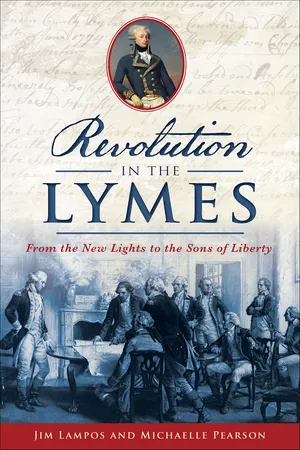
The Revolutionary War in the Lymes started as a rebellion of ideas. From its origins in the Cromwellian Saybrook Colony, Lyme (today's Lyme, Old Lyme, East Lyme and Salem) prospered under the free hand of self-governance and spurned King George III's efforts to rein in the wayward colonies. In 1765, Reverend Stephen Johnson wrote incendiary missives against the Stamp Act. A few years later, the town hosted its own Tea Party, burning one hundred pounds of British tea near the town green. When the alarm came from Lexington in 1775, Lyme's citizens were among the first to answer. Historians Jim Lampos and Michaelle Pearson explore how local Patriots shaped an epic revolt.
eBook - ePub
Revolution in the Lymes
From the New Lights to the Sons of Liberty
- 160 pages
- English
- ePUB (mobile friendly)
- Available on iOS & Android
eBook - ePub
About this book
Information
Subtopic
Early American HistoryIndex
HistoryChapter 1
INTRODUCTION
Thunder came down the Post Road from Meetinghouse Hill, just past midnight. The roar grew louder, more insistent, and the ground shook. Reverend Stephen Johnson was awakened by the sound. Listening closely, he realized what it was: hoofbeats. A rider galloping swiftly down the hill, throwing clods up from the road recently cleared of snows from the winter gales.
He arose and dressed quickly, his heart pounding through his body; but the more insistent pounding came from without, not within. Had the thunders of Divine Providence arrived at his door, stood at attention and knocked? Could those thunders be summoned as the alchemists of old had promised, as the learned Governor John Winthrop had intimated? Yes. The thunder was at his door, and he flew down the stairs to answer. Who would impose upon his home at this ungodly hour, pounding with the force of a storm, on this day, April 21, in the year of our Lord 1775, and for what reason? Johnson threw open his threshold and beheld a man he knew well. Israel Bissel, having frantically ridden without rest from Worcester, spoke his urgent message: “TO ARMS! TO ARMS! THE WAR HAS BEGUN!” Johnson was alarmed but not surprised. He’d been waiting and preparing, for he knew this moment would come. Indeed, his pen was the cause of it.
Before a single shot is fired in battle, a more profound war of ideas has already been fought and decided, well in advance of a single soldier being sent out to shed his blood in proof. Reverend Stephen Johnson’s seditious writing against Britain’s Stamp Act in 1765 had already secured his legacy as a Patriot and set the colonies on the path to revolution. Within hours of receiving the alarm, Johnson organized Lyme’s militia to answer the call at Lexington. By summer, the reverend would be marching to Bunker Hill.
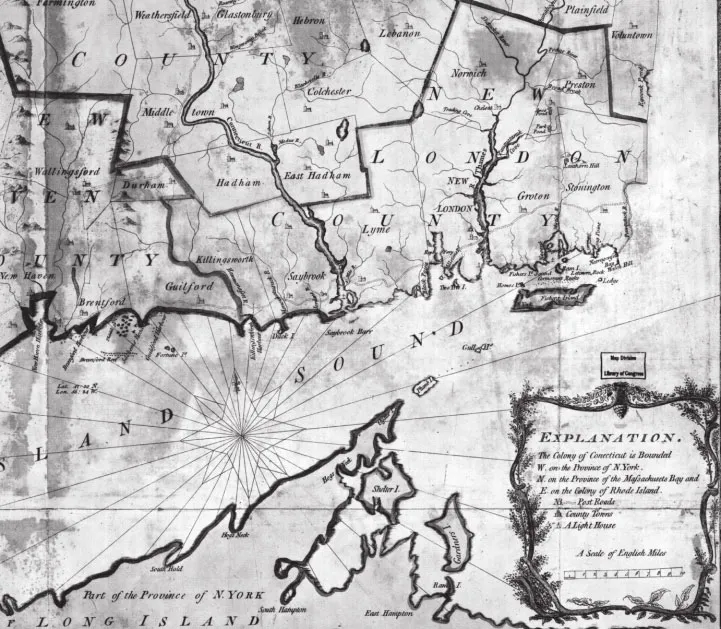
Moses Park map, 1766. University of Connecticut Map Collection.
The striking aspect of Lyme’s role in the American Revolution is the dedication of its leading citizens to the patriotic cause. Matthew Griswold, the most prominent member of Lyme’s founding family; Reverend Stephen Johnson, the minister of the Congregational church; John McCurdy, the wealthiest merchant in the colony; and Samuel Holden Parsons, a leading attorney and professional soldier, all immediately and zealously took up the cause of liberty. For a town of such long-standing traditions, stability and wealth, the lack of British sympathies is as remarkable as the unambiguous patriotic dedication of its leaders.
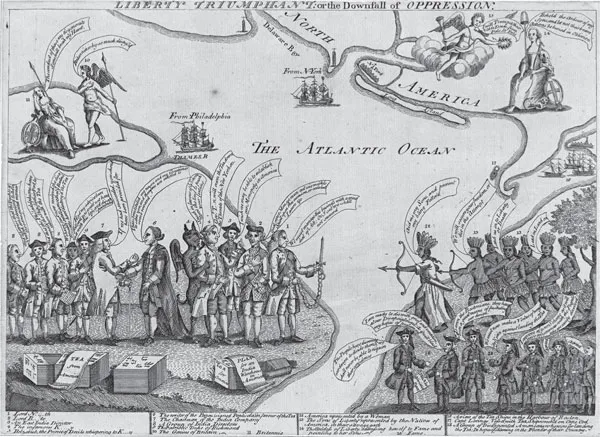
Liberty Triumphant, or the Downfall of Oppression, 1785, likely London. New York Public Library.
The origins of the American rebellion can be traced to the 1740s and even further, to the founding of the colonies during the English Civil War. The founders of Lyme were not humble pilgrims, but Cromwellians, part of the movement fighting King Charles I. With Cromwell’s victory, Lyme enjoyed a great deal of independence and self-governance.
The confluence of scientific discoveries, world exploration, trade and philosophical inquiry based on a revival of classical principles sparked a new paradigm of thought that would inspire intellectuals, ministers, merchants and entrepreneurs from the mid-seventeenth century through the eighteenth. It was a world that was becoming at once more potent and magical while its myths were being dispelled and its rulers depotentiated. Alchemists embraced the occult while also experimenting with scientific principles that would rationalize their world. They sought both the purification of the spirit and the creation of wealth and tried to develop tools that would give them both at will. In doing so, they walked an invisible line between the enchanted and material worlds. Governor and alchemist John Winthrop the Younger single-handedly halted Connecticut’s persecution of witchcraft. By the 1730s, New England’s Christian ministers, such as Lyme’s Reverend Jonathan Parsons, acknowledged in their sermons that thunderstorms were not messages from God but natural occurrences that could be understood through scientific inquiry. By the time of the Revolution, the nation’s leading intellectual divine, Ezra Stiles, was berating preachers and others who saw earthquakes and other natural disasters as evidence of God’s judgment. This process of embracing scientific inquiry in their pursuit of spiritual grace had another result that naturally followed suit: it was no longer possible to justify the authority of kings on the basis of “divine right.” In politics as well as religion, a more refined understanding of the world was taking shape.
Let us begin then in 1635. The dramatis personae include John Winthrop and the Cromwellians who hired him to establish the colony of Saybrook, of which Lyme was then a part, before the Saybrook Colony lost its autonomy and became part of Connecticut Colony.
Chapter 2
THE CROMWELLIANS OF SAYBROOK COLONY
Bind your king with chains and your nobles with fetters of iron, preached the Reverend Hugh Peters, one of the founders of Saybrook Colony. Peters, a Cambridge-educated radical Puritan cleric, left England and migrated first to Holland, then to Saybrook, in July 1635 to avoid the religious inquisition of King Charles I’s Star Chamber Court.
Reverend Peters officially joined the Parliamentary forces of the English Civil War in 1641, when he was invited by the Earl of Warwick, Sir Thomas Fairfax, and Oliver Cromwell to meet in the English town of Lyme to plan their strategy for challenging the king.
The founding of Saybrook Colony came at a pivotal moment in history—the dawn of the Enlightenment—an age of exploration, new technology and ideas. It was an era that produced the Royal Society in England, which counted Sir Isaac Newton and Saybrook’s Governor John Winthrop Jr. as members. The society was dedicated to empirical research and the dissemination of scientific ideas, as the art of alchemy was evolving into the discipline of chemistry. New ideas, technologies and innovations caused an economic boom in Western Europe, and a new class of independently wealthy entrepreneurs and investors began rising to power.
In England, the constitution guaranteed a balance of three estates: the king, the House of Lords and the House of Commons. No tax could be levied or law enacted without the consent of these three equally sovereign bodies. But new economies and philosophies meant a shift in the balance of power, and when the House of Commons opposed King Charles’s tax on shipping, England began to slip toward civil war.
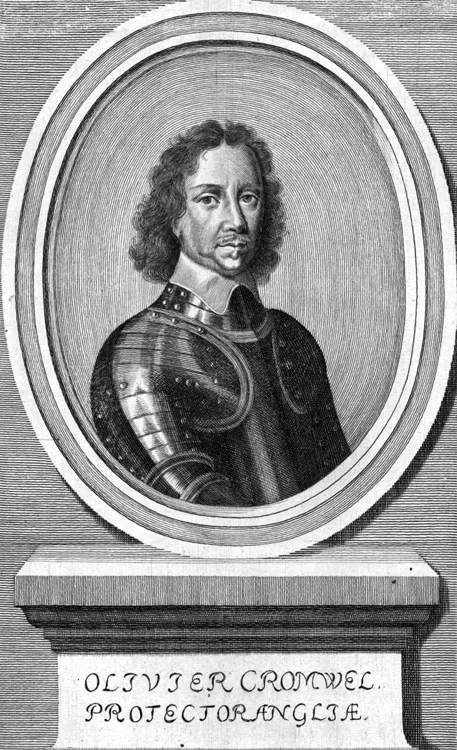
Oliver Cromwell in armor. New York Public Library.
The more King Charles sought to exert his authority, the more Parliament pushed back. The final straw came when Charles, on dubious counsel from his ministers, sent armed forces into the House of Commons to arrest the opposition. Parliament responded by raising its own Parliamentary army, and with Oliver Cromwell at its helm and Reverend Hugh Peters as chaplain, the war was engaged. It was a war that Charles I would lose, along with his head, on January 30, 1649.
Saybrook was founded as a place to “receive men of qualitie”: the supporters of Cromwell. The colony was to be a refuge should they need to flee England and set up a government in exile. The Colony of Saybrook was established under a patent issued by Robert Rich, Earl of Warwick: the same man who had met with Hugh Peters and Cromwell in Lyme, England. Rich would subsequently become an influential member of Cromwell’s forces. On March 19, 1631, he issued what came to be known as the Warwick Patent, conveying Saybrook as an independent colony to eleven patentees, primarily relatives, such as Sir Nathaniel Rich; and close associates, including William Fiennes, Viscount Saye and Sele; and Robert Greville, Lord Brooke. These men were involved in multiple enterprises in the Americas. For governor of Saybrook Colony, the patentees chose John Winthrop the Younger. Alchemist, occultist, physician, astronomer, pioneer and venture capitalist, Winthrop was a man well known to them by virtue of his talents and connections. In July 1635, Winthrop married Elizabeth Reade, Hugh Peters’s stepdaughter. The next day, he accepted a one-year commission as governor of Saybrook Colony.
The Connecticut River was under Dutch authority at the time, but they had merely set up trading posts with light fortifications and no permanent settlements. The English saw an opportunity. Knowing the Dutch were primarily concerned with holding New Amsterdam and unwilling to seriously defend Saybrook and Hartford, the English seized Connecticut. In November 1635, John Winthrop dispatched an advance party to run off the Dutch and take control of Saybrook Point. After taking possession, Winthrop was charged with hiring three hundred men: a fifty-man crew to till Saybrook’s soil, a fifty-man team of carpenters to construct homes fit for “men of qualitie” and a two-hundred-man garrison to defend the newest English colony, Fort Saybrook. Up to 1,500 acres would be reserved for nobles, including a large tract for Oliver Cromwell—the planned site of a great mansion to serve as his home when he arrived.
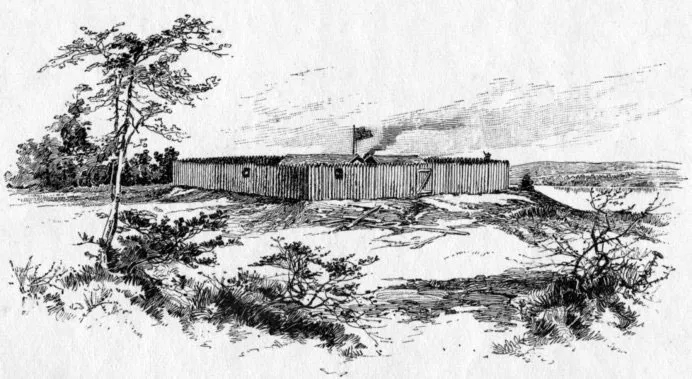
Saybrook Fort in 1636. Wood engraving. New York Public Library.
While living in Boston, where his father, John Winthrop the Elder, was governor, Winthrop had made the acquaintance of Lieutenant Lion Gardiner, a man hired by the elder Winthrop to construct a fortress at Fort Hill. In testament to his skills, the fortress Gardiner built was still in use 140 years later—the British garrisoned troops there during the Battle of Bunker Hill and the siege of Boston.
Prior to his arrival in Boston, Gardiner’s ability as a military engineer had been well established in Holland. England and Holland had a military alliance at the time, so travel and commerce between the two nations were relatively fluid. In Holland, Gardiner met the exiled Reverend Peters and the dissenting London divine and future founder of New Haven, Reverend John Davenport. Winthrop the Younger knew that Gardiner was the man he needed to make Saybrook a success. Peters and Davenport convinced Gardiner to accept his most challenging commission: the construction of a fortress and settlement in the new colony of Saybrook at the mouth of the Connecticut River.
By March 1636, Gardiner arrived with twenty men and was actively working on the fortifications and settlement. Governor Winthrop landed one month later, accompanied by his father-in-law, Hugh Peters, and the only actual patentee under the Warwick Patent to settle at Saybrook, Colonel George Fenwick.
Fenwick was a lawyer and a soldier and, through the agency of his wife, Lady Alice, daughter of Sir Edward and Lady Apsley of Sussex, became a committed supporter of the Puritan and Parliamentarian cause. Meeting the Reverends Peters and Davenport in Holland, Fenwick helped procure supplies to be shipped to Saybrook Colony.
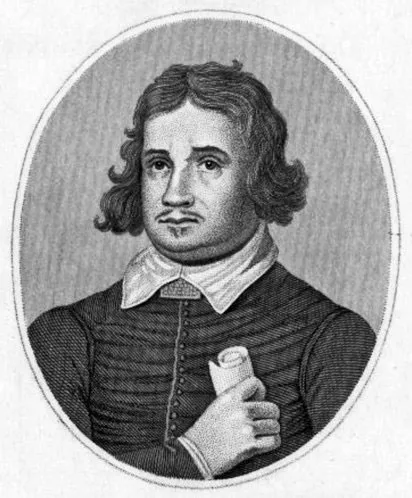
Reverend Hugh Peters. New York Public Library.
In 1635, Fenwick arrived with Peters in Boston, and the next spring he embarked with Winthrop and Peters for Saybrook. Winthrop returned to England in 1636 when his term as governor expired, and Lion Gardner took his place as Saybrook’s chief magistrate. Fenwick took over in 1639, when, after the expiration of his term, Gardiner took possession of the Isle of Wight, later renamed Gardiner’s Island, just across the Long Island Sound from Saybrook.
Fenwick’s term as Saybrook’s governor was difficult, but the colony slowly prospered and set the solid groundwork for its future success. Under his leadership, the New England Confederation of Colonies was formed in Boston in 1643. The confederation helped the colonies cooperate on issues of mutual interest and gave them an identity apart from their mother country. Saybrook did not have identity issues. The founders knew who they were and what they were about. They were loyal subjects of the king so long as their king was loyal to them, not only as fellow Englishmen, but as free people endowed with the right to determine their own affairs.
Saybrook was unlike the other colonies of America. It was independent long before 1776. The colonies of New Hampshire, New York, the Carolinas and Georgia were under direct royal control, meaning they had to clear their legislation with London and were bound by royal orders. Massachusetts, Maryland and Pennsylvania were under partial control. But Saybrook was founded as an independent corporate entity, empowered to decide its own affairs. In this respect, it was closest to the autonomous colonies of Connecticut, New Haven and Rhode Island.
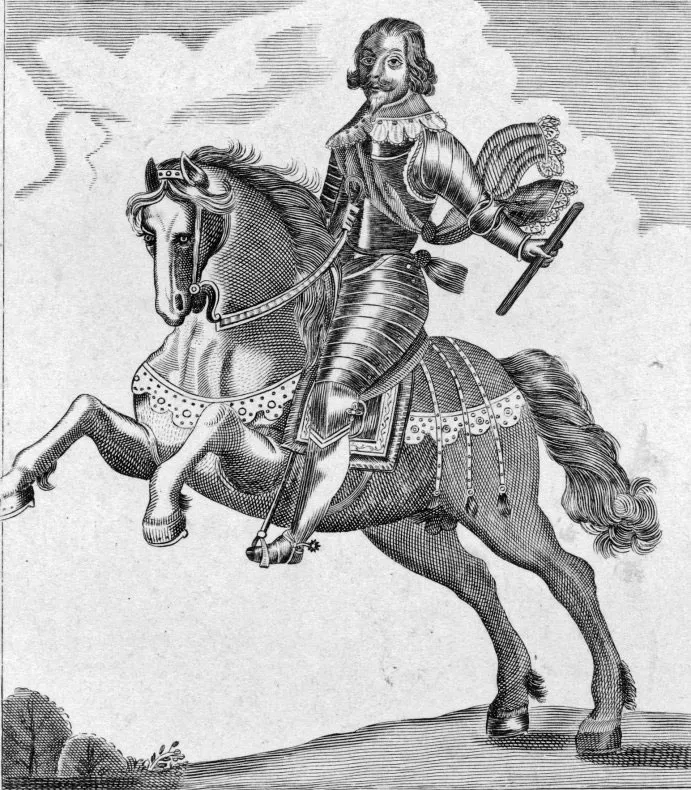
Viscount Saye and Sele. New York Public Library.
Saybrook’s right to self-determination did not end when Fenwick sold it to the Colony of Connecticut in 1645 for approximately $900,000 in today’s money. It is important to note that Fenwick did not sell the land but merely the fort at Saybrook and political control over the region. Although it was now a town rather than an independent colony, Saybrook retained the power to determine its own affairs locally through town meetings of freemen, and on the colonial level it kept the power to elect its representatives to the General Assembly of Connecticut. This was an extraordinary measure of independence and a rather unique state of affairs in the political world of colonial America at the time.
The success of the Parliamentarians’ cause and Cromwell’s military assault on the king’s men proved to be Saybrook’s undoing. As Cromwell consolidated power throughout the 1640s, it became clear that not only would the Parliamentarians not need to flee to Saybrook, but they might also soon rule England.
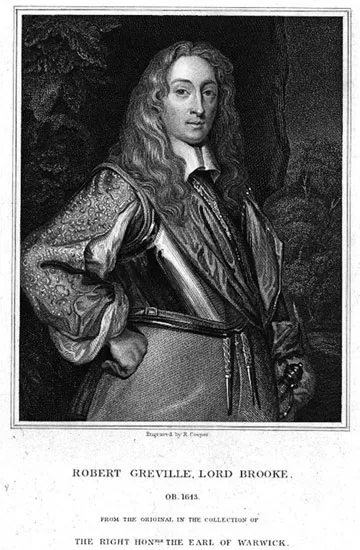
Lord Brooke. New York Public Library.
Hugh Peters returned to England in 1641 to join Cromwell, and Fenwick left in 1645 after the death of his wife and the end of his commission. Upon returning to England, Fenwick commanded regiments under Cromwell, took part in the invasion of Scotland, was appointed to the trial of King Charles I, became a member of Parliament under the Protectorate and finally served as governor of Edinburgh Castle.
Saybrook languished in this period, as its reason for being—a seat for the Cromwellian government in exile—ceased to be with...
Table of contents
- Front Cover
- Half Title
- Title Page
- Copyright
- Dedication
- Contents
- Acknowledgements
- 1. Introduction
- 2. The Cromwellians of Saybrook Colony
- 3. The Great Awakening: How Radical Clerics Shaped a Revolution
- 4. Stephen Johnson and the Stamp Act
- 5. The Old Post Road
- 6. Lyme’s Sons of Liberty
- 7. Lyme Hosts a Tea Party
- 8. Israel Bissel’s Ride
- 9. Samuel Holden Parsons: Lyme’s Major General
- 10. Ezra Lee and the American Turtle
- 11. The War Comes Home
- 12. Matthew Griswold IV: The Revolutionary Governor
- 13. The Tree of Liberty
- Bibliography
- About the Authors
Trusted by 375,005 students
Access to over 1.5 million titles for a fair monthly price.
Study more efficiently using our study tools.
Frequently asked questions
Yes, you can cancel anytime from the Subscription tab in your account settings on the Perlego website. Your subscription will stay active until the end of your current billing period. Learn how to cancel your subscription
No, books cannot be downloaded as external files, such as PDFs, for use outside of Perlego. However, you can download books within the Perlego app for offline reading on mobile or tablet. Learn how to download books offline
Perlego offers two plans: Essential and Complete
- Essential is ideal for learners and professionals who enjoy exploring a wide range of subjects. Access the Essential Library with 800,000+ trusted titles and best-sellers across business, personal growth, and the humanities. Includes unlimited reading time and Standard Read Aloud voice.
- Complete: Perfect for advanced learners and researchers needing full, unrestricted access. Unlock 1.5M+ books across hundreds of subjects, including academic and specialized titles. The Complete Plan also includes advanced features like Premium Read Aloud and Research Assistant.
We are an online textbook subscription service, where you can get access to an entire online library for less than the price of a single book per month. With over 1.5 million books across 990+ topics, we’ve got you covered! Learn about our mission
Look out for the read-aloud symbol on your next book to see if you can listen to it. The read-aloud tool reads text aloud for you, highlighting the text as it is being read. You can pause it, speed it up and slow it down. Learn more about Read Aloud
Yes! You can use the Perlego app on both iOS and Android devices to read anytime, anywhere — even offline. Perfect for commutes or when you’re on the go.
Please note we cannot support devices running on iOS 13 and Android 7 or earlier. Learn more about using the app
Please note we cannot support devices running on iOS 13 and Android 7 or earlier. Learn more about using the app
Yes, you can access Revolution in the Lymes by Jim Lampos,Michaelle Pearson in PDF and/or ePUB format, as well as other popular books in History & Early American History. We have over 1.5 million books available in our catalogue for you to explore.