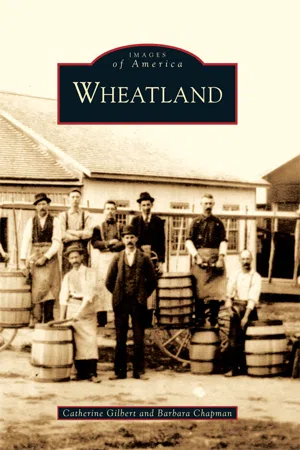
The town of Wheatland lies along the west bank of the Genesee River in the southwest corner of Monroe County. In 1786, the adventurous frontiersman Ebenezer Indian Allan built a log cabin near the river. The Allan family soon moved on, but the settlement of the entire area west of the Genesee River had begun. The name given to the town in 1821 recognized the successful wheat crops already yielded by its fertile soil. Oatka Creek, which winds its way across town to the river, once powered flour and plaster mills that made the villages and hamlets of Wheatland thriving communities. Today Wheatland remains a rural area known for its picturesque countryside and its recreational opportunities.
- 128 pages
- English
- ePUB (mobile friendly)
- Available on iOS & Android
eBook - ePub
Wheatland
About this book
Information
Six
SCOTTSVILLE

This 1890s view looking northwest shows Route 251 crossing Oatka Creek. On the left, the 1878 steel truss bridge replaced an earlier wooden structure. From left to right, the Salyerds’ Block, the Cargill House, and the home of Mary M. Fraser are visible. The dam maintained the water at a sufficient level to feed the Genesee Valley Canal. This view today can be seen from the New York State Greenway Trail.

This 1872 map of Scottsville is from the Atlas of Monroe County, N.Y. by F. W. Beers. Buildings existing at that time and their owner’s names were indicated. Allen was the early name of the local creek before the popular Native American word Oatka was used. On the right, the Genesee Valley Canal crossed the creek. On the left, the dug millrace provided waterpower for the mills. Beginning with early settler Isaac Scott, the village grew to be the largest population center in the town of Wheatland and was incorporated in 1914.

Isaac Salyerds purchased the site of a burned-out building on the corner of Main Street and Canawaugus Road, and in 1881, he built a two-story frame building using the first floor for a meat market. He also peddled groceries around the countryside with a horse and cart. The fire department was in the west half of this building.

The Scottsville Fire Company of 60 members used buckets of water to fight fires when it started in the 1870s. In this 1890s photograph, Isaac Van Hooser is inspecting the equipment used by the hook and ladder and bucket brigade companies. He was a fire commissioner in 1913. Van Hooser was also a printer and bicycle repairman and was active in support of Windom Hall.

In 1820, Powell Carpenter erected the Eagle Hotel on the corner of Main and Rochester Streets. Later he enlarged it by adding a 20-by-40-foot section. In 1830, the hotel was sold to George Ensign and in 1846 to Elijah T. Miller, who added a bar and ballroom. In 1887, Norman Cargill renamed it the Cargill House. It was razed in 1930. (Courtesy of Richard LeRoy.)

In this Main Street view, looking west, are some of the early buildings. Beginning on the left is the Salyerds’ Block, the Tucker house, Thomas Brown’s office, Slocum’s Hardware store, and the Oatka Hotel. The street was unpaved but had streetlights and utility poles. In 1903, a concrete sidewalk was installed from Brown’s Grove along Rochester and Main Streets to the Holy Angels Cemetery on Caledonia Avenue.

The Rafferty Carriage Shop was on the north side of Main Street between Race Street and the millrace. Patrick Rafferty came to Scottsville in 1837 to work as a wagon and carriage maker. By 1841, he had established his own shop. When he retired in 1871, his sons, William and Thomas, succeeded him. Later they expanded the business into neighboring buildings. In 1908, the property was used as a repair and blacksmith shop, and in later years, it was an automobile garage. This sketch is from the 1877 History of Monroe County, New York, by W. H. McIntosh. The lower image shows materials purchased by John Talcott Wells from the W. and T. Rafferty Company in December 1892 for Oliver Allen’s barn.


Isaac Van Hooser came to the village of Scottsville in the 1880s, where he conducted a printing business at his home at 8 Rochester Street. In 1894, he purchased the property at 11 Main Street for a bakery and ice-cream shop. He also moved his printing press there. When bicycles became popular, he closed the bakery and ice-cream shop and switched to selling and repairing bicycles.

At 11 Main Street, Isaac Van Hooser poses with his printing equipment where posters and sale circulars for the events of the village were made. He printed George E. Slocum’s history of Wheatland in 1908. His daughter, Stella Van Hooser, who later married Chester Harmon, worked in the print shop with him.

Abraham Hanford built this Greek Revival house about 1823 on the south side at 13 Main Street. He lived there for 20 years. Then it became the parsonage for the Presbyterian church. In later years, it has been converted for various uses, including the Slocum Hardware, and most recently, a laundromat. (Sketch by Carl F. Schmidt from The Early Architecture of the Genesee Valley.)

In 1911, Scottsville enlarged its fire district and p...
Table of contents
- Title Page
- Copyright Page
- Table of Contents
- ACKNOWLEDGMENTS
- INTRODUCTION
- One: THE PIONEERS
- Two: EARLY FARMING AND MILLING
- Three: MUMFORD
- Four: NORTH ROAD AND SOUTH ROAD SETTLEMENTS
- Five: HAMLETS OF GARBUTT AND WHEATLAND CENTER
- Six: SCOTTSVILLE
- Seven: ROADS AND RAILROADS
- Eight: SOCIAL GATHERINGS AND EVENTS
Trusted by 375,005 students
Access to over 1.5 million titles for a fair monthly price.
Study more efficiently using our study tools.
Frequently asked questions
Yes, you can cancel anytime from the Subscription tab in your account settings on the Perlego website. Your subscription will stay active until the end of your current billing period. Learn how to cancel your subscription
No, books cannot be downloaded as external files, such as PDFs, for use outside of Perlego. However, you can download books within the Perlego app for offline reading on mobile or tablet. Learn how to download books offline
Perlego offers two plans: Essential and Complete
- Essential is ideal for learners and professionals who enjoy exploring a wide range of subjects. Access the Essential Library with 800,000+ trusted titles and best-sellers across business, personal growth, and the humanities. Includes unlimited reading time and Standard Read Aloud voice.
- Complete: Perfect for advanced learners and researchers needing full, unrestricted access. Unlock 1.5M+ books across hundreds of subjects, including academic and specialized titles. The Complete Plan also includes advanced features like Premium Read Aloud and Research Assistant.
We are an online textbook subscription service, where you can get access to an entire online library for less than the price of a single book per month. With over 1.5 million books across 990+ topics, we’ve got you covered! Learn about our mission
Look out for the read-aloud symbol on your next book to see if you can listen to it. The read-aloud tool reads text aloud for you, highlighting the text as it is being read. You can pause it, speed it up and slow it down. Learn more about Read Aloud
Yes! You can use the Perlego app on both iOS and Android devices to read anytime, anywhere — even offline. Perfect for commutes or when you’re on the go.
Please note we cannot support devices running on iOS 13 and Android 7 or earlier. Learn more about using the app
Please note we cannot support devices running on iOS 13 and Android 7 or earlier. Learn more about using the app
Yes, you can access Wheatland by Catherine Gilbert,Barbara Chapman in PDF and/or ePUB format, as well as other popular books in History & North American History. We have over 1.5 million books available in our catalogue for you to explore.