- 128 pages
- English
- ePUB (mobile friendly)
- Available on iOS & Android
eBook - ePub
About this book
Read of Calhoun's many influences on transportation, in wartime, and in the commerce of the South.
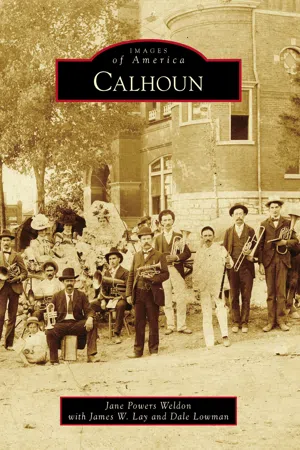
Calhoun, the seat of Gordon County, is situated in the rolling Ridge and Valley geologic region of northwest Georgia. The long valley formed a natural migration pattern that influenced the area's settlement and is a strong economic factor today. Transportation arteries, from rivers to railroads to highways, remain a critical part of the city's development. The Cherokee Indians began the infamous Trail of Tears march near Calhoun. Later, Gen. William T. Sherman almost destroyed the village as he led his troops to the Battle of Atlanta. The region's cotton farmers supplied the early tufted-textile industry that evolved into enormous carpet and floor-covering businesses.
Information
One
LAND OF THE CHEROKEE
When Hernando de Soto and his troops marched into what would become Gordon County, they encountered the Coosa chiefdom, a large Native American alliance near the Coosawattee River in Gordon and Murray Counties. De Soto’s troops left the area about 1540, also leaving destruction and disease against which the natives were defenseless.
Remains of the diminished chiefdom joined to form new groups, among them Cherokees. After the American Revolution, Cherokees, strongly divided in response to the new nation, were encouraged by the federal government to emulate white ways. A centralized Cherokee society in 1827 became the Cherokee Nation, with a governing body and constitution modeled on that of the United States. The Cherokees established their national capital at the confluence of the Coosawattee and Conasauga Rivers, naming it New Echota, or New Town. They laid out a formal village, vestiges of which are seen today along with reconstructions.
Because whites were settling in northern Georgia, the state surveyed and divided Cherokee land by lottery, awarding it to the whites. Though the natives resisted, the discovery of gold in 1829 in Cherokee territory led to increased pressure on the state and federal governments to remove the Indians.
The United States Congress in 1830 passed the Indian Removal Act, which divided Cherokee leadership, with one faction advocating moving to lands in the West, the other hoping to stay in its homeland. Leaders favoring removal signed the Treaty of New Echota in 1835 and began an orderly move, but others resisted until federal troops forcibly removed them in 1838. Families were herded from their homes with few possessions, penned in stockades, and sent on land or water routes to the West. About 16,000 Cherokees began the long Trail of Tears. They left more than 4,000 of their number in graves along the way on the “trail where they cried.”
The Cherokees who stayed went underground, hiding in the hills to escape detection. Many intermarried and denied their native roots. Today’s part Cherokees again acknowledge their heritage, proudly working to preserve the quiet beauty of New Echota and the county they call home.

The Arch is a small park at the northern end of Calhoun at the intersection of US Highway 41 and Georgia State Route 225, which leads to New Echota State Historic Site. The area was called the Battlefield Route because Civil War troops marched near it. The statue to the right is a World War I doughboy; Sequoyah is framed by the arch, and to the left is a Confederate soldier.
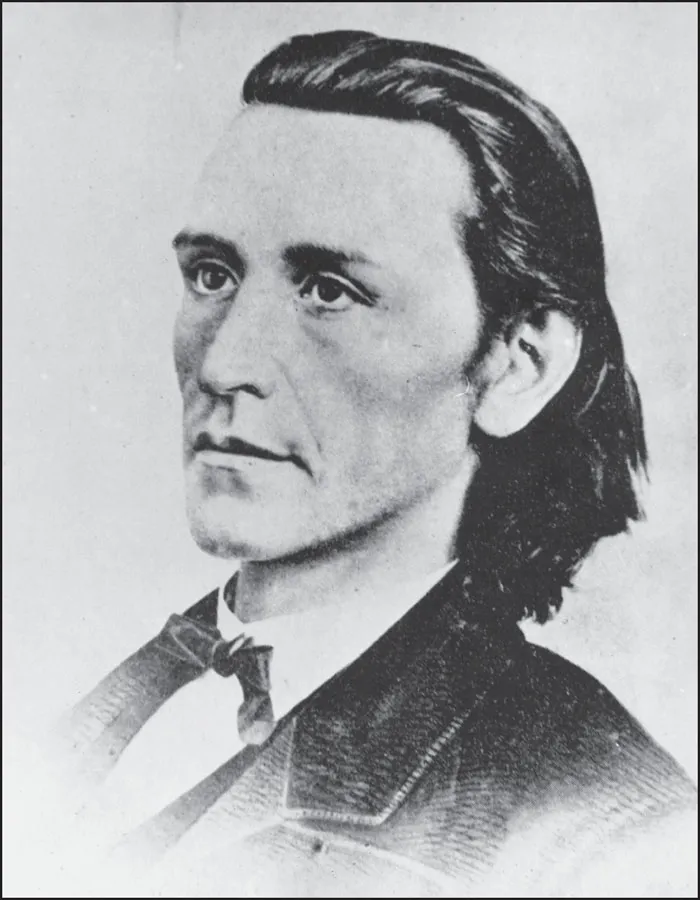
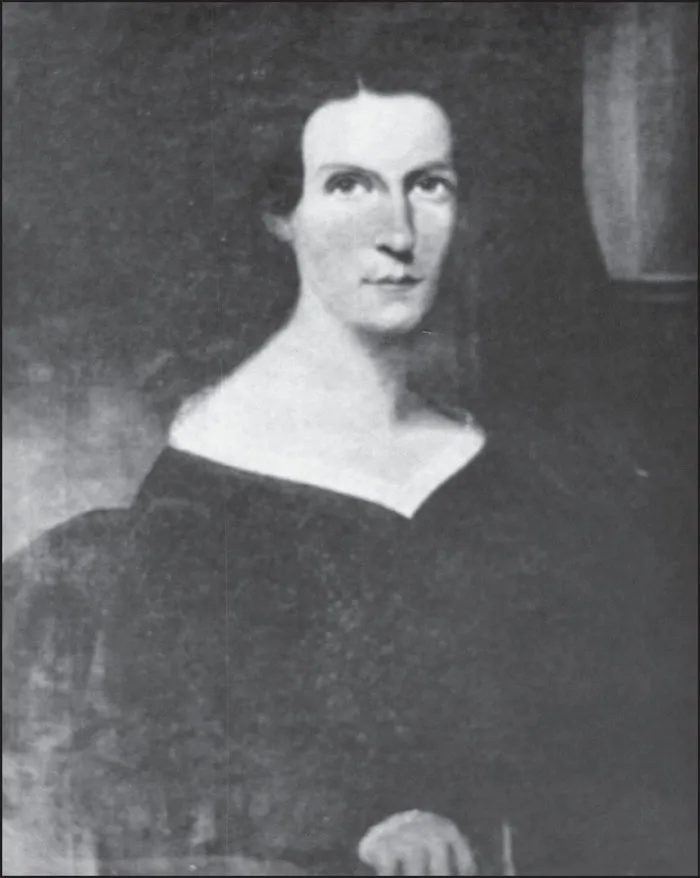
Elias Boudinot, originally Galagina, or Buck Oowatie, studied at Spring Place mission northeast of New Echota, at a mission school in Cornwall, Connecticut, and at Andover Theological Seminary. He was the first editor of the Cherokee Phoenix. Due to Boudinot’s attempts to describe both sides of the Cherokee schism in 1832, principal chief John Ross forced him to resign. As a signatory of the Treaty of New Echota, Boudinot agreed to the Cherokee removal. In 1839, he and two other leaders were assassinated because of their perceived betrayal. Boudinot and another Cherokee student, John Ridge, fell in love with and married white women whom they met at the Cornwall School. The two interracial marriages caused such strife in the town that the school was forced to close in 1827. Boudinot and his wife, Harriet Gold, pictured here, were burned in effigy during the protests.
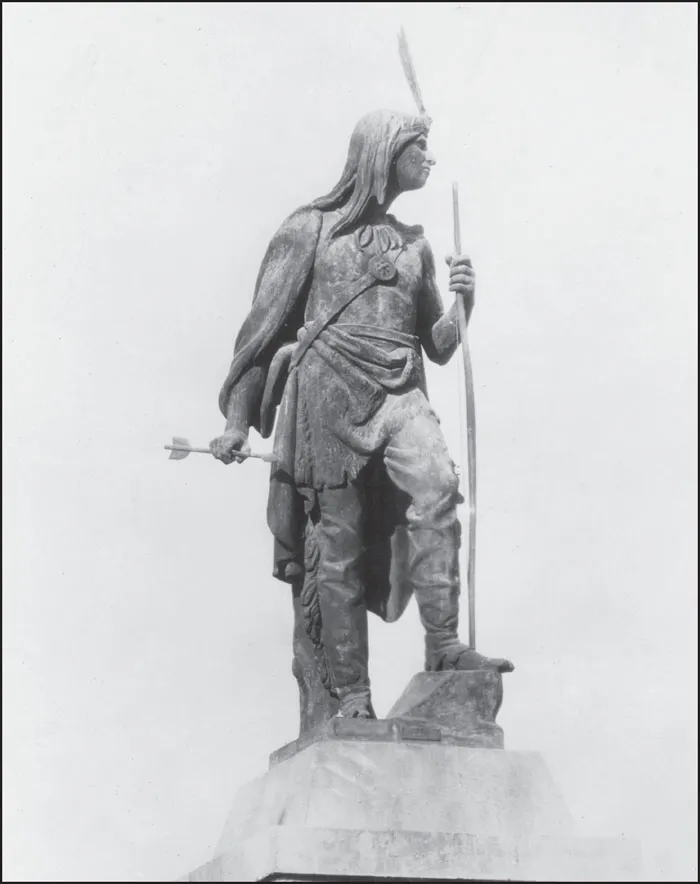
Two statues commemorating Sequoyah, creator of the Cherokee syllabary, stand in Calhoun—one at the Arch at the northern edge of the city and one in Bicentennial Park. The statues are idealized depictions of Native Americans and have little in common with Cherokees, who generally dressed as whites did. The statue in Bicentennial Park, to the south of the Calhoun Gordon County Library, was first placed at the old Calhoun School in 1913. It was moved when the school was demolished in 1974. The park had originally been the Ladies’ Park, site of Calhoun’s first library.

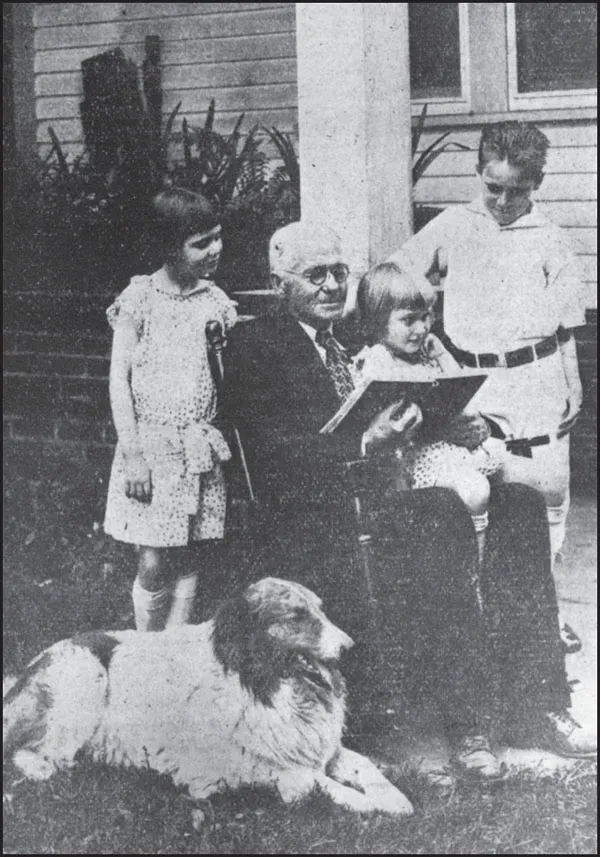
Georgia poet laureate Ernest Neal recited his poem “The Indian’s Heart” when the federal government erected a monument in 1931 at the site of New Echota. Here, he reads to his grandchildren after he was named poet laureate in 1927. Professor Neal had taught at Calhoun and several Gordon County schools. When he was reduced to near penury, Gov. Eugene Talmadge made him curator of the Georgia Capitol Museum.

Several men who had played a part in the restoration and reconstruction of New Echota gathered to check progress on Vann’s Tavern in late 1957. Construction on the tavern and the Worcester House went on from 1955 to 1959, and the tavern officially opened in 1962. Pictured here are, from left to right, C.F. Gregory, John Slagle, J. Roy McGinty, R.D. Self, and Henry Mauldin. (Courtesy of Kathryn Self Sproull.)
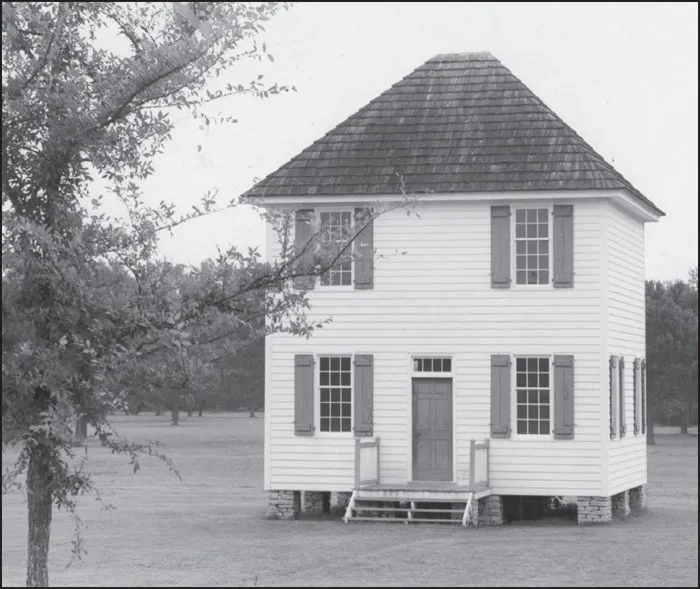
Reconstruction of the Supreme Court building of the Cherokee Nation was completed by the opening of New Echota as a public park in 1962. For a few years in the late 1820s, the Cherokees lived under a remarkable form of constitutional government. Their court met in the fall and could hear both civil and criminal appeals. The Supreme Court of the State of Georgia held a session at this building in 1993.

The Worcester House is the only structure at New Echota that stands on the original site. Samuel A. Worcester, an American Board missionary, was postmaster at New Echota until he was evicted and his house commandeered by the State of Georgia in 1834. Gov. Ernest Vandiver (at podium) speaks when the restoration was completed. Listening are Georgia Secretary of State Ben Fortson (in wheelchair) and Calhoun Times editor emeritus J. Roy McGinty (far right). (NESHS.)
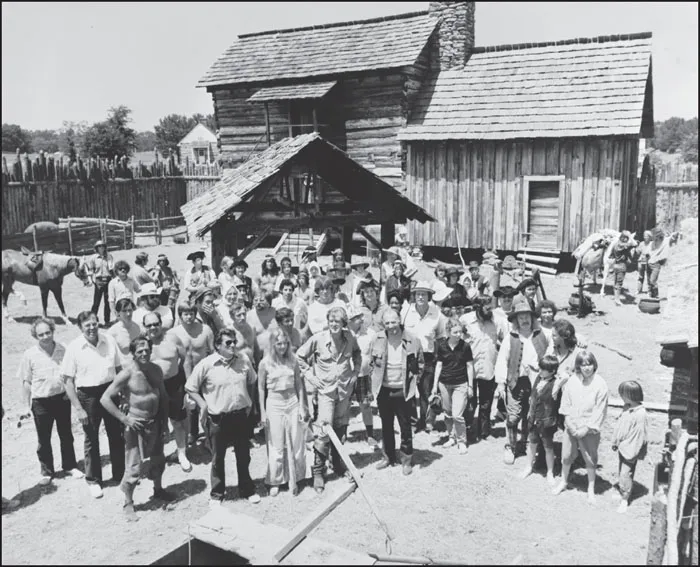
Actors in the documentary Give Me Liberty, filmed for the US bicentennial, pose at Vann’s Tavern. Cherokee James Vann built the tavern about 1805 at a ferry in Hall County, Georgia, where the Old Federal Road crossed the Chattahoochee River. When rising water from Lake Lanier threatened the building in 1956, it was moved to New Echota. (Courtesy of VG gor518.)

Rev. John Gambold, a Moravian missionary, established Oothcaloga Mission around 1822. Until his death in 1828, he continued to lead the slow efforts to convert the Cherokees. About that time, the mission had over 50 students, converts, and children. Whites lived in the house after the land lottery of 1832. Several members of the Gordon County Historical Society gather on May 17, 1977, at Reverend Gambold’s grave on Belwood Road to commemorate a new marker.
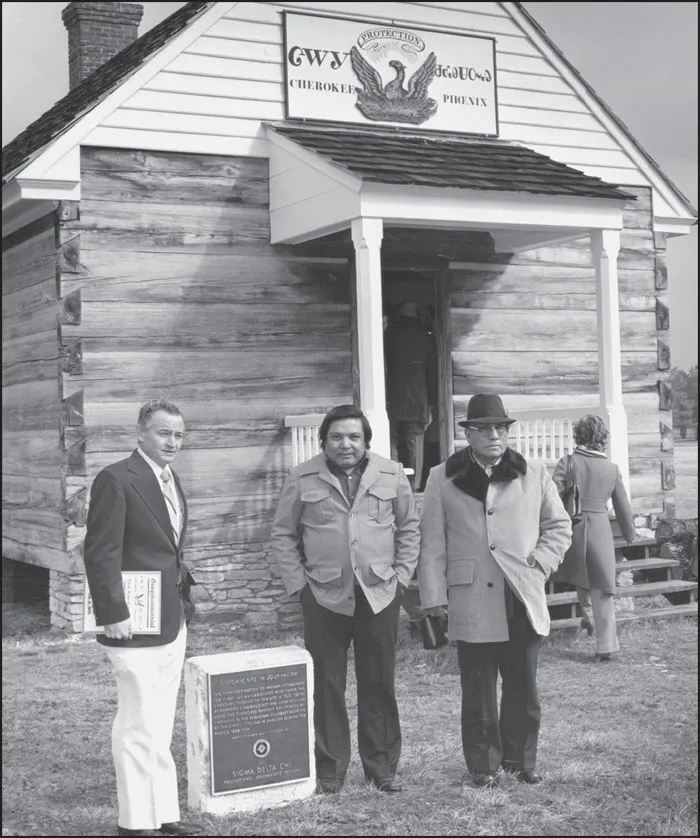
Sigma Delta Chi Professional Journalism Society honored New Echota Print Shop in 1971 as a Historic Site in Journalism. The marker reads, “The Cherokee Nation of Indians established the first Indian language newspaper, the Cherokee Phoenix, ...
Table of contents
- Cover Page
- Title Page
- Copyright Page
- Dedication
- Table of Contents
- Acknowledgments
- Introduction
- 1. Land of the Cherokee
- 2. Calhoun Goes to War
- 3. Hot Times in the Old Town
- 4. School Days, School Days
- 5. Good Old Golden Rule Days
- 6. Taking Care of Business
- 7. All around the Town
- Bibliography
Trusted by 375,005 students
Access to over 1.5 million titles for a fair monthly price.
Study more efficiently using our study tools.
Frequently asked questions
Yes, you can cancel anytime from the Subscription tab in your account settings on the Perlego website. Your subscription will stay active until the end of your current billing period. Learn how to cancel your subscription
No, books cannot be downloaded as external files, such as PDFs, for use outside of Perlego. However, you can download books within the Perlego app for offline reading on mobile or tablet. Learn how to download books offline
Perlego offers two plans: Essential and Complete
- Essential is ideal for learners and professionals who enjoy exploring a wide range of subjects. Access the Essential Library with 800,000+ trusted titles and best-sellers across business, personal growth, and the humanities. Includes unlimited reading time and Standard Read Aloud voice.
- Complete: Perfect for advanced learners and researchers needing full, unrestricted access. Unlock 1.5M+ books across hundreds of subjects, including academic and specialized titles. The Complete Plan also includes advanced features like Premium Read Aloud and Research Assistant.
We are an online textbook subscription service, where you can get access to an entire online library for less than the price of a single book per month. With over 1.5 million books across 990+ topics, we’ve got you covered! Learn about our mission
Look out for the read-aloud symbol on your next book to see if you can listen to it. The read-aloud tool reads text aloud for you, highlighting the text as it is being read. You can pause it, speed it up and slow it down. Learn more about Read Aloud
Yes! You can use the Perlego app on both iOS and Android devices to read anytime, anywhere — even offline. Perfect for commutes or when you’re on the go.
Please note we cannot support devices running on iOS 13 and Android 7 or earlier. Learn more about using the app
Please note we cannot support devices running on iOS 13 and Android 7 or earlier. Learn more about using the app
Yes, you can access Calhoun by Jane Powers Weldon,James W. Lay,Dale Lowman in PDF and/or ePUB format, as well as other popular books in History & North American History. We have over 1.5 million books available in our catalogue for you to explore.