- 96 pages
- English
- ePUB (mobile friendly)
- Available on iOS & Android
eBook - ePub
NASA Kennedy Space Center
About this book
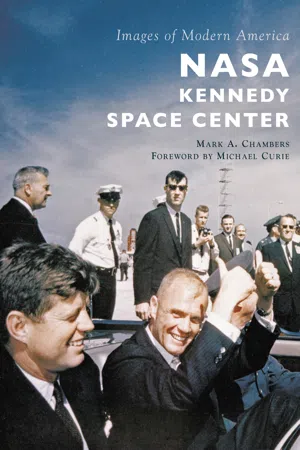
From Bumper V-2 rocket launches in 1950 to the launch of the Orion spacecraft atop a Delta IV rocket in 2014, NASA's Kennedy Space Center has served as the nation's portal to outer space for over 60 years. Images of Modern America: NASA Kennedy Space Center provides a fascinating look at the evolution of spacecraft technology and vintage images of Florida's scenic Merritt Island, known as the "Space Coast." This photographic history of the nation's premier spaceport looks back at the United States' glorious past in space exploration and ahead to its future.
Information
One
THE ROOTS OF NASA’S
ROCKET PROGRAM
ROCKET PROGRAM
In 1943, a German civilian rocket scientist, Dr. Wernher von Braun, was recruited by the German Army to develop a new Vengeance or “V” weapon, the notorious V-2 rocket, that would turn the tide of World War II, in the European Theater, back in favor of the Germans. V-2 rockets were developed and flight tested at a German Army Research Center at Peenemünde, located on the German Baltic Coast. Von Braun and a host of other German rocket scientists successfully developed and flight tested numerous V-2s at Peenemünde before it was bombed by Royal Air Force (RAF) Bomber Command heavy bombers operating as part of Operation Hydra in late July 1943.
To escape intense Allied aerial bombing, the Germans moved their V-2 development efforts to an elaborate series of V-2 rocket assembly facilities under Kohnstein Mountain, Nordhausen, in East Germany in October 1943. The V-2 assembly facilities became known as Mittelwerk. Once assembled at Mittelwerk, the V-2 components were to be transferred to an elaborate series of launch prep and launch facilities, located underground and covered by an immense, thick concrete dome, at La Coupole in Nazi occupied northern France. La Coupole was subjected however to heavy Allied aerial bombardment and its building completion was abandoned in 1944. Not even routine V-2 production and launch operations from locations in France, Belgium, and Germany, however, could save Nazi Germany from total defeat. Germany formally surrendered to the Allies on May 7, 1945.
Top German army officials and Wernher von Braun, as well as the other German rocket scientists, fled to the Austrian Alps to avoid capture by Russian troops, surrendering instead to the US Army. Von Braun and his fellow German rocket scientists were brought to the United States under the auspices of Operation Paperclip and helped develop the US ballistic missile and space exploration rocket programs. Serving as the basis for these American programs was the V-2 rocket, von Braun’s brainchild.
Interestingly, many of the facilities now at NASA KSC, such as the huge Vehicle Assembly Building and the Solid Motor Assembly Building, were modeled after the facilities planned for La Coupole, France. Thus, brainpower and facilities intended for use for evil purposes were instead utilized by the United States to help win the Cold War and the great Space Race against the Soviet Union.
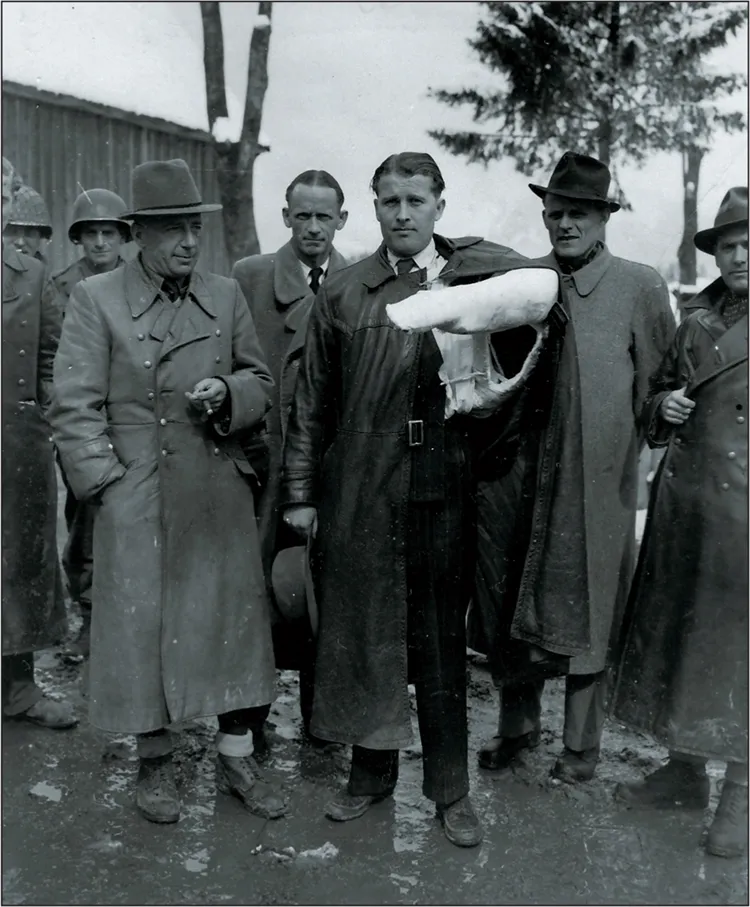
FATHER OF THE US BALLISTIC MISSILE AND SPACE EXPLORATION ROCKET PROGRAMS. From left to right are German army major general and V-2 experimental laboratory commander Walter Dornberger, German army lieutenant colonel Herbert Axtem, V-2 scientist and professor Wernher von Braun (arm in sling), and scientist Hans Lindenberg upon surrender to the US Army in the Austrian Alps on May 8, 1945. Von Braun, considered the “father” of the US ballistic missile and space exploration rocket programs, had his left arm in a sling, the result of a car accident. (Courtesy of the US National Archives, Still Pictures Branch.)
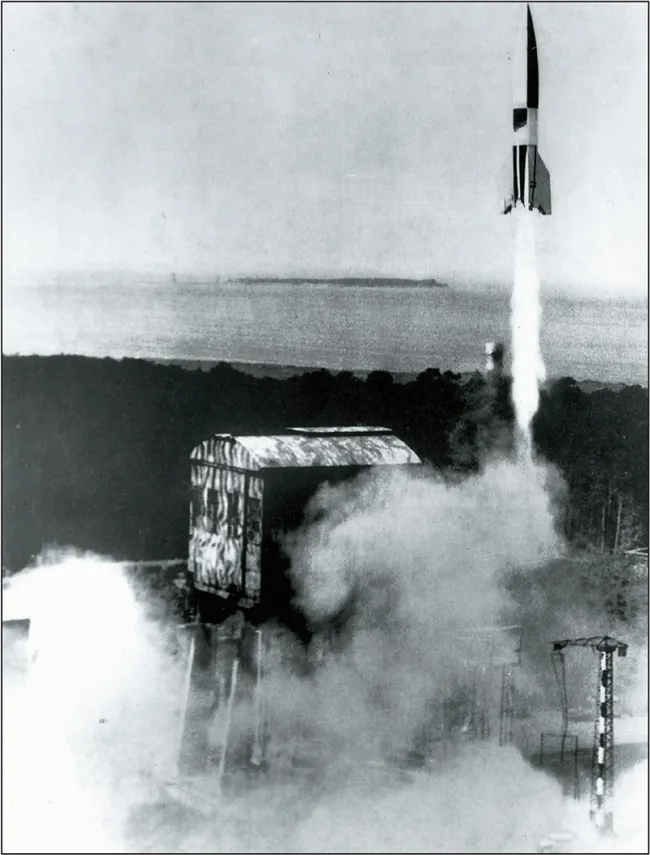
GERMAN WARTIME LAUNCH OF A V-2 FROM PEENEMüNDE. A V-2 rocket launches from the German army experimental station at Peenemünde on the Baltic coast in 1943. The US Army confiscated numerous V-2s at the end of World War II, and these rockets were extensively studied, forming the basis of the US ballistic missile and space exploration rocket programs. (Photograph by Ullstein Bild, courtesy of Getty Images.)

V-2 ROCKETS ON RAILCARS. On April 6, 1945, the first US Army soldiers advanced and captured the Messinghausen rail yard in Germany. They made a major technology discovery when they encountered these V-2 rockets stored on flatcars, bound for V-2 launch sites. (Courtesy of the US National Archives, Still Pictures Branch.)

V-2 ROCKET ENGINE AT NORDHAUSEN. Members of the US Congress, Senate, and military inspect a German V-2 rocket engine at the German underground V-weapon assembly facilities at Mittelwerk in Nordhausen, Germany, on May 10, 1945. From left to right are Rep. John M. Vorys (Ohio Republican), Rep. Ed V. Izac (California Democrat), Sen. C. Wayland Brooks (Illinois Republican), Lt. Col. J.K. Beeson of Pittsburgh, Pennsylvania, and Brig. Gen. John M. Weir, War Department representative. (Courtesy of the US National Archives, Still Pictures Branch.)

V-2 ROCKET TAIL ASSEMBLIES AT NORDHAUSEN. US officials inspect German V-2 rocket assembly facilities at Nordhausen amid rocket tail assemblies on May 10, 1945. From left to right are Sen. Leverett Saltonstall (Massachusetts Republican), Maj. H.A. Beckley, Maj. Gen. Wilton B. Persons, Sen. Kenneth S. Wherry (Nebraska Republican), Sen. C. Wayland Brooks, Rep. Ed V. Izac, Rep. John M. Vorys, Lt. Col. J.K. Beeson, Brig. Gen. John M. Weir, and Maj. Gen. L.W. Rocks of the Supreme Headquarters Allied Expeditionary Force (SHAEF). (Courtesy of the US National Archives, Still Pictures Branch.)
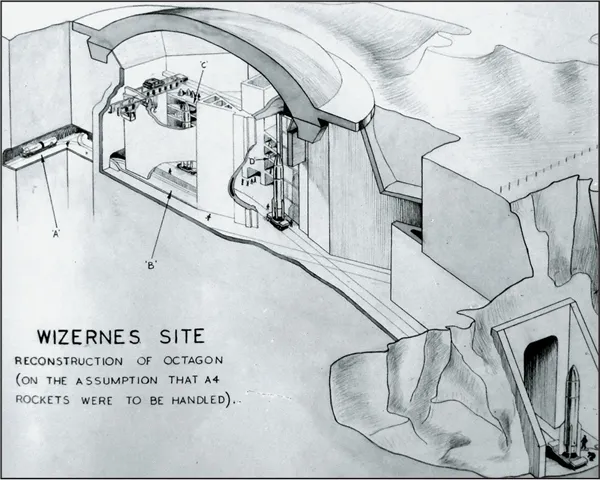
PLANNED LA COUPOLE V-2 ROCKET LAUNCH PREP AND LAUNCH FACILITIES. This is a 1944 rendition of the planned V-2 launch prep and launch facilities at La Coupole in Nazi occupied northern France. These facilities, protected by an immense, thick concrete dome that was virtually impervious and impenetrable to Allied aerial bombing, bear a striking resemblance to facilities at NASA KSC, including the VAB. The German plan at La Coupole was to launch massive V-2 rocket strikes against London and other Allied cities throughout Europe. (Courtesy of Sanders, T.R.B.)
Two
CAPE CANAVERAL
1949–1960
1949–1960
In October 1949, Pres. Harry S. Truman designated a vast area spanning 5,000 miles of America’s Atlantic coast from Cape Canaveral to Ascension Island as the Joint Long-Range Proving Ground, now called the Eastern Range. This designated over-water area was to be used as a military rocket test range. Cape Canaveral Station, located on Florida’s Cape Canaveral in Brevard County, proved to be an excellent launch site for rockets, as the area was secluded (not located close to heavily populated areas) and privy to optimal weather conditions throughout the year.
On July 24, 1950, history was made at Cape Canaveral when a modified, captured German V-2 rocket roared off a makeshift launchpad, rocketing to an altitude of 10 miles, becoming Cape Canaveral’s first successful rocket launch. In 1957, the Soviet Union launched Sputnik, the world’s first satellite, and successfully placed it into low Earth orbit.
America matched this feat by launching the nation’s first satellite, Explorer I, on January 31, 1958, from Cape Canaveral’s Launch Complex-26 and the great Space Race was born. The Explorer I development and launch was conducted by an Army-civilian team that included Dr. Kurt H. Debus, who worked with Wernher von Braun on V-2 rockets in Germany during World War II and was also brought to the United States as part of Operation Paperclip. Debus would ultimately become Cape Canaveral’s (and later, Kennedy Space Center’s) first director in 1962. The Explorer I development/launch team comprised the basis of Cape Canaveral’s rapidly expanding workforce. In addition, Pres. Dwight D. Eisenhower created the National Aeronautics and Space Administration (NASA) in October 1958 to spearhead the nation’s spac...
Table of contents
- Cover Page
- Title Page
- Copyright Page
- Dedication
- Table of Contents
- Foreword
- Acknowledgments
- Introduction
- 1. The Roots of NASA’s Rocket Programs
- 2. Cape Canaveral, 1949-1960
- 3. America’s First Manned Space Exploration Exploits, 1961-1966
- 4. Lunar Exploration and Besting the Soviets, 1966-1972
- 5. Nixon’s Dream and Interplanetary Exploration, 1973-1981
- 6. The Space Shuttle and International Space Station Eras, 1982-2000
- 7. Manned Studies in Earth Orbit, Deep Space Exploration, and the Future, 2001-Present
Trusted by 375,005 students
Access to over 1.5 million titles for a fair monthly price.
Study more efficiently using our study tools.
Frequently asked questions
Yes, you can cancel anytime from the Subscription tab in your account settings on the Perlego website. Your subscription will stay active until the end of your current billing period. Learn how to cancel your subscription
No, books cannot be downloaded as external files, such as PDFs, for use outside of Perlego. However, you can download books within the Perlego app for offline reading on mobile or tablet. Learn how to download books offline
Perlego offers two plans: Essential and Complete
- Essential is ideal for learners and professionals who enjoy exploring a wide range of subjects. Access the Essential Library with 800,000+ trusted titles and best-sellers across business, personal growth, and the humanities. Includes unlimited reading time and Standard Read Aloud voice.
- Complete: Perfect for advanced learners and researchers needing full, unrestricted access. Unlock 1.5M+ books across hundreds of subjects, including academic and specialized titles. The Complete Plan also includes advanced features like Premium Read Aloud and Research Assistant.
We are an online textbook subscription service, where you can get access to an entire online library for less than the price of a single book per month. With over 1.5 million books across 990+ topics, we’ve got you covered! Learn about our mission
Look out for the read-aloud symbol on your next book to see if you can listen to it. The read-aloud tool reads text aloud for you, highlighting the text as it is being read. You can pause it, speed it up and slow it down. Learn more about Read Aloud
Yes! You can use the Perlego app on both iOS and Android devices to read anytime, anywhere — even offline. Perfect for commutes or when you’re on the go.
Please note we cannot support devices running on iOS 13 and Android 7 or earlier. Learn more about using the app
Please note we cannot support devices running on iOS 13 and Android 7 or earlier. Learn more about using the app
Yes, you can access NASA Kennedy Space Center by Mark A. Chambers in PDF and/or ePUB format, as well as other popular books in History & North American History. We have over 1.5 million books available in our catalogue for you to explore.