- 144 pages
- English
- ePUB (mobile friendly)
- Available on iOS & Android
eBook - ePub
About this book
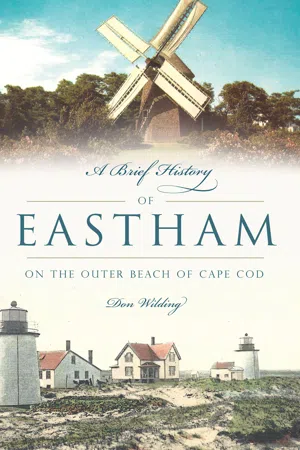
First known as Nauset, Eastham once reached across the eastern half of Cape Cod from Bass River to the tip of what is now Provincetown. The area was home to the Nauset tribe for thousands of years before exploration by Champlain and the Pilgrims, and it is now known as the "Gateway to the Cape Cod National Seashore." Whether it's the U.S. Life-Saving Service and its shipwreck rescues, Cape Cod's oldest windmill or tales of sea captains and rumrunners, Eastham is truly rich in history and tradition. Author Don Wilding wanders back in time through the Outer Cape's back roads, sand dunes and solitary beaches to uncover Eastham's fascinating past.
Trusted by 375,005 students
Access to over 1.5 million titles for a fair monthly price.
Study more efficiently using our study tools.
Information
Subtopic
North American HistoryIndex
History1
FROM NAUSET TO EASTHAM
It was estimated that there were about one hundred Nauset families in 1621. The 1764 census showed only four Nausets in the town of Eastham and in 1802 but one Indian was left. How sad must have been the life that solitary native, the last of the Nauset race in Eastham.
—Alice A. Lowe, Nauset on Cape Cod, 1968
Nine thousand years ago, one group of people lived on the land that is now known as Cape Cod. As historian and twelfth-generation Cape Codder Todd Kelley explained, the land was more extensive then. It was actually possibly for the natives to walk from Cape Cod out to Nantucket, Martha’s Vineyard and George’s Bank before the sea began to fill in about six thousand years ago.
Prior to the seventeenth century, the land now known as Cape Cod belonged to five distinct tribes, all with ties to the Wampanoags. One of those tribes, the Nausets, occupied the land along the Cape’s outer coast. Just to the south was the Monomoyick tribe, which resided in the area of Chatham. There were “no borders,” according to Marcus Hendricks of the Native Land Conservancy. “Our borders were the rivers. We didn’t really go by the months—the smell of the air, the way the animals reacted, what was going on with the earth and the water, we had our own calendar—it was based on the moon.”
Their lives were simple. Families lived in small wetus in the summer and the larger longhouses, or wigwams, in the winter. Inside the wigwam, they’d have a stew or chowder cooking all day. When it came to heading out on the water, meshunes, made of white pine or white cedar—some as large as school buses—were the primary method of transportation. Out on the water, they’d hunt for whales or seals. Spear fishing was common, too.
Around the dawn of the sixteenth century, this way of life changed forever, with the arrival of explorers from Europe. As Kelley put it, the natives’ stable life was undermined. “It isn’t like the Europeans had this diabolical plan, it was more of a series of events that led to the collapse of the communities here.”
Whether the Vikings landed on the Cape is a subject debated by historians—the name “Wonderstrand” was allegedly bestowed on this region by the Norsemen over one thousand years ago. When John Cabot and his crew began hauling in large catches of codfish around the peninsula in 1497, more explorers and fishermen were in the nearby waters. The natives often spotted their vessels, which Hendricks said that they referred to as “floating islands.”
Bartholomew Gosnold was one of the first explorers, hauling in such an abundant cod catch near Provincetown that he dubbed the peninsula “Cape Cod.” Much of Gosnold’s exploration, however, was farther up on the Cape.
According to William Nickerson’s unpublished 1933 manuscript, “Some Lower Cape Indians,” there were no European settlements anywhere along the North American seaboard from the St. Croix River in Maine to the St. Johns in Florida. That summer, the French explorers Samuel de Champlain and Sieur de Monts set sail from the area of the Canadian Maritimes and anchored in what is now Nauset Harbor, which, in turn, is connected to the Salt Pond in Eastham and the Town Cove on Eastham’s southern border with Orleans. For a week, the French vessel stayed there, with Champlain observing the activities of the Nauset village ashore. The hillsides overlooking the marsh were dotted with Nauset wetus.
Champlain was intrigued, and he set about sketching the village and harbor. He named the area Malle-barre and landed on the beach north of the inlet, where they met the first Nausets. “We found the place very spacious, being perhaps three or four leagues in circuit, entirely surrounded by little houses, around each one of which there was as much land as the occupant needed for his support,” Champlain observed. “There were also several fields entirely uncultivated, the land being allowed to remain fallow.…[T]heir cabins are round, and covered with heavy thatch made of reeds.”

A map of the Nauset natives’ settlement, sketched by French explorer Samuel de Champlain during his visit in 1605. Eastham Historical Society.
Over the last few centuries, the size of the barrier beach that separates the Atlantic Ocean from Nauset Harbor and Marsh has decreased significantly. As recently as the early twentieth century, the barrier beach north of the inlet was three to four miles long and nearly a quarter of a mile wide, with towering dunes. By early 2017, the northern portion of the beach was reduced to just over a mile long, about one hundred yards wide, and mostly flattened, with only a small dune area near the east-facing beach. The inlet also migrates from south to north over time. When the inlet reaches the farthest northern point of the barrier beach, a new one opens to the south near the border of Orleans. The harbor that Champlain sailed into over four hundred years ago is significantly smaller now than it was then.
Unfortunately for the Frenchmen, a dispute over a kettle led to the first bloodshed and fatality of a European visitor on Cape Cod shores.
Even with this major misunderstanding, the Frenchmen were able to patch up their differences with the Nausets. They went north on the beach, then westward, across the land that would later become Deacon John Doane’s farm. Fields of corn and tobacco were abundant. They sampled the Indian beans and squashes and saw the fish weir on the north side of the marsh.
The French visitors didn’t stay for long, but they returned a year later. This time, Champlain was traveling with Sieur de Poutrincourt and stayed at Nauset only briefly. Champlain and de Poutrincourt then sailed south, but the ship ran into trouble off Pollock Rip (Chatham Bar) and somehow worked its way into Stage Harbor (known to the Monomoyicks as Seaquanset). Relations with the Monomoyicks there were initially good but quickly soured within ten days, and two of the explorers were killed. Initially dubbed Port of Fortune, it wasn’t long before other names were bestowed on the Chatham harbor, including Place of Mishappenstance. De Poutrincourt had a fur trade monopoly going on in Nova Scotia, and that was stripped from him because this trip was such a disaster. French explorations south of Nova Scotia ceased after this point.
More trouble erupted following a visit by Captain John Smith in 1614. According to Nickerson, while his two ships gathered fish, Smith explored Cape Cod Bay in a small boat near Provincetown. He returned to England with the first ship full of fish, while the other one stayed to fill up with dry fish and head to Spain. Thomas Hunt was left in charge, and “he abused the savages where he came, and betrayed twenty-seven of these poor innocent souls, which he sold off for slaves in Spain.” It’s believed that the seven from Nauset never returned.
In 1616, a French ship was wrecked near Pawmet, with three or four survivors, and they were captured and tortured by the Nausets. One of the Frenchmen survived and eventually married the daughter of Aspinet, the Nauset chief. They had a child but perished in what was known as the Great Plague of 1616–18.
“It’s a significant part of the story that isn’t told about enough,” Kelley explained. “That happened from Maine to Narragansett, but probably didn’t on the Cape. It could have been measles, bubonic plague, yellow fever—something that the native people had no resistance to. European settlers had been coming around the area. When that came along, thousands of people just died, and their bones were just left there.”
Tisquantum, or Squanto, one of twenty prisoners taken at Plymouth, regained his freedom in Europe and returned to Pawtuxet, only to find his people gone. Fluent in both English and the tribal languages, Squanto became a critical link between the two cultures before his death in 1622.
The Pilgrims were the next visitors from England to settle in the area. Their vessel, the Mayflower, approached Cape Cod in November 1620. As the Mayflower approached the Cape, it approached Pollock Rip and found itself near the shoals, courtesy of a strong northerly wind. Fortunately for the ship, the wind eased and shifted to the south—”a good, strong lifesaving breeze,” as noted by W. Sears Nickerson: “Captain [Christopher] Jones praised the Lord, swung his ship’s head around, squared his yards before it, and clawed her out through the treacherous rips into the blue water beyond. Before sundown he had her back off Chatham and hove-to for the night, with plenty of water under her keel.”
As Nickerson noted, “Hudson River country” was the Pilgrims’ destination, but life aboard the Mayflower was becoming more difficult by the day. Provisions, including fresh water, were dangerously low, and the firewood was gone. Two of the Mayflower’s party had already succumbed to illness. “This was but the beginning of that deadly malady which put nearly fifty per cent of the crew and passengers into their graves before spring,” Nickerson wrote. Captain Jones survived and returned to England on the Mayflower several months later, but he died shortly thereafter.
Jones consulted a map from Captain John Smith that showed a harbor, Milford Haven (what is now Provincetown Harbor), just to the north. With the dire conditions on the ship and favorable conditions for sailing, Jones headed in that direction. As Nickerson wrote:
It was high tide at Nawset about nine o’clock which means that the Mayflower, squaring away at sunrise from her night’s berth off Chatham just north of the Shoals, ran right into a high tide and held it until sunset. Knowing her average rate of speed, I do not see how even a fair wind could have pushed her against it much farther than somewhere just north of High Head in Truro before nightfall. Thus it is quite possible the Pilgrims watched the sun go down that night behind the hill in Provincetown where some three centuries later a grateful posterity would erect a Monument to their memory.
The Mayflower eventually anchored in the harbor, and the Pilgrims signed the Mayflower Compact on November 11, 1620. They didn’t stay on the Outer Cape for long, opting to settle across the bay in an area they would name Plymouth. Before leaving the Cape, the Pilgrims sent a group of explorers south into Nauset territory, resulting in a brief skirmish with the Nausets that would forever be remembered as the “First Encounter.” By 1620, tensions were still running high among the Nausets and other tribes when it came to European visitors. Accounts of what route the Mayflower passengers, or “Old Comers,” as William Bradford called them, took to get there vary, but Nickerson noted that Myles Standish and his men never saw one Indian on the way.

A map indicating the expeditions of the Pilgrims, which includes the journey to First Encounter Beach in Eastham before the explorers settled across Cape Cod Bay in Plymouth. Cape Cod National Seashore.
On the morning of December 8—”twilight in the morning,” as described by William Bradford—Standish and his men were greeted by the war whoop of the Nausets and a flurry of arrows. Still well aware of what happened with Thomas Hunt and some of their fellow tribesmen six years earlier, Aspinet and the Nausets remained hostile to any outside visitors. As William Bradford wrote, “The cries of ye Indeans [sic] was dreadful. Their notes was after this manner…’Wooach! Wooach! Ha! Ha! Wooach!’” According to Nickerson, the attack happened “on the point of land near the landing place on the north side of the mouth of the Boat Meadow Creek.” Neither side suffered casualties. Eighteen of the arrows were rounded up and sent to England.

Postcard depicting the “First Encounter” conflict between the Nausets and Pilgrims along Cape Cod Bay in Eastham. Eastham Historical Society.
In 1920, a plaque was placed on the site: “On this spot hostile Indians had their first encounter December 8, 1620, old style, with Myles Standish, John Carver, William Bradford, John Tilley, Edward Winslow, John Howland, Edward Tilley, Richard Warren, Stephen Hopkins, Edward Dotey, John Allerton, Thomas English, Master Mate Clark, Master Gunner Copin, and three sailors of the Mayflower Company.”
A new plaque was erected in 2011:
Near this site the Nauset Tribe of the Wampanoag Nation, seeking to protect themselves and their culture, had their First Encounter 8 December 1620 with Myles Standish, John Carver, William Bradford, Edward Winslow, John Tilley, Edward Tilley, John Howland, Richard Warren, Stephen Hopkins, Edward Dotey, John Allerton, Thomas English, Master Mate Clark, Master Gunner Copin and three sailors of the Mayflower Company.

Monument on the bayside of Eastham, marking the site of the First Encounter. It reads: “On this spot hostile Indians had their first encounter December 8, 1620, old style, with Myles Standish, John Carver, William Bradford, John Tilley, Edward Winslow, John Howland, Edward Tilley, Richard Warren, Stephen Hopkins, Edward Dotey, John Allerton, Thomas English, Master Mate Clark, Master Gunner Copin, and three sailors of the Mayflower Company.” Eastham Historical Society.
Peace between the Nausets and settlers came the following summer. John Billington, a juvenile prone to trouble, was lost in the woods, and Indians took him to Nauset. As Nickerson wrote:
The governor sent the shallop for him, and she lay aground at Nauset on the ebb tide, Aspinet came and brought the boy with him, one of his men bearing the lad through the water on his shoulders. There were another hundred Indians present. There he delivered us the boy, bestrung with beads, and made peace with us, we bestowing a knife on him, and likewise on another that first entertained the boy and brought him thither.
In 1643, arrangements were made for the Nauset Purchase, and the following year, forty-nine people from Plymouth, unhappy with their lives there, settled in Nauset. “Affairs at Plymouth had not been prospering as formerly,” according to Alfred Alder Doane’s The Doane Family and Their Descendants. “There was not sufficient upland. There was without doubt a slight division in the church, which made those persons of similar minds and ambitions to think of removal to Nauset.”
The heads of seven families—Thomas Prence, Deacon John Doane, Nicholas Snow, Edward Bangs, Richard Higgins, John Smalley and Josias Cook—known as “The Purchasers,” sailed across Cape Cod Bay in the sloop Swan. The newly christened town, which originally reached from Bass River to Provincetown, became known as Eastham in 1651. The town was likely named for its English counterpart, East Ham. The Nauset territory purchase payment to the Indians consisted of “moose skins, Indian boats, wampum, and little knives.”
Prence, whose name is also spelled “Prince” in early writings, was the governor of the Plymouth Colony and lived in a house located at the corner of what is now Route 6 and Governor Prence Road from 1644 to 1663. Prence served as governor from 1634 to 1635 and 1638 to 1639 and again from 1657 until his death in 1673.
Doane settled on a plot of land north of Town Cove, near Nauset Marsh. A granite post was erected on the site of the house in 1869, on what was open land until t...
Table of contents
- Front Cover
- Title Page
- Copyright
- Dedication
- Contents
- Acknowledgements
- Introduction
- 1. From Nauset to Eastham
- 2. Agricultural Assets: Asparagus and Turnips
- 3. The Windmill: Eastham’s Landmark
- 4. The Era of “Thumpertown”
- 5. The Eastham Railroad’s Golden Age
- 6. Nauset Light: The “Big Star” of Eastham
- 7. Storm Warriors: The Coast Guard in Eastham
- 8. Tales of the Eastham Rumrunners
- 9. The “Old House of Learning”
- 10. Captains of Eastham
- 11. Some Eastham Washashores
- 12. Keepers of the Cape Chronicles
- 13. Eastham, D.C.
- 14. Gateway to the Cape Cod National Seashore
- 15. Celebrating Eastham’s Past
- Bibliography
- About the Author
Frequently asked questions
Yes, you can cancel anytime from the Subscription tab in your account settings on the Perlego website. Your subscription will stay active until the end of your current billing period. Learn how to cancel your subscription
No, books cannot be downloaded as external files, such as PDFs, for use outside of Perlego. However, you can download books within the Perlego app for offline reading on mobile or tablet. Learn how to download books offline
Perlego offers two plans: Essential and Complete
- Essential is ideal for learners and professionals who enjoy exploring a wide range of subjects. Access the Essential Library with 800,000+ trusted titles and best-sellers across business, personal growth, and the humanities. Includes unlimited reading time and Standard Read Aloud voice.
- Complete: Perfect for advanced learners and researchers needing full, unrestricted access. Unlock 1.5M+ books across hundreds of subjects, including academic and specialized titles. The Complete Plan also includes advanced features like Premium Read Aloud and Research Assistant.
We are an online textbook subscription service, where you can get access to an entire online library for less than the price of a single book per month. With over 1.5 million books across 990+ topics, we’ve got you covered! Learn about our mission
Look out for the read-aloud symbol on your next book to see if you can listen to it. The read-aloud tool reads text aloud for you, highlighting the text as it is being read. You can pause it, speed it up and slow it down. Learn more about Read Aloud
Yes! You can use the Perlego app on both iOS and Android devices to read anytime, anywhere — even offline. Perfect for commutes or when you’re on the go.
Please note we cannot support devices running on iOS 13 and Android 7 or earlier. Learn more about using the app
Please note we cannot support devices running on iOS 13 and Android 7 or earlier. Learn more about using the app
Yes, you can access A Brief History of Eastham by Don Wilding in PDF and/or ePUB format, as well as other popular books in History & North American History. We have over 1.5 million books available in our catalogue for you to explore.