![]()
1
EARLY ARLINGTON
THE ORIGINAL ARLINGTON
“Welcome to the Eastern Shore of Virginia,” read the roadside greeting in Northampton County.
My wife and I used a vacation in June 2016 for a pilgrimage to the original Arlington Plantation, from which our fair suburban county drew its name. The site, off the tourist circuit, is reached by driving north from Norfolk via the miraculous Chesapeake Bay Bridge-Tunnel or by heading south from Chincoteague down Highway 13.
In its own quiet way, the site of the 346-year-old home known as Arlington Plantation is a near-forgotten mother lode in the history of our county, state and nation. Once Virginia’s finest residence, it was briefly the Old Dominion’s capital and is the original source of the wealth married into by George Washington.
Mystery hovers around the origins of our county’s name. The basics are clear: George Washington Parke Custis, the grandson of Martha Washington raised at Mount Vernon, inherited the 1,100-acre tract of land on the upper Potomac from his father, John Parke Custis. Beginning in 1802, he built the home he called Arlington House, after his ancestral home on the Eastern Shore.
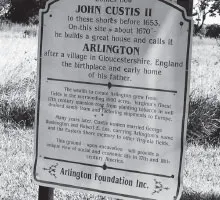
That Chesapeake mansion, built by John Custis II (1628–1696), was likely named for his father’s English home in Gloucester, in the Cotswolds, west of London, called Arlington. (A competing tale says Custis was honoring Henry Bennet, Earl of Arlington.) Either way, “Virginia’s finest 17th-century mansion rose from planting tobacco in well-drained sandy loam and factoring shipments to Europe,” reads the signage.
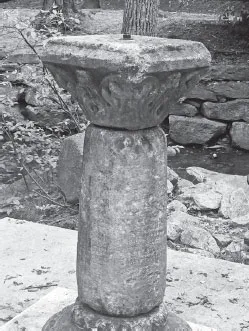
The tomb of the ancestor of Arlington, John Custis. Charlie Clark.
In our era, Arlington Plantation merits only a squib in tourist brochures for the Eastern Shore—a struggling region dependent on fishing. The local visitors’ center gets few inquiries. A historical marker on Highway 13 reads, “Arlington on the Potomac was named for this Arlington.” We turned onto Arlington Road and Custis Tombs Road and drove by cornfields, then we arrived at the labeled site of a well-manicured and marked open grass lot. Alongside it is a small parking lot and a brick enclosure next to a modern private home.
We found the pamphlet produced by the Arlington Foundation Inc., founded in 1997 and run out of nearby Eastville. It owns the historically protected property, and its archaeological digs in 1988 and 1994 uncovered ancient jugs, wine bottles and decorative masonry. “This house dwarfed other fine homes in Virginia,” its sign reads. Expanding from seven to one thousand acres, the Custis property was populated as of 1677 by five slaves (later seventeen) and nine indentured servants. Despite the high Old Plantation Creek water table, the fancy home had a proper English basement.
In 1676, after the famous Bacon’s Rebellion in Jamestown, Governor William Berkeley fled and took shelter with Custis, making Arlington the temporary capital.
Two tombstones contain remains of John Custis II and IV. The dimpled inscription on that of the younger—signed by its London manufacturer, “Wm. Coley Mason of Fenn Church Street”—contains the ironic claim that he died “aged 71 years, and yet lived but seven years which was the space of time he kept a bachelor’s house at Arlington on the Eastern Shore of Virginia.” In fact, as explained in a booklet by the late Arlington Historical Society president Sherman Pratt, this statement was a dig at Custis’s wife, Frances. Their relationship was so icy that they communicated only through servants. Going to hell, Custis once told her, is “better than living in Arlington with you.”
FATHER OF OUR COUNTRY IN ARLINGTON
George Washington drank here. From a spring. In the 1780s. In Arlington, on the Moses Ball land grant property off of Carlin Springs Road. You can see it if you’re willing to venture onto the property owned by Virginia Hospital Center.
I visited the site in May 2016, when I took the marvelous George Washington’s Forest History Walk put on by the peripatetic volunteers at WalkArlington.
All of us have sensed that the father of our country set foot in what became Arlington’s suburban environs. But here was a chance to brave the rain and devote a Saturday afternoon to see an off-the-beaten-track Washington monument on a, let’s say, more intimate scale.
Our brainy guide was attorney and Revolutionary War enthusiast Kevin Vincent. He connected dots in the picture of Washington’s presence after he purchased twelve hundred acres of Lord Fairfax’s land on the eve of the Revolution because he needed timber out at Mount Vernon.
Our group of seven debarked from the Ball-Sellers House, the pride of the Arlington Historical Society in the Glencarlyn neighborhood. Built before 1755 by miller John Ball, it offers the county’s best glimpse into the everyday lives of our eighteenth-century forebears. After Ball died in 1766 (there is no record that he met Washington), the home was sold to neighborhood namesake William Carlin, who was Washington’s tailor.
The county sign down the street in front of Carlin Hall contains one error, Vincent confided, about the Ball brothers, Moses and John. There’s no evidence that they were related to Washington via the first president’s mother, Mary Ball, though they hailed from the same parts of Virginia, he said.
In an entry from May 1786, Washington wrote, “When I returned home I found Moses Ball, his son John Ball and William Carlin here, the first having his effects under execution wanted to borrow money to redeem them. Lent him ten pounds for this purpose.”
Moses owned the adjoining property, which is why it is likely that the commander of the Continental army tied his horse and sipped from Ball’s spring, his injured slave Billy Lee at his side. (Those area springs would be marketed as a resort from 1872 to 1884.)
What Washington shared with Moses Ball was the need to use a wellknown oak tree as a reference point in his survey. That tree was felled by a storm in 1898; a stump survives on exhibit in the Glencarlyn Branch Library.
Fading marker of the site of the survey tree used by George Washington. Charlie Clark.
To glimpse the site of that famous tree, we hiked the woods of the Long Branch Nature Center. “There are few trees from the eighteenth century because they were cut down during the Civil War,” Vincent explained. “But they’re starting to grow back to look like they did when George Washington bought here.”
We arrived at our destination—Arlington soil that we know Washington once trod. It’s a hundred yards north of where Washington’s property began and extended through Shirlington. (It would later include the Columbia Pike mill for Arlington House built by George Washington Parke Custis.) What you see is a pockmarked pillar—to which passersby are oblivious—marking the site of the survey tree. There is no plaque, Vincent said. The text Vincent once wrote disappeared.
ONCE ARLINGTON’S BEST VIEW
When you alight at Reagan National Airport, you’re likely in a travelfixated hurry. It might not dawn on you to slow down and stroll to the historic Abingdon Plantation. The airport authority and specialists from the Arlington Historical Society have created an easy and well-marked walk from the Metro stop through the parking garage.
You should take a contemplative break and visit one of our county’s historical gems.
Abingdon has been regarded as the oldest house in Arlington, built before 1741 by Gerard Alexander of the Scottish-bred landowning family who are the city’s namesakes. High on hills overlooking the Potomac and Old Town Alexandria, this prime property in the area called Gravelly Point would become the birthplace of George Washington’s step-granddaughter Eleanor Parke “Nelly” Custis. (In 1941, a Nelly Custis Airmen’s Lounge was built near the airport’s radar station.)
Abingdon under the Custises was also said to be the site of original planting of weeping willows in the United States.
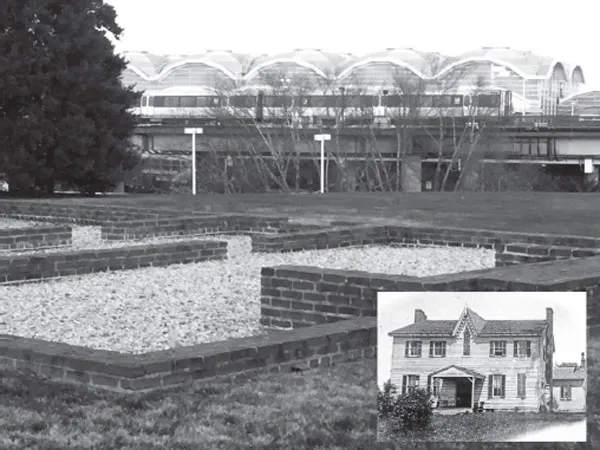
Because the impressive Georgian home was destroyed by fire in 1930, what you see today are reconstructed red brick remains sketching the old home’s outline. But you can envision it from benches surrounding tended plants and informative signage.
According to the exhibits, encyclopedias and Eleanor Lee Templeman’s Arlington Heritage, the Alexanders’ original house was nearly forty years old when it was purchased in 1778 by Martha Washington’s son John Parke “Jacky” Custis. (George warned that Jacky overpaid for the eleven-hundred-acre tract.) After Jacky died of camp fever, his widow married the general’s business associate, Dr. David Stuart, who helped plan the nation’s capital. General Washington himself stayed there, and a bedroom was named for him.
The Custis who spent the least time at Abingdon was Nelly’s brother George Washington Parke Custis, the builder of Arlington House who was raised at Mount Vernon. By the time he inherited thousands of acres in 1802, Abingdon had returned to the Alexanders.
The home was eventually sold to the Hunter family. General Alexander Hunter held a post in the Alexandria Customhouse and had money to renovate Abingdon. He was tight enough with President Andrew Jackson to host him there. (Other guests included presidents John Tyler and James Polk.)
During the Civil War, Abingdon was confiscated because its owners had joined the Confederacy. It was occupied by a Union regiment from New Jersey. In 1900, ownership fell to the Washington Brick Company; in 1924, it became the property of the Richmond, Fredericksburg and Potomac Railroad.
Following the 1930 fire, architects examined Abingdon to consider a restoration. They settled for a plaque by the Association for Preservation of Virginia’s Antiquities. Historically accurate improvements were made by the Civilian Conservation Corps.
In 1940, Abingdon was acquired for National Airport. During planning for its expansion in the late 1980s, there was talk of paving over the site for a parking garage. Governor Doug Wilder and legislators blocked the idea, and a subsequent dig unearthed artifacts now on display in Terminal A.
Former resident Alexander Hunter II described the old Abingdon in 1904: “I doubt whether in the whole Southland there had existed a finer country seat; the house was built solidly, as if to defy time itself, with its beautiful trees, fine orchards, its terraced lawns, graveled walks leading to the river a quarter of a mile away; the splendid barns, the stables with fine horses.”
Today’s site offers a placid respite from the airport’s holiday bustle.
Many airport passengers miss the once-vital Abingdon Plantation and site of a house that burned in 1930. Charlie Clark.
TIMES A-CHANGING AT ARLINGTON HOUSE
On April 4, 2015, at Arlington House, the National Park Service put on a rich evening commemoration of the unfolding of the end of the Civil War 150 years ago. April 4 marks the day President Lincoln entered the shattered Confederate capital of Richmond—five days before the surrender at Appomattox Court House.
That Saturday’s bill of fare consisted of nineteenth-century dancing under the columns of Robert E. Lee’s mansion, tours of the rooms and prominent graves, fireworks, a candlelight vigil for the dead, plus great talks by park service staff and volunteers. “You may be wondering why there’s a good mood here tonight,” said park ranger Matt Penrod. “The joy that all the death and destruction was coming to an end” was not shared elsewhere in the South. “But northern Virginia was different, and in Arlington the mood was jubilant.”
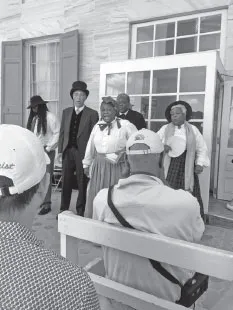
Singers celebrate the reenactment of the enslaved persons’ wedding at Custis’s Arlington House. Charlie Clark.
Mrs. Robert E. Lee, having grown up at Arlington House and given birth to six children there, was still bitterly vowing the war would go on, Penrod noted. Union quartermaster general Montgomery Meigs’s anger that General Lee, his former colleague, had defected from the Union led him to place the first officer graves on the rim of Mrs. Lee’s garden.
Arlington House—with its commanding view of Washington, D.C.—was known early in the war as a must-hold fort. “Imagine what a couple of Confederate gun batteries could do from here,” Penrod said. When Lee signed his commitment to fight for the South there, it cost his family greatly. He would never see the mansion again (though his postwar efforts at reconciliation gave Congress cause in the 1950s to re-designate the site as a Lee memorial).
Though somber, that Saturday’s lessons were expertly recounted over the strains of a quartet of fiddlers and guitarists. They serenaded hoopskirted ladies and men in snappy vests or Union military uniforms dancing the Virginia reel in an authentic re-creation of the actual celebrations.
No primer on Arlington House can omit reference to Freedman’s Village, the nearby property for blacks released from slavery in the 1860s. Among those liberated was James Parks (1843–1929), who was born at Arlington House, worked as a graves superintendent and helped guide the site’s restoration in the 1920s.
Within a year, however, a small makeover was being planned for Arlington’s namesake home.
At the Arlington Cemetery auditorium in November 2015, I was privileged to sit in on a National Park Service historians’ roundtable discussing how the well-visited Arlington House might modernize its portrayal of blacks, women and plantation domestic life. Park service regional historian Dean Herrin expressed gratitude to Washington philanthropist David Rubenstein for the previous year’s $12.5 million gift to the National Park Foundation. The funds will be used to upgrade exhibits.
Then th...