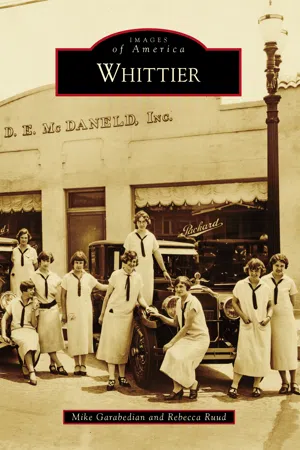
- 128 pages
- English
- ePUB (mobile friendly)
- Available on iOS & Android
eBook - ePub
Whittier
About this book
When Quaker colonists arrived in Southern California in 1887 to establish their "ideal city of dreams" between the San Gabriel River and the base of the Puente Hills, this land already had a storied past. It was once a place where native Tongvans gathered, the site of Spanish land grant holder Manuel Nieto's rancho, and home to the mansion of the last governor of Alta California, Pío Pico. Named by the early settlers after the abolitionist poet, "Ye Olde Friendly Towne of Whittier" grew from a small colony of Quaker pioneers to a bustling center for the production of citrus, walnuts, and avocados. After incorporation in 1898, Whittier also became a flourishing suburb connected to Los Angeles via the Pacific Electric trolley; the home of Whittier College, celebrated for its academics and the mascot Johnny Poet; and home to several notable Americans, including the 37th president of the United States.
Information
One
BEFORE THE QUAKERS
THE LATE 19TH CENTURY

Anglo-American settlers traverse the Little V Creek near the San Gabriel River around 1875. Before the end of the 19th century, the settlement near what would become Whittier was dictated by where inhabitants—Native Americans, Spanish Catholic missionaries, then Mexican and American ranchers—could obtain water for drinking and irrigation. (Los Angeles Public Library.)
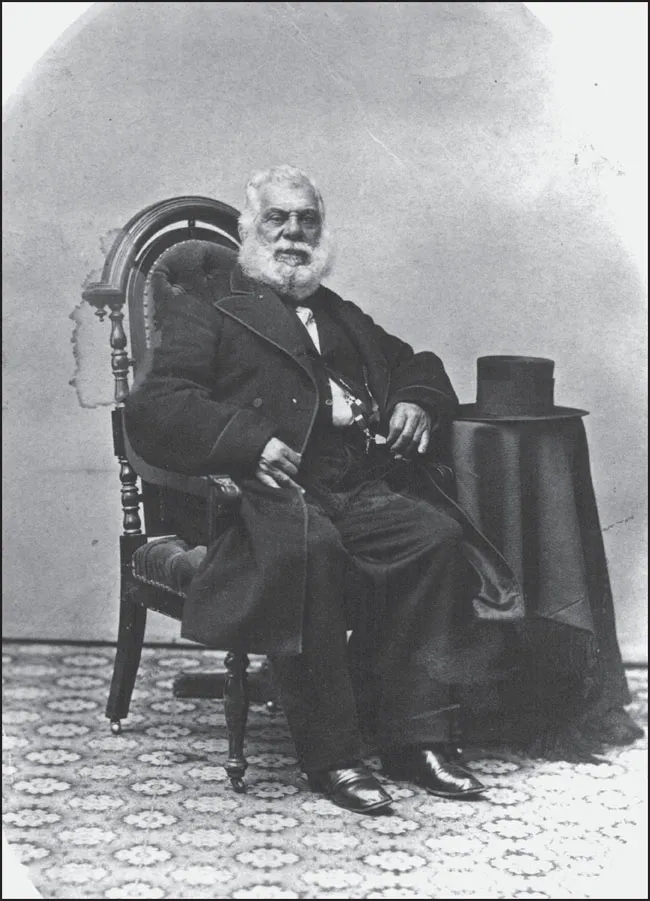
Born in 1801 at the San Gabriel mission, Pío de Jesús Pico was the last governor of Mexican Alta California. A wealthy man by midcentury, Pico bought the Rancho Paso de Bartolo, an 8,900-acre Mexican land grant, in 1850; it included half of the area that would become Whittier. In 1852, he built a home on the ranch on the east bank of the San Gabriel River, where he lived for 40 years. (WM.)

Pico dubbed his estate “El Ranchito” and built a chapel, saloon, and guesthouses. Regular fiestas, rodeos, and dances rendered the working ranch a Californio time capsule, even as white settlers poured into the region in the late 1800s. Unfortunately, Pico fell victim to bad business dealings and a real estate scam. In 1892, he lost El Ranchito and was evicted from his adobe homestead; he died in poverty two years later. (WM.)
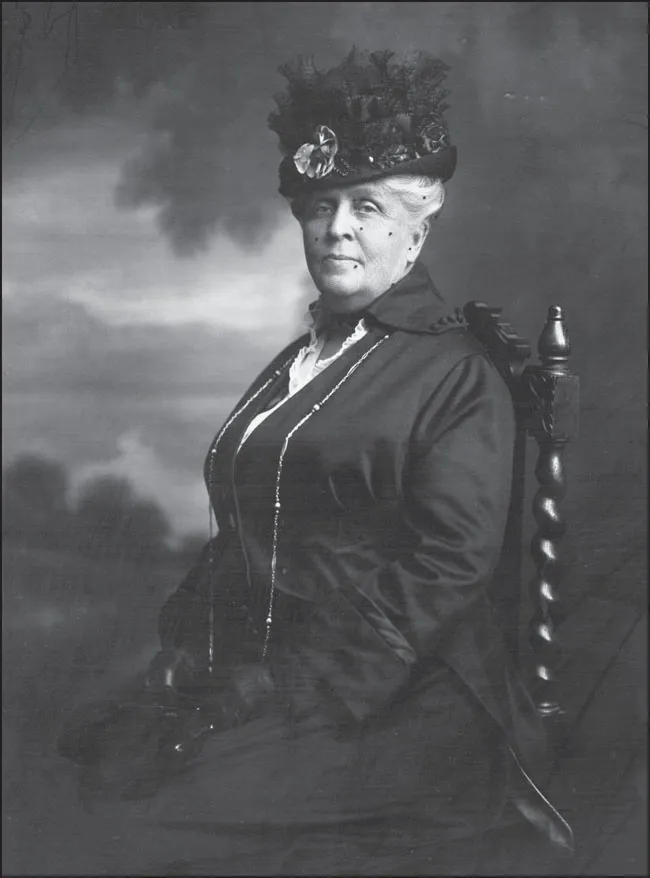
Pío de Jesús Pico’s neighbor and friend Harriet Williams Russell Strong, proprietress of the San Gabriel River-adjacent Ranchito del Fuerte, was among the first to suggest preserving Pico’s old adobe homestead for posterity. Strong purchased and restored the property in 1909 and gifted the land to the State of California in 1917. In 1927, El Ranchito was designated one of California’s first state historic parks. (WM.)
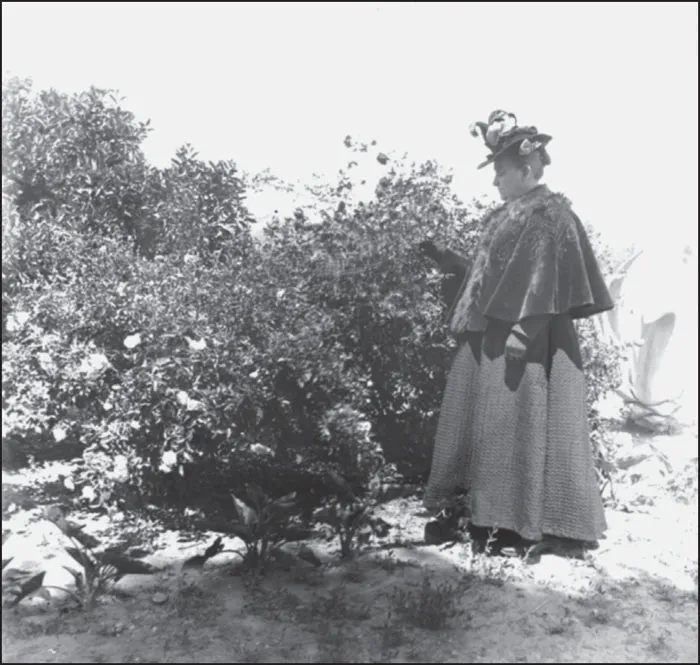
Widowed in 1883 at age 39, Strong immediately attended to running the Ranchito del Fuerte, planting walnut trees but also pampas grass, whose plumes she sold to European milliners, amassing a fortune. A National Women’s Hall of Fame inductee, Strong was a community leader, philanthropist, composer, and pioneer in water conservation who was granted patents for new irrigation techniques. In her later years, she advocated for women’s rights, education, and suffrage. (WPL.)

In 1867, Pío de Jesús Pico plotted the town of Picoville on El Ranchito land, which included a riverside camp of Tongva Indians and Mexican laborers. In 1892, saloonkeeper Jim Harvey purchased the property, which was bounded by Whittier and Beverly Boulevards, the San Gabriel River, and Whittier’s western border. Many of the agricultural laborers who patronized Harvey’s bar constructed a shantytown on Picoville’s former streets. In the early 1900s, “Jim’s Town” (later “Jimtown”) remained “a rendezvous for bands of gypsies and undesirables” and “soakers,” according to early Whittier historians B.F. Arnold and A.D. Clark. Disdainful of these neighbors and dedicated to preventing the ill effects of what John Greenleaf Whittier called “the evil of intemperance,” Whittier’s Quaker settlers outlawed saloons—even incinerating a makeshift tavern in 1888—and prohibited construction of drinking establishments within the town limits until 1940. (WM.)
Two
A QUAKER COLONY
1887–1898

Begun in 1894, Whittier’s Founders’ Day picnics have always been held in Central Park. This photograph from one of the first picnics features some of Whittier’s earliest Quaker settlers and founders in their characteristic plainclothes, including Henry Dorland, Nele Davis, and Whittier’s first Quaker settlers, Rebecca and Jonathan Bailey, who are at far left in the first two seats of the front row. (W.E. Butler, WPL.)

Aquila Pickering, pictured here with his first wife, Ruth Dorland, and their children, is generally regarded as the person most responsible for choosing the location for the Quaker colony that became Whittier. A Chicago-based Quaker businessman, Pickering and his second wife, Hannah, came to California in early 1887 to establish a faith-based community that would have a positive impact on a state where “the need of moral and Christian influence was everywhere apparent.” Near the end of their search, in early spring, the Pickerings visited the John M. Thomas Ranch, a 1,300-acre tract for sale 15 miles southeast of Los Angeles. As Aquila later recalled, “From the first we were favorably impressed with this beautiful situation: the high ground sloping away from the Puente Hills from which we could see the whole valley reaching toward the south and west until our eyes rested upon the ocean, some eighteen miles away.” (Barbara Rasmussen.)
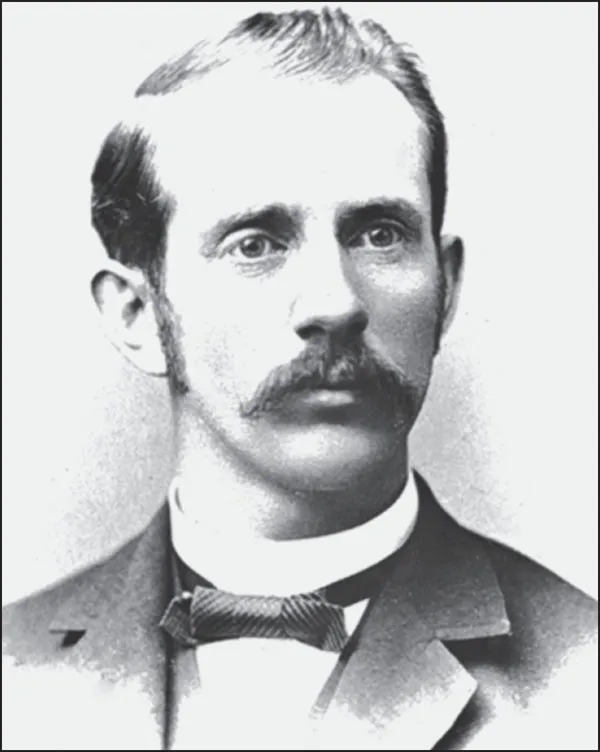
Shortly after his arrival in Southern California, Aquila Pickering met with Quaker educator (and, later, Whittier College president) Thomas E. Newlin, who introduced him to other Quakers from Pasadena and Los Angeles interested in the colony proposal, as well as real estate agent Hervey Lindley (pictured). Lindley helped the Quakers organize the Pickering Land and Water Company in order to option the John M. Thomas Ranch and served as the group’s first secretary-treasurer. (W.E. Butler, WPL.)

On April 8, 1887, the Pickering Land and Water Company board met at the ranch house on the Thomas tract and agreed to buy the land for $69,890 from then-owner J. Mill Boal, who had purchased the property from Thomas in August 1886 for $33,000. Representatives from the Pickering Land and Water Company signed the deed on May 11, 1887. The house (later called the Jonathan Bailey House) became the site for meetings of the company and, subsequently, a hub for religious, social, commercial, and civic meetings in Whittier’s earliest days. (WPL.)
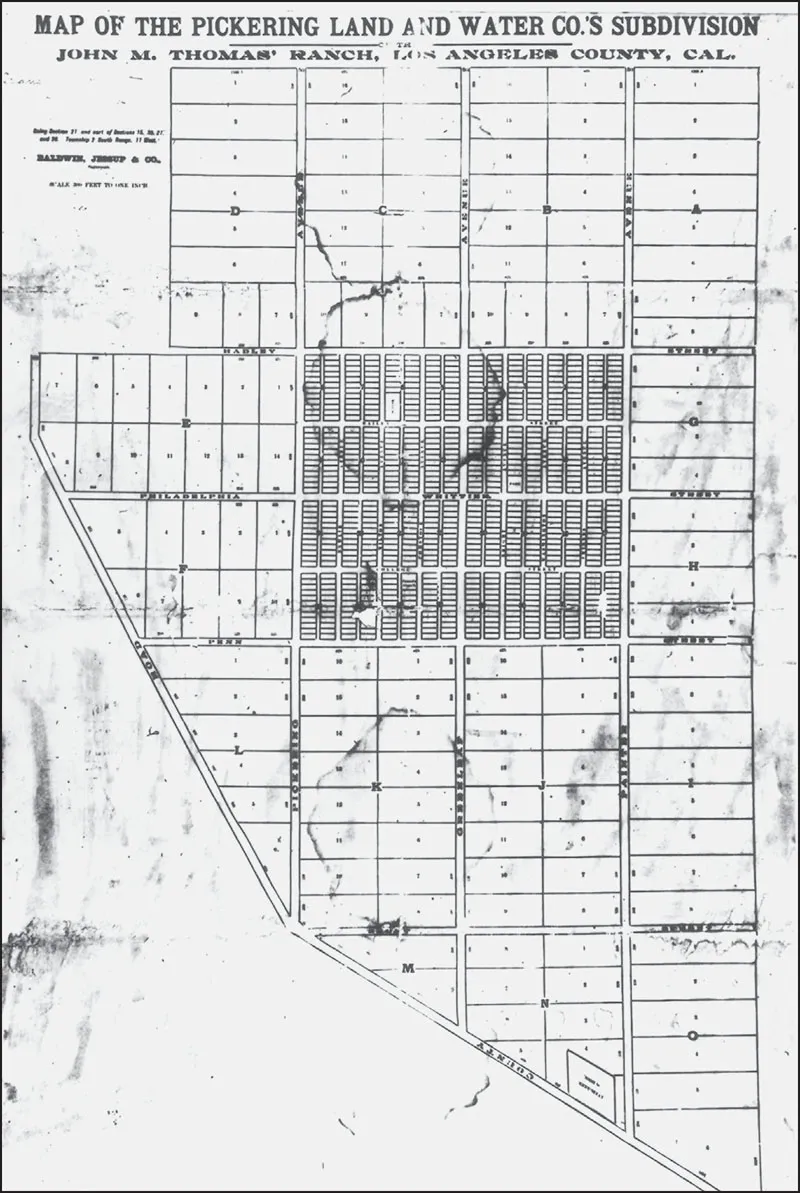
With Lindley’s guidance, the Pickering Land and Water Company contracted with real estate and surveying firm Baldwin & Jessup to subdivide the ranch land, with 160 acres offered as town lots and the rest of the property broken into five- and ten-acre parcels sold at $100 an acre on the condition that buyers agreed to make $1,000 worth of improvements. In this map from mid-May 1887, the principal north-south avenues and east-west streets have already been designated, named after concepts and places dear to Quaker hearts (e.g., Friends, Penn, Philadelphia); the recently-named town-to-be (Greenleaf and Whittier); the board and members of the company (president Jonathan Bailey...
Table of contents
- Cover Page
- Title Page
- Copyright Page
- Dedication
- Table of Contents
- Acknowledgments
- Introduction
- 1. Before the Quakers: The Late 19th Century
- 2. A Quaker Colony: 1887–1898
- 3. From Sleepy Town to Bustling City: 1898–1918
- 4. Interlude: Whittier College
- 5. Interwar Urbanization and Growth: 1918–1939
- 6. Interlude: Richard Milhous Nixon
- 7. Midcentury Development and Expansion: 1939–1967
- 8. Redevelopment, Remembrance, Resilience: 1967–1987
Trusted by 375,005 students
Access to over 1.5 million titles for a fair monthly price.
Study more efficiently using our study tools.
Frequently asked questions
Yes, you can cancel anytime from the Subscription tab in your account settings on the Perlego website. Your subscription will stay active until the end of your current billing period. Learn how to cancel your subscription
No, books cannot be downloaded as external files, such as PDFs, for use outside of Perlego. However, you can download books within the Perlego app for offline reading on mobile or tablet. Learn how to download books offline
Perlego offers two plans: Essential and Complete
- Essential is ideal for learners and professionals who enjoy exploring a wide range of subjects. Access the Essential Library with 800,000+ trusted titles and best-sellers across business, personal growth, and the humanities. Includes unlimited reading time and Standard Read Aloud voice.
- Complete: Perfect for advanced learners and researchers needing full, unrestricted access. Unlock 1.5M+ books across hundreds of subjects, including academic and specialized titles. The Complete Plan also includes advanced features like Premium Read Aloud and Research Assistant.
We are an online textbook subscription service, where you can get access to an entire online library for less than the price of a single book per month. With over 1.5 million books across 990+ topics, we’ve got you covered! Learn about our mission
Look out for the read-aloud symbol on your next book to see if you can listen to it. The read-aloud tool reads text aloud for you, highlighting the text as it is being read. You can pause it, speed it up and slow it down. Learn more about Read Aloud
Yes! You can use the Perlego app on both iOS and Android devices to read anytime, anywhere — even offline. Perfect for commutes or when you’re on the go.
Please note we cannot support devices running on iOS 13 and Android 7 or earlier. Learn more about using the app
Please note we cannot support devices running on iOS 13 and Android 7 or earlier. Learn more about using the app
Yes, you can access Whittier by Michael Garabedian,Rebecca Ruud in PDF and/or ePUB format, as well as other popular books in History & North American History. We have over 1.5 million books available in our catalogue for you to explore.