eBook - ePub
Galt
About this book
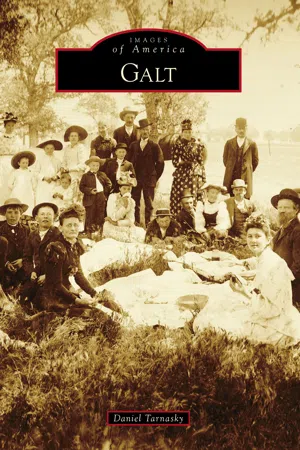
New York native Dr. Obed Harvey came to California to seek his fortune in the Gold Rush. Like so many others, he turned to farming the great Central Valley. With the help of the Central Pacific Railroad, Dr. Harvey established a town around the railroad that ran through his property. His friend John McFarland, a rancher, chose the name Galt after his boyhood home in Canada. Over the years, unique businesses like the Sego Milk Plant and the Galt Winery came and went. The citizens celebrated the Fourth of July with parades and attended the Sacramento County Fair, held in town. Still a farming community with a small-town atmosphere, Galt is noted for Spaans Cookie Co., McFarland Living History Ranch, and the Rae House Museum.
Information
One
BIRTH OF A
FARMING COMMUNITY
FARMING COMMUNITY

Agriculture and the railroad dominated early Galt. The soil was rich, and water was only 15 to 20 feet below the surface. Shipping surplus agricultural products brought prosperity. Wheat, barley, cattle, and hogs were the money makers. When the Ione connection was made by the railroad in 1876, salesmen and traders frequented Galt. In 1869, the Galt Hotel was built, and the Devon Exchange Hotel was moved from Liberty and placed on Front (now Fourth) Street. The first store was opened by Whitaker and Ray on the corner of Front and C Streets in a building owned by John McFarland. The small town of Galt was growing quickly.
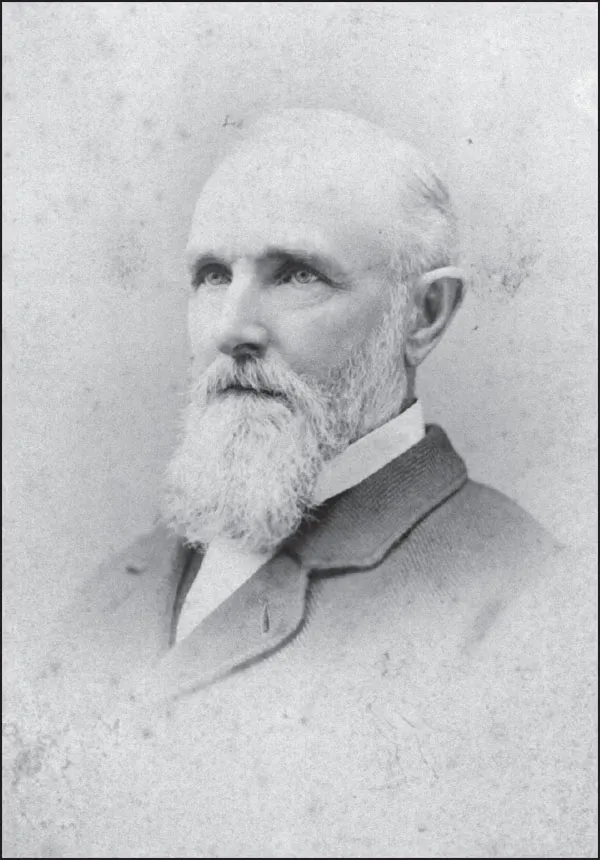
Dr. Obed Harvey attended what is now the University of Iowa Medical School. He came to California during the Gold Rush, but instead of mining, he made his fortune practicing medicine and farming. Harvey became good friends with Charles Crocker, one of the Big Four of the Central Pacific Railroad, and together, they laid out the town of Galt.

The home of Dr. Harvey was located on Second Street between C and E Streets behind his medical office. Slowly turning over his medical practice to others, Dr. Harvey devoted more of his time to his 3,500-acre ranch, his interest in building schools and churches, and to serving in state political office.

Dr. Harvey set up his medical practice in Galt soon after his arrival. He was one of three physicians who resided in Galt at the time, and his office was within yards of his home on Second Street. This photograph is of Harvey’s office during the time it was in use. The office was across from what is now Harvey Park.

The Galt Depot, central to the existence of town, was on the northeast corner of the rail line and C Street. Typical of most depots, its location was close to the Main Street shops, eateries, and other services. The building was Southern Pacific Company design No. 18, a standard blueprint modified for the use the station would receive in that geographic location. The structure was expanded in November 1925.

The station agent’s office was a fairly roomy area with a pot-bellied coal burning stove sitting in the center of the room. A wind-up clock hung on the north wall, and on the northwest wall was an extended bay window with glass on three sides from which the operator could view train movements. Western Union Telegraph Company equipment, including a telegraph key, was located here, as was a crank telephone that was connected to the Stockton dispatcher’s desk.
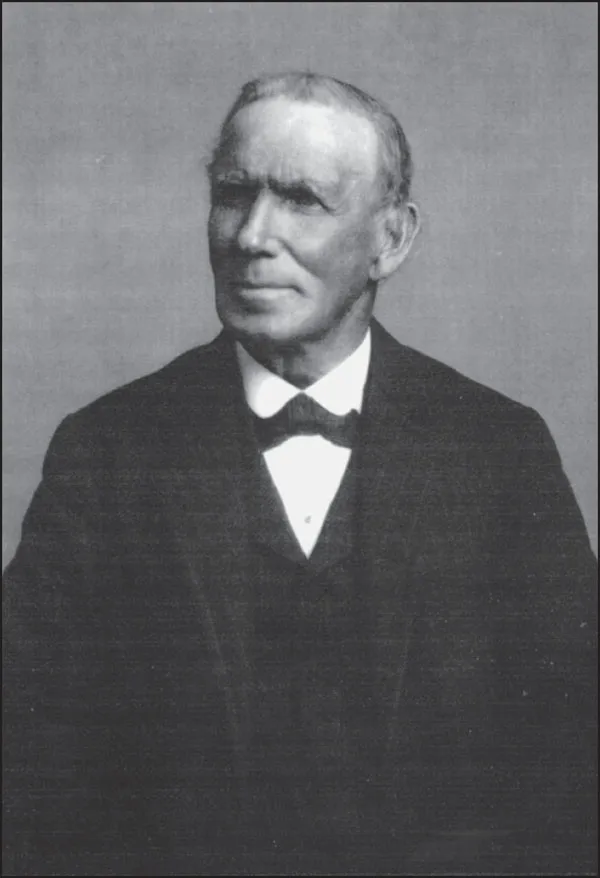
John McFarland was born in Starlingshire, Scotland, and lived briefly in Galt, Ontario, Canada. In 1850, the lure of the Gold Rush brought him to Placerville, California, where he made his fortune in mining and selling water for mining purposes. In 1857, he traveled to the Sacramento Valley and bought 1,600 acres of farmland northwest of what would become Galt, California.

John McFarland built a home on his newly purchased property in 1878. Other buildings on the property included a barn, a tank house, a blacksmith shop, and corrals. McFarland became a prominent member of the Galt community and, because of his carpentry background, helped build or fund the construction of many of its buildings.
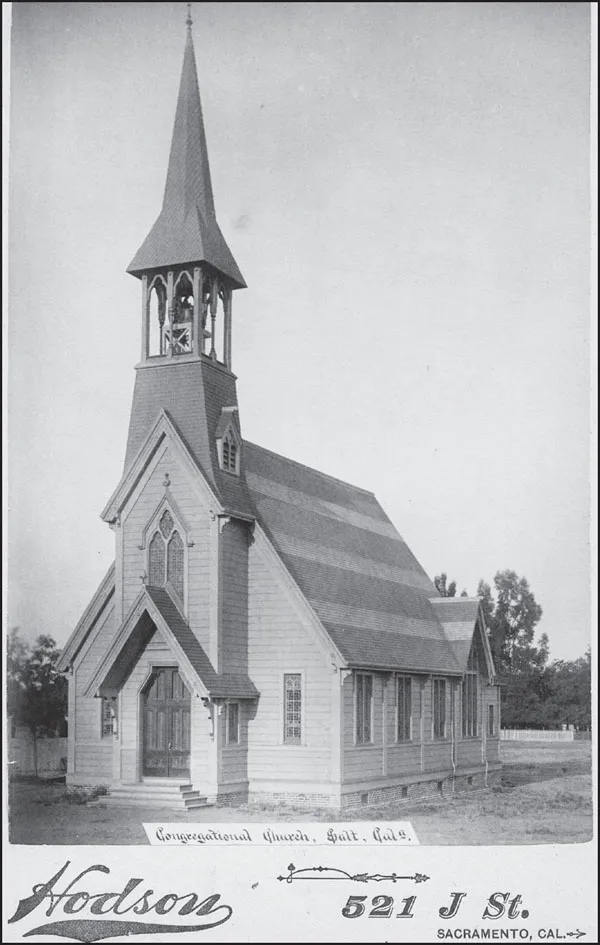
One of the original churches built in Galt was the First Congregational Church (later to become St. Luke’s Episcopal Church) on the corner of Third and B Streets. John McFarland and Dr. Obed Harvey were the men behind the efforts to raise funds to build what would become the third church in town. (Judy Jacobson.)
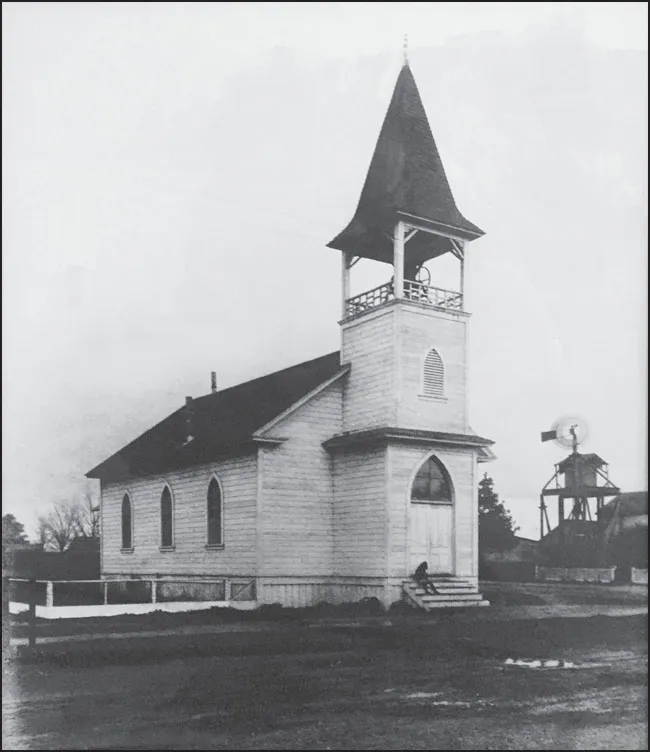
In 1880, when the Hicksville congregation moved to Galt, the United Methodist Church of Galt was founded. It was located close to Seventh and F Streets and was the second church to be placed in the town of Galt as was agreed upon by the railroad and Dr. Harvey. At that time, the church was served by a Methodist circuit rider who came through Galt on his route to bring the word of God and to “marry and bury.”

In 1857, the Christian church was built in the little town of Liberty. It is said to be the first church in the area. When the town of Galt was created, Liberty began moving its buildings (including the church) into the new town. In 1878, the Christian church was placed at a corner of the original grid, now Seventh and B Streets.

As the Christian church grew, its windows leaked, and woodpeckers nested in the bell tower. In 1925, a basement was added as a meeting hall. William Hobday told how difficult it was to remove dirt without damaging the church structure. The original church was constructed of lumber that came around Cape Horn. That lumber is still in use as the main body of the church.
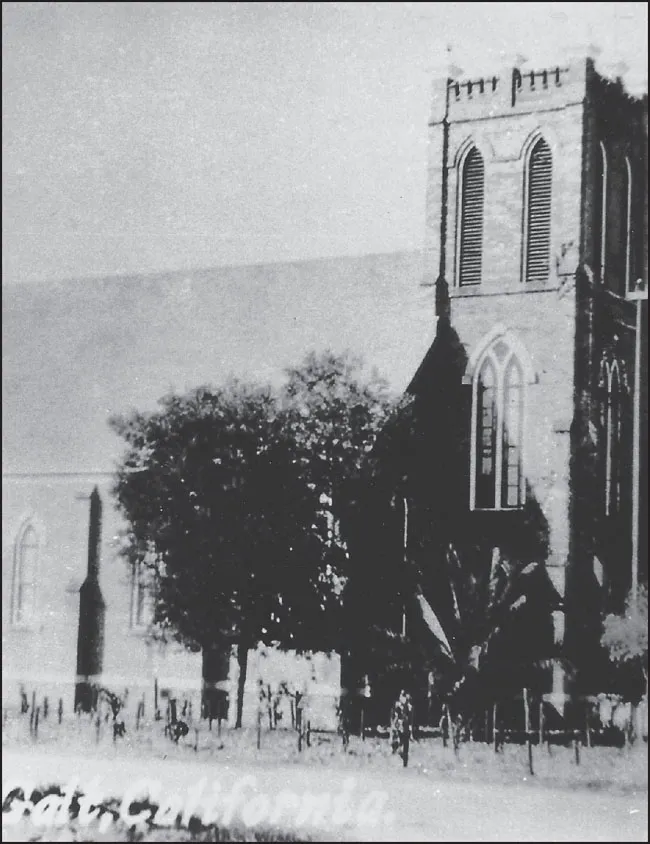
On October 12, 1885, the brick St. Christopher’s Catholic Church was built and dedicated in Galt at the corner of Third and F Streets. St. Christopher’s finished the four promised churches, each on a corner of the original town grid. As it happened, the day of the dedication was also the 393rd anniversary of the discovery of America by Christopher Columbus, so the congregation chose the patron sain...
Table of contents
- Cover Page
- Half-Title
- Title Page
- Copyright Page
- Dedication
- Table of Contents
- Acknowledgments
- Introduction
- 1. Birth of a Farming Community
- 2. Amber Waves of Grain
- 3. Reading, Writing, and Arithmetic
- 4. Cookies and Milk
- 5. Parades, Parties, and Other Pastimes
- 6. “I Remember That Place”
- 7. “Government of the People, by the People, for the People”
- 8. Founding Families and Local Legends
Trusted by 375,005 students
Access to over 1.5 million titles for a fair monthly price.
Study more efficiently using our study tools.
Frequently asked questions
Yes, you can cancel anytime from the Subscription tab in your account settings on the Perlego website. Your subscription will stay active until the end of your current billing period. Learn how to cancel your subscription
No, books cannot be downloaded as external files, such as PDFs, for use outside of Perlego. However, you can download books within the Perlego app for offline reading on mobile or tablet. Learn how to download books offline
Perlego offers two plans: Essential and Complete
- Essential is ideal for learners and professionals who enjoy exploring a wide range of subjects. Access the Essential Library with 800,000+ trusted titles and best-sellers across business, personal growth, and the humanities. Includes unlimited reading time and Standard Read Aloud voice.
- Complete: Perfect for advanced learners and researchers needing full, unrestricted access. Unlock 1.5M+ books across hundreds of subjects, including academic and specialized titles. The Complete Plan also includes advanced features like Premium Read Aloud and Research Assistant.
We are an online textbook subscription service, where you can get access to an entire online library for less than the price of a single book per month. With over 1.5 million books across 990+ topics, we’ve got you covered! Learn about our mission
Look out for the read-aloud symbol on your next book to see if you can listen to it. The read-aloud tool reads text aloud for you, highlighting the text as it is being read. You can pause it, speed it up and slow it down. Learn more about Read Aloud
Yes! You can use the Perlego app on both iOS and Android devices to read anytime, anywhere — even offline. Perfect for commutes or when you’re on the go.
Please note we cannot support devices running on iOS 13 and Android 7 or earlier. Learn more about using the app
Please note we cannot support devices running on iOS 13 and Android 7 or earlier. Learn more about using the app
Yes, you can access Galt by Daniel Tarnasky in PDF and/or ePUB format, as well as other popular books in History & North American History. We have over 1.5 million books available in our catalogue for you to explore.