- 128 pages
- English
- ePUB (mobile friendly)
- Available on iOS & Android
eBook - ePub
Three Mile Island
About this book
Construction of the Unit 1 reactor began on Three Mile Island in May 1968, with the production of commercial electricity beginning in 1974. Approval for the construction of the Unit 2 reactor was granted in November 1969, and it was only producing commercial electricity for less than 90 days when on March 28, 1979, a loud roar erupted from the nuclear power plant that shook windows and awakened residents in the communities on both sides of the Susquehanna River. This loud warning was the result of a series of mechanical and human errors that contributed towards a partial meltdown of the Unit 2 reactor and the most severe nuclear power accident in the history of the United States. In the days that followed, many residents of the surrounding communities left their homes and possessions out of fear of radioactive plumes, meltdowns, and exploding hydrogen bubbles. Those who remained behind faced anxiety and uncertainty, as information flowing from the power plant circumvented the truth and lacked credibility. As the Unit 2 reactor cooled, protests and court battles ensued as attempts were made to restart the power plant's dormant Unit 1 reactor. The Three Mile Island Nuclear Generating Station symbolized the fight over nuclear power as a safe and viable energy source in the late 20th century.
Information
One
IN THE BEGINNING
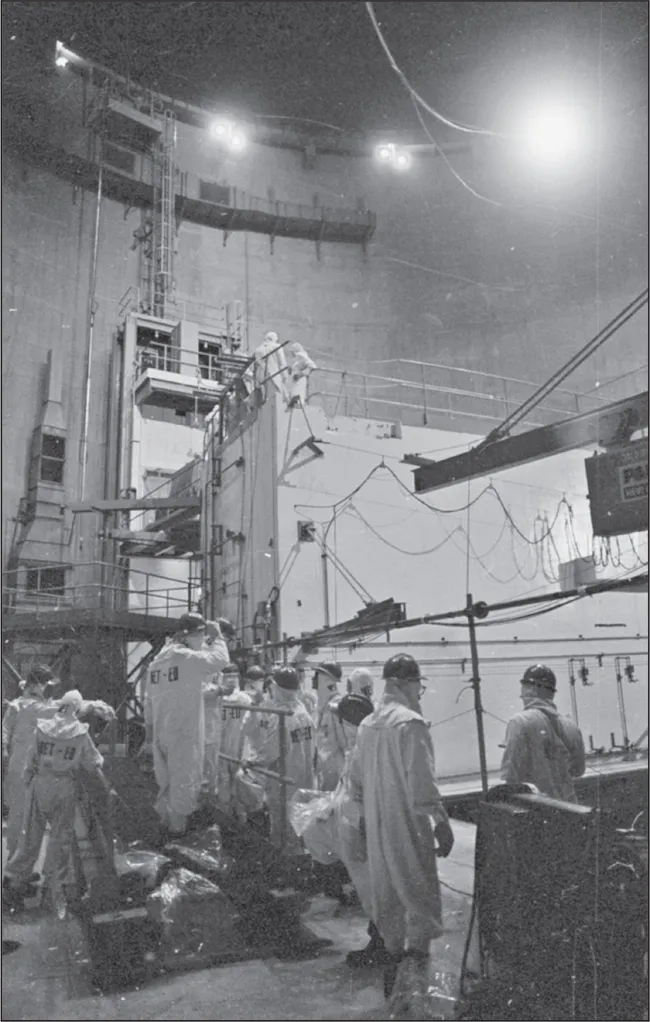
On November 14, 1974, Walter Creitz, president of Metropolitan Edison, was giving a tour of the Three Mile Island Nuclear Power plant to a group of journalists. Creitz made a bold prediction to the visiting group, exclaiming that “nuclear power will revolutionize the world.” Nuclear power would revolutionize the world, and Three Mile Island would be ground zero for that revolution.

In this aerial view of the Susquehanna River, Three Mile Island is visible in its entirety with the nuclear power plant at its northern end. The large island to the west is Shelley’s Island, which is largely farmland except for the summer cottages that line its outer edges. The northern access to Three Mile Island is reached by a bridge spanning to Londonderry Township, located in the southernmost portion of Dauphin County. This western edge of the township is dominated by farmland with a small sprinkling of houses along Route 441. This route travels south along the river, past the southern access bridge to Three Mile Island, and toward the small community of Falmouth (upper left), just over the Lancaster County line. A portion of Goldsboro (upper right) is visible on the western shore of the Susquehanna River.

Three Mile Island, along with Shelley, Hill, and several smaller islands that surround the three larger islands, are all within the boundaries of Londonderry Township in Dauphin County. Three Mile Island, named for its approximate distance to Middletown Borough, was utilized as farmland and produced choice tobacco crops for Col. James Duffy during the late 19th century. As a result, the island was called “Duffy’s Island” for many years and even held on to the moniker after the colonel’s death in 1888. Prior to this, the island was labeled Conewago Island in the 1875 atlas of Dauphin County; it was named for the creek that empties into the Susquehanna River near the island’s southern end.


In 1905, the York Haven Water and Power Company purchased the island, after it had passed from the estate of Col. James Duffy, with the intent of building a dam from the island to the eastern shore. In 1926, the Metropolitan Edison Company absorbed the York Haven Water and Power Company and acquired Three Mile Island in the process. However, the power companies were not interested in the island itself but rather its location within the Susquehanna River and the possibilities it held in relation to their power plants. As a result, the island was leased to farmers who made their residences on the island and even constructed a one-room schoolhouse.
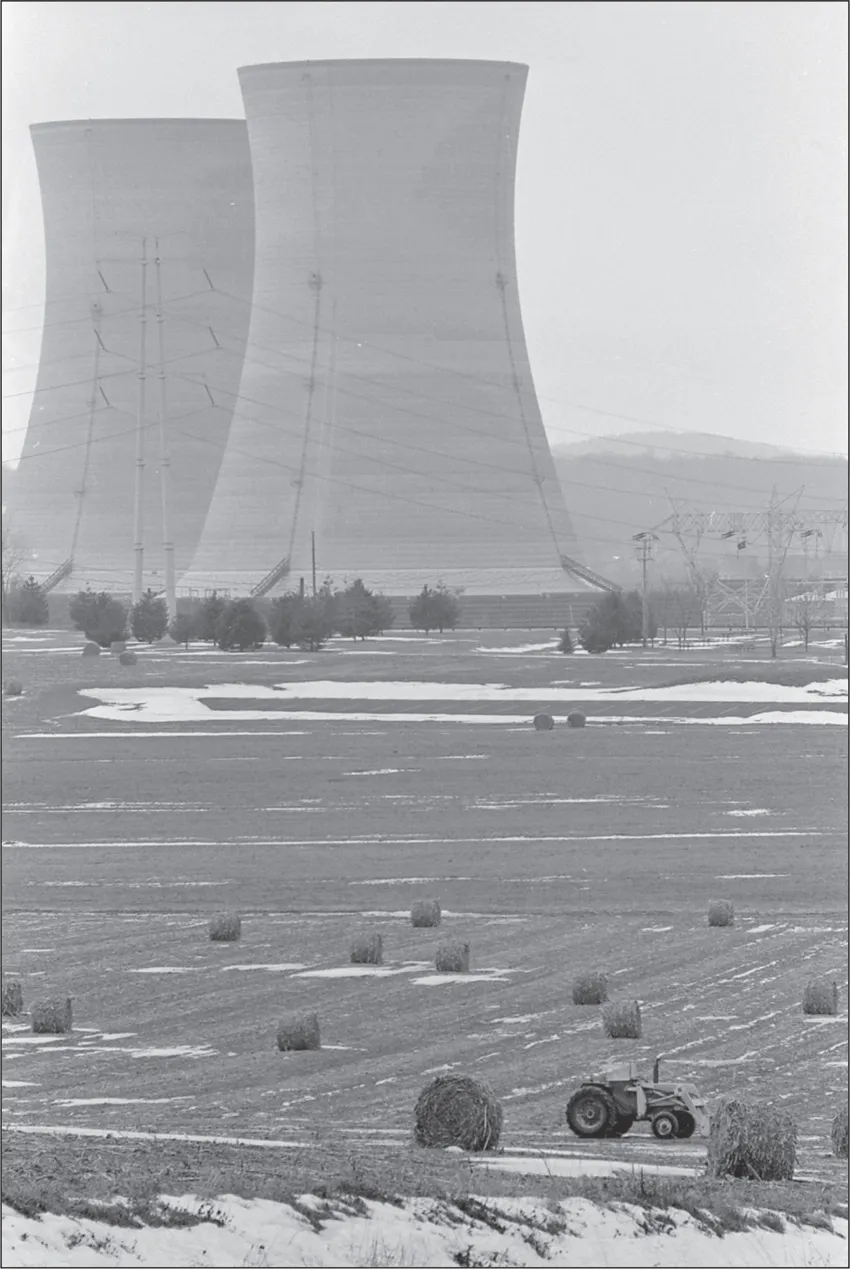
Londonderry Township dates to 1767, when it was split from Derry Township, which was then part of Lancaster County. The township was incorporated into Dauphin County when it was established in 1785. The southernmost township in Dauphin County, Londonderry Township has existed largely as a rural collection of small farms for the last 200 years. Many of the farmers are of Pennsylvania German descent, raising dairy cattle and rotated crops such as corn and soybeans. The small villages of Rocktown and Gainesburg could once be found in the township along the East Harrisburg Pike, but they have since faded away. The Pennsylvania Canal also ran through the township along the bank of the Susquehanna River. The population of the township has steadily remained at around 5,000 inhabitants since the nuclear accident in 1979.

Dairy farmer Ronald Kopp stands in his fields near Colebrook Road in Londonderry Township in this image taken in March 1989. Kopp is a second-generation dairy farmer on a small family farm that was purchased by his father in 1946. The Kopp farm is typical of the non-commercialized farms that could be found in Londonderry Township during the last half of the 20th century.
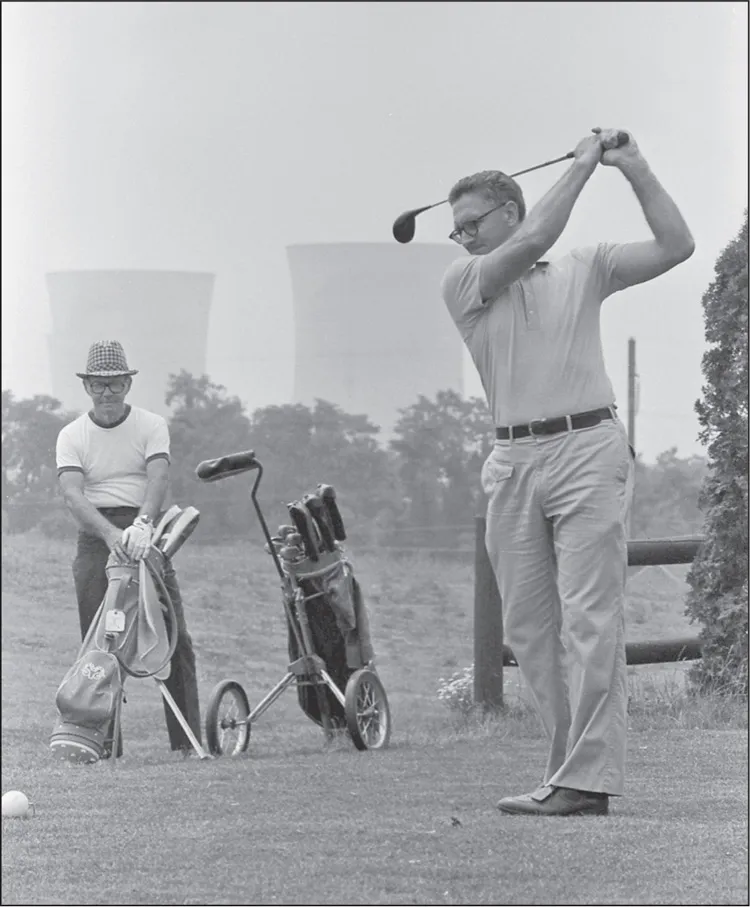
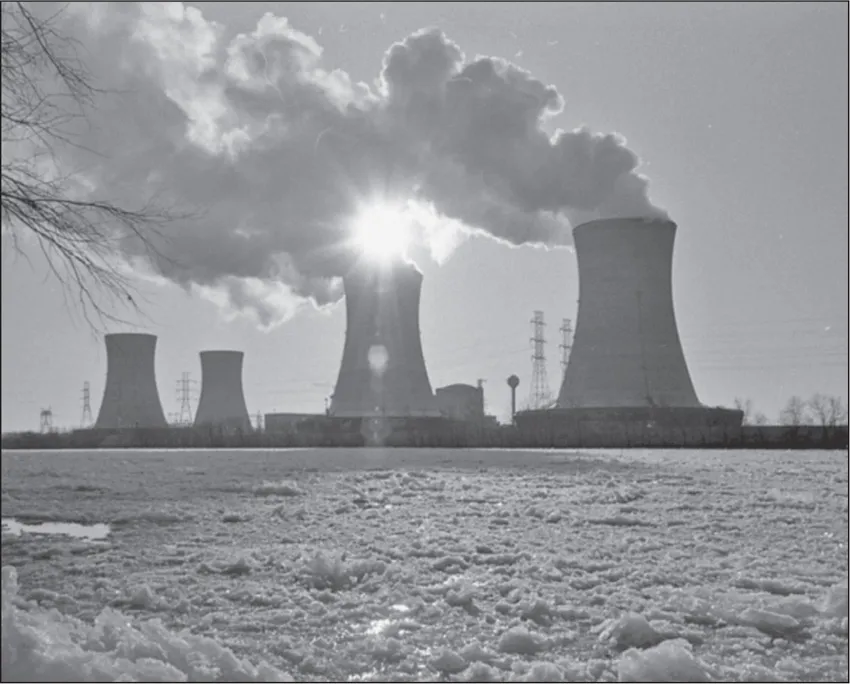
It is tee time at the Sunset Golf Course in Londonderry Township, with the cooling towers of the Three Mile Island nuclear power plant visible in the background. The golf course, in part, dates to the 1930s as a nine-hole course laid out for the officers of the Middletown Air Depot. The grounds were acquired in 1968 by Londonderry Township for use as a public golf course with adjacent recreational facilities.

Goldsboro, which was a community of 600 residents during the 1970s, is situated along the western shore of the Susquehanna River opposite Three Mile Island, whose cooling towers seemingly loom over the tiny borough and visually dominate the landscape. Founded in 1850 by Major Goldsboro, an engineer who worked on the Pennsylvania Railroad, the relatively isolated community became a destination for those seeking leisurely activities on the Susquehanna River and its many islands. Prior to the nuclear accident, Goldsboro’s only other entries into the national spotlight came from a 47-round prizefight in 1867 between pugilists Sam Collyer of Baltimore and John McGlade of New York City and as the hometown of former major-league baseball player Greg Gross.


Above, Geary Huntsberger, a farmer from nearby Etters, pilots his barge away from the dock in Goldsboro and heads upstream to nearby Hill Island, which is situated in the Susquehanna River one mile northeast of Three Mile Island. Huntsberger, shown below in the freshly plowed fields on Hill Island, leased 170 acres of land on Three Mile Island, where he grew corn and wheat, from Metropolitan Edison during the 1960s. In 1967, when Three Mile Island was selected as the site for a nuclear power plant, Metropolitan Edison discontinued his lease for the farmland but contracted him out for the removal of cabins and trailers of individuals who leased space on the island for their summer “cottages.” Huntsberger ferried the cabins and trailers on his barge to nearby Shelley Island, also owned by Metropolitan Edison.


Construction of the Unit 1 nuclear power plant on Three Mile Island began in May 1968 with an estimated price tag of $100 million, with hopes that it would be completed by March 1971. However, it would not be until September 1974 that commercial electricity was produced at the plant at a completed cost of over $400 million. The permit granting approval for construction of the Unit 2 nuclear power plant was issued in November 1969, but the Unit 2 nuclear power plant did not begin producing co...
Table of contents
- Cover Page
- Title Page
- Copyright
- Dedication
- Contents
- Acknowledgments
- Introduction
- 1. In the Beginning
- 2. The Accident
- 3. Fallout
Trusted by 375,005 students
Access to over 1.5 million titles for a fair monthly price.
Study more efficiently using our study tools.
Frequently asked questions
Yes, you can cancel anytime from the Subscription tab in your account settings on the Perlego website. Your subscription will stay active until the end of your current billing period. Learn how to cancel your subscription
No, books cannot be downloaded as external files, such as PDFs, for use outside of Perlego. However, you can download books within the Perlego app for offline reading on mobile or tablet. Learn how to download books offline
We are an online textbook subscription service, where you can get access to an entire online library for less than the price of a single book per month. With over 1.5 million books across 990+ topics, we’ve got you covered! Learn about our mission
Look out for the read-aloud symbol on your next book to see if you can listen to it. The read-aloud tool reads text aloud for you, highlighting the text as it is being read. You can pause it, speed it up and slow it down. Learn more about Read Aloud
Yes! You can use the Perlego app on both iOS and Android devices to read anytime, anywhere — even offline. Perfect for commutes or when you’re on the go.
Please note we cannot support devices running on iOS 13 and Android 7 or earlier. Learn more about using the app
Please note we cannot support devices running on iOS 13 and Android 7 or earlier. Learn more about using the app
Yes, you can access Three Mile Island by Erik V. Fasick in PDF and/or ePUB format, as well as other popular books in History & North American History. We have over 1.5 million books available in our catalogue for you to explore.