- 128 pages
- English
- ePUB (mobile friendly)
- Available on iOS & Android
eBook - ePub
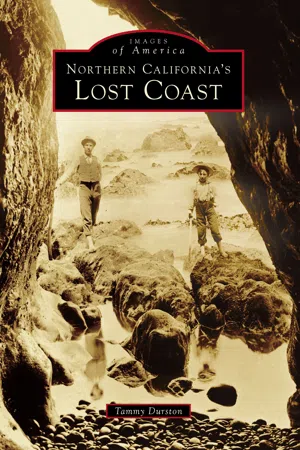
Northern California's Lost Coast
About this book
The Lost Coast is one of the last undeveloped stretches of the California coastline, with mountains that rise thousands of feet from the sea. Located approximately 200 miles north of San Francisco, this remote area of pristine beauty is comprised of jagged cliffs, rocky shorelines, and black sand beaches. It is the only significant stretch of California without a highway. Rich in natural resources, the area was once a haven for Native Americans such as the Coast Yuki, Sinkyone, Mattole, and the Wiyot. Now it is a secluded landscape with a few isolated towns surrounded by conservation areas. The famed Lost Coast Trail begins in northern Mendocino County in the Sinkyone Wilderness and continues up into Humboldt County and the King Range National Conservation Area. During the 1800s, the Lost Coast bustled with logging settlements and mill towns. After logging wound down, those towns disappeared, and only remnants of their existence remain. From Westport north to Ferndale, this book showcases historical photographs from libraries, historical societies, and residents.
One
HISTORY AND
EARLY INHABITANTS
EARLY INHABITANTS

The Lost Coast is truly the last remaining stretch of undeveloped land in California. Native Americans lived in the inland valleys and sometimes along the coastline. Those who lived inland traveled to the coast for seasonal food. Now, the area is primarily known for the Lost Coast Trail, which follows the coastline from the mouth of the Mattole River to Usal. Charles Nordhoff, in his article Northern California 100 Years Ago, published in Harper’s, writes this about the Northern California coastline: “You will see, in Mendocino County, one of the most remarkable coasts in the world, eaten by the ocean into the most singular and fantastic shapes . . . you descend from what appears to you an indeterminable mass of mountains suddenly into a plain, and pass from deep forests shading the mountain-road at once into a prairie valley, which nature made ready to the farmer’s hands, taking care even to beautify it for him.” This photograph showcases the terrain that characterizes the Lost Coast. (Author’s collection.)

Many Native Americans lived in the Lost Coast area for thousands of years before European explorers and white settlers arrived. Plentiful acorns and abundant salmon created an environment where they could thrive. Native Americans divided themselves by language. The common term “tribes” was invented by Europeans and not used by the Native Americans themselves. The Athabascan-speaking groups occupied almost the entire southern and eastern parts of what is now Humboldt County. According to Two Peoples, One Place by Ray Raphael and Freeman House, there were more than 20 different groups in this region, with several variations between them. For example, in the north, the Athabascan culture was similar to that of the Pacific Northwest Indians with their dependence on salmon. In the south, Native Americans were more aligned with the central California cultures and their use of acorns. Along the Lost Coast, the groups from north to south included the Wiyots, the Bear River Mattoles, the Mattoles, the Sinkyones, and the Coast Yukis. This map shows groups by language. (Mattole Valley Historical Society [MVHS].)

The Lost Coast is comprised of mountains, meadows, and the sea. The mountains rise in elevation very quickly from sea level, which creates very steep, jagged cliffs. Tucked between the two are meadows and small valleys. Native Americans managed the land in various methods, such as cultivation, pruning, selected harvesting, as well as planting. The above photograph shows the prairie and mountains in the Cooskie Range. The photograph below is of the coastline near Cape Mendocino. (Above, MVHS; below, Humboldt State University.)


Salmon was one of the staples of Native American diets. The seasonal salmon run often involved ceremonies called the first-run salmon rites (Sinkyones.) During the salmon run, the entire village would camp along the river. This photograph was taken in 1923 by photographer Edward Curtis. (Library of Congress.)

Fishing weirs were used by the Bear Rivers and the Mattoles. Although this photograph is of a fishing weir on the Trinity River, the design is similar to what was used. A very important component of the weir was the cordage. Fibers of the wild iris were considered to be the strongest. Some weirs were fixed and some were handheld. The Mattoles used fixed weirs to catch salmon. (Library of Congress.)

Shellfish were plentiful along the coast of Mendocino and Humboldt Counties. This is a photograph from 1894 of two Wiyot women preparing for clam digging. Razor clams are plentiful on the North Coast. (Library of Congress.)

Acorns were tremendously important for many Native Americans. A large oak could yield 500 to 1,000 pounds of acorns per season. Tan oak acorns were the preferred type, but the Indians used what was available. The basic steps in preparing acorns are drying, grinding, leaching, and cooking. This photograph from 1924 shows a Pomo woman cooking acorns. (Library of Congress.)

Baskets were an essential item for daily duties, ranging from gathering seeds to food storage to carrying children. Many other plants contributed to the Native American diet, from huckleberries to manzanita and madrone fruits. Various grassland seeds were ground into pinole. Plants were also widely used for medicine. The Sinkyones used Sitka spruce and coast redwood fibers for baskets. (Both, Library of Congress.)


Housing varied by Native American group. The Mattoles, Bear Rivers, and Sinkyones had wedge-shaped structures, almost like lean-tos. In the northern area, planks were used after being split with elk horn wedges. Temporary houses were also excavated and constructed out of brush in a circular fashion with a center beam and used during the hunting season. They were abandoned after the season ended. These homes are similar to central California Indian dwellings. Sweathouses were also constructed. The above photograph shows a typical home; the photograph below shows a later version using planks, as well as white and European influence. (Above, Humboldt State University; below, MVHS.)


Many Native American villagers lived by the Eel River and traveled on it by canoe. The redwood canoe was very important. Not only did it offer transportation, but it also allowed access to waterways such as the Eel River, picture...
Table of contents
- Cover Page
- Title Page
- Copyright Page
- Dedication
- Table of Contents
- Acknowledgments
- Introduction
- 1. History and Early Inhabitants
- 2. Northern Lost Coast
- 3. Southern Lost Coast
Trusted by 375,005 students
Access to over 1.5 million titles for a fair monthly price.
Study more efficiently using our study tools.
Information
Publisher
Arcadia PublishingYear
2017Topic
HistoryPrint ISBN
9781467125444
Subtopic
North American HistoryeBook ISBN
9781439659878
Index
HistoryFrequently asked questions
Yes, you can cancel anytime from the Subscription tab in your account settings on the Perlego website. Your subscription will stay active until the end of your current billing period. Learn how to cancel your subscription
No, books cannot be downloaded as external files, such as PDFs, for use outside of Perlego. However, you can download books within the Perlego app for offline reading on mobile or tablet. Learn how to download books offline
Perlego offers two plans: Essential and Complete
- Essential is ideal for learners and professionals who enjoy exploring a wide range of subjects. Access the Essential Library with 800,000+ trusted titles and best-sellers across business, personal growth, and the humanities. Includes unlimited reading time and Standard Read Aloud voice.
- Complete: Perfect for advanced learners and researchers needing full, unrestricted access. Unlock 1.5M+ books across hundreds of subjects, including academic and specialized titles. The Complete Plan also includes advanced features like Premium Read Aloud and Research Assistant.
We are an online textbook subscription service, where you can get access to an entire online library for less than the price of a single book per month. With over 1.5 million books across 990+ topics, we’ve got you covered! Learn about our mission
Look out for the read-aloud symbol on your next book to see if you can listen to it. The read-aloud tool reads text aloud for you, highlighting the text as it is being read. You can pause it, speed it up and slow it down. Learn more about Read Aloud
Yes! You can use the Perlego app on both iOS and Android devices to read anytime, anywhere — even offline. Perfect for commutes or when you’re on the go.
Please note we cannot support devices running on iOS 13 and Android 7 or earlier. Learn more about using the app
Please note we cannot support devices running on iOS 13 and Android 7 or earlier. Learn more about using the app
Yes, you can access Northern California's Lost Coast by Tammy Durston in PDF and/or ePUB format, as well as other popular books in History & North American History. We have over 1.5 million books available in our catalogue for you to explore.