- 128 pages
- English
- ePUB (mobile friendly)
- Available on iOS & Android
eBook - ePub
About this book
Ames began as two communities. At its founding in 1864, Ames Station, on the Chicago & North Western Railway?s main line, lay two miles east of Iowa Agricultural College, across the Squaw Creek. When the Ames & College Railway joined the college to the town in 1891, a cooperative spirit emerged that exists to this day. A rich history of achievements and colorful characters marks Ames?s 150 years. One founding father commanded the 20th US Colored Infantry in the Civil War, while a Confederate veteran served as commander of the Iowa State College corps of cadets. Physicists at Iowa State College developed the uranium refinement process for the first atomic bomb and established the Ames Laboratory, the smallest US Department of Energy National Laboratory. Companies like Collegiate Manufacturing made material for the soldiers in World War II, and Kingland Systems now stands among global leaders in reference data software. Ames?s businesses, citizens, and institutions, past and present, have created a rich community heritage for a vibrant, 21st-century city.
Information
Topic
HistoireSubtopic
Histoire de l'Amérique du NordOne
SOLID FOUNDATIONS,
1864–1893
1864–1893
When Story County, Iowa, was first settled in the 1850s, no one gave any thought to placing a town in the swampy bottomland near the confluence of the Skunk River and Squaw Creek. Most of the county’s population lay east of the Skunk, a major barrier to travel westward. The establishment of the state’s agricultural college and model farm in 1858 on the isolated prairie west of the Squaw gave even the institution’s founders pause to consider whether they had chosen the right location. They need not have worried. John Insley Blair brought his Chicago & North Western Railroad through the central part of the state in 1864, opening the way for more settlement in the area. All of this development came at a price, though. Local farmers, realizing the great wealth of the railroad, would sell land to Blair only at inflated prices. To avoid these exorbitant charges, Blair chose to purchase bottomland in Washington Township that was considered unworthy for any other purpose and build his station there. That station stop, built on land purchased from Cynthia Duff and named Ames Station after Blair’s friend US congressman Oakes Ames, became the town of Ames. Settlers in the township soon saw a thriving town spring up around Blair’s railway station stop. For the first 27 years of Ames’s existence (1864–1891), the town and the college two miles to its west across the Squaw Creek developed as independent communities. The two were intimately aware of each other but remained essentially independent until local visionaries found the means—political, social, and physical—to bind them together. Then, in 1891, the Ames & College Railway united the two communities. These early years set a solid foundation for building the strong community that became the city of Ames.

The model farm began operations in 1858. One of the earliest images of farm activities from about 1875 shows students working with horses. The Civil War delayed construction of a main college building until 1864. Poor workmanship led to the demolition of that original building before it was occupied. (Special Collections, ISU Library.)

Shown here in 1885, the College Building (later known as “the Main”), housing classrooms, dormitories, and offices, finally opened in 1868. The first class of students arrived for a preparatory term that autumn, and classes began on campus in January 1869. Splendid as the Main appeared, however, it had inadequate indoor sanitation and soon became cramped quarters for the growing college. (Special Collections, ISU Library.)

When the first 173 students arrived at the Iowa State Agricultural College, the nation’s first coeducational land grant college, they found a campus under the leadership of Adonijah S. Welch, the college’s first president, who served from 1869 to 1883. Welch had experience at the helm of new colleges, having been the first principal of Michigan State Normal School (Eastern Michigan University) from 1851 to 1865. In his role as president at Iowa State, Welch was instrumental in developing the agriculture and mechanical arts curriculum, and he supported the right of women to receive college degrees at the school alongside men. He is also credited with planting the first trees on campus, beautifully defining the school’s grounds within the surrounding prairie. Although Welch resigned the college presidency in 1883 because of pressure from colleagues who did not share his vision for the institution’s advancement, he continued to teach at the school as the chair of History of Civilization and Practical Psychology until his death in 1889. (Special Collections, ISU Library.)

Shortly after Iowa State Agricultural College was established in Washington Township, pioneer settlers Lucian and Abigail Hoggatt donated an acre of land for a school, later named Hoggatt School. Built between 1861 and 1862 north of Boone Street, near the intersection with Maple Avenue, the one-room school predated the railroad’s arrival in Ames. The building was later incorporated into a home and restored in 1981, as shown in this photograph. (FTBPA.)
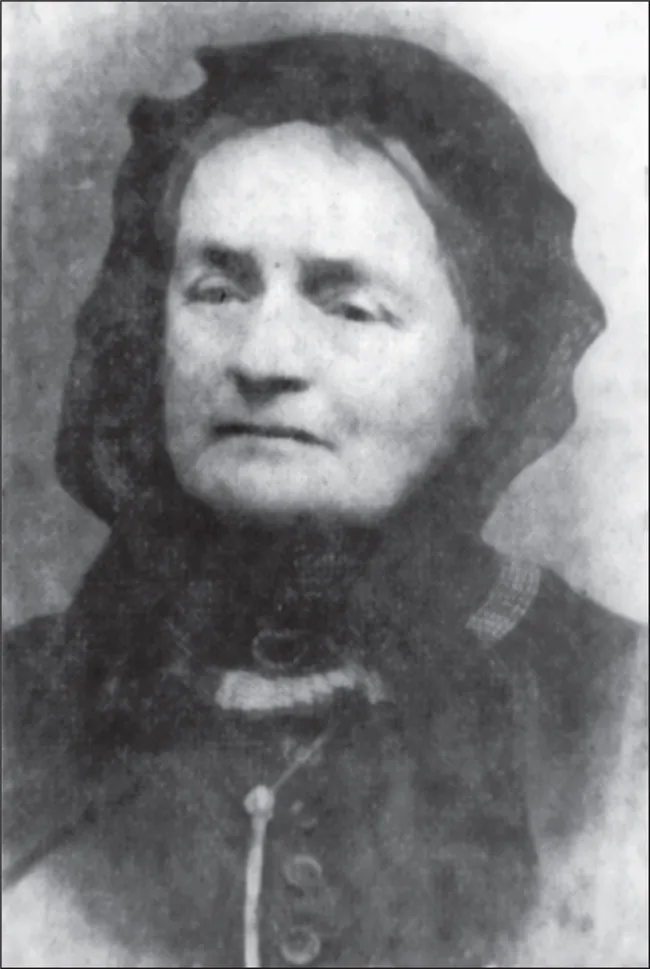
Cynthia Olive Kellogg Duff, shown here around 1870, and her husband, Alexander, purchased land in Washington Township in 1863. One portion of that land was sold to John Insley Blair in 1864 for the construction of the Chicago & North Western Railroad’s Ames Station. A second portion was platted as the town of Ames in December 1864. City assessor’s records now identify those parcels as the “Original Town.” (FTBPA.)

John Insley Blair’s Chicago & North Western Railroad constructed the first building in Ames— the railway depot—in 1864 on land purchased from Cynthia and Alexander Duff. In this 1867 photograph of the depot, an array of railroad workers line the south side of the tracks at the east end of what became the business district (now called “Downtown”). (FTBPA.)
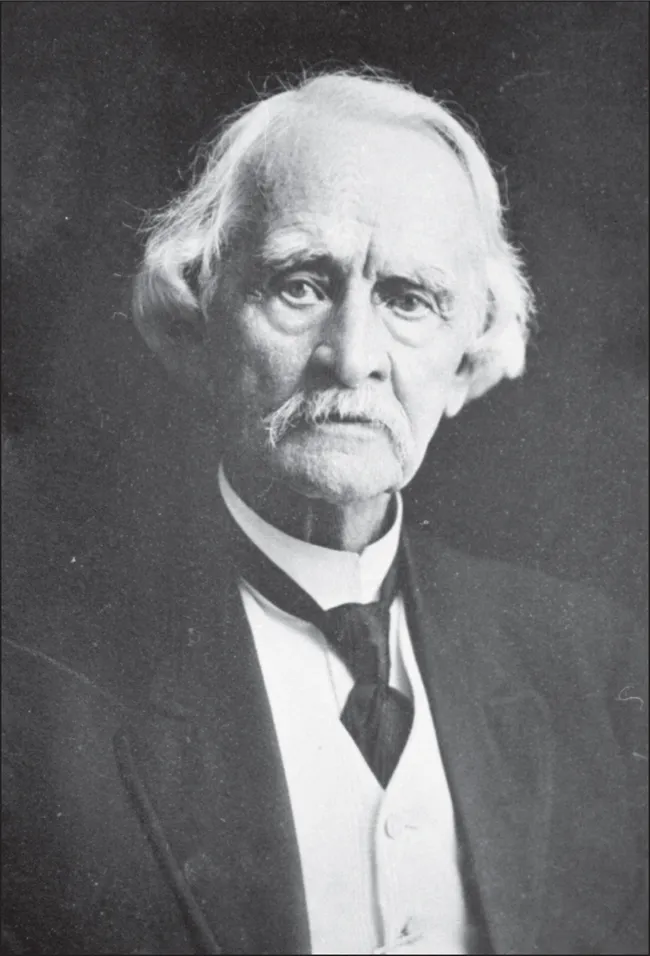
By 1870, Ames had elected its first mayor, William West (1822–1920), the proprietor of the West Hotel on Douglass (now Douglas) Avenue. Mayor West, a former Ohio legislator, served only three months of his one-year term before passing the office to interim mayor W.D. Lucas (1838–1892), a local banker, in 1871. Lucas served a second mayoral term from 1874 to 1875. (FTBPA.)

This 1875 “Bird’s Eye View of Ames, Story Co., Iowa” shows the depot (No. 4) just south of the M&W Evans Elevator (No. 3). Other key buildings include the following businesses and public institutions: Steam Saw Mill (No. 1), Steam Flour Mill (No. 2), New York House (No. 5), West Hotel (No. 6); Methodist Episcopal church (No. 7), Baptist church (No. 8), Congregational church (No. 9), North Public School (No. 10), South Public School (No. 11), and Iowa State Agricultural College (No. 12). The depiction shows an idyllic town with tree-lined neighborhoods and smooth streets thronged with wagons. What settlers actually contended with was a marshy area of interconnected sloughs that left little room between the Skunk River and the Squaw Creek to build tidy homes on smooth, dry streets and more often mired wagons up to their hubs in mud. (FTBPA.)

A typical Ames residence of 1866 was more farmhouse than city dwelling. This house built by Vanderlyn “Van” Chamberlain, who came to Ames in 1865 and later became manager of Queal, Hostler & Boards lumberyard, is reputedly similar to the first house in Ames built by Noah Webster in 1864 at the corner of Douglass (now Douglas) Avenue and Story (now Fifth) Street. (FTBPA.)

Prosperous residents, like successful merchant Daniel Bigelow (left), could afford homes that suited their status. Bigelow arrived in Ames in 1866 and opened a dry goods store with partner Henry Huntington in 1867. In the late 1860s, around the time George Galen Tilden joined the firm to create the longtime partnership of Bigelow, Huntington & Tilden, Bigelow built the house on Duff Avenue pictured in this 1870s photograph. (FTBPA.)

Aware of national trends even in 1875, Ames celebrated Memorial Day with a parade of veterans only two years after the holiday was first officially recognized in New York in 1873. More than 130 Civil War veterans lie buried in the Ames Municipal Cemetery, among them many prominent Ames residents, such as Daniel Bigelow, Kendrick Brown, George G. and Frederick Tilden, Iraneou...
Table of contents
- Cover Page
- Title Page
- Copyright Page
- Dedication
- Table of Contents
- Acknowledgments
- Introduction
- 1. Solid Foundations, 1864–1893
- 2. Business and Boosterism
- 3. Roads, Railways, and Forward Progress
- 4. People and Institutions
- 5. Daily Life and Leisure Pastimes
- 6. The City, the State, and the Nation
- 7. Local Events of Note
- 8. One Community, 1964–2014
Trusted by 375,005 students
Access to over 1.5 million titles for a fair monthly price.
Study more efficiently using our study tools.
Frequently asked questions
Yes, you can cancel anytime from the Subscription tab in your account settings on the Perlego website. Your subscription will stay active until the end of your current billing period. Learn how to cancel your subscription
No, books cannot be downloaded as external files, such as PDFs, for use outside of Perlego. However, you can download books within the Perlego app for offline reading on mobile or tablet. Learn how to download books offline
Perlego offers two plans: Essential and Complete
- Essential is ideal for learners and professionals who enjoy exploring a wide range of subjects. Access the Essential Library with 800,000+ trusted titles and best-sellers across business, personal growth, and the humanities. Includes unlimited reading time and Standard Read Aloud voice.
- Complete: Perfect for advanced learners and researchers needing full, unrestricted access. Unlock 1.5M+ books across hundreds of subjects, including academic and specialized titles. The Complete Plan also includes advanced features like Premium Read Aloud and Research Assistant.
We are an online textbook subscription service, where you can get access to an entire online library for less than the price of a single book per month. With over 1.5 million books across 990+ topics, we’ve got you covered! Learn about our mission
Look out for the read-aloud symbol on your next book to see if you can listen to it. The read-aloud tool reads text aloud for you, highlighting the text as it is being read. You can pause it, speed it up and slow it down. Learn more about Read Aloud
Yes! You can use the Perlego app on both iOS and Android devices to read anytime, anywhere — even offline. Perfect for commutes or when you’re on the go.
Please note we cannot support devices running on iOS 13 and Android 7 or earlier. Learn more about using the app
Please note we cannot support devices running on iOS 13 and Android 7 or earlier. Learn more about using the app
Yes, you can access Ames by Douglas L. Biggs,Gloria J. Betcher in PDF and/or ePUB format, as well as other popular books in Histoire & Histoire de l'Amérique du Nord. We have over 1.5 million books available in our catalogue for you to explore.