- 128 pages
- English
- ePUB (mobile friendly)
- Available on iOS & Android
eBook - ePub
About this book
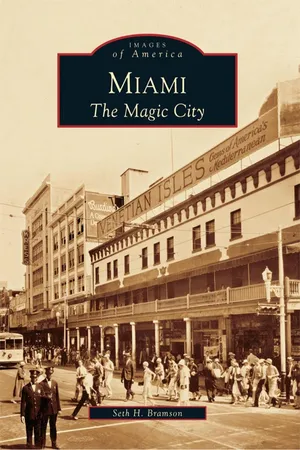
Whether you call it the Gateway to the Americas, the Capital of Latin America, or even the Magic City, Miami is a city that has enchanted millions for many years.
The city we know as Miami only came into existence in 1896, but evidence suggests people lived in the area for over 2000 years before Europeans ever set foot on the continent. The land was conquered by the Spanish in 1566, but Florida didn't become part of the United States until 1821. Miami holds the distinction of being the only major city founded by a woman - Julia Tuttle was a wealthy citrus grower who originally owned the land the city was built on. When a prolonged bout of cold weather known as the Great Freeze throttled crops further north, farmers arrived to the area in droves, and Tuttle convinced railroad tycoon Henry Flagler to extend his Florida East Coast Railway to the region, for which she became known as "the Mother of Miami." Miami has weathered yellow fever epidemics, the 1920s boom and bust, two World Wars, hurricanes, and numerous other economic ups and downs to become one of the world's great cities and the growth of South Florida.
Trusted by 375,005 students
Access to over 1 million titles for a fair monthly price.
Study more efficiently using our study tools.
Information
Four
A CITY BOOMS—AND THEN BUSTS
The Miami story, from its unlikely beginning through the current era, is completely unmatched by any other place in America and is more suited to a fable than to reality. Perhaps the most incredible part of the story is the great Florida boom of the 1920s, followed by the bust that began in 1926. Though devastating, the bust would lay the foundation for a more solid future.
Miami grew unceasingly almost from the moment of the arrival of the first train on April 22, 1896. People poured in from the United States and the Bahamas. George Merrick’s family first came in 1898, and he developed Coral Gables after building many Miami subdivisions. Carl Fisher would come to Miami Beach—not yet named—in 1911. All of those arriving had one thing in common: they arrived on FEC Railway passenger trains at the Miami depot.
With the conclusion of the First World War, the pulse of business increased daily. New people meant new stores and new businesses, and while the black community grew larger in Overtown and the Jewish community opened more synagogues, people of every color and faith began the process of making Miami the melting pot it remains today.
The hottest commodity available was land, and the binder boys would turn over parcels of land and acreage 8 to 12 times in one day. Flagler Street and the other downtown streets and avenues became jumbles of yelling, screaming young men attempting to interest passersby in buying land. Subdivisions sprang up in all directions, and the Everglades were relentlessly pushed back. A new group of Miamians began to assume power, and people such as Marjory Stoneman Douglas; Frank Shutts, founder of the law firm of Shutts and Bowen and owner of the Miami Herald; Ev Sewell; James A. Cox, owner of the Miami News, formerly the Metropolis; Dr. Bowman Foster Ashe, first and longtime president of the University of Miami; aviation pioneer Glenn Curtiss and James A. Bright, partners in the founding of Hialeah, Miami Springs, and Opa-Locka; William J. Rubin and his son of Traveler’s Luggage and Jewelry; Newt Roney, builder of Miami Beach’s Roney Plaza; and D. A. Dorsey, the most prominent leader in the black community, started to exert influence in the growing city.
With the capsizing of the four-masted schooner Prinz Valdemar, blocking Miami’s harbor entrance in January 1926, followed by the FEC’s embargoing due to the immense and almost overpowering amount of freight that took up every single siding on the railroad between Jacksonville and Miami, and finally the September 17–18, 1926, hurricane, Miami’s fate was sealed. Business would not recover until the late 1930s.

“Something Worth While” was the opportunity to buy a lot or a house on the Bay (Biscayne Bay, of course) at Biscayne Heights, one of the innumerable developments that was giving everybody locally and throughout the country the opportunity to buy land or a building in Miami. This was just before the street and avenue numbering was changed in 1921, and what would become Flagler Street is still shown on the card as Twelfth Street.

There were two towers on the Miami River, and both were tourist landmarks in the early years of the century and up until the mid-1920s. Here a small boat is approaching the Car Dale Tower and Landing.

One of the most incredible Miami pictures ever taken, this image, like most in this book, has never before been published. It came from R. E. Coates, who sent it from Fort Meade, where he had moved and opened a business, in 1948. It was taken shortly after the First World War, and with the rumblings of the boom on the horizon, from left to right, Dexter Douglass, Dave Tuten, Monroe Padgett, Gus Haseltine, Fonnie Talbert, T...
Table of contents
- Title Page
- Copyright Page
- Dedication
- Table of Contents
- ACKNOWLEDGMENTS
- INTRODUCTION
- One - THE PIONEERS
- Two - HENRY FLAGLER, THE FEC RAILWAY, AND THE ROYAL PALM HOTEL
- Three - THE TIME OF THE TROLLEY
- Four - A CITY BOOMS—AND THEN BUSTS
- Five - STRUGGLING THROUGH THE DEPRESSION
- Six - WORLD WAR II AND ITS AFTERMATH
- Seven - A WORLD-CLASS CITY MOVES TOWARD THE FUTURE
Frequently asked questions
Yes, you can cancel anytime from the Subscription tab in your account settings on the Perlego website. Your subscription will stay active until the end of your current billing period. Learn how to cancel your subscription
No, books cannot be downloaded as external files, such as PDFs, for use outside of Perlego. However, you can download books within the Perlego app for offline reading on mobile or tablet. Learn how to download books offline
Perlego offers two plans: Essential and Complete
- Essential is ideal for learners and professionals who enjoy exploring a wide range of subjects. Access the Essential Library with 800,000+ trusted titles and best-sellers across business, personal growth, and the humanities. Includes unlimited reading time and Standard Read Aloud voice.
- Complete: Perfect for advanced learners and researchers needing full, unrestricted access. Unlock 1.4M+ books across hundreds of subjects, including academic and specialized titles. The Complete Plan also includes advanced features like Premium Read Aloud and Research Assistant.
We are an online textbook subscription service, where you can get access to an entire online library for less than the price of a single book per month. With over 1 million books across 990+ topics, we’ve got you covered! Learn about our mission
Look out for the read-aloud symbol on your next book to see if you can listen to it. The read-aloud tool reads text aloud for you, highlighting the text as it is being read. You can pause it, speed it up and slow it down. Learn more about Read Aloud
Yes! You can use the Perlego app on both iOS and Android devices to read anytime, anywhere — even offline. Perfect for commutes or when you’re on the go.
Please note we cannot support devices running on iOS 13 and Android 7 or earlier. Learn more about using the app
Please note we cannot support devices running on iOS 13 and Android 7 or earlier. Learn more about using the app
Yes, you can access Miami by Seth H. Bramson in PDF and/or ePUB format, as well as other popular books in History & North American History. We have over one million books available in our catalogue for you to explore.