- 160 pages
- English
- ePUB (mobile friendly)
- Available on iOS & Android
eBook - ePub
About this book
Westbound immigrants, pioneers and entrepreneurs alike arrived in Kansas City with a thirst for progress and beer. Breweries both small and mighty seized opportunity in a climate of ceaseless social change and fierce regional competition. Muehlebach Brewing Company commanded the market, operating in Kansas City for more than eighty years. Built in 1902, the iconic brick warehouse of Imperial Brewing still stands today. Prohibition made times tough for brewers and citizens in the Paris of the Plains, but political "Boss" Tom Pendergast kept the taps running. In 1989, Boulevard Brewing kicked off the local craft beer renaissance, and a bevy of breweries soon formed a flourishing community. Food and beer writer Pete Dulin explores Kansas City's hop-infused history and more than sixty breweries from the frontier era to the twenty-first century.
Trusted by 375,005 students
Access to over 1.5 million titles for a fair monthly price.
Study more efficiently using our study tools.
Information
Subtopic
ManufacturingIndex
HistoryChapter 1
Early Brewing in Kansas City
A walk east along Third Street behind the City Market leads past the River Market North stop on the Kansas City Streetcar line. Asphalt on side streets covers brick cobblestones and layers of dirt, rock and limestone bedrock far below. The Metrobus line stops at Third and Grand Streets, where passengers board and take the 103, 110 or 142 routes. Today, the densely populated River Market neighborhood could pack a brewery’s taproom within walking distance of home and work. Roughly 160 years ago, Kansas City’s first known brewery was located one block east at Third and Oak and served the city’s growing populace.
Kansas City’s population grew from 700 residents in 1846 to 5,185 people by the end of 1857. The city had two unidentified breweries, based on records cited in C.C. Spalding’s Annals of the City of Kansas and the Great Western Plains.
By comparison, St. Louis was home to twenty-four breweries by 1854 and reached forty breweries six years later with a collective annual output of 189,400 gallons of beer. These breweries employed hundreds of German immigrants, beer gardens flourished and lager became the emerging beer style of choice. To the west, brewing in Kansas City would not fully get underway until the mid- to late 1850s.
1842: WESTON BREWING COMPANY, ROYAL BREWING COMPANY
Touting itself as the “oldest brewery west of the Hudson River,” Weston Brewing Company (500 Welt Street, Weston, westonirish.com) was founded in 1842 by German immigrant John Georgian north of Kansas City. The brewery used ice from the Missouri River during winter to fill four stone cellars and chill solid oak lagering tanks. These conditions enabled storage below sixty degrees for more than six weeks. Weston Brewing became one of the first lager breweries in the United States. The cellars are still used today.
After Georgian died in 1857, August Kunz of Leavenworth, Kansas, acquired the brewery. The Kunz family ran a brewery in Leavenworth around the same time as Georgian. When a fire destroyed the Weston brewery in 1860, Kunz rebuilt it and continued operations. Twelve years later, financial problems forced Kunz to close the brewery.
English immigrant, engineer and Leavenworth brewer John Brandon teamed with fellow Leavenworth resident George Mack in 1885 to reopen the brewery. Two years later, Brandon and Mack negotiated a deal with Lawrence brewer John Walruff, who acquired the brewery with his son. Walruff also operated a large brewery and beer garden in Lawrence, Kansas.
Kansas passed a prohibition law in 1880 that led to a shutdown of the state’s breweries. Walruff spent six years and thousands of dollars trying to circumvent the law by claiming his products were “medicinal beer” that cured various ailments. An 1887 Supreme Court decision against Salina, Kansas brewer Peter Mugler and the United States Brewers’ Association affirmed a state’s right to close down a brewery if the state deemed it would prevent injurious use of its product. That court decision prompted Walruff to relocate his brewery to Weston, where the hand of the state did not intrude as deep into a brewer’s affairs.
Walruff and son August spent $50,000 and overhauled the brewery. Under the reign of August, the brewery made twelve thousand barrels of pale lager annually. Between 1887 and 1907, the brewery changed ownership and incorporation twice. By the early 1900s, the brewery was the largest manufacturing plant in Platte County and annually produced twenty thousand barrels.
Weston Brewing’s branch offices were located at Fifteenth and Hickory Streets in Kansas City and 319 Shawnee at the Leavenworth depot. In 1901, a new corporation was formed called the Royal Brewing Co. of Kansas City. A branch office was established at 1111–14 Grand Avenue in Kansas City. In 1904, it moved to 1912 Grand Avenue. The Kansas City branch office was moved to 308 West Sixth Street and later to 310 West Sixth Street. The brewery closed with the onset of Prohibition (1920–33).
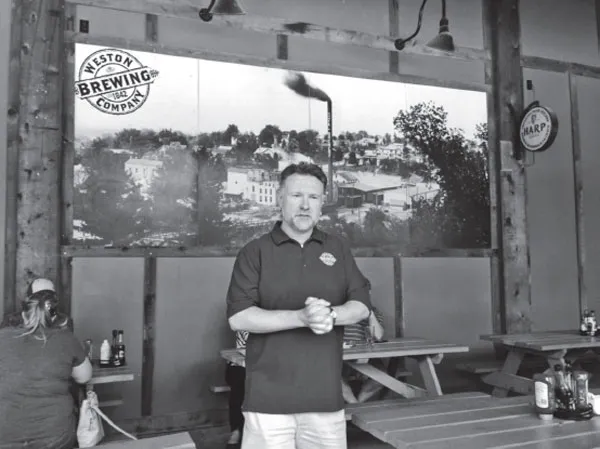
Weston Brewing Company co-owner Michael Coakley stands before an image of the mid-nineteenth-century brewery, once known as Royal Brewing Company, as the smokestack indicates. Photograph by Pete Dulin.
Under new ownership from 1997 to 1999, Weston Brewing Company operated a twenty-four-barrel traditional brewing operation located next to the original stone walls of the Royal brewery. It produced Weston Pale Lager and Irish Ale true to original nineteenth-century beer styles. The former minority owner and brewer closed the brewery for unspecified reasons, laid off employees and left the brewhouse intact. The property remained dormant for years.
Meanwhile, homebrewers Corey Weinfurt and Michael Coakley, childhood friends since the ages of five and six, dreamed of owning and operating a brewery. They homebrewed together in college. Post-college, Coakley worked as a server at River Market Brewing Company in Kansas City during the mid-1990s and advanced to management. He helped to open Power Plant Restaurant and Brewery in Parkville and stayed for two years before returning to college to complete a master’s degree.
Circa 2003–4, Weinfurt called Coakley when the previous owner of Weston Brewing closed shop. They initiated discussions with property owner Pat O’Malley about leasing the space. A deal with a five-year lease was struck with O’Malley, and Weston Brewing Company was reborn under new ownership.
“In May 2005, there was still beer in the tanks that was brewed in 1999,” Coakley said. “It took two years to refurbish the brewery and replace motors, pumps, plastic, and rubber seals.”
Weinfurt and Coakley not only bought the brewery, but they also acquired O’Malley’s Pub and America Bowman Restaurant located on the premises. By 2012, they discontinued leasing the property and bought the real estate from O’Malley. The brewhouse is equipped with a twenty-five-barrel brew kettle, two fifty-barrel fermenters and eight fermenters that range between twenty-five and thirty-five barrels. Annual volume fluctuates around eight thousand barrels.
Top-selling brands include O’Malley’s Cream Ale and English Bitter–style Drop Kick Ale. The brewery also makes O’Malley’s Stout, O’Malley’s IPA, Emerald Lager and seasonal Leapin’ Leprechaun Ale. Weston Brewing has a 25 percent ownership stake in Root Sellers Brewing Company, launched in 2015, which produces and sells alcoholic Row Hard Root Beer, Pedal Hard Ginger Beer and Hard Cream Soda. Root Sellers’ production is split between Weston Brewing and Root Sellers’ base in Columbia, Missouri.
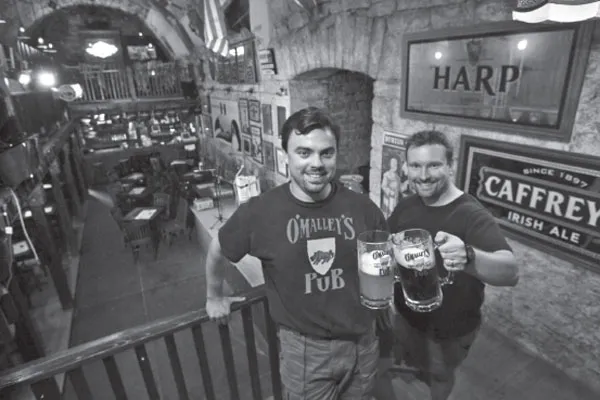
Weston Brewing Company co-owners Corey Weinfurt (left) and Michael Coakley stand in O’Malley’s Pub located in an underground cellar by the brewery. Courtesy of Weston Brewing Company.
At one point, Weston Brewing was a contract brewer for Cathedral Square Brewing in St. Louis for two years and Flying Monkey Brewing Company in Olathe, Kansas. In 2009, Weston Brewing acquired Flying Monkey and continues to brew several of its brands. Weston Brewing’s products are distributed in twenty states across the United States, but the bulk of distribution is concentrated in Missouri and Kansas.
Around 2013, Weston Brewing converted to only packaging in cans. Sunlight is unable to enter cans and potentially affect its contents. Cans are also much lighter to ship and easier to recycle than bottles, making them cost-effective and environmentally sustainable.
Weston Brewing offers tours on Saturdays. The one-hour walking tour covers the brewery’s fascinating history, includes a walk-through of the brewery and underground cellars and concludes with a tasting of a flight of beers in O’Malley’s Pub. The original stone walls of Royal Brewery are still visible as a reminder of the brewery’s vivid history.
LATE 1850S: KANSAS CITY BREWERY THIRD STREET BREWERY
Peter John Schwitzgebel opened the oldest known brewery in Kansas City sometime in the late 1850s. Schwitzgebel, a native of Germany, and his wife, Wilhelmina, moved from St. Louis to Kansas City in 1855. By 1860, he operated Kansas City Brewery at the corner of Third and Oak Streets near the East Levee. Schwitzgebel placed an advertisement in the Kansas City Daily Journal dated August 8, 1865, that boldly declared, “I am prepared to furnish the public with the best lager beer made west of St. Louis; also white beer, ale, and porter,” having “secured the services of a Pittsburg brewer.” By 1869, the business was called Third Street Brewery.
The 1870 Kansas City Business Directory recorded that by the end of the previous year, proprietor “Peter Schwitzgable [sic]” had manufactured five thousand barrels of beer, valued at $65,000, and employed eight workers. The entry stated, “This brewery is the oldest in the city, its lager is famous for its fine flavor and rich taste. It stands in high reputation among the connoisseurs of this agreeable beverage.”
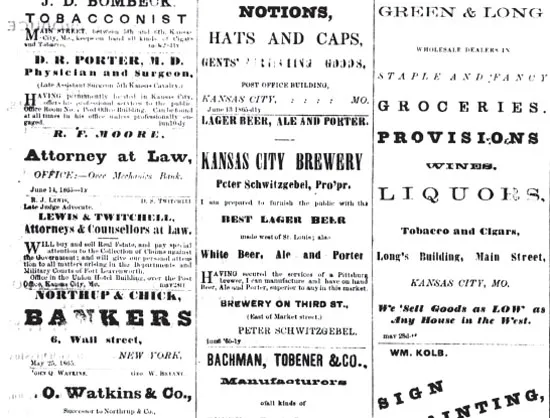
An advertisement in the Kansas City Daily Journal for Peter Schwitzgebel’s Kansas City Brewery, circa 1865. Courtesy of the State Historical Society of Missouri.
According to a report in the Daily Journal of Commerce of Kansas City dated February 26, 1870, Schwitzgebel employed ten men and three wagons. He had about $50,000 invested in the brewery, which had a capacity of forty-five barrels per day, one-third of which was consumed in the city. The daily production capacity of the expanded brewery’s malt house was one hundred bushels. The same issue of the journal lists an advertisement for P. Schwitzgebel, Proprietor of Kansas City Brewery, for beer and lager.
In 1871, Schwitzgebel changed the brewery’s name back to Kansas City Brewery. He lost his property in 1872 in advance of the Panic of 1873. This national financial crisis was instigated when Jay Cooke and Co., a banking firm that led U.S. government investment in railroad construction, closed its doors on September 18, 1873. Schwitzgebel’s loss was one of many casualties as a major economic panic swept the United States. The brewery’s listing in the 1875 city directory shows a name change to Kansas City Brewing Company with Clark and Kump as proprietors.
CIRCA 1857: WILLIAM PARISH JAMES HYATT MCGEE AND JOHN TRAS
William Parish built a mill near the modern area of Thirty-third Street and Cleveland Avenue. He partnered with James Hyatt McGee, who operated a brewery and distillery in Westport near the area of Roanoke and the Allen School. McGee, one of the original fourteen founders of Kansas City, amassed a huge swath of property beyond the city’s existing limits to the south. Known as McGee’s Addition, this area was platted and built into homes, schools, churches and businesses. McGee also operated a gristmill and ferry, among other holdings. The property that housed the brewery and distillery was later sold.
Also, John Tras operated a brewery and saloon in Westport during this period, according to Hometown Beer. No other information is available on his business.
1859–60: KANSAS CITY’S POPULATION BOOMS BEFORE THE CIVIL WAR
Kansas City’s commercial trade expanded as the city’s population swelled. Residency reached nearly eight thousand people in 1859 before dipping to six thousand as a result of tensions in the Kansas-Missouri Border War and approaching Civil War (1861–65). Advertisements in the city directory appeared for businesses in St. Louis, Indianapolis, Cincinnati, Kansas City and a growing number of railroads, all seeking the attention and trade of this thriving Midwest city.
Occupations of the city’s residents included painter, glazier, lightning rod peddler, bar-tender, brick maker, attorney, saddler, tinner, physician, tailor, stage driver, seamstress, stonemason, bookkeeper, cistern builder, carpenter and more. Business owners, workers and visitors to the city patronized twenty-two saloons and three established breweries located downtown by 1860.
In addition to Schwitzgebel’s Kansas City Brewery, two other breweries were listed in the city directory for that year. John Lenhard is noted as a brewer at Fifth and Cherry in the city directory but is absent the following year. No other information is available about how long it operated. Meanwhile, G.S. Raffaletti is listed in the directory with a designation of “wines and liquors, Main and Walnut.” Raffaletti’s second listing is tied to Pacific Brewery.
1860: PACIFIC BREWERY, WESTERN BREWERY
German immigrant Heinrich W. Helmreich moved from St. Louis to Kansas City in the late 1850s and partnered with Gaudenzion S. Raffaletti to enter the brewing business in a building located on East Commercial, a street just south of Levee. The Missouri State Gazetteer and Business Directory of 1860 also lists a Kansas City Brewery under Raffaletti and Helmreich. Helmreich left Raffaletti sometime in 1860 for unknown reasons.
Records from Missouri’s Union Provost Marshal Papers: 1861–1866 show that on August 7, 1862, Raffaletti secured an “oath, bond and permit for the introduction and sale of liquors within the limits of the Central Division of Missouri.” It appears that he entered the saloon business and operated it between Main and Walnut.
Meanwhile, Helmreich formed a separate partnership in 1860 with George Messerschmitt to found Pacific Brewery on East Levee near Cherry. They moved the brewery in 1862 to a location at Twenty-third Street and Westport Road, a half mile south of the city limits at the time. Messerschmitt passed away in 1865.
In 1870, Helmreich began using the name Western Brewery with Henry Helmreich and Co. listed as proprietor. Helmreich’s partners were son-in-law Martin Keck and Charles Raber. Raber was a retired western freighter, brewery worker and billiard hall keeper. Raber, not achieving much success in the brewing industry, sold out of the business after two years.
As of 1870, the Daily Journal of Commerce reports that the capital invested was about $30,000. Western Brewery employed six men and three wagons, and daily production amounted to about forty barrels.
Meanwhile, the 1870 city business directory reported that by the end of August 1869, Western Brewery had manufactured three thousand barrels of beer for the year, valued at $39,000, and employed seven hands. The directory stated that the proprietor, “Mr. Helmrich [sic], being a gentleman of enterpris...
Table of contents
- Front Cover
- Half Title
- Title Page
- Copyright
- Contents
- Preface
- Acknowledgements
- Introduction
- 1. Early Brewing in Kansas City
- 2. Out-of-Town Competition Brews
- 3. Temperance and Temptation Along the Kansas-Missouri State Line
- 4. 1880s to Prohibition
- 5. Early to Mid-1900s
- 6. Boulevard Brewing Company
- 7. Brewpubs and Breweries in the 1990s
- 8. Twenty-first-Century BreweriesChapter 8
- Bibliography
- About the Author
Frequently asked questions
Yes, you can cancel anytime from the Subscription tab in your account settings on the Perlego website. Your subscription will stay active until the end of your current billing period. Learn how to cancel your subscription
No, books cannot be downloaded as external files, such as PDFs, for use outside of Perlego. However, you can download books within the Perlego app for offline reading on mobile or tablet. Learn how to download books offline
Perlego offers two plans: Essential and Complete
- Essential is ideal for learners and professionals who enjoy exploring a wide range of subjects. Access the Essential Library with 800,000+ trusted titles and best-sellers across business, personal growth, and the humanities. Includes unlimited reading time and Standard Read Aloud voice.
- Complete: Perfect for advanced learners and researchers needing full, unrestricted access. Unlock 1.5M+ books across hundreds of subjects, including academic and specialized titles. The Complete Plan also includes advanced features like Premium Read Aloud and Research Assistant.
We are an online textbook subscription service, where you can get access to an entire online library for less than the price of a single book per month. With over 1.5 million books across 990+ topics, we’ve got you covered! Learn about our mission
Look out for the read-aloud symbol on your next book to see if you can listen to it. The read-aloud tool reads text aloud for you, highlighting the text as it is being read. You can pause it, speed it up and slow it down. Learn more about Read Aloud
Yes! You can use the Perlego app on both iOS and Android devices to read anytime, anywhere — even offline. Perfect for commutes or when you’re on the go.
Please note we cannot support devices running on iOS 13 and Android 7 or earlier. Learn more about using the app
Please note we cannot support devices running on iOS 13 and Android 7 or earlier. Learn more about using the app
Yes, you can access Kansas City Beer by Pete Dulin in PDF and/or ePUB format, as well as other popular books in History & Manufacturing. We have over 1.5 million books available in our catalogue for you to explore.