![]()
PART I
ANCIENT TOWNS
![]()
1.
CASSVILLE, BARTOW COUNTY
A pleasant place to live, and an element of culture and refinement was apparent.4
In one final rebellion, the crisp autumn day turned dark. A foreboding sky brought cold rainfall on Cassville as Federal smoke rose from the smoldering remains. It was November 5, 1864.
At ninety years old, J.L. Milhollin remembers the day with perfect clarity. He was a fourteen-year-old boy; his father had died in July. J.L.’s father, John F. Milhollin, served as clerk of the inferior court from 1855 until he enlisted in the Confederate army in 1861. Killed in Virginia, his body was returned to Cassville in the summer of 1864. His wife and children lived across from the cemetery. When the order came to destroy Cassville, the Milhollin family lost their home just like their neighbors. The young Milhollin son covered his father’s grave with salvaged wood planks. He then fashioned a rough tent frame with a quilt attached to a fence and his father’s headstone. The Milhollin family spent the night on top of the grave. J.L. was the man of the family now, and he took responsibility. The next morning the young Milhollin found a slave cabin four miles away and moved in with their remnant belongings.5
Many families had evacuated long before this terrible day. Many left before the May 19, 1864 battle. Sally May Akin escaped with her husband, Confederate congressman Warren Akin, before the Union army came to North Georgia. Akin would have been sent to a Northern prisoner-of-war camp. The Akins escaped to Oxford, Georgia, to live as refugees.6
Refugees leaving Cassville toward Atlanta found that food was scarce and expensive. A turkey, if it could be found, was seventy-five dollars. Bacon was twenty-five dollars per pound, and a small package of needles for mending cost fifteen dollars.7
When the war was over, the Akins came back to Bartow (formerly Cass) County, but not to Cassville. Like many others, they moved to the new county seat in Cartersville. The family began a law practice in Cartersville near the train depot. That same practice remains open to this day and is run by Akin descendants.8
Not everyone left Cassville before November 5, 1864. Many women were war widows and had nowhere else to go. Huddled with their children, women refugees suffered through a sleeting day and watched their homes burn to the ground. Some returned to rebuild; some found homes elsewhere. Most never returned.9
Today, Cassville is a three-way stop to somewhere else. Once the largest city in northwest Georgia, 1840s Cassville was an educational and cultural center.10 According to the Etowah Valley Historical Society:
The town was home to doctors, lawyers and entrepreneurs. Cassville was a bustling, brick-paved town filled with business, education and culture. By 1864, Cassville was lost. The promising thirty-two-year-old town went up in smoke, first when it missed the train and, later, when Federal fires leveled the town.
COUNTY SEAT
In 1832 the Georgia legislature concurrently created Cassville and Cass County (now Bartow), making Cassville the county seat. Cass County was carved from former Cherokee territory. Gold prospectors invaded sovereign Cherokee land that was once off-limits to white Georgians. This early gold rush would lead to the desolation of the sovereign Cherokee Nation and to the Trail of Tears (see chapter 2).12
Cassville was a promising development centrally located in the Cherokee section. It became the legal center. Many barristers in the Cherokee Circuit maintained offices in Cassville. By 1833 the town had judges, lawyers, commissioners and a senator.13
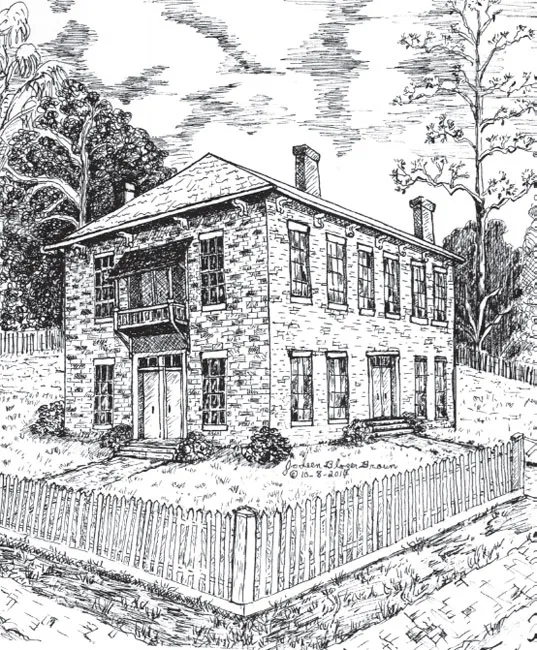
Local artist Jodeen Brown researched antebellum courthouses and reconstructed this pen-and-ink sketch of Cassville’s historic courthouse. Ink sketch by Jodeen Brown.
Within ten years of its birth, Cassville was growing. By 1836, forty homes occupied the city limits, with more farms outside of town. A brick kiln was the first manufacturer, supplying the construction boom of community buildings. The jail, the academy and the courthouse used the locally made bricks.
The courthouse was the most impressive building in Cassville. It cost $9,000 to build this two-story structure in 1836. The pen-and-ink image by local artist Jodeen Brown was re-created from this passage in Joseph B. Mahan’s book A History of Old Cassville: 1833–1864:
THE RAILROAD SITUATION
When Western & Atlantic Railroad laid track through northwest Georgia in the 1840s, the route excluded Cassville. The closest access to the railroad would be two miles down the road at Cass Station. Several theories have existed as to why tracks never ran through the largest town in the region.
There is evidence that residents did not want the evil train coming through the young town. As in many towns of this era, the people did not want the railroad to change the character of their town. The only evidence that Cassville’s residents refused to allow the tracks to come through town were newspaper accounts that suggested the route was changed and that the citizenry celebrated because Cassville was not “contaminated by the vile railroad.” A local newspaper reported that they did not want the dirt, smoke and whistles disturbing students and “hard working newsmen.” This rhetoric may have been an attempt to make the best of an inevitable situation. The combination of geology and geography was the most likely reason.
This region in northwestern Georgia is a geologist’s playground. The area between Adairsville and Cassville in Cass County had a gravel plateau that would have made laying tracks to Cassville expensive and difficult. There is evidence that town leaders knew the value of the railroad coming to town and tried to make it happen.
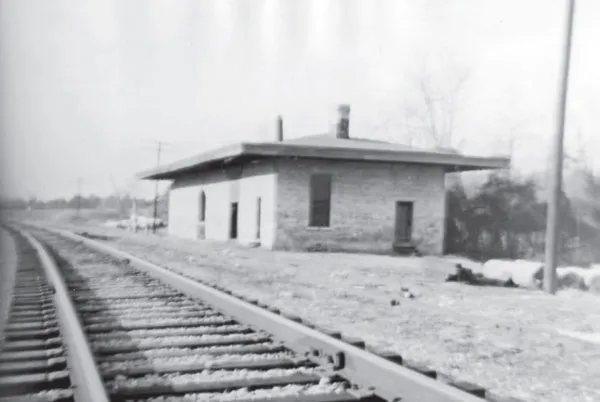
Cass Station, two miles from Cassville, was one of the reasons Cassville never rebuilt after the Civil War. The railroad never ran through it. Courtesy the Atlanta History Center.
Whether it was the geography or the attitude of the town, the train never came closer than two miles to 1840s Cassville. The hotels lost vacancies, and business was down. Perhaps that explains an 1857 “Why go elsewhere?” advertisement in the Standard:
Cassville, despite the loss of the railroad, still had a great deal to offer. The citizens realized they needed to adapt to the changes. If Cassville could no longer be the center of commerce, it would be the cultural and educational center of North Georgia.
CULTURAL CENTER
Cassville was a young town populated with young people, as reported by a local newspaper: “A pleasant place to live, and an element of culture and refinement was apparent.”16 Most early citizens were in their twenties and thirties. They wanted to offer education and culture to the North Georgia area. Cassville wanted to become the cultural center, even as it was losing economic supremacy due to the railroad situation.
It was losing business as the railroad went to Cass Station and Cartersville. The hotels lost their monopoly and small businesses suffered from shipping issues, but Cassville adapted. In 1845, the same year the Cass Station was completed, the Thespian Society was organized two miles away. It was intended that young men would study and perform drama for public entertainment in the brick academy. The group’s first performances were two comedic productions, The Lottery Ticket and Family Jars. As usual for the times, men played all the parts.17
NOT ONE BUT TWO COLLEGES
The ambitious town decided to begin two colleges, to be run by other organizations but operating under a board of trustees made up of Cassville residents. Both colleges were established in 1852. Cassville Female College began classes in 1854, but the men’s college had a slower start. Cherokee Baptist College was set to open in February 1856, but one night in January a fire destroyed the building. The college still opened, and classes were held in private homes until the school was rebuilt.
Sarah Joyce Hooper was the first graduate of the women’s college—the first and only graduate in 1855. Wyley M. Dyer of LaFayette, Georgia, was awarded a bachelor of philosophy degree (BPh) on July 14, 1857. He was the first and only graduate that year from the men’s college.18
Cassville Female College and Cherokee Baptist College coexisted. Some gossips commented about the boys taking the long way around town to return to their college, having to pass the women’s college. Some things never change.
The colleges were closed in 1863 as war approached North Georgia. Records show that Cassville Female College became a place for both sides to ravage and occupy. Snipers killed ten Union soldiers and threw nine on the female college grounds, where the Federals were b...