- 160 pages
- English
- ePUB (mobile friendly)
- Available on iOS & Android
eBook - ePub
About this book
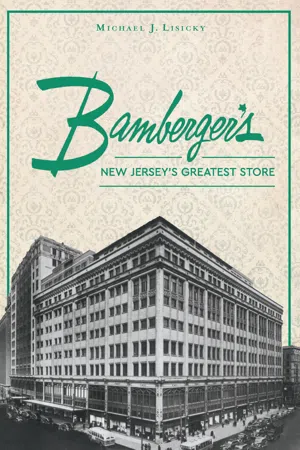
For almost one hundred years, generations of New Jersey customers flocked to Bamberger's. From its grand Newark flagship to numerous suburban locations, the store was hailed for its myriad quality merchandise and its dedicated staff. Its promotional events were the highlight of every season, from the Thanksgiving Parade to elaborate Christmas festivals featuring celebrities such as Bob Hope, Carol Channing and Jerry Lewis. Though the once mighty flagship closed in 1992, Bamberger's is still fondly remembered as a retail haven. With vintage photographs, interviews with store insiders and favorite recipes, nationally renowned department store historian and New Jersey native Michael J. Lisicky brings the story of New Jersey's Greatest Store back to life.
Information
Subtopic
Business BiographiesIndex
HistoryChapter 1
One of America’s Great Merchants
The name of Louis Bamberger is associated with the finest tradition of merchandising, Jewish communal life, and cultural advancement.
—Jewish Chronicle, June 20, 1941
Before he arrived in Newark and became one of the city’s greatest merchants and philanthropists, Louis Bamberger learned his trade and honed his skills in Baltimore. Bamberger was born on May 15, 1855, to Elkan and Theresa Hutzler Bamberger. Elkan operated a small “dry goods and fancy business” alongside his brothers David and Moses. Named Bamberger Brothers, it was located in the center of Baltimore’s retail and wholesale district at 71 North Howard Street. In February 1853, the Bamberger Brothers business dissolved “by mutual consent” as Elkan Bamberger bought out his brothers’ interest. In 1858, Louis’s uncle, Moses Hutzler, established his own dry goods business, which grew into one of Baltimore’s iconic department stores. In 1869, at age fourteen, Louis Bamberger joined the Hutzler Brothers firm as a stock boy. At a weekly salary of four dollars, Bamberger swept Hutzler’s floors and ran errands, but he soon worked his way up the company ranks.1 After learning further skills from his uncle and cousins, Louis rejoined his father’s dry goods business alongside his brother Julius and nephew Edgar. In 1887, Louis and his father, Elkan, sold his company to Hutzler Brothers, and the two men left for New York. Julius and Edgar remained in Baltimore with the Hutzler store, and Louis and Elkan opened a wholesale operation in New York.2 While in New York, Louis also worked as a buyer for “several Western department stores.”3 However, Louis ultimately wanted to operate his own retail operation. In 1892, Louis learned that a Newark store, Hill & Craig, located at Market Street at Library Court, had filed for bankruptcy and liquidation. Bamberger quickly purchased Hill & Craig’s assets and hoped to establish his own retail firm in the booming industrial city. Newark was a “thriving center of both industry and agriculture” that was underserved by commercial firms.
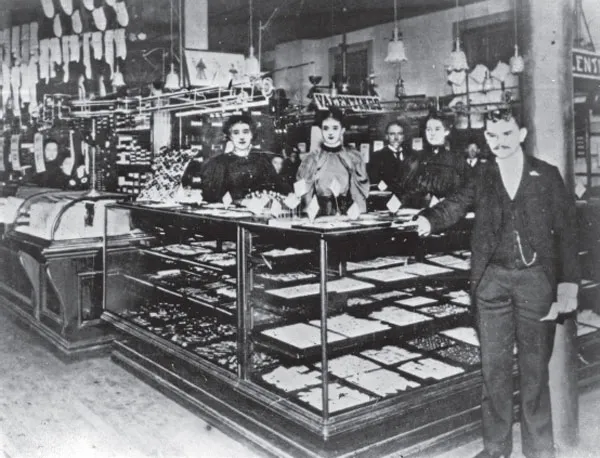
Louis Bamberger poses with employees in February 1893, shortly after the store’s grand opening earlier in the month. L. Bamberger & Co.’s first venture was located at Market Street and Library Court, in the former Hill & Craig building. Courtesy of the Newark Public Library.
Historian Charles F. Cummings stated, “Newark was one of the [top four] most important industrial cities in all of America.” By 1910, 70 percent of Newarkers were immigrants and most transplanted families earned their wages as factory workers. They eagerly accepted employment but “worked hard and died young.”4 Though the industries offered abundant employment, workers received modest pay and were forced to live in substandard and crowded housing options. However, factory owners involved in the city’s chemical, beer, silver and utility industries also resided in the city. These wealthier families lived along High Street and in such neighborhoods as Forest Hill. But “small efforts” by Newark’s shop owners were made to court Newark’s middle- to upper-class residents, who were often forced to travel to New York City and purchase necessities and luxuries. When Louis Bamberger first visited Newark and observed the Hill & Craig business, he walked throughout Newark’s business district, studied the various stores and counted its crowds. A 1941 article about Louis Bamberger stated, “He wanted to make a connection with the retail end of the business and believed that Newark provided an opportunity to do this.”5
Louis Bamberger soon learned that the purchase of Hill & Craig was more complicated than he had imagined. Bamberger examined its stock and realized that “he had bought far more [goods] than his experience as a sales agent for several New York firms would permit him to handle.”6 He enlisted the help of family and associates to sell off the excess goods to various surplus firms but was unsuccessful. Bamberger partnered with his brother-in-law Louis M. Frank and a young rubber goods salesman, Felix Fuld. The two men invested in Louis Bamberger’s new company and helped Louis prepare the store for a liquidation sale. On December 13, 1892, the bankrupt Hill & Craig store reopened under new ownership and held a public sale. A sale advertisement declared, “All Goods Offered at a Great Sacrifice!” The overwhelmingly successful sale encouraged the three men to quickly add fresh stock and remain in business. Louis’s aspiration to operate his own retail store was formally realized on February 1, 1893. The firm was renamed L. Bamberger & Co., with Bamberger, Fuld and Frank as equal partners.7
L. Bamberger & Co. embraced many of the revolutionary business practices that helped build other successful large firms in other major cities. Fixed pricing, guaranteed returns and an extensive offering of goods set L. Bamberger & Co. apart from other Newark retailers. Louis also developed close working relationships with many supply houses that provided the company with quality goods and competitive prices. Frank I. Liveright, one of Louis Bamberger’s closest business associates, called Louis “the most ethical man I’ve ever met” and cited his employee, customer and supplier loyalty as “company hallmarks.” With Louis Frank in charge of merchandise and Felix Fuld responsible for sales and advertising, Bamberger established a group of leaders that pushed the firm into expansion.
The former two-story Hill & Craig quickly proved too small for the growing concern. In 1898, the firm moved to the northeast corner of Market and Halsey Streets and doubled in size.8 Within six short years, the company employed approximately five hundred workers and boasted total sales of over $1.3 million. Felix Fuld managed the company’s workforce, and the store was known as a good employer. Fuld termed his employees “coworkers,” and vacation pay, salary commissions, sick pay and death benefits were put into practice as early as 1901. The firm continually increased its customer base with exclusive merchandise offerings and special services. L. Bamberger & Co. offered home delivery on horse-drawn wagons and sleds throughout New Jersey. In later years, it was one of the first stores to switch to motor vehicle deliveries.9 In May 1901, the store installed New Jersey’s first escalator. The moving stairway that “stirred Newark” was called the “Reno Escalator” and frightened some customers and insurers.10 As the company continued on its successful path, it sometimes overpowered the three businessmen.11 They closely counted all sales transactions and advertising expenditures so that they remained current on all financial obligations. The store continually removed walls and expanded in order to increase sales square footage. L. Bamberger & Co. knew that the firm could not remain at its current site permanently.
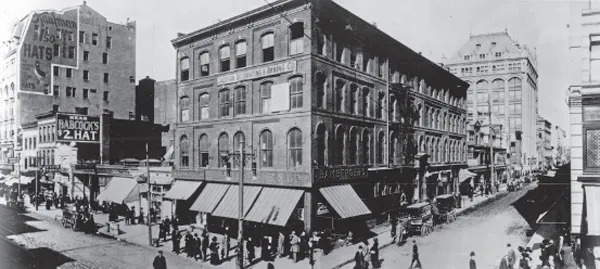
L. Bamberger & Co.’s original store opened for business on February 1, 1893, at the corner of Market and Halsey Streets. The business, according to the photograph, was called “Bamberger’s Annex,” and its windows promoted it as a “High Grade Store.” Courtesy of the Newark Public Library.
On August 4, 1910, L. Bamberger & Co. received some devastating news. Louis M. Frank had died suddenly from apoplexy while vacationing in Lucerne, Switzerland, with his wife, Caroline Bamberger Frank. Upon the death of Louis Frank, L. Bamberger & Co. incorporated its business, which named Louis Bamberger president, Felix Fuld vice-president and treasurer and associate Frank I. Liveright secretary. The incorporation secured L. Bamberger & Co.’s future. The firm set its sights on a parcel of property just west of its current store. Located within the streets bounded by Market, Halsey, Washington and Bank, numerous small storefronts filled the city block. Bamberger was afraid to publicly announce his intentions and quietly acquired the properties through a realty company. He feared that some store owners would hold out for exorbitant fees while others would refuse to sell for any price. After it finally secured all desired properties, L. Bamberger & Co. enlisted the services of renowned Chicago architect Jarvis Hunt to design a new home for “New Jersey’s Greatest Store.” Once the plans for the new building were officially announced, the company stated, “The new Bamberger Store, even now, is one of the showplaces of Newark. What will it be when the doors [of the new location] are finally thrown open?”12
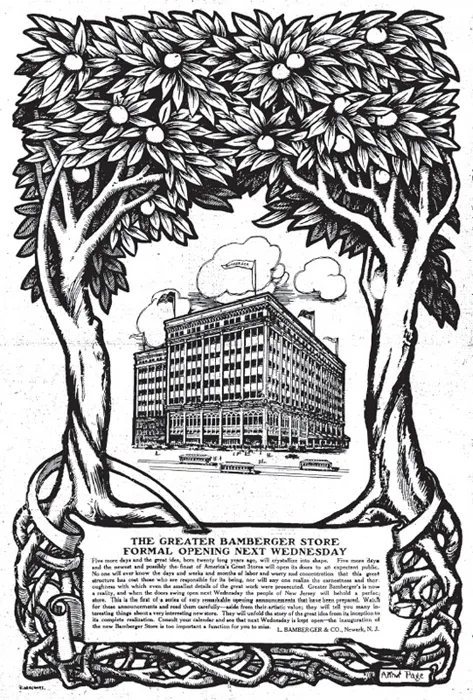
A series of ornate advertisements announced the opening of “Greater Bamberger’s” in October 1912. This announcement promised, “The people of New Jersey will behold a perfect store.” L. Bamberger & Co. assured customers that the inauguration of the store was “too important a function to miss.” Collection of the author.
Chapter 2
The Always Busy Store
L. Bamberger & Co. opened its new 500,000-square-foot, eight-story department store on October 16, 1912, to great fanfare. The massive terra-cotta building, designed by Jarvis Hunt, became known as the “Great White Store.” The company officially announced that the new store was “a monument to the minds of those who created it—a lasting tribute to the buying public that made the great work possible.”13 Former company secretary Frank Liveright recalled, “We didn’t give out souvenirs at the opening, but the public took care of that itself. On opening day our restaurant was crowded; when we closed that night, almost all of the cutlery stamped ‘Bamberger’s’ and the crockery with the Bamberger monogram were taken away as souvenirs.”14 An article in the New York Times cited the building’s “pleasing façade” and “artistic charm.” The newspaper continued, “It is pleasing to see that the owners of a big business like that of Bamberger have recognized the moral and lasting worth of a retail store, beautiful to look at.”15 With 144 feet of Market Street frontage, the structure represented a $2 million investment. This new “perfect store” contained sixteen elevators, an “air washing” device that kept the store free from “dust and other impurities,” a four-hundred-seat dining hall, a six-hundred-seat concert hall and a hospital with a resident physician and nurses. Two tunnels connected the old and new Bamberger operations, and its former location transitioned into a warehouse and delivery facility. The New York Evening Mail newspaper stated, “This institution is a credit to the industrial progress of the State of New Jersey. If we could persuade New York stores to conduct their business on the same lines of justice and integrity, the millennium would be close at hand.”16 At the corner of Market and Halsey Streets, a large round clock jutted out from the new store, and the site became one of Newark’s most popular meeting places.
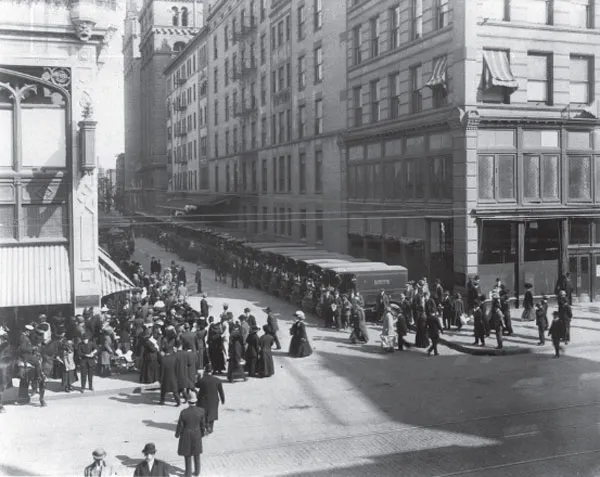
Crowds form at the corner of Market and Halsey Streets on opening day, October 16, 1912. The building on the right side of the photograph is the former Bamberger’s store that operated from 1898 to 1912. Numerous delivery wagons are located alongside the former Bamberger’s retail store. The former store served as a warehouse until 1930. Courtesy of the Newark Public Library.
Former mayor Kenneth A. Gibson credits Newark’s growth to the city’s water supply. “The reason Newark became such an industrial base was due to the quality of its water. It gave the dye for chemicals better quality and helped develop many of Newark’s huge breweries, such as Ballantine’s and Krueger’s. The water out of the faucet was of such high quality that people came to work with empty bottles,” says Gibson. The new Bamberger store portrayed itself as a symbol of Newark’s industrial success. It celebrated and catered to the different demographics of the growing city. As the building neared completion, the company stated, “The new Bamberger store is not a store for the classes, nor yet is it a store for the masses. It is a store for both masses and classes—it is a store for all the people!…Newark is a monument to all the people—rich and poor. It is a tribute to the industry, thrift and loyalty of the great buying public. It is the people’s store.”17
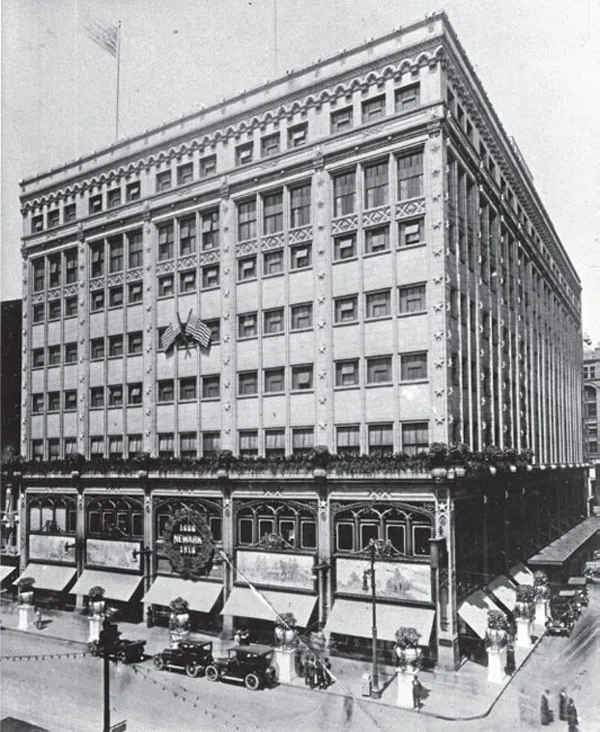
The first section of the modern L. Bamberger & Co. flagship store opened in 1912. The Bamberger store helped celebrate Newark’s 250th anniversary in 1916 with a large wreath placed over the Market Street doors. Courtesy of the Newark Public Library.
With its expanded size, the Great White Store increased its offerings and brought forth a new era of innovative products and services. One of the company’s most valuable leaders was Walter Moler. Moler became the head of public relations and brought notoriety to the company with unique events that captured local and national attention. He helped inaugurate an exposition of Newark-made products. The exhibit proved so successful that it was repeated in 1914 with President Woodrow Wilson at the official exhibit opening.18 Throughout the teens, Moler also presented fashion shows, war bond drives, Christmas celebrations and celebrity visits to the department store. Arguably his most visible promotions were deliveries by the company’s airplane. In May 1919, Bamberger’s purchased a Curtiss JN-4D training plane and planned to make express deliveries by ...
Table of contents
- Front Cover
- Title Page
- Copyright
- Citation
- Dedication
- Contents
- Acknowledgements
- Introduction
- 1. One of America’s Great Merchants
- 2. The Always Busy Store
- 3. It’s Smart to Be Thrifty
- 4. Off to Market
- 5. Broad and Market
- 6. Everything Changed with Paramus
- 7. “Newark Was Sick”
- 8. Aftermath
- 9. Rags to Riches
- 10. More Than Just a Place to Work
- 11. The Last Bastion of Market Street
- Appendix. Soup and Sandwich
- Notes
- About the Author
Trusted by 375,005 students
Access to over 1.5 million titles for a fair monthly price.
Study more efficiently using our study tools.
Frequently asked questions
Yes, you can cancel anytime from the Subscription tab in your account settings on the Perlego website. Your subscription will stay active until the end of your current billing period. Learn how to cancel your subscription
No, books cannot be downloaded as external files, such as PDFs, for use outside of Perlego. However, you can download books within the Perlego app for offline reading on mobile or tablet. Learn how to download books offline
Perlego offers two plans: Essential and Complete
- Essential is ideal for learners and professionals who enjoy exploring a wide range of subjects. Access the Essential Library with 800,000+ trusted titles and best-sellers across business, personal growth, and the humanities. Includes unlimited reading time and Standard Read Aloud voice.
- Complete: Perfect for advanced learners and researchers needing full, unrestricted access. Unlock 1.5M+ books across hundreds of subjects, including academic and specialized titles. The Complete Plan also includes advanced features like Premium Read Aloud and Research Assistant.
We are an online textbook subscription service, where you can get access to an entire online library for less than the price of a single book per month. With over 1.5 million books across 990+ topics, we’ve got you covered! Learn about our mission
Look out for the read-aloud symbol on your next book to see if you can listen to it. The read-aloud tool reads text aloud for you, highlighting the text as it is being read. You can pause it, speed it up and slow it down. Learn more about Read Aloud
Yes! You can use the Perlego app on both iOS and Android devices to read anytime, anywhere — even offline. Perfect for commutes or when you’re on the go.
Please note we cannot support devices running on iOS 13 and Android 7 or earlier. Learn more about using the app
Please note we cannot support devices running on iOS 13 and Android 7 or earlier. Learn more about using the app
Yes, you can access Bamberger's by Michael J. Lisicky in PDF and/or ePUB format, as well as other popular books in History & Business Biographies. We have over 1.5 million books available in our catalogue for you to explore.