![]()
One
BUILDINGS AND SPACES
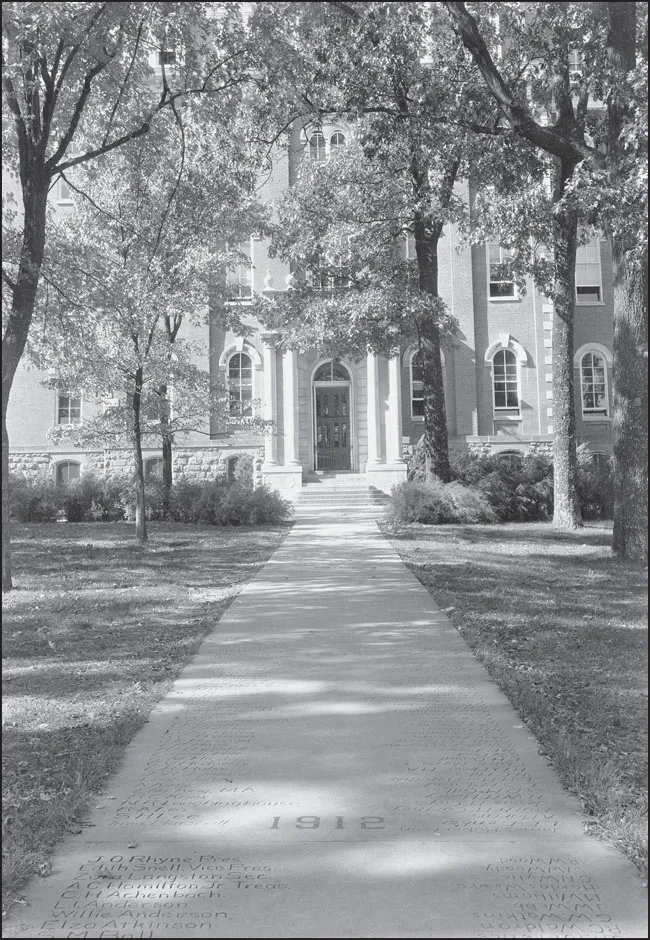
The buildings and spaces on campus serve as the backdrop for learning, entertainment, and lots of memories. The U of A hosts an eclectic mix of styles, from the ancient style of the Greek theater to collegiate Gothic, such as Memorial Hall, to mid-century modern with the fine-arts center. Two of the most iconic places are pictured here: Old Main and Senior Walk. (Picture Collection 1299n.)
Old Main, first known as University Hall, was the first permanent building on campus and the only campus building from the 19th century that is still standing. The building contract was awarded to Mayes and Oliver of Fayetteville, and construction began in 1873. Despite setbacks, the first phase of the building was completed in 1875, several months ahead of schedule. (Picture Collection 1481a.)
Old Main is seen from the vantage point of Leverett Street. In the beginning, Old Main was used for everything, including the library, chapel, museum, gymnasium, machine shop, classrooms, laboratories, and offices. Extra rooms were even rented for faculty members or students to live in. Old Main fell into disrepair and was closed in the 1980s due to safety concerns. Funds were raised to restore the building, and Old Main was rededicated in 1991. (Picture Collection 3608.)
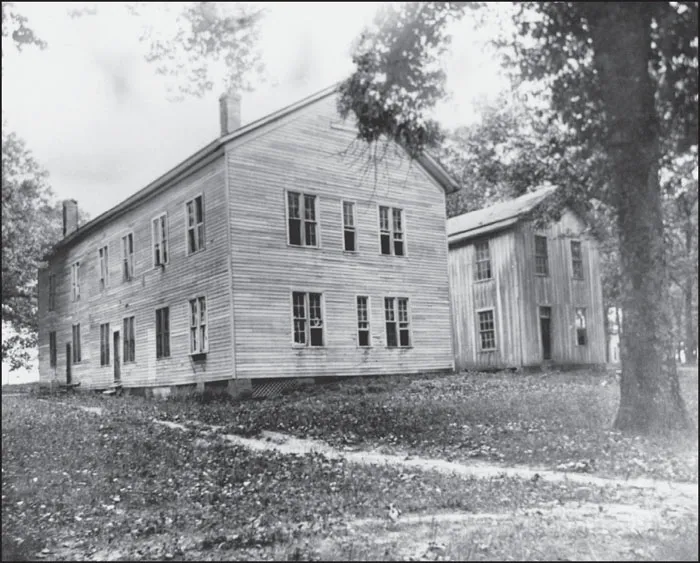
The university started modestly in two wood-frame buildings in 1872. They were two stories tall and connected by an enclosed hallway. All classes and the meager library, which consisted of approximately 137 books, were housed in these buildings until Old Main was completed in 1875. (Picture Collection 1118.)
This photograph shows the first Agriculture Experiment Station, which was located on Maple Street behind the current home economics building. It was completed in 1888 under the Hatch Act for a cost of $4,000 and then furnished with another $4,000 worth of equipment. By the 1930s, the building was being used for music students and then later for editorial services before being torn down around 1970. (Picture Collection 2737.)
Old Main has dominated the skyline of Fayetteville and surrounding areas ever since its construction in 1875. Situated on one of the many hills in Fayetteville, the building has remained an iconic symbol of not only the flagship campus of the University of Arkansas system but also higher education throughout the state. Materials to construct the building were supplied through local sources. Bricks were made from clay deposits near Fayetteville, and the bricks were fired in a local brickyard. Stone for the building was quarried in Washington and Madison Counties. Lafayette Gregg served on the building committee and personally oversaw the construction of Old Main. Previously, Gregg had been instrumental in securing the funding so the university would be located in Fayetteville. He also served on the board of trustees. (Picture Collection 3457.)
Ella Carnall Hall, the first women’s dormitory on campus, opened in 1906. It contained a dining room, kitchen, parlor, library, and piano practice rooms. Beginning in 1967, the building was used as a fraternity house and then for the anthropology, geography, and sociology departments. After major renovation, the building reopened in 2003 as the Inn at Carnall Hall and Ella’s Restaurant. (MC 1157, Image 2.)
The facilities building, shown here about 1910, housed the machine and wood shops, a foundry, and the boiler room. According to the 1910 catalog, the shops offered opportunities for students to understand how the machines operated to have a deeper understanding of the work. (MC 1157, Image 10.)
This c. 1910 photograph shows a rare glimpse of early landscaping and winding paths toward Hill Hall and Gray Hall, two of the early men’s dormitories, completed in 1901 and 1905, respectively. Both of these buildings and this garden, located on what is currently the center of campus, have long been replaced by other buildings. (Picture Collection 3691.)
Gray Hall was the third men’s dormitory on campus, opening in 1905. The building was patterned after US Army barracks. It contained 34 bedrooms on each of its two floors. Starting in the 1920s, it was used for the College of Agriculture until it was torn down in 1966. (MC 1157, Image 1.)
In the early 1900s, the university farm was located near the center of campus. The barn pictured here about 1910 has long since disappeared, although the university still runs an active farm. Even after 100-plus years, agriculture remains a core mission of the university. In 1995, the College of Agriculture was named for former Arkansas governor and US senator Dale Bumpers for his efforts to improve Arkansas agriculture. (MC 1157, Image 11.)
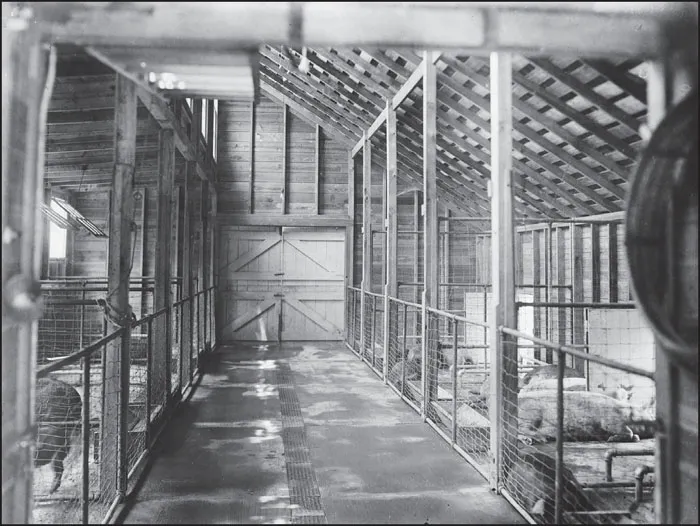
No, these are not captured razorbacks, but hogs raised on the campus farm. All types of livestock were kept so that agricultural students could study new methods and practices to improve farming techniques. Today, the university still operates a swine farm just north of campus. This photograph dates from about 1910. (MC 1157, Image 14.)
This 1908 photograph shows the interior of the creamery room, which was operated by the Departments of Animal Husbandry and Dairying. Here, the students had access to different types of pasteurizers, ripeners, and churns. The building that housed this creamery also contained a cheese-making room where students could manufacture cheddar cheese. (MC 1157, Image 23.)
The greenhouse shown here in 1907 contained an inventory of ornamental plants used for indoor decoration and horticultural experiments. The horticulture department was recognized in 1897. In addition to greenhouses, the department offered instruction in soil preparation, plant management, obtaining new varieties, gardening, nurseries, and orchards. (Photograph by the Grabill photography studio, MC 1157, Image 4.)
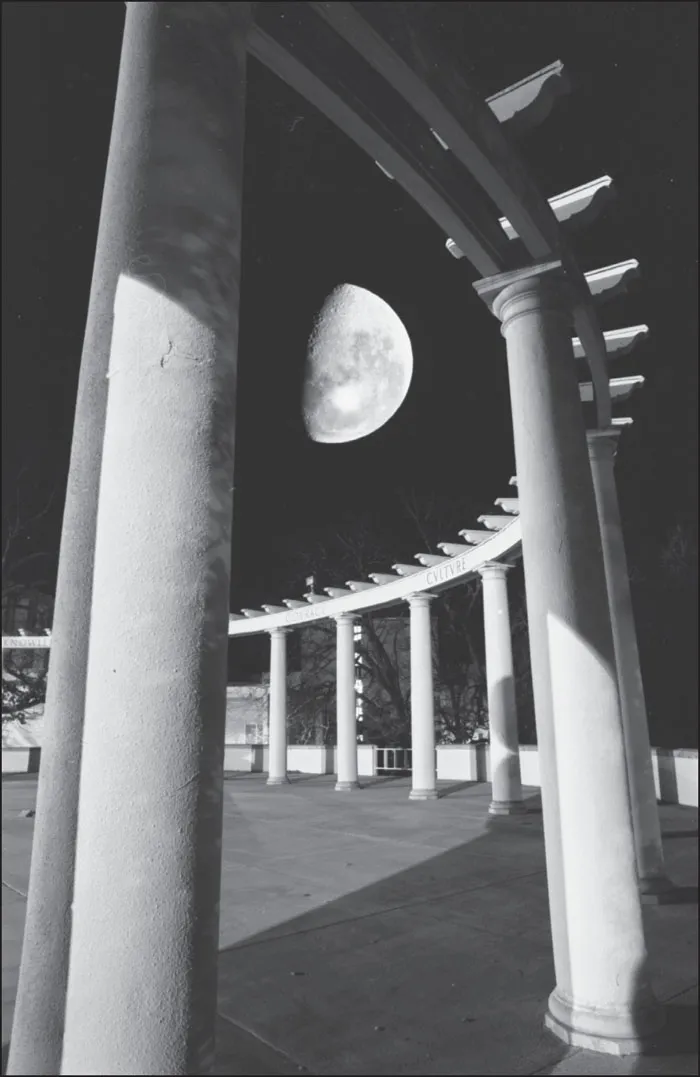
The Chi Omega Greek Theater is pictured here in the moonlight in 1988. The theater has been a fixture of the...