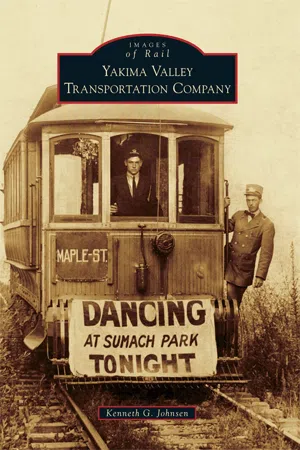
The National Register of Historic Places lists the Yakima Valley Transportation Company (YVT) as the last intact early 20th century electric interurban railroad in America. From its beginning in 1907, the YVT was no quitter, surviving a takeover by the Union Pacific, large financial losses as the last trolley railroad in Washington state, attempts at dieselization, and a concerted effort to put the company in its grave. Thanks to the efforts of local preservationists, YVT trolleys are still in operation. The railroad and its infrastructure never changed. What is seen today is what was built 100 years agoa living slice of history. Images of Rail: Yakima Valley Transportation Company is the most authoritative chronicle of the famous YVT yet compiled.
- 128 pages
- English
- ePUB (mobile friendly)
- Available on iOS & Android
eBook - ePub
Yakima Valley Transportation Company
About this book
Information
Three
RISE AND FALL AND RISE AGAIN OF CITY SERVICE
Opinions vary about whether the YVT was intended to be a city transit service or an interurban railroad from the beginning. Newspaper accounts from 1906 and 1907 never mention a word about freight service, and indeed only passenger trolleys were purchased initially. But in letters to the board by early director William Sawyer, there are cryptic references to working out deals with “our friends in the east.”
In an interview in 2000, Homer Splawn (Jack Splawn’s youngest and last surviving son) told the author that “George Rankin and my Dad had been told from the beginning by the Union Pacific that if they could get a trolley line built from Yakima to the State Fairgrounds, and have two trolleys running on it, the Union Pacific would help them financially.”
Whatever their motives, Splawn and company were required by their franchise to provide city passenger service on all lines. This requirement was in effect until the franchise renewal of 1946. At that time, YVT traded its right to operate on Yakima Avenue (for freight from the Cascade Lumber mill on Eighth Street) for permission to abandon all passenger service.
During those 40 years of city transit service, the YVT saw a steady decline in patronage that correlated with a steady increase in the number of automobiles in Yakima. The railroad tried substituting bus service in 1926 and also bought state-of-the-art trolleys in 1930, but by the end of World War II, passenger service was losing too much money.
Following cessation of trolley service (the last in the state of Washington) on February 1, 1947, the YVT provided transit service with a fleet of buses for 10 years. This too was a losing proposition, and at the expiration of its 10-year bus franchise, YVT sold its buses to a private operator and got out of the passenger service for good—almost.
In 1974, passenger trolley service of a tourist nature was revived on the YVT by a consortium of city, county, and private individuals. Today the entire railroad and its trolleys and locomotives belong to the City of Yakima, and the service continues.

In the horse-and-buggy days, modern streetcars were an amenity usually reserved for larger cities. Yakimans were proud of their up-to-date trolley line, and patronage flourished. This view is of east Yakima Avenue in late 1908, after the track was complete and the new trolleys were placed into service. (Yakima Federal Savings and Loan collection.)

Many people and no automobiles were good for Yakima’s trolley railroad. Ridership grew each of the first few years, starting with the initial runs on Christmas Day, 1907, on which 1,320 fares were collected. (KGJ.)

An interesting nighttime view of big-city activity on Yakima Avenue was recorded some time in 1909, before the avenue’s second track was laid. Ladies in hoop skirts and their gentlemen are seen climbing aboard one of the single-truck trolleys, perhaps headed off to the theater. (YVM.)

All of YVT’s streetcars were originally painted in YV...
Table of contents
- Title Page
- Copyright Page
- Dedication
- Table of Contents
- ACKNOWLEDGMENTS
- INTRODUCTION
- One - EARLY DAYS
- Two - EXPANSION INTO AN INTERURBAN RAILROAD
- Three - RISE AND FALL AND RISE AGAIN OF CITY SERVICE
- Four - FROM FREIGHT ONLY TO A LIVING MUSEUM
- Five - ROSTER AND INFRASTRUCTURE
- YVT ROSTER
- INDEX
- YAKIMA VALLEY TROLLEYS
Trusted by 375,005 students
Access to over 1.5 million titles for a fair monthly price.
Study more efficiently using our study tools.
Frequently asked questions
Yes, you can cancel anytime from the Subscription tab in your account settings on the Perlego website. Your subscription will stay active until the end of your current billing period. Learn how to cancel your subscription
No, books cannot be downloaded as external files, such as PDFs, for use outside of Perlego. However, you can download books within the Perlego app for offline reading on mobile or tablet. Learn how to download books offline
Perlego offers two plans: Essential and Complete
- Essential is ideal for learners and professionals who enjoy exploring a wide range of subjects. Access the Essential Library with 800,000+ trusted titles and best-sellers across business, personal growth, and the humanities. Includes unlimited reading time and Standard Read Aloud voice.
- Complete: Perfect for advanced learners and researchers needing full, unrestricted access. Unlock 1.5M+ books across hundreds of subjects, including academic and specialized titles. The Complete Plan also includes advanced features like Premium Read Aloud and Research Assistant.
We are an online textbook subscription service, where you can get access to an entire online library for less than the price of a single book per month. With over 1.5 million books across 990+ topics, we’ve got you covered! Learn about our mission
Look out for the read-aloud symbol on your next book to see if you can listen to it. The read-aloud tool reads text aloud for you, highlighting the text as it is being read. You can pause it, speed it up and slow it down. Learn more about Read Aloud
Yes! You can use the Perlego app on both iOS and Android devices to read anytime, anywhere — even offline. Perfect for commutes or when you’re on the go.
Please note we cannot support devices running on iOS 13 and Android 7 or earlier. Learn more about using the app
Please note we cannot support devices running on iOS 13 and Android 7 or earlier. Learn more about using the app
Yes, you can access Yakima Valley Transportation Company by Kenneth G. Johnsen in PDF and/or ePUB format, as well as other popular books in History & North American History. We have over 1.5 million books available in our catalogue for you to explore.