- 128 pages
- English
- ePUB (mobile friendly)
- Available on iOS & Android
eBook - ePub
Tehama County
About this book
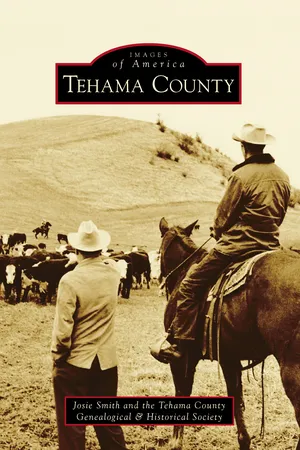
Tehama County--its name is a mystery but its sense of place is not. The county portrays a friendly Norman Rockwell-like America, with everything from May Day picnics and parades to fall harvests, rugged lumbermen, tough cowboys, and rodeo roundups. Carved out of three Northern California counties in 1856, Tehama County is largely rural, with fertile open spaces dominated by ranching and agriculture. To the east and west are lofty mountains and deep-set canyons sculpted by fast-moving streams to delight recreationists. These streams tumble into the mighty Sacramento River that courses through the middle of the county on its way to the Pacific Ocean. While rural, Tehama County has a rich and colorful heritage reflected in its people. Some of the more notable residents have included Ishi, a Yahi Indian considered the last of his people; William B. Ide, commander in chief of the brief Bear Flag Republic; and railroad magnate and governor of California, Leland Stanford, who built the largest vineyard and brandy distillery in the world here.
Information
Topic
StoriaSubtopic
Storia nordamericanaOne
NORTHEAST
Cattle rustlers were rumored to hide in the riparian forests of the Bend Area, which later became plum, almond, and peach orchards. Because a young Spanish girl knew how to cook, the Queen of Spain rewarded her with a gift of land along the river, but not wanting it, she sold it. It became part of William Benitz’s 22,000-acre Mexican land grant known as Rancho de Breisgau. When he never occupied the land, squatters settled there and eventually were able to buy their homesteads from the US government for 62.5¢ per acre. Just to the south of the old land grant, Andrew Jelly bought land and built a road and river ferry there, which operated for almost 100 years.
Hollywood actor Glenn Ford became a spokesperson for Lake California, which was the dream of Dr. Joseph L. Price (1911–1968), who envisioned a community surrounding a 225-acre man-made lake. Dr. Price also developed a variety of almond tree, which he patented as the Price Almond. (Franciscan padres were the first to bring almond trees to California in the 1700s; almonds were grown commercially in the 1860s.)
In the foothills are the old stage stops of Dales Station, named for Creath and Anna Dale, who moved there from the mines of Shasta County in 1908; and Paynes Creek, where Edna “Grovie” Apple was a stage driver as tough and fearless as any man—she once crossed a slough where the water ran over the horses’ backs.
On January 8, 1856, borax was first discovered in California (and North America) at Lick Springs by Dr. John Veatch (later renamed and site of the famous Tuscan Springs Resort). Higher in the mountains is Mineral. Snow skiing was introduced to the area in 1932 when Husky Beresford built a ski run and added lights for nighttime skiing, perhaps creating the first lighted ski run in the state. Morgan Springs was developed as a hot springs resort and later sold to become a private ranch where Pres. Herbert Hoover enjoyed fly fishing in Mill Creek.
Timber supplied lumber for mills in the Lyonsville area, and the boards were floated to the valley by flume. In Manton, the Forward brothers (Frank and Alfred) built and operated mills in 1893 and 1906 until they were destroyed by fire on March 26, 1958. Today, the only “teepee” burner left standing in Tehama County is at their old mill site, which is a registered E Clampus Vitus historical site.

This adobe is part of the William B. Ide Adobe State Historic Park, although Ide never lived in it (he lived farther downriver). It was built in 1852 by Abraham Dibble. It was first mistakenly called Ide’s Adobe by K.V. Bumpass. Judge Lewis continued the error in his 1880 History of Tehama County. It changed ownership at least 20 times before the State of California acquired the site in 1951, restored the adobe, and dedicated it as a park honoring Ide, an early pioneer and the only president of the short-lived Bear Flag Republic (which lasted from June 14 to July 9, 1846). Ide later settled in Monroeville (at that time, the seat of Colusa County), where he died of smallpox in 1852. Ide was virtually its one-man everything. A story recounts that he acted as prosecutor, defense attorney, and judge in the trial of a horse thief (found guilty). In 2014, several large limbs of the huge 350-plus-year-old Valley Oak that shaded the adobe fell and caused significant damage to it and nearby buildings. (Tehama County Library collection.)

Archaeologists from California State University, San Francisco, aided in the restoration of the adobe at the William B. Ide Adobe State Historic Park. Adobe is mud mixed with straw, shaped, and dried in the sun to form large bricks that help dwellings stay cool in summer and warm in winter. This adobe departed from the typical Californio adobe by featuring Anglo innovations such as a fireplace, chimney, and plank floors. (Tehama County Library Collection.)

The dedication ceremony for the park was held April 30 to May 1, 1960. It began with a parade in Red Bluff and formal dedication ceremonies at the site. Preparing for the dedication on the corner of Oak and Jefferson Streets are, from left to right, Earl Davies, Fourth District supervisor (he rode the steer); E.C. Pryor, Second District supervisor; and Curtis E. Wetter, superior court judge for the County of Tehama. A barbecue attended by 4,000 people was held at the fairgrounds. (Maurice Ness collection.)

Dales Station was halfway between Manton and Red Bluff. In 1863, William and Mary DeHaven offered hot meals and a place to stay for teamsters and travelers on the Tehama County Wagon Road. Creath and Anna Dale arrived there in 1908. In 1936, Creath imported Louisiana bullfrogs with dreams of making a fortune on frog legs, but a flood in 1937 washed the frogs and his dreams away. (Tehama County Library collection.)

It is uncertain how Manton got its name. One story is that the name of Man’s Town was submitted to postal authorities who changed it to Manton in 1889. Another is that an early settler, J.M. Meeder, named it after his hometown of Manton, Rhode Island. The area attracted settlers in the 1850s with its productive soil, virgin timber, and creeks supplying water for irrigation and hydropower. (Pamela Wilson/Manton Store collection.)

This c. 1900 view looks east along the Red Bluff–Manton Road. On the left, from front to back, is a saloon, blacksmith shop, store, and the Manton Hotel. Marion McGeehee was a Civil War veteran who sported seven-and-a-half-foot-long whiskers that he kept braided. He would ride his horse, Peacock, into town for provisions (“chawin’ tobaccee”) then make a beeline to the saloons. Once out of money, he would ride home or sleep it off in a nearby field. (Tehama County Library collection.)
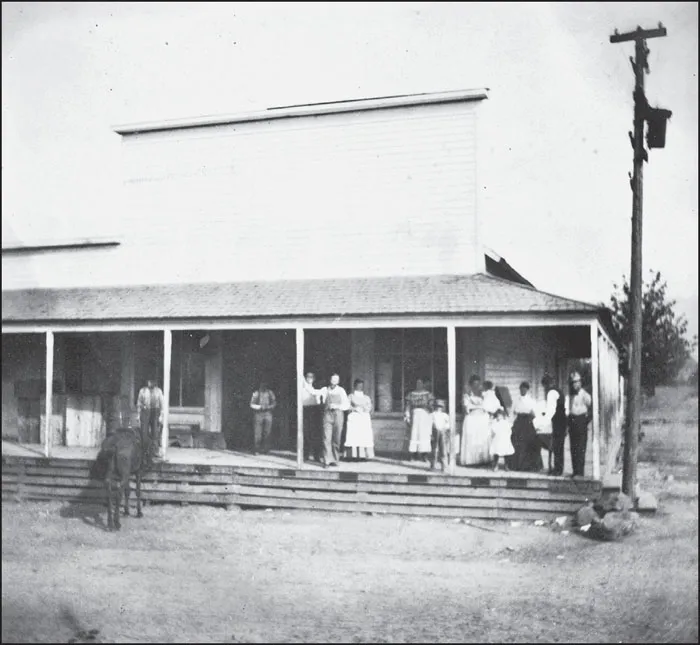
Manton’s first store was built in the 1880s. It was later enlarged and established as the post office in 1889. The Manton General Store was built in 1904 by James L. Barham (at center with hand on post). Next door to it were two saloons, and across the street was the Manton Hotel, jail, and Woodmen of the World Hall, which was later dynamited by unknown persons. (Tehama County Library collection.)

The Manton jail was built about 1902 from two-foot-by-four-foot fir. Its first inmate was a man jailed for stealing turkeys, Hugh Robertson. After that, it was called Robertson’s Fort for a time. It was also used to store black powder. Here, Henry Myer is passing the jail on a sled pulled by mules around 1925. (Pamela Wilson/Manton Store collection.)

The Manton Hotel, pictured in 1890, sat at the wye east of the Manton Store. It was known for its excellent cuisine and comfortable accommodations. It had several different owners over the years. In the 1950s, Pacific Gas & Electric bought the property for its water rights and tore the building down. (Tehama County Library collection.)

The first settlers in the Battle Creek Meadows ar...
Table of contents
- Cover Page
- Title Page
- Copyright Page
- Dedication
- Table of Contents
- Acknowledgments
- Introduction
- 1. Northeast
- 2. Transportation
- 3. Southeast
- 4. Agriculture
- 5. Southwest
- 6. Recreation
- 7. Northwest
- Bibliography
- About the Organization
Trusted by 375,005 students
Access to over 1.5 million titles for a fair monthly price.
Study more efficiently using our study tools.
Frequently asked questions
Yes, you can cancel anytime from the Subscription tab in your account settings on the Perlego website. Your subscription will stay active until the end of your current billing period. Learn how to cancel your subscription
No, books cannot be downloaded as external files, such as PDFs, for use outside of Perlego. However, you can download books within the Perlego app for offline reading on mobile or tablet. Learn how to download books offline
Perlego offers two plans: Essential and Complete
- Essential is ideal for learners and professionals who enjoy exploring a wide range of subjects. Access the Essential Library with 800,000+ trusted titles and best-sellers across business, personal growth, and the humanities. Includes unlimited reading time and Standard Read Aloud voice.
- Complete: Perfect for advanced learners and researchers needing full, unrestricted access. Unlock 1.5M+ books across hundreds of subjects, including academic and specialized titles. The Complete Plan also includes advanced features like Premium Read Aloud and Research Assistant.
We are an online textbook subscription service, where you can get access to an entire online library for less than the price of a single book per month. With over 1.5 million books across 990+ topics, we’ve got you covered! Learn about our mission
Look out for the read-aloud symbol on your next book to see if you can listen to it. The read-aloud tool reads text aloud for you, highlighting the text as it is being read. You can pause it, speed it up and slow it down. Learn more about Read Aloud
Yes! You can use the Perlego app on both iOS and Android devices to read anytime, anywhere — even offline. Perfect for commutes or when you’re on the go.
Please note we cannot support devices running on iOS 13 and Android 7 or earlier. Learn more about using the app
Please note we cannot support devices running on iOS 13 and Android 7 or earlier. Learn more about using the app
Yes, you can access Tehama County by Josie Smith,Tehama County Genealogical & Historical Society in PDF and/or ePUB format, as well as other popular books in Storia & Storia nordamericana. We have over 1.5 million books available in our catalogue for you to explore.