eBook - ePub
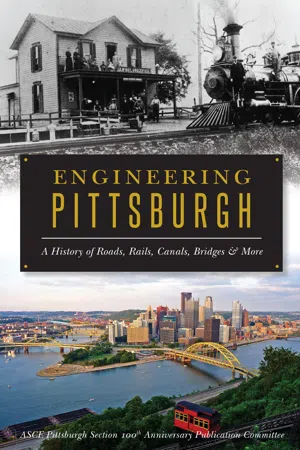
Engineering Pittsburgh
A History of Roads, Rails, Canals, Bridges and More
- 224 pages
- English
- ePUB (mobile friendly)
- Available on iOS & Android
eBook - ePub
Engineering Pittsburgh
A History of Roads, Rails, Canals, Bridges and More
About this book
Western Pennsylvania's infrastructure is renowned for traversing valleys, mountains, rivers and everything in between. Early surveying in the region delineated state and local boundaries that allowed for the mapping of canals, railroads and roadways. Engineers developed bridges, ground transportation systems and airports that linked Pittsburgh to the world. Frequently overflowing rivers transformed into reliable navigation passageways. Drinking water and wastewater treatment systems allowed development and population to flourish, leading to investments in iconic buildings. Join expert civil engineers and professionals as they narrate the story of Pittsburgh and the surrounding region's engineering triumphs.
Trusted by 375,005 students
Access to over 1.5 million titles for a fair monthly price.
Study more efficiently using our study tools.
Information
Subtopic
North American HistoryIndex
HistoryBRIDGES
By Todd M. Wilson, PE
THE REGION’S FIRST BRIDGES
Western Pennsylvania is a dissected plateau with many valleys and streams forming the headwaters of America’s most significant westward-flowing river, the Ohio. Natural and mineral resources along its waterways, combined with its challenging topography, set the stage for development that required many bridges over rivers, streams and valleys.
In the mid-1700s, British colonists formed land companies to develop the frontier west of the Appalachians. This area intersected with French trading routes along the Ohio and Allegheny Rivers that connected French colonies in Louisiana and Quebec. Central to the ensuing conflict of the French and Indian War was the strategic need to control the “Forks of the Ohio,” as George Washington called the land that eventually became Pittsburgh.
Western Pennsylvania’s illustrious bridge-building history has its origins in that war. The British hurried to fortify the “Forks” in 1754 but surrendered Fort Prince George to the French, who built Fort Duquesne later that year. Plans showed a bridge over the ditch into the fort. The British military constructed Braddock’s Road (1755) and Forbes’ Road (1758) to retake the land, which became major routes later upgraded with bridges. After the French retreat, the British constructed Fort Pitt in 1759–61, building several bridges over the moats. Ever since then, bridges have played an essential part in transporting people and goods in Western Pennsylvania.
EARLY ROAD BRIDGES
Western Pennsylvania’s first bridges were constructed along primitive military roads, American Indian paths and new routes connecting emerging frontier towns. They were made of locally available materials such as stone or wood, which limited span lengths. By assembling wooden members together in triangular shapes called trusses, builders could create longer spans. Trusses were expensive to build and difficult to assemble, so bridge operators started covering them for protection, creating wooden covered bridges. Pittsburgh’s first major wooden covered bridges were built in the late 1810s, about a decade after America’s first prominent covered bridge was built in Philadelphia. Before bridges, private ferries were used for river crossings. Costly bridges were constructed later, when investors projected that sufficient traffic would make them economically viable.
American engineers started introducing iron for its strength and durability in the 1800s. While Chinese engineers had started building bridges with iron chains centuries earlier, the first documented European iron chain bridge was not built until 1734. The first all-iron arch bridge was completed in England in 1779. The second was planned for Philadelphia, but it was never built. Founding father Thomas Paine planned to have it fabricated and shipped from England in the late 1700s but lacked sufficient investment to do so. At that time, however, Fayette County’s James Finley was serving as a state senator in Philadelphia. Was he exposed to the knowledge of European iron bridge building? Did that exposure develop his interest in designing bridges? After returning to Western Pennsylvania, he was awarded a contract in 1801 to construct a seventy-foot bridge over Jacobs Creek on Braddock’s Road south of Mount Pleasant. There, Finley designed what is considered to be America’s first iron bridge and the world’s first modern suspension bridge. He patented his design in 1808. The bridge used externally anchored iron chains hung from towers, forming catenary curves. Stiffened by wooden trusses, the level road deck was supported by suspenders hung from the catenaries. Finley marketed and built similar chain bridges, including an eighty-foot bridge over Dunlap’s Creek in Brownsville in 1809. Finley designed what were intended to be Pittsburgh’s first bridges over the Monongahela and Allegheny Rivers in 1810, but the bridge company was unable to secure sufficient investment and financing. When Pittsburgh was incorporated as a city in 1816, the eventual “City of Bridges” had none.
America’s first federally funded road, the National (Cumberland) Road, was built from Baltimore to Wheeling in 1811–18 to reach Ohio, which had just achieved statehood in 1803. The road was routed across Finley’s Dunlap’s Creek Bridge in Brownsville. To cross the nearby Monongahela River, fill was extended across the river in 1817 to form a sort of causeway— the Monongahela’s first crossing. Along the road, stone bridges were used for smaller rivers and streams. The largest was the Great Crossings Bridge over the Youghiogheny River. Flooded by the Youghiogheny Reservoir in 1944, it reappears when water levels are low. The Little Crossings Bridge over the Casselman River still stands twenty miles to the west near Grantsville, Maryland. Its eighty-foot arch was recognized as America’s largest when built.
Charters for Pittsburgh’s first river bridges were reauthorized in 1816, the year Pittsburgh was incorporated as a city. Rather than using Finley’s designs, the reorganized bridge companies hired Philadelphia engineer Lewis Wernwag to design covered bridges instead. Wernwag had achieved fame in 1812 by building a record-setting covered bridge in Philadelphia. His 1,500-foot, eight-span Monongahela Bridge opened in 1818, connecting Pittsburgh with the Washington Turnpike (Boggs Avenue) on the river’s south side. The similar 1,037-foot, six-span Allegheny Bridge opened the following year, connecting Sixth Street in Pittsburgh with Federal Street in Allegheny City (now Pittsburgh’s North Side).

The 1818 Great Crossings Bridge, shown when it reappeared during low Youghiogheny Reservoir water levels in 1999. Todd Wilson.

Brownsville’s 1839 Dunlap’s Creek Bridge, America’s first iron arch bridge. Todd Wilson.
After Andrew Jackson’s election in 1828, the federal government wanted to transfer National Road ownership to the states. Pennsylvania would assume ownership only if the federal government repaired the road first, including replacing the Dunlap’s Creek Bridge in Brownsville. Finley’s bridge had collapsed in 1820, and subsequent replacements were hastily built and short-lived. The federal government assigned the task to Captain Richard Delafield of the Army Corps of Engineers. Unlike America’s untrained craftsmen-turned-engineers of the time, Delafield had acquired knowledge of English and French engineering practices at the U.S. Military Academy. Wanting to build America’s first cast-iron bridge, he designed an eighty-foot arch consisting of five cast-iron tubes, each formed by nine iron voussoirs (wedge-shaped elements) bolted together. Built in 1836–39 and widened in 1920, America’s first iron arch bridge still carries traffic in its original location.
AQUEDUCTS AND THE RISE OF JOHN ROEBLING
Pennsylvania’s Main Line canal, constructed in 1826–34 from Philadelphia to Allegheny City (now Pittsburgh’s North Side), gave the Pittsburgh area a means to compete economically with the National Road (1818) and the Erie Canal (1825). Aqueducts along the route were either wooden or stone. Since the canal was routed along the Allegheny River’s north bank, Pittsburgh leaders demanded a connection to bring it into their city. The state constructed the seven-span Allegheny Aqueduct, a wooden covered bridge, at Eleventh Street into Pittsburgh in 1829. It became unsafe and had to be closed in 1843. Unable to afford its repair, the state granted the City of Pittsburgh authority to replace it in exchange for future tolls. John Roebling secured the low bid, promising to replace it as quickly and as cheaply as possible with a new bridge. This launched his noteworthy career, cumulating with New York’s 1883 Brooklyn Bridge.
Originally from Saxony in eastern Germany, Roebling attended the Berlin Polytechnic Institute, where he studied the work of engineers, including James Finley. Roebling developed a love for suspension bridges. He left Europe and helped to found the agrarian community of Saxonburg, Butler County. Returning to engineering, he was working as a surveyor for the Main Line’s Portage Railroad when he witnessed two people crushed when a hemp rope pulling an incline car snapped. Having studied the concept of wire rope in Europe, he patented a manufacturing method in 1842 and successfully lobbied the Portage Railroad to use it to replace hemp ropes on inclines. Roebling’s ultimate goal was to use his wire rope for suspension bridges.
At the time, builders pre-manufactured wire rope, limiting its size and leading to damage during installation. Roebling’s new technique of continuously spiral wrapping the cable in place ensured uniform tension on each rope strand. The Allegheny Aqueduct replacement was his first chance to use his rope for a suspension bridge, which was completed in May 1845 on time and on budget.
One month prior to the aqueduct’s opening, Pittsburgh suffered a devastating fire that destroyed a third of the city, including the Monongahela Bridge at Smithfield Street. Roebling successfully submitted the low bid for its replacement, a suspension bridge, to be built atop the surviving piers in 1845–46. Meanwhile, Roebling’s competitor, Charles Ellet, won the commission for what became the Wheeling Suspension Bridge to carry the National Road over the Ohio River. Completed in 1849, it was the first to cross the Ohio River and the first to surpass the one-thousand foot-span barrier. It collapsed in a windstorm in 1854. Roebling was hired to rebuild it, adding diagonal stays from the towers to the deck for stiffening. Roebling’s last work in Pittsburgh was his 1859 replacement for the original Allegheny River Bridge at Sixth Street. The toll company hired Roebling to design a suspension bridge so beautiful it would attract traffic away from the competing 1839 Ninth Street covered bridge while also improving nighttime safety for pedestrians.

John Roebling’s Monongahela River Bridge at Smithfield Street (1846–83). Carnegie Library of Pittsburgh.
RAILROAD BRIDGES AND THEIR ENGINEERING LEGACY
Through the 1700s and into the 1800s, bridge designers were military-trained engineers, apprenticed craftsmen or self-taught bridge builders. The title “engineer” was loosely defined. Engineering science was just developing. Early engineering was empirical, not theoretical. When a bridge collapsed, the craftsman turned engineer just built it stronger next time. Losses per failure were generally limited to a horse-drawn vehicle and its occupants and cargo. This was not acceptable for railroads. Failures risked many deaths, significant equipment losses and costly service interruptions. Meanwhile, heavy locomotives needed unprecedented engineering solutions to cross wide rivers and deep valleys, requiring bridge design innovations. Trained engineers started to differentiate themselves from craftsmen, which cumulated in professional licensure. Engineers also started making great strides in structural analysis. American engineer Squire Whipple self-published A Work on Bridge Building in 1847, which was the first prominent publication to accurately analyze truss bridge members. Other bridge analysis methods soon followed.
Meanwhile, railroads needed not just stronger bridges but more durable ones. More advanced truss designs incorporating iron began to be patented in the 1840s. William Howe patented the Howe truss in 1840, which used vertical iron tension members and wooden compression members. This design was often built for early railroads, including the original Fort Wayne Railroad Bridge over the Allegheny River in Pittsburgh. Opening in 1857, it was Pittsburgh’s first railroad bridge crossing a river. Thomas and Caleb Pratt patented the Pratt truss in 1844, which initially used diagonal iron tension members and vertical wooden compression members but soon became an all-metal design. It became the most common truss configuration.
Whipple devised a way to double the Pratt trusses per span in 1847 in an early all-iron configuration that used cast-iron compression members and wrought-iron tension members. In 1862–65, engineer Jacob Linville’s Panhandle Railroad bridges over the Monongahela and Ohio Rivers in Pittsburgh and Steubenville ushered in the era of long-span metal truss bridge design. Using modified Whipple trusses, the bridges had record-breaking 260-foot and 320-foot main spans, respectively, leading to Whipple trusses being adopted for most first-generation large railroad bridges. When the Panhandle Railroad Bridge at Steubenville was replaced in 1889, two of the spans were moved to Allegheny City. They carried California Avenue over Woods Run until 1926. The Monongahela River Bridge was replaced in 1903 with the current Panhandle Bridge.
Other truss configurations were patented in subsequent years to improve strength or reduce material use. The 1848 Warren truss reduced materials by using equilateral triangles instead of right triangles. The 1870 Parker truss introduced a curved top chord to a Pratt truss. The 1871 Baltimore truss, developed by the B&O and Pennsylvania Railroads, used subdivided Pratt trusses for longer spans. The Pennsylvania Railroad began to subdivide Parker trusses in 1875 for even longer spans. The resulting Pennsylvania truss replaced the Whipple as the definitive long-span truss.
One record-breaking Western Pennsylvania bridge built during this time was the 1882 Kinzua Viaduct along the New York, Lake Erie and Western Railway in McKean County. Erected in ninety-five days, the 2,052-footlong, 301-foot-high iron viaduct was believed to be the world’s tallest railroad bridge when it opened. It was designed by noted French-born engineer Octave Chanute, who later became known as one of the fathers of aviation. The viaduct was rebuilt of steel in 1900. Wooden Howe trusses were placed from one tower across an intermediate one to the next tower so the intermediate tower could be rebuilt, and the process shifted from one...
Table of contents
- Cover
- Half Title
- Title Page
- Copyright
- Dedication
- Contents
- Acknowledgements
- Prologue: Civil Engineers, ASCE and the Pittsburgh Region, by N. Catherine Bazán-Arias
- Pennsylvania’s Borders: How They Got that Way, by Gregory F. Scott and Jodi S. Klebick
- Canals, by David L. Wright
- Railroads, by John F. Oyler
- Roads and Highways: The Ultimate Independence, by Jason Machuga and Carrie Machuga
- Bridges, by Todd M. Wilson
- Public Transportation: Mobility for All, by Jason Machuga and Carrie Machuga
- Airports and Aviation: Connection to the World, by Patrick Mulvihill
- Drinking Water: Civil Engineering Protecting Life, by Gregory Scott and Rachel Rampa
- Wastewater: Dealing with Water Pollution, by Uzair (Sam) Shamsi
- Navigation and Flood Control on the Three Rivers, by Brian Greene, Anton Krysa, Werner Loehlein, Stephen Stoltz and Patrick J. Sullivan Jr
- Buildings, by John F. Oyler
- Epilogue: A Moment in Time, by N. Catherine Bazán-Arias
- Bibliography
- About the Authors
Frequently asked questions
Yes, you can cancel anytime from the Subscription tab in your account settings on the Perlego website. Your subscription will stay active until the end of your current billing period. Learn how to cancel your subscription
No, books cannot be downloaded as external files, such as PDFs, for use outside of Perlego. However, you can download books within the Perlego app for offline reading on mobile or tablet. Learn how to download books offline
Perlego offers two plans: Essential and Complete
- Essential is ideal for learners and professionals who enjoy exploring a wide range of subjects. Access the Essential Library with 800,000+ trusted titles and best-sellers across business, personal growth, and the humanities. Includes unlimited reading time and Standard Read Aloud voice.
- Complete: Perfect for advanced learners and researchers needing full, unrestricted access. Unlock 1.5M+ books across hundreds of subjects, including academic and specialized titles. The Complete Plan also includes advanced features like Premium Read Aloud and Research Assistant.
We are an online textbook subscription service, where you can get access to an entire online library for less than the price of a single book per month. With over 1.5 million books across 990+ topics, we’ve got you covered! Learn about our mission
Look out for the read-aloud symbol on your next book to see if you can listen to it. The read-aloud tool reads text aloud for you, highlighting the text as it is being read. You can pause it, speed it up and slow it down. Learn more about Read Aloud
Yes! You can use the Perlego app on both iOS and Android devices to read anytime, anywhere — even offline. Perfect for commutes or when you’re on the go.
Please note we cannot support devices running on iOS 13 and Android 7 or earlier. Learn more about using the app
Please note we cannot support devices running on iOS 13 and Android 7 or earlier. Learn more about using the app
Yes, you can access Engineering Pittsburgh by ASCE Pittsburgh Section 100th Anniversary Publication Committee in PDF and/or ePUB format, as well as other popular books in History & North American History. We have over 1.5 million books available in our catalogue for you to explore.