![]()
PART I
MANIFESTATIONS ON MAIN STREET
![]()
1
B&O RAILROAD STATION MUSEUM
TRAINS COME AND GO, BUT THE SPIRITS NEVER LEAVE.
TRAINS AND TRAVELING ARE VERY powerful presences and metaphors in both the physical and metaphysical world. Over the past nearly two centuries, thousands of passengers have come through the Baltimore & Ohio Railroad Station at Ellicott’s Mills on their way to the city or points west. Some unfortunate souls have made the station their last stop by meeting their deaths on or near the adjacent railroad tracks. Most accounts of these travels and tragedies have been lost in the mists of history, but continued reports of strange happenings keep the connection to the past fresh in the minds of the community.
THE HISTORY
Completed in 1831, the sturdy, two-story, granite B&O Railroad Station building at 3711 Maryland Avenue is the first and oldest commercial railroad station terminus in the United States. It was built as the ending point for the first thirteen miles of commercial railroad track that ran between Baltimore and Ellicott’s Mills.
Originally, the south end of the station was a garage area where the steam engines could be repaired. The center section was devoted to storing freight. The north part was the station agent’s office. Before 1857, passengers bought their tickets and relaxed at the nearby Patapsco Hotel and then walked over the Oliver Viaduct to catch their train.
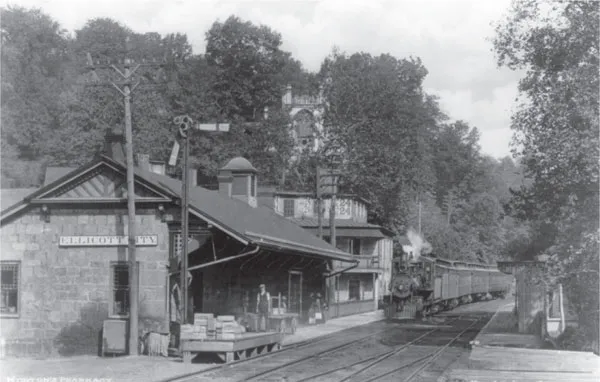
Baltimore & Ohio Railroad Ellicott Mills Station, built in 1830 as the first railroad terminus in the country. Howard County Historical Society.
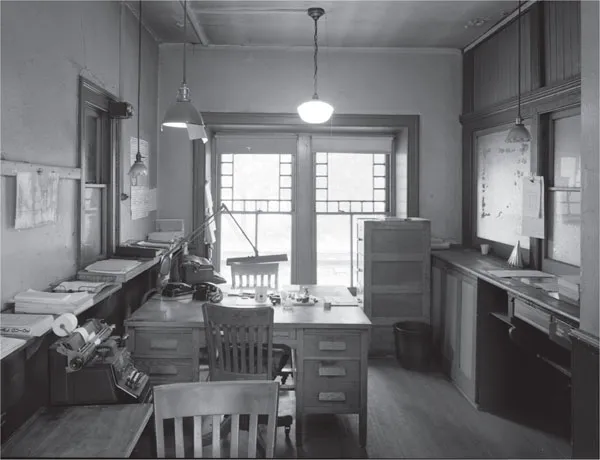
Station agent’s office at the Ellicott Mills Station. Library of Congress Historic American Buildings Survey.
In the mid-1800s, the station was remodeled. The freight area was turned into passenger waiting rooms, one for women and children and one for men. Sometime in the 1860s, a turntable was installed. Later, in 1885, E. Francis Baldwin designed the brick freight house at the south end of the station.
Passengers continued riding the rails until the 1950s, although by 1928, only three trains left Baltimore on the line each day. Freight service continued until the early 1970s. In 1972, Hurricane Agnes took out the B&O Railroad’s Old Main Line, and the tracks were unused for many years until CSX began running freight trains through the town again. As of this publication, freight trains regularly rumble past the old station, which is now used as a museum.
THE HAUNTING
From the deaths of hundreds who have been struck and killed by trains over the years to the heartbreaking loss of two teenaged girls who were crushed by tons of coal during a train derailment in 2012, the B&O Railroad Station has been the site of many arrivals and departures in this world and the next.
Anyone in Ellicott City who knows anyone who has worked at the B&O Railroad Station Museum has heard the stories. People working alone in the offices on the ground floor talk about the scraping and shuffling sounds of ghostly freight being moved around on the upper floor of the building. Newcomers rush up to find out what’s happening. Old-timers just shrug and get back to what they were doing.
Of course, not every haunting is the result of a death. Some are simply “recordings” of past events that keep being replayed and picked up by the living who are open to listening.
During one of the station’s Civil War programs, a group of Union reenactors were staying overnight in the station. One of the participants couldn’t sleep, so he went outside and sat on the steps of the station. While he was there, another man in military garb, who he thought was a Union reenactor, came up to him. He didn’t recognize him but assumed that he was friends with someone else in the group. They chatted for a minute or two, then the man said he had to go. As he was walking away, the reenactor called after him, “Hey, aren’t you going back to the station?” At that very moment, the man disappeared, vanishing into the mists rising from the Patapsco River.
The next morning, the reenactor looked around for the man he’d spoken with the night before. He described the man to his fellow reenactors and asked if they had invited him or knew where he was. No one recognized the other man by his description. When he talked with the station managers, he learned that the number of participants was exactly the same that had signed up to be there both inside and out. Everyone was accounted for, except the vanished Union soldier.
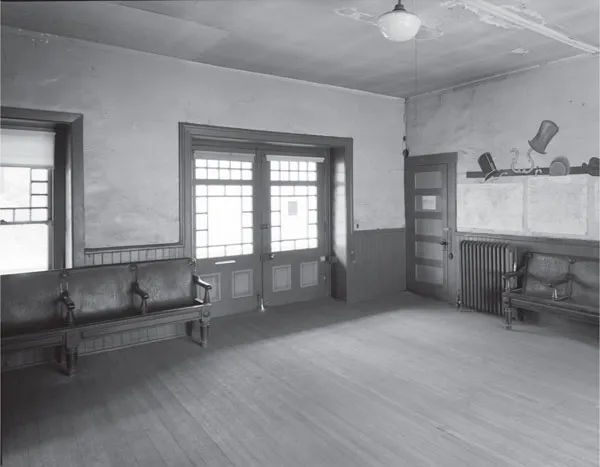
Passenger waiting room at the Ellicott Mills Station, where disturbing sounds are heard. Library of Congress Historic American Buildings Survey.
Trains have likely claimed hundreds of lives since the tracks were first laid in the 1830s. There’s no reason to believe that they won’t claim more. Perhaps the ghosts of the unfortunate victims of these railroad tragedies linger on to warn the living about the dangers of tempting fate and these hurtling engines of death.
![]()
2
THE RAILROAD HOTEL
A REFUGE FOR AN ESCAPED CONFEDERATE PRISONER WHO MAY HAVE MANAGED TO OUTRUN DEATH.
ALTHOUGH THE BUILDING IS PLAIN and unremarkable, hidden behind the silent stone face of 8030, 8032 and 8034 Main Street is a treasure trove of secrets. The first account involves little-known stories of Ellicott City’s bustling days as a commercial hub. The second is a haunting that may be an eternal replay of a Civil War–era murder that continues to reverberate today.
THE HISTORY
Constructed between 1832 and 1847 by Andrew McLaughlin on land he purchased from Andrew and John Ellicott, this four-story granite block structure was built as a hotel to house railroad workers. The building was originally partitioned into eighteen individual rooms, each with its own fireplace. The halls were narrow, as were the twenty-six-inch-wide staircases at each side of the building.
The earliest written record is an indenture dated November 6, 1847, from the Granite Manufacturing Company to Thomas Wilson that also mentions an old right-of-way for wagons and stagecoaches to bring supplies and mail to the establishment.
After the end of the Civil War, the building seemed to be used for retail commercial purposes. A lease dated May 16, 1877, shows that Thomas Wilson rented a shop to Prussian “confectioner” Albert Hermes for fifteen dollars a month.
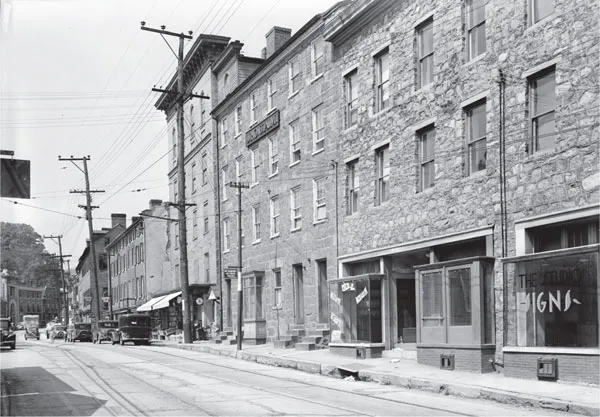
The Railroad Hotel (third building from right) and the Town Hall (fourth from right). Library of Congress Historic American Buildings Survey.
Wilson died in 1879, and the building, along with the Patapsco Hotel next door, was sold to Thomas Hunt in 1881 for $4,000. The Railroad Hotel remained in the Hunt family until their trustee conveyed the hotel to Edwin Rodey on September 6, 1912. The next year, Rodey sold the building to a charitable social organization called Howard County Forty-Six, Junior Order United American Mechanics of Howard County for $3,000.
The Mechanics organization held on to the building through most of the twentieth century, selling it to a Mr. and Mrs. John Baker in 1960. In 1972, Mr. and Mrs. Thomas Cate bought the property. They turned around and sold it to John and Mary Swan in March 1973. The Swans owned it until 1985, when they sold it to the 8030 Main Street Partnership for $215,000. The partnership later sold the 5,248-square-foot building to ECH LLC in 2002 for $325,000.
Over its nearly two hundred years on Main Street, the building has been home to dozens of businesses and organizations. Among them are Turn Over a New Leaf, the Meeting House, Caryl Maxwell Ballet, New Covenant Faith Fellowship, Upper Room, ZeBop, Randoph C. Ruckert Accountants, Concatentions, Automotive Publications, the Garden Creative, Affairs Remembered, Cima Talent, Lamp & Gift, Summer of Love and many others.
THE HAUNTING
The story begins and ends in darkness one night during the years when the Civil War was ripping the country apart along the seams of Maryland’s western and northern borders.
It’s said that on this night, a young Confederate soldier escaped from the custody of Union troops guarding the Thomas Viaduct in Elkridge. After sneaking away, he slipped into the inky blackness of the woods of what is now the Patapsco State Park and made his way down the railroad tracks.
Lost and disoriented, he decided to follow the tracks, hoping that they led south toward Washington, D.C., and back toward home. Unfortunately for him, they didn’t. The tracks the escaped Confederate ran along for miles and miles ran straight into Ellicott City.
When the lights of the town came into view, he was horrified. He recognized the skyline from earlier in the week, when he had been transported through it by train from western Maryland, where he’d been captured.
His horror was completely justified. The town was home to the Patapsco Guard and a provost marshall’s office, so Union soldiers were everywhere. He stumbled into town along Maryland Avenue near the B&O Railroad Station’s freight house and slipped into Tiber Alley. After stealthily looking both ways, he crossed Main Street and ran up the long flight of stairs next to the Railroad Hotel, hoping he could get in and find a closet to hide in. But it was too late.
The Union soldiers in Elkridge had telegraphed a warning about their escaped prisoner. By the time he got to town, they were already on the lookout for him. And they didn’t have to look far, because many of the Patapsco Guard were bunking at the Railroad Hotel.
The story goes that the young Confederate made it to the third floor of the hotel, where two Union soldiers saw him. Frightened, he turned around and started running down the same steps he had just come up, hoping he could escape and run into the woods along the train tracks as he’d done in Elkridge.
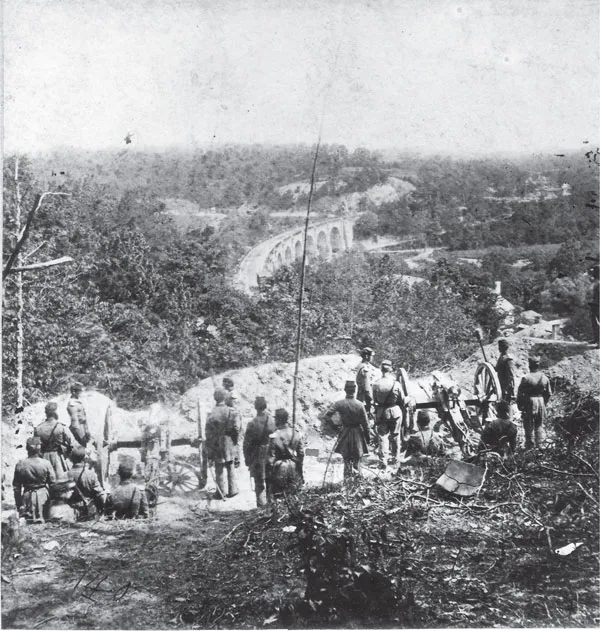
The Sixth Massachusetts and Eighth New York Regiments and Major Cook’s Boston Light Artillery guarding the Thomas Viaduct, May 5, 1861. Howard County Historical Society.
Unfortunately, this time he was not so lucky. He had taken just a few strides down the dark steps when one of the Union soldiers took aim and shot him in the back. The impact of the bullet tumbled him head over heels down the steep steps. By the time the two soldiers got to him, he was dead. When they turned him over, they saw his lifeless eyes slowly open to stare up at the moonless sky.
The killing could be called justified, since the Civil War was raging and the man was an escaped Confederate soldier. But since he was shot in the back, murder might be a more appropriate description.
Whatever one wants to call it, the violence of this tragic event seems to be trapped in time. It’s a paranormal recording that, on moonless nights, plays over and over again. Witnesses to the phenomenon say they’ve heard the pounding sound of running feet on the third floor of the building where the presence of the young soldier can still be sensed. Paranormal investigators have detected motion on the steps. And a few say they have seen the shadowy apparition of a Confederate soldier running for his life down the steep outdoor stairway between the Railroad Hotel and the Town Hall. Even in death, there seems to be no rest in Ellicott City for this runaway Civil War prisoner.
![]()
3
TOWN HALL
DEADLY DRAMAS TAKE THE STAGE AT AN EMPORIUM FILLED WITH HISTORY AND HORRORS.
EASILY THE TALLEST BUILDING ON Main Street, the Town Hall may also be among the oldest. Known variously as the Opera House, the “new Town Hall,” Rodey’s Amusea and, most recently, the home of the Forget-MeNot-Factory, the structure located at 8044 Main Street is built into the steep granite slope on the north side of what was originally the Old National Road. Over the past two centuries, the Town Hall has opened its doors to a wide variety of visitors and residents. Most moved on, but, according to local lore, some spirits remain there to this day to give the living a glimpse of the lives left behind.
THE HISTORY
Rising five stories above Main Street, the towering stone and brick Town Hall building is erected on land owned by the Ellicott family. The first building on the property may have been the humble stone tavern described by Joseph Scott, author of the Geographical Description of Ellicotts Mills, published in 1807.
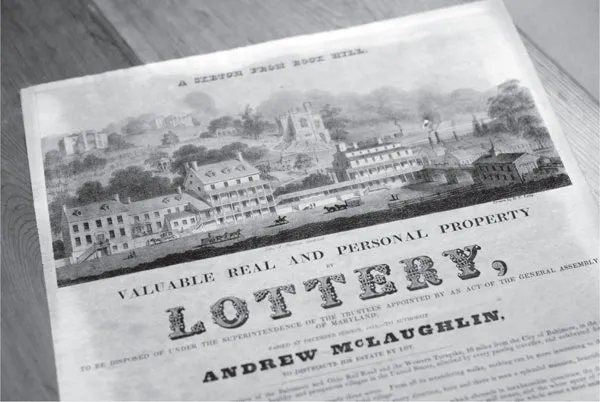
In 1830, the Ellicotts partitioned the land, and Lot 4 passed into the hands of Andrew and John Ellicott. They sold the lot that the Town Hall would be built on to Andrew McLaughlin of Baltimore, who quickly got into financial trouble. In late 1833, he persuaded the Maryland General Assembly to allow him to hold a lottery the following year to sell off his property.
The 1834 lottery poster shows the Patapsco Hotel and other major landmarks at the time. From the Howard County Historical Society’s archives. Steve Freeman.
Participants in the 1834 lottery paid ten dollars per ticket for the chance to win McLaughlin’s lots and buildi...