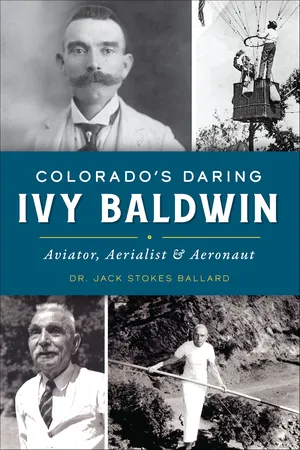
At the beginning of the twentieth century, aerialist Ivy Baldwin had achieved celebrity status as a premier tightrope walker, aeronaut and aviation pioneer. He executed astonishing and perilous performances across America and internationally, including Mexico and the Far East. First by flying balloons, he went on to pilot dirigibles and, finally, aircraft. In his later years in Colorado, he became famous for crossing canyons on a tightrope. Historian Jack Stokes Ballard deftly captures Baldwin's colorful and hazardous life from childhood runaway to aviation record holder.
- 112 pages
- English
- ePUB (mobile friendly)
- Available on iOS & Android
eBook - ePub
About this book
Trusted by 375,005 students
Access to over 1.5 million titles for a fair monthly price.
Study more efficiently using our study tools.
Information
Subtopic
Military BiographiesIndex
History1
A DARING CAREER BEGINS
He knew absolutely nothing about a balloon, but he had the nerve, and that is the stuff that aeronauts are made of.
—Houston Daily Post, 1905
The impressive list included acrobat, aeronaut, balloonist, parachute jumper, trapeze artist, tightrope walker, entertainer and aviator. Those were some of the titles assigned to one man, the legendary Ivy Baldwin. Also, citizens from many other countries, and especially those from the state of Colorado, attached to those titles such colorful descriptive terms as reckless, crazy, daring and courageous. While Ivy Baldwin truly earned all those titles, they did not fully capture Ivy Baldwin the man. He had a unique personality and was an individual whom many never knew. Without a doubt, in the late nineteenth and early twentieth centuries, Ivy Baldwin, the master of so many entertaining aerial acts, reigned at or near the top of the United States’ professional aeronauts. Few believed he could be surpassed in his aerial artistry and achievements, and they made him famous in his time and for the following generations.2
Born in Houston, Texas, on July 31, 1866, the fourth son of John H. and Elizabeth Ivy, the future “Ivy Baldwin” entered the world as William Ivy. In the family, he would always be called Willie. Little is known about his early childhood in south Texas, other than that he was a newsboy and shined shoes. As the years passed, he remained small in stature but very athletic.3 He would never exceed five foot three and one-half inches and 112 pounds. Ivy’s wiry, slender frame and wide-eyed face with very dark, bushy eyebrows gave him a long-enduring boyish appearance. Noted author Gene Fowler said Ivy had “squirrel-shooter eyes,” meaning they were intense and piercing.4 Perhaps the early arrival of a mustache helped establish that he had reached manhood. He lacked large, well-defined or articulated muscles, but he was especially strong. Very early, using his remarkable balance and body flexibility, he demonstrated gymnastic skills.5 He would put his size and these notable physical attributes to advantage as he rapidly evolved into a circus acrobat and trapeze performer.
Ivy ran away from his Houston home when he was thirteen.6 He claimed that his father beat him as a reason for leaving the family.7 He went to San Antonio and sold the San Antonio Express newspaper. One time, while watching a man walk the tightrope, he determined to try the stunt. He even did a walk across the San Antonio River. Later, while crossing a lake near Pedro Springs,8 he caught the eye of the owner of the Thayer-Noyes Circus. Hired on the spot, he then traveled with the circus and reportedly could do seven acts a day, quickly becoming one of the best performers. Later, he toured with the Sells Brothers Circus and soon developed into a more rounded showman by adding acrobatic and trapeze acts. Ivy often used an assumed billing name, as he feared his parents might pursue him. His early departure from his home and his subsequent circus performances reflected his adventuresome spirit and a strong desire to try almost anything. An element of wanderlust, appropriate for the circus shows, would dominate many years in Ivy’s life.
Ivy’s daring acts caused many injuries. He suffered a broken ankle and ribs at Wichita Falls, Texas, in 1882, when a drunk rode a horse into some men holding his tightrope guywires.9 Regardless of injuries, Ivy enjoyed the itinerant lifestyle and the attention he received in a traveling circus show.
One of Ivy’s favorite stories of his early years—and he had many of them—concerned a tightrope walk in Baltimore. During a Shriners’ convention, he was to do a wire walk from 120 feet over a street. After the first performance, he encountered the police, who informed him that the city had an ordinance banning any aerial act without a safety net under it. He received a fine of five dollars. Ivy then went to the port docks, bought an old fishing net and laid it on the pavement under the wire for the next day’s exhibition. He succeeded in avoiding another fine, and he delighted in claiming that he had out-foxed the police and city authorities.10
Ivy expanded his circus skills to balloon ascensions, and he claimed that he made his first balloon ascension in Terre Haute, Indiana, in 1879.11 He described his introduction to ballooning this way: “One of the regular men with the circus that used to make the balloon ascension, he got on a drunk, didn’t show up, so the manager asked me if I could go up and I went up with the balloon, and after that I took to ballooning.”12
Later, a Houston newspaper interview made the observation that “he knew absolutely nothing about a balloon, but he had the nerve, and that is the stuff that aeronauts are made of.”13 Indeed, Ivy would become noted for his nerve, a characteristic that attracted paying spectators.
The fearless adolescent William Ivy soon caught the attention of two other circus showmen, brothers Tom and Sam Baldwin. Thomas Scott Baldwin acted as a leader and star performer for the Baldwin Brothers troupe, while Samuel Yates Baldwin often served in a more supportive way, such as fueling a balloon.14 The Baldwins knew about a rising and talented young acrobat named William Ivy through contacts with many of their circus colleagues. Tom Baldwin had actually worked with Ivy as an acrobat in 1883. They decided to recruit Ivy as a Baldwin show tightrope walker, trapeze performer and balloonist. They wrote to Ivy, proposing that they form an exhibition team. William Ivy was receptive to the Baldwin proposal, which would lead to becoming virtually a partner. He reported to the Baldwin Brothers headquarters and Baldwin home in Quincy, Illinois, in the fall of 1889. Very quickly, Tom Baldwin and Ivy combined various stunts and soon added dramatic parachuting from a balloon.15
Thomas Baldwin, manager of the Baldwin Brothers show, had already earned a reputation as an outstanding aeronaut in the United States. Furthermore, his athletic appearance impressed crowds along with his daring acts. An English journalist described Tom Baldwin as “a clean- limbed, well-built man, evidently of enormous muscular strength, and in the best of health.”16 At five feet ten inches tall and approximately 180 pounds, he had a far sturdier physique than Ivy.
Like Ivy, Thomas Baldwin started performing as an acrobat and slack wire walker. He first achieved widespread fame with an 1885 slack wire walk of seven hundred feet from Cliff House to Seal Rock over the roiling sea near San Francisco. He then turned to balloon ascensions and, even later, daredevil parachuting acts from balloons. His development of a flexible parachute used in balloon ascensions “stimulated in turn the revival of an earlier phase of aeronautics—the use of the hot-air balloon.”17 Tom Baldwin’s many experiences with balloons earned him at least one noteworthy label as a “Columbus of the Air.”18
Unfortunately, by 1889, Thomas Baldwin had gained considerable weight and was over two hundred pounds. This constituted a particular problem in balloon ascensions and parachuting.19 Recruiting the slight Ivy, who was six years younger than Tom, made good business sense. Furthermore, Ivy already possessed some parachuting skills, so he immediately became a featured performer.
It was during this time that William Ivy assumed the name Ivy Baldwin. In a much later interview, Ivy commented, “My right name is William Ivy, but I took that name Baldwin, I think it was 1887. Somewhere along there. I forgot the date I really did take the name.”20 The year seems to be 1889, when Ivy went to Quincy. According to Ivy, the primary reason for the name change was because “they didn’t want the third man to be any different so we just made it all three Baldwins. We were doing acts then, you know, you’ve seen the flying trapeze.”21 In time, Tom Baldwin took on a role as manager, while Ivy became the star performer.22
Balloon ascensions had been around for a long time, and by the 1880s and 1890s, they had occurred in most regions of the United States. The history of such dramatic aerial events and the enduring public fascination with them stretched back to the Montgolfier brothers in France in 1783. Americans quickly came into the ballooning picture. On December 1, 1783, Benjamin Franklin, in France at the time, observed the first ascension of a man in a balloon. Like so many others, he was intrigued with what he saw and wrote about such startling aeronautical activity. Franklin wrote to Sir Joseph Banks, president of the Royal Society in London, commenting, “All well satisfied and delighted with the success of the experiment, and amusing one another with discourses of the various uses it may possibly be applied to.” Prophetically, Franklin further added, “Among the pleasantries conversation produces on the subject, some suppose flying to be now invented, and that since men may be supported in the air, nothing is wanted but some light handy instrument to give and direct motion.”23 Ivy Baldwin and Tom Baldwin, along with many others, would strive to find some way to “give and direct motion,” as noted by Franklin, but they had found use of balloons in another way— public entertainment.
Balloons at the time of the Baldwins were mostly crude vehicles and were often constructed by performers themselves. For example, Ivy Baldwin and his wife made some of his balloons. When asked what his balloons were made of, Ivy replied, “They were made of sea-island cotton. Yes, something like a bed sheet.” He continued, “Then we put them over a stack and built a fire in the trench and let the soot stop up the pores, you know. When we got them stopped up, then we’ve got a good balloon that will go up about 3,000 feet.” As Ivy noted, the cotton sheet balloon was usually fueled by a fire via a fifteen-foot-long trench, and this “chimney” would feed the hot air to the balloon.24

Ivy Baldwin stands on the right edge of a balloon basket just before an ascent. History Colorado Collection.
Gas-filled balloons, most often with hydrogen produced by a combination of iron filings and sulfuric acid, were in use during this time, but the hot-air balloon proved most popular. The main reason was simple: hot-air balloons were cheaper to operate. Also, the exhibition balloonists found that it was easier to inflate the hot-air variety, and furthermore, they could recover the deflated bags with less inconvenience. Another factor was the ease with which a new recruit could operate the hot-air balloon. A raw recruit, like Ivy Baldwin, could learn hot-air balloon operation without knowing much about the science of aeronautics, while a gas balloon required more careful training.25
Controlling a balloon began with a mesh net over the top and dangling ropes with as many as twenty men tethering the gas bag while it filled. As the balloon was readied to rise, you could drop sandbags or ballast from the basket to produce the desired lift. A valve at the top could be opened to allow release of the hot air to descend. Balloonists were at the mercy of the wind, however, to go sideways after the men released the ropes.
Ivy Baldwin added more drama to his ascensions by dangling from a released rope. To the spectator, this appeared as if a man tethering the balloon had accidentally gotten entangled in the rising balloon’s ropes. Ivy would sometimes hang thirty feet below the balloon on one rope and then climb up the rope and enter the basket when the balloon rose to three thousand feet.26
Men like Ivy and Tom Baldwin were always showmen and entertainers. They fully realized when the ascensions became stale and they needed to add gimmicks to retain the interest of paying customers. One new twist to the ascension was a trapeze act on a bar suspended below the basket. Parachuting from the balloon produced still another thrill. Parachuting had, at one time, been popular with spectators in Europe and the United States. When Tom Baldwin performed with impresario Park A. Van Tassel, they decided to revive the parachuting stunt.
While performing during the winter in San Francisco, Tom Baldwin experimented with parachute designs. On January 30, 1887, ready to do a test, he made a highly publicized parachute jump. The first parachute drops were from tethered balloons, and later, Tom Baldwin became one of the first to do one from a free-floating balloon. It was the July 4 celebration in his hometown, Quincy, Illinois, however, when he established his reputation for his parachuting skills. Baldwin reported that he had engaged six women to sew and stitch nine hundred yards of canvas at a cost of $1,000 to create a ninety-foot-high special balloon labeled “City of Quincy” for the big civic event. Further, he had fabricated a parachute of twenty-six feet in diameter with a five-foot-diameter wicker basket below. The day before the main festival, balloon inflation began from a city gas main, and the next morning, the balloon was moved by wagon to Quincy’s Singleton Park. Tom Baldwin, dressed in a gray business suit, first announced the ascension and parachute drop would be postponed because of wind, greatly angering some eight to ten thousand spectators. Assessing the mood of the crowd, Baldwin decided to go ahead with the performance. After some frightening problems with men releasing the circle of retaining ropes and the discharge of ballast, the balloon rose rapidly. At more than four thousand feet, Baldwin made his drop, and th...
Table of contents
- Front Cover
- Title Page
- Copyright
- Dedication
- Contents
- Preface
- 1. A Daring Career Begins
- 2. Touring beyond the United States
- 3. Military Balloonist
- 4. Off to the Spanish-American War
- 5. Back to Denver
- 6. Airships and Airplanes
- 7. Eldorado Springs
- Notes
- Selected Bibliography
- About the Author
Frequently asked questions
Yes, you can cancel anytime from the Subscription tab in your account settings on the Perlego website. Your subscription will stay active until the end of your current billing period. Learn how to cancel your subscription
No, books cannot be downloaded as external files, such as PDFs, for use outside of Perlego. However, you can download books within the Perlego app for offline reading on mobile or tablet. Learn how to download books offline
Perlego offers two plans: Essential and Complete
- Essential is ideal for learners and professionals who enjoy exploring a wide range of subjects. Access the Essential Library with 800,000+ trusted titles and best-sellers across business, personal growth, and the humanities. Includes unlimited reading time and Standard Read Aloud voice.
- Complete: Perfect for advanced learners and researchers needing full, unrestricted access. Unlock 1.5M+ books across hundreds of subjects, including academic and specialized titles. The Complete Plan also includes advanced features like Premium Read Aloud and Research Assistant.
We are an online textbook subscription service, where you can get access to an entire online library for less than the price of a single book per month. With over 1.5 million books across 990+ topics, we’ve got you covered! Learn about our mission
Look out for the read-aloud symbol on your next book to see if you can listen to it. The read-aloud tool reads text aloud for you, highlighting the text as it is being read. You can pause it, speed it up and slow it down. Learn more about Read Aloud
Yes! You can use the Perlego app on both iOS and Android devices to read anytime, anywhere — even offline. Perfect for commutes or when you’re on the go.
Please note we cannot support devices running on iOS 13 and Android 7 or earlier. Learn more about using the app
Please note we cannot support devices running on iOS 13 and Android 7 or earlier. Learn more about using the app
Yes, you can access Colorado's Daring Ivy Baldwin by Dr. Jack Stokes Ballard in PDF and/or ePUB format, as well as other popular books in History & Military Biographies. We have over 1.5 million books available in our catalogue for you to explore.