- 128 pages
- English
- ePUB (mobile friendly)
- Available on iOS & Android
eBook - ePub
Onizuka Air Force Base
About this book
For nearly five decades, some of the United States military's most secretive operations were conducted out of a collection of nondescript buildings at the intersection of State Route 237 and Mathilda Avenue in Sunnyvale, California. The installation was known by a variety of names in its early years: Satellite Test Center, Air Force Satellite Control Facility, the "Blue Cube," and Sunnyvale Air Force Station. In July 1986, the facility was renamed Onizuka Air Force Base after Col. Ellison S. Onizuka, the first Asian American astronaut, who was killed during the space shuttle Challenger accident. The location was selected due to its proximity to Lockheed Missiles and Space Company's Sunnyvale facilities and supported early satellite reconnaissance programs such as Corona, Gambit, and Hexagon. As the nation's nucleus for satellite command and control, workers at Onizuka Air Force Base directed efforts for the National Reconnaissance Office (NRO), US military, and NASA's space shuttle program until the closure of the base in 2010.
Trusted by 375,005 students
Access to over 1 million titles for a fair monthly price.
Study more efficiently using our study tools.
Information
One
ELLISON SHOJI ONIZUKA
1946–1986
Ellison Shoji Onizuka, the eldest son of Masamitsu and Mitsue Onizuka, was born on June 24, 1946, in Kona, Hawaii. His parents were merchants who opened a general store in the early 1930s to serve the needs of local farmers. As he grew up in the middle of coffee plantations, Ellison was surrounded by two older sisters, Shirley and Norma, and one younger brother, Claude. In school, Ellison was a determined young man, participating in extracurricular activities—he was on the staff of the school paper, junior class treasurer, and in the National Honor Society, to name a few. His athletic ability also shone through in baseball, basketball, and many intramural sports. As a teenager, he earned the coveted Eagle Scout through exemplary work with the Boy Scouts of America. He graduated from Konawaena High School in 1964 and departed Hawaii for college in Colorado soon after.
Ellison chose the University of Colorado, Boulder, for its aerospace engineering program, earning both a bachelor’s and a master’s degree in aerospace engineering in 1969. He participated in the university’s Air Force ROTC, earning a commission as a second lieutenant, and the distinguished military graduate entered active duty in January 1970. Serving as a flight test engineer and later graduating from the USAF Test Pilot School, Onizuka learned how to judge performance, stability and control, and systems flight testing of aircraft, logging more than 1,700 hours of flying time in various types of aircraft.
Selected as an astronaut candidate in 1978, Onizuka completed a one-year training and evaluation program in 1979. He worked on orbiter test and checkout teams and on the Shuttle Avionics Integration Laboratory team before being selected for his first space flight aboard Discovery in 1985, becoming the first Asian American in space. STS-51-C was Discovery’s first mission for the Department of Defense, and Onizuka was responsible for the Inertial Upper Stage (IUS). He was selected for his second space mission aboard Challenger soon after. After the Challenger tragedy, Onizuka’s accomplishments were recognized by many memorials, including the renaming of a nondescript Air Force station in Silicon Valley in July 1986.

This official STS-51-L crew photograph of Lt. Col. Ellison S. Onizuka was taken four days before the ill-fated Challenger accident. As a spaceflight veteran of STS-51-C, Onizuka’s powder-blue NASA flight suit is adorned with the previous mission patch. (NASA.)

NASA’s astronaut candidate class of 1978, unofficially known as the “TFNGs,” included six women, three African Americans, and an Asian American (Onizuka, second row from bottom). This was the first new group of astronauts since 1969, hence the acronym. Wanting to introduce diversity into the astronaut corps for the space shuttle era, NASA contracted actress Nichelle Nichols (Lieutenant Uhura on Star Trek) to recruit for the agency in the late 1970s. (NASA.)

The crew of mission STS-51-C poses in NASA flight suits. From left to right are (first row) pilot Loren Shriver and commander Thomas K. Mattingly II; (second row) payload specialist Gary E. Payton, mission specialist James F. Buchli, and mission specialist Ellison S. Onizuka. Astronaut Payton’s USAF shoulder patch identifies him as a manned spaceflight engineer (MSE), a Department of Defense effort to create a cadre of military astronauts. (NASA.)

The same crew is seen here. From left to right in their military uniforms are (first row) Lt. Col. Loren Shriver (USAF) and Capt. Thomas K. Mattingly II (USN); (second row) Maj. Ellison S. Onizuka (USAF), Lt. Col. James F. Buchli (USMC), and Maj. Gary E. Payton (USAF). STS-51-C was the first dedicated Department of Defense flight in the space shuttle program. Few flight details were acknowledged before, during, or after the mission. (Department of Defense.)
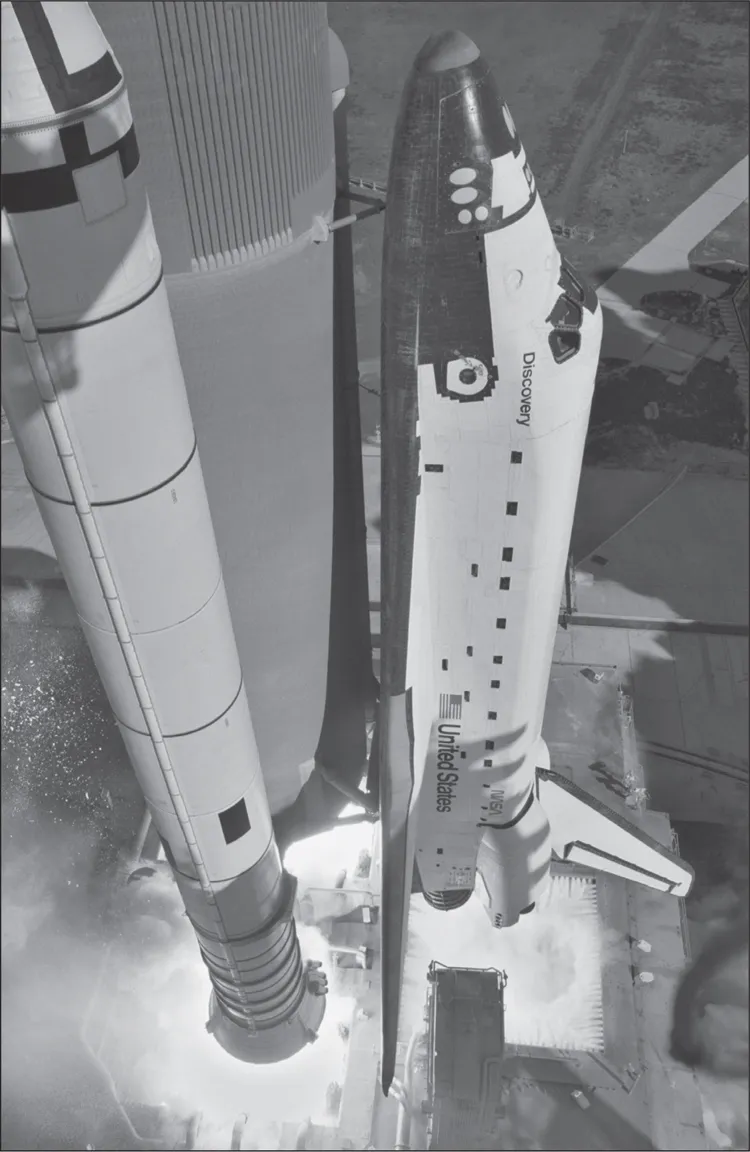
Discovery takes off from Cape Canaveral, Florida, on January 24, 1985, for mission STS-51-C. Discovery was the first shuttle orbiter built to lift reconnaissance payloads into orbit. Discovery was intended to be stationed at Vandenberg Air Force Base in California for polar-orbiting missions, giving the Air Force a “Blue Shuttle” (military) launch capability. Weighing 6,870 pounds less than Columbia or Challenger, Discovery could lift a larger payload into a polar low earth orbit than the earlier orbiters. During STS-51-C post-mission analysis, NASA engineers discovered the O-rings, required to seal the hot gases inside the combustion chambers of the solid rocket booster while firing, showed heavy charring. According to the Rogers Commission report, this defect, combined with cold weather, was the primary contributor to the explosion of Challenger during STS-51-L almost one year later. (NASA.)
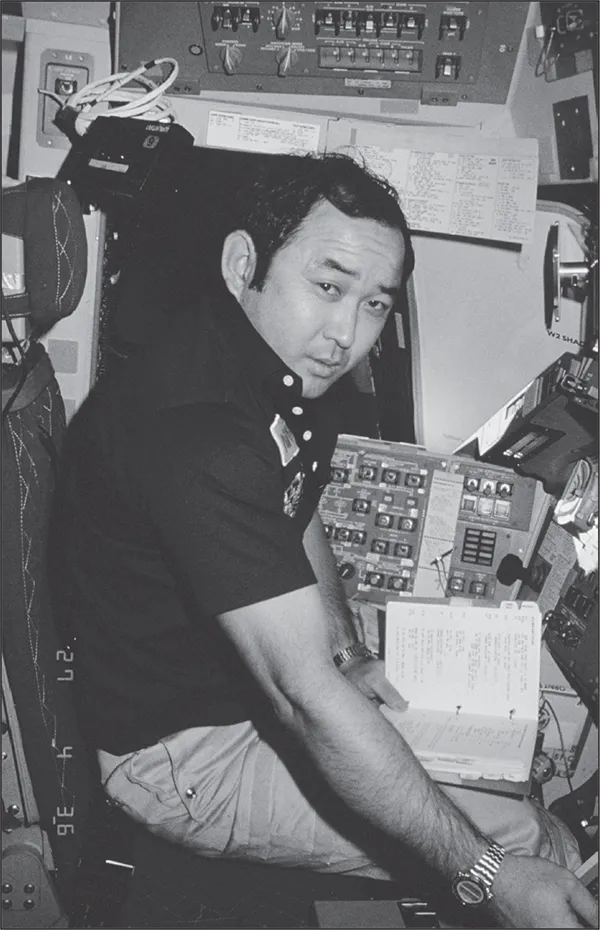
El Onizuka sits in the commander’s seat while running a checklist. The flight of STS-51-C lasted three days, one hour, and thirty-three minutes; this was the shortest operational flight and the third-shortest in the entire 135-mission shuttle program. During the flight, NASA would broadcast short messages stating that the flight was “nominal” but nothing more. One could assume the AFSCF in Sunnyvale was busy during the same period. (NASA.)

El Onizuka and Loren Shriver experience weightlessness. The camera provides an artificial sense of what is “up” or “down,” but in microgravity the references are meaningless. One interesting detail about STS-51-C was released by NASA in post-flight documents: “The U.S. Air Force Inertial Upper Stage booster was deployed and met the mission objectives.” (NASA.)

Above, El Onizuka eats a meal with chopsticks in microgravity. The early days of the space shuttle program saw astronauts try new activities in microgravity, such as eating new foods and playing with simple toys, to compare against their earthbound experiences. As a second-generation Japanese American, El Onizuka was extremely proud of his heritage and took opportunities to share his experiences and cultural nuances with the crew and members of the American public. His wearing a hachimaki, or stylized headband, with the phrase “Kamikaze” on the side seems to echo stories of Onizuka’s sense of humor from his astronaut colleagues. (Both, NASA.)

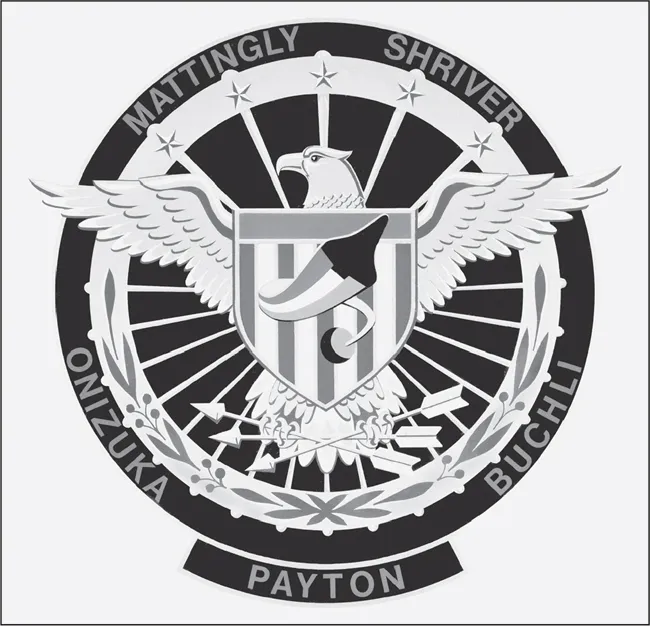
The logo of STS-51-C, NASA’s 15th overall shuttle flight, prominently displays heraldry common within military emblems. The eagle holding arrows in its talons is part of the US Department of Defense logo. The heraldic shield in the center shows a shuttle with a red, white, and blue ribbon streaming from the Earth. The names of the crew are spaced around the patch, with MSE Payton’s name at the bottom. (NASA.)

The STS-51-C crew is seen outside the Consolidated Club in late 1984. During this visit to Sunnyvale AFS, the crew followed strict operational security p...
Table of contents
- Cover Page
- Title Page
- Copyright Page
- Dedication
- Table of Contents
- Acknowledgments
- Introduction
- 1. Ellison Shoji Onizuka: 19461986
- 2. Birthplace of Space Reconnaissance: 19591969
- 3. Hip to Be Cubed: 19692009
- 4. Gateway to the Stars
- 5. Enigmatic Emblems
- 6. Passing the Torch: 2010
- Bibliography
- About the Sunnyvale Historical Society and Museum Association
Frequently asked questions
Yes, you can cancel anytime from the Subscription tab in your account settings on the Perlego website. Your subscription will stay active until the end of your current billing period. Learn how to cancel your subscription
No, books cannot be downloaded as external files, such as PDFs, for use outside of Perlego. However, you can download books within the Perlego app for offline reading on mobile or tablet. Learn how to download books offline
Perlego offers two plans: Essential and Complete
- Essential is ideal for learners and professionals who enjoy exploring a wide range of subjects. Access the Essential Library with 800,000+ trusted titles and best-sellers across business, personal growth, and the humanities. Includes unlimited reading time and Standard Read Aloud voice.
- Complete: Perfect for advanced learners and researchers needing full, unrestricted access. Unlock 1.4M+ books across hundreds of subjects, including academic and specialized titles. The Complete Plan also includes advanced features like Premium Read Aloud and Research Assistant.
We are an online textbook subscription service, where you can get access to an entire online library for less than the price of a single book per month. With over 1 million books across 990+ topics, we’ve got you covered! Learn about our mission
Look out for the read-aloud symbol on your next book to see if you can listen to it. The read-aloud tool reads text aloud for you, highlighting the text as it is being read. You can pause it, speed it up and slow it down. Learn more about Read Aloud
Yes! You can use the Perlego app on both iOS and Android devices to read anytime, anywhere — even offline. Perfect for commutes or when you’re on the go.
Please note we cannot support devices running on iOS 13 and Android 7 or earlier. Learn more about using the app
Please note we cannot support devices running on iOS 13 and Android 7 or earlier. Learn more about using the app
Yes, you can access Onizuka Air Force Base by Joseph T. Page II in PDF and/or ePUB format, as well as other popular books in Technology & Engineering & Military & Maritime History. We have over one million books available in our catalogue for you to explore.