- 144 pages
- English
- ePUB (mobile friendly)
- Available on iOS & Android
eBook - ePub
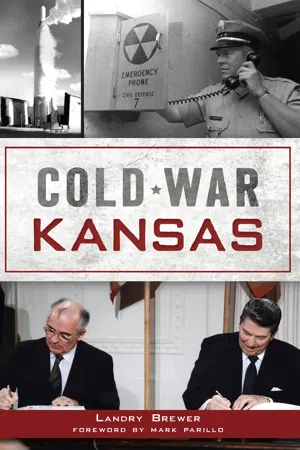
Cold War Kansas
About this book
Kansas played an outsized role in the Cold War, when civilization's survival hung in the balance. Forbes Air Force Base operated nine Atlas E intercontinental ballistic missile launch sites. Schilling Air Force Base was the hub for twelve Atlas F ICBMs. McConnell Air Force Base operated eighteen Titan II ICBMs. A Kansas State University engineering professor converted a discarded Union Pacific Railroad water tank into his family's backyard fallout shelter. A United States president from Kansas faced several nuclear war scares as the Cold War moved into the thermonuclear age. Landry Brewer tells the fascinating story of highest-level national strategy and how everyday Kansans lived with threats to their way of life.
Information
Subtopic
Military & Maritime HistoryIndex
History1
COLD WAR ORIGINS
Though the United States and the Soviet Union were allies during World War II, the two nations became adversaries when the war ended in 1945.2 The Nazi military had taken control of Eastern Europe by the end of 1941. When the war ended four years later, the Red Army, having defeated the German army on its march to Berlin, controlled that territory for the Soviet Union. “The Soviet Union occupied East Europe. This crucial result of World War II destroyed the Grand Alliance and gave birth to the Cold War,” according to historians Stephen Ambrose and Douglas Brinkley.3
At the February 1945 Yalta Conference, three months before World War II ended in Europe with Germany’s surrender, leaders of the United States, Great Britain and the Soviet Union—Franklin Roosevelt, Winston Churchill and Joseph Stalin, respectively—agreed to postwar arrangements in Europe. In return for the Soviet Union joining the war against Japan within three months of Germany’s surrender, Roosevelt and Churchill consented to allow the Soviet Union to exert control over Eastern Europe—but only if Stalin promised to allow free elections there. Stalin agreed. However, Stalin “never accepted the Western interpretation of the Yalta agreements.”4 The Soviet Union controlled Eastern Europe and did not intend to relinquish that control.
The United States dropped two atomic bombs on the Japanese cities Hiroshima and Nagasaki in August 1945. Shortly thereafter, the Japanese government surrendered, and World War II ended. As conditions between the former war allies worsened and the Soviet Union consolidated control over much of Europe, former British prime minister Winston Churchill played the role of prophet when he delivered a March 5, 1946 speech in President Truman’s home state at Westminster College in Fulton, Missouri, with the president seated nearby. In what is now known as the “Iron Curtain” speech, Churchill said this about Soviet control of the eastern portion of a divided Europe:
From Stettin in the Baltic to Trieste in the Adriatic an iron curtain has descended across the continent. Behind that line lie all the capitals of the ancient states of Central and Eastern Europe. Warsaw, Berlin, Prague, Vienna, Budapest, Belgrade, Bucharest and Sofia; all these famous cities and the populations around them lie in what I must call the Soviet sphere, and all are subject, in one form or another, not only to Soviet influence but to a very high and in some cases increasing measure of control from Moscow.5
By 1947, President Truman’s foreign policy toward the Soviet Union and Communism had intensified. State Department official William C. Bullitt gave a mid-1947 speech at the National War College in which he likened Stalin to Hitler and said that the Soviet Union wanted to conquer the world. Communists threatened to replace the British-supported Greek government, though British aid and forty thousand British troops in Greece were preventing that from happening. When the British government informed the Americans in February 1947 that no further aid would be forthcoming and British troops would soon return home, President Truman decided that the United States must intervene. He believed that if Greece fell to Communism, its neighbor Turkey, which had been pressured by the Soviet Union to allow it a military presence there, would be next to fall. On March 12, 1947, President Truman addressed a joint session of Congress, appealing for American aid for both countries, announcing the Truman Doctrine: “I believe that it must be the policy of the United States to support free peoples who are resisting attempted subjugation by armed minorities or by outside pressures.”6
Congress granted Truman’s request with $400 million in aid for Greece and Turkey, and the United States began a new era. “For the first time in its history, the United States had chosen to intervene during a period of general peace in the affairs of peoples outside North and South America.”7 President Truman articulated the American government’s new policy of containment, through which the nation sought to stop the spread of Soviet Communism.
According to Truman biographer David McCullough, American policy toward the Soviet Union changed markedly after Secretary of State George Marshall returned from a 1947 meeting with his European counterparts. Marshall told Truman that the United States could not deal with the Soviets and diplomacy was destined to fail. By late 1947, the conflict between the United States and the Soviet Union was being called the “Cold War” by columnist Walter Lippmann. Though the expression had been used earlier, Lippmann was the first to attach it to the increasingly hostile East-West divide.8
Secretary Marshall returned on Saturday, April 26, 1947, shocked by what he had seen in Berlin and Western Europe during his trip, which included a visit to Moscow for talks with the Soviet government. Slow to recover economically from the ravages of World War II, Western Europe was teetering on the brink of economic collapse and needed to be rescued. Marshall instructed his State Department to formulate a plan to give economic aid that would help revive Europe’s economy. “Millions of people were slowly starving. A collapse in Europe would mean revolution and a tailspin for the American economy.”9 Marshall announced the European Recovery Program—its goal to help prevent economic collapse and starvation, ensure that the United States had economically viable trading partners in Europe and stave off a Communist takeover of Western Europe—during a June 5 speech at Harvard in which he announced the plan’s intent:
Our policy is directed not against any country or doctrine, but against hunger, poverty, desperation and chaos. Its purpose should be the revival of a working economy in the world so as to permit the emergence of political and social conditions in which free institutions can exist.10
The amount requested for what came to be called the Marshall Plan was $17 billion. Fearing Congress would refuse to appropriate the money, President Truman met with Speaker of the House Sam Rayburn to sell the idea. “Truman said there was no way of telling how many hundreds of thousands of people would starve to death in Europe and that this must not happen, not if it could be prevented.” The president “was also sure… that if Europe went ‘down the drain’ in a depression, the United States would follow.” He said to the speaker that they had “‘both lived through one depression, and we don’t want to have to live through another one, do we, Sam?’” The Marshall Plan was passed by the Congress almost one year after Marshall’s Harvard speech, in April 1948.11
The National Security Act of 1947 was also important for American Cold War military operations and foreign policy. President Truman sent the bill to Congress for its consideration in February to reorganize the nation’s military so that its several branches were all brought under the oversight “of a single Department of Defense and a single Secretary of Defense.” In addition to creating the DOD, the legislation also created a separate air force, removing it from the army. The act also created the National Security Council and the Central Intelligence Agency.12
The eastern portion of Berlin had been occupied by the Soviets, with the Americans, British and French in the western portion of the city since World War II ended, each country within its own sector. In the summer of 1948, Joseph Stalin ordered a blockade of Berlin to prevent the Western powers from gaining access to the city by ground or water transport in an attempt to starve the democracies into submission and force them out of the city. Opinions within the American government differed as to what the country’s response should be, though President Truman was adamant that the United States stand its ground. Army Chief of Staff Omar Bradley recommended to President Truman that access to West Berlin could be gained by air. Soon, “air transport… flying round-the-clock missions into Berlin, supplying up to 13,000 tons of goods per day” commenced, and “the Berlin airlift caught the imagination of the world.”13 With the airlift lasting just under one year before Stalin finally called it off in 1949,
official U.S. Air Force numbers include[d]: total cargo delivered to Berlin—2,325,809 tons, 1,783,573 of those by the Air Force and 542,236 tons by the Royal Air Forces of Britain, Australia and New Zealand, along with private aircraft chartered by the British government. The total number of flights into Berlin was recorded as 277,569—189,963 by the Americans, and 87,606 by the British and their Commonwealth partners.14
The triumph of the Berlin airlift overlapped with another diplomatic triumph: the North Atlantic Treaty Organization (NATO). Delivering his inaugural address after winning the 1948 presidential election, Truman “pledged…to aid those European nations willing to defend themselves.” Carrying out the president’s wishes, Secretary of State Dean Acheson brokered the North Atlantic Treaty, which was signed on April 4, 1949, in Washington, D.C. “Britain, France, Belgium, the Netherlands, Italy, Portugal, Denmark, Iceland, Norway, Canada, and the United States pledged themselves to mutual assistance in case of aggression against any of the signatories.”15 NATO was born, furthering the cause of containment in Europe.
Any feelings of triumph were overwhelmed by concern as summer became fall in 1949. In early September, a U.S. Air Force plane discovered radioactivity over the northern Pacific Ocean. On Monday, September 19, the scientists who reviewed the radioactive samples that had been gathered concluded that the Soviet Union had, for the first time, detonated an atomic bomb. The American atomic monopoly had ended. President Truman was informed the next day. He released a statement to the press Friday, September 23, informing the American public, and though there was no panic in the country, the fears and tensions of the Cold War were greatly amplified. It was a different world now.”16
Early the next month, the years-long Chinese civil war fought between Communists led by Mao Tse-tu-ng and Nationalists led by American ally Chiang Kai-shek came to an end. Although the United States had spent billions of dollars supporting Chiang in hopes of staving off Communism’s advances in China since World War II ended, it was not enough. Just one week after President Truman informed the American people that the Soviet Union had acquired its own atomic bomb, “the People’s Republic of China, the most numerous Communist nation in the world, with more than 500 million people, one fifth of humanity, was officially inaugurated.”17
That same month, October 1949, the Cold War intensified yet again. Soon after President Truman informed the nation that the Soviets had the atomic bomb, American officials began to discuss pursuing “a thermonuclear or hydrogen weapon—a superbomb, or ‘Super’—which would have more than ten times the destructive power of the bombs dropped on Hiroshima and Nagasaki.”18 The belief was that if the Soviets had the capacity to build an atomic bomb, they would likely have the means and desire to create their own thermonuclear bomb, which meant that the United States must also have this weapon. President Truman agreed with his advisors who followed this logic, and on January 31, 1950, he officially signed off on developing the hydrogen—or thermonuclear—bomb.
Because of Communist ascendancy in China, the Soviet acquisition of the atomic bomb and the specter of a Soviet thermonuclear bomb—and the domestic political pressure that these events created—on January 30, 1950, President Truman tasked the Department of State and the Department of Defense with reviewing the nation’s defense and foreign policy. A report was prepared, forwarded to the National Security Council and then delivered to the president as National Security Council Paper No. 68, or simply NSC 68. The report advocated a massive military buildup in an effort to offset Communist gains and discourage further Soviet expansion. It predicted that “the Soviets would probably achieve nuclear equality by 1954,” and although “no cost estimates were included, the figures discussed with Truman ranged from $40 to $50 billion a year, at least three times the current military budget.” The report ended ominously: “‘The whole success hangs ultimately on recognition by this government, the American people and all the peoples that the Cold War is in fact a real war in which the survival of the world is at stake.”19
That summer, Communist North Korean troops invaded South Korea. The United States would fight a three-year war trying to restore the status quo ante bellum and prevent a Communist takeover of the southern half of the Korean Peninsula. Then, in the 1960s, Americans began fighting another war, a decade-long conflict in Southeast Asia, to prevent a Communist takeover in South Vietnam. Between the two Cold War–inspired hot conflicts, the United States and the Soviet Union would reach the brink of nuclear war, each with long-range bombers and ballistic missiles that could fly thousands of miles with nuclear bombs capable of inflicting civilization-ending destruction. Then, as the 1970s became the 1980s, the nuclear arms race between the United States and the Soviet Union resumed, and new fears of nuclear war emerged. Throughout these decades, Americans—including Kansans—hoped for the best but prepared for the worst. The Cold War ushered in a different world, indeed.
2
KANSAS MISSILES
As the Soviet Union appeared to surpass American nuclear capability in the late 1950s, the United States government moved quickly to reassert its nuclear dominance.20 That nuclear dominance was on display in the early 1960s in Kansas as several locations near Forbes Air Force Base, Schilling Air Force Base and McConnell Air Force Base operated intercontinental ballistic missiles (ICBMs) as part of the nation’s offensive nuclear arsenal. Additionally, the state operated defensive antiaircraft missile sites to protect one of the state’s most important cities against possible attack. Housing those missiles required massive construction projects that provided thousands of individuals with jobs and infused the state with large sums of money, which was welcomed by many Kansans, who learned to live with nuclear weapons in their midst. Most importantly, those ICBMs fortified the nation’s nuclear deterrent, and antiaircraft missiles defended Americans during the Cold War’s most dangerous years.
ATLAS
During Dwight Eisenhower’s presidency (1953–61), American defense policy relied heavily on the nation’s nuclear arsenal deterring Soviet aggression against the United States or its allies. President Eisenhower assumed office wanting to spend less money than his predecessor on national defense by reducing conventional forces and their costs. Instead, Eisenhower believed that the nation could get more for its money while maintaining its security by responding to Soviet threats against the United States and its allies with threats of nuclear retaliation. Called the “New Look” by the administration and “Massive Retaliation” by the media, Eisenhower’s policy of nuclear deterrence relied on American nuclear superiority.21
Central to this deterrence was development of ICBMs. The nation’s first ICBM was the Atlas. Development of the Atlas missile had begun by the early mid-1950s, but things changed dramatically when the Soviet Union announced that it had successfully launched the world’s first ICBM in August 1957 and launched the Sputnik satellite just two months later. Pressure quickly mounted on the American government to complete the Atlas project. The Cold War power balance had shifted dramatically in 1949 when the Soviet Union acquired an atomic bomb, and the power balance appeared to radically shift again eight years later. The United States scrambled to right the perceived imbalance.22
Convair Astronautics, later made a division of General Dynamics, began work on the Atlas in the early 1950s. Though only ten employee...
Table of contents
- Front Cover
- Half Title
- Title Page
- Copyright
- Dedication
- Contents
- Foreword, by Mark Parillo
- Acknowledgements
- Introduction
- 1. Cold War Origins
- 2. Kansas Missiles
- 3. After the Obsolescence
- 4. Sunflower State Civil Defense
- 5. Dwight Eisenhower: Cold War President
- 6. Kansas Military Installations
- 7. The Day After
- 8. Cold War Legacy
- Notes
- About the Author
Trusted by 375,005 students
Access to over 1.5 million titles for a fair monthly price.
Study more efficiently using our study tools.
Frequently asked questions
Yes, you can cancel anytime from the Subscription tab in your account settings on the Perlego website. Your subscription will stay active until the end of your current billing period. Learn how to cancel your subscription
No, books cannot be downloaded as external files, such as PDFs, for use outside of Perlego. However, you can download books within the Perlego app for offline reading on mobile or tablet. Learn how to download books offline
We are an online textbook subscription service, where you can get access to an entire online library for less than the price of a single book per month. With over 1.5 million books across 990+ topics, we’ve got you covered! Learn about our mission
Look out for the read-aloud symbol on your next book to see if you can listen to it. The read-aloud tool reads text aloud for you, highlighting the text as it is being read. You can pause it, speed it up and slow it down. Learn more about Read Aloud
Yes! You can use the Perlego app on both iOS and Android devices to read anytime, anywhere — even offline. Perfect for commutes or when you’re on the go.
Please note we cannot support devices running on iOS 13 and Android 7 or earlier. Learn more about using the app
Please note we cannot support devices running on iOS 13 and Android 7 or earlier. Learn more about using the app
Yes, you can access Cold War Kansas by Landry Brewer in PDF and/or ePUB format, as well as other popular books in History & Military & Maritime History. We have over 1.5 million books available in our catalogue for you to explore.