- 208 pages
- English
- ePUB (mobile friendly)
- Available on iOS & Android
eBook - ePub
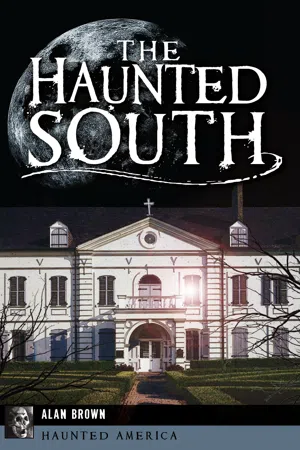
The Haunted South
About this book
Southerners love the South. And some souls never leave. Savannah, New Orleans and St. Augustine are among the most haunted places in America, and chilling stories abound nearly everywhere below the Mason-Dixon line. At Seaman's Bethel Theater in Mobile, Alabama, actors and staff are frightened by the unnerving sounds of a child's laughter. The ghost of Alfred Victor DuPont, a noted ladies' man, is said to harass female employees in the stairwell at DuPont Mansion in Louisville, Kentucky. The Café Vermilionville is housed in what is reputed to be Lafayette's first inn. A young girl in a yellow dress, thought to be a previous owner's daughter who died from polio around the time of the Civil War, startles patrons from the balcony of the restaurant. Join author Alan Brown as he traverses the supernatural legends of the American South.
Information
Topic
HistoriaSubtopic
Historia de NorteaméricaLOUISIANA
LAFAYETTE
The Café Vermilionville
The Café Vermilionville is housed in what is reputed to be Lafayette’s first inn. Constructed in 1799, the building is distinctive for its Anglo-American and French features. A Swiss immigrant named Henry Louis Monnier purchased the property in 1853. The inn was occupied by Union soldiers for a brief period during the Civil War. Legend has it that a jealous Frenchman shot and killed a Yankee captain who was paying too much attention to his wife. His son, Auguste Monnier, a prominent businessman, inherited the property after Henry’s death. Auguste sold much of the Monnier property in 1875 but retained the two-story house. On May 30, 1882, a physician named M.E. Girard bought the old inn, which eventually became his retirement home. The property remained in the Girard family for several generations. M. Eloi Girard started a nursery on a portion of the property. Maurice Heymann bought the inn and the nursery from Merrick Girard in 1939. He eventually developed the nursery and the other landholdings of the Girard family into the Oil Center and Shopping Village. Heymann was planning to raze the historic inn, but he was prevented from doing so by Horace Rickey, who bought the old building. Rickey then set about renovating the old inn. He attached the kitchen, the dining room and the garçonnière to the old house, thereby creating 640 square feet of additional space. When the inn was transformed into the Café Vermilionville, the garçonnière was converted into the cocktail lounge. Two bars and a glass patio room were added on later. Today, when people order spirits with their meals, they might end up with the ethereal kind.
Most of the paranormal activity inside the old inn can be traced back to a tragic incident that occurred over 150 years ago when the inn was used as a private residence. A few years before the Civil War, the building was owned by a family with a little girl who was afflicted with polio. Her father, who lavished attention on the child, had to travel to New Orleans on a regular basis to buy his daughter the medicine that sustained her life. While her father was on one of these trips, the child died. The father, understandably, was wracked with guilt and remorse on his return.
The earliest recorded ghost stories date back to the time when the inn was being used as office space, just a few years before it was converted into the Café Vermilionville. A local woman who had driven by the building every morning between 4:00 a.m. and 5:00 a.m. stopped by one afternoon to tell one of the secretaries that she frequently saw a little girl in a yellow dress standing on the balcony. A few years later, after the Café Vermilionville opened up inside the old building, a man was standing in the restaurant, trying to photograph his wife before their meal was ready. He said when he looked through the viewfinder, he saw a little girl in a yellow dress, standing next to his wife. When he lowered the camera, the little spirit was gone.
In recent years, the little ghost has been seen many times in the Café Vermilionville. Apparently, all the changes that have been made to the structure have not made her feel unwelcome. For this little girl, the old inn will always be home, regardless of its appearance.
NEW ORLEANS
The Old U.S. Mint
The Old U.S. Mint, which has been declared a National Historic Landmark, is not only the oldest surviving building to have served as a U.S. Mint, but it is also the only structure in America to have served as both a U.S. Mint and as a Confederate Mint. Located on the northeastern edge of the French Quarter, the U.S. Mint was constructed in 1835 at the urging of President Andrew Jackson, who believed that a New Orleans mint would assist in the financial development of the western frontier. The Greek Revival building was designed by renowned architect William Strickland, one of the designers of the U.S. Capitol in Washington, D.C. Strickland went on to design the first four U.S. Mint buildings. A central Ionic portico makes up the north façade of the building. Inside the building, two large wings wrap around the central core to form a W-shaped structure. Because Strickland did not account for New Orleans’ high water table, the New Orleans Mint had to be reinforced with iron rods in 1840. In 1854, Pierre Gustave Toutant Beauregard fireproofed the mint and rebuilt the basement arches. After the mint minted its first thirty dimes on March 8, 1838, it proceeded to strike many different denominations of either silver or gold.
The New Orleans Mint’s first tour of duty extended from 1838 to January 26, 1861, when Louisiana seceded from the United States. The Federal employees who had been working at the mint were permitted to keep their jobs as employees of Louisiana. In 1861, the New Orleans Mint struck 962,633 half dollars, a large number of which had alternate reverse dies. After the New Orleans Mint ran out of bullion on April 1, 1861, Confederate troops were quartered in the building until the city was taken by Admiral David G. Farragut’s naval forces.
The mint building was closed until 1876, when it reopened as an assay office. The building’s second tour of duty as a U.S. Mint began in 1879, when the superintendent of the U.S. Mint, Dr. M.F. Bonzano, recommended that the old mint be refurbished. After new minting equipment was installed, the New Orleans Mint produced silver coins, including the Morgan silver dollar, from 1879 to 1904. Women were hired during this time to weigh the unstamped coin planchets and to serve as counters and packers and to work at the coining presses. The New Orleans Mint was closed in 1909 because the main mint at Philadelphia was effectively meeting the need for coinage in the United States.
The old U.S. Mint Building in New Orleans served a variety of purposes over the next seven decades. Between 1909 and 1932, the building was again converted into an assay office. A federal prison was housed there between 1932 and 1943, when the U.S. Coast Guard used it as a storage facility. By 1966, the Old U.S. Mint Building had stood abandoned for many years and had fallen into decay. The State of Louisiana agreed to save the structure from the wrecking ball on the condition that it would be renovated within fifteen years. In 1981, the Old U.S. Mint opened as part of the Louisiana State Museum complex.
The museum had not been open for very long before rumors began circulating about ghosts inside the old building. Employees have been touched and lights flicker. Motion-activated alarms occasionally go off for seemingly no reason. The door in one of the museum’s storerooms has been known to open and close on its own. Employees have seen an apparition, and a shadowy figure has been spotted on the first floor. Thuds, bumps and other noises have also been heard on the first floor.
One of the employees who has seen the ghost on the first floor is the curator, Sarah Elizabeth Gundlach. Late one afternoon, she left the main entry desk and was getting ready to close up. She was on her way downstairs when she noticed a dramatic drop in temperature. She then caught a glimpse of a head and shoulders floating above the floor. She did a double take and looked away for an instant. When she turned back around, the apparition was gone.
Other employees have also had strange experiences inside the museum. Security guard Jimmy Jackson saw a male apparition on the second floor five times. Jackson concluded that the figure was a male because it had a beard. The first time he saw the ghost, the specter was standing against a wall at the end of a row of jail cells. The apparition was wearing ragged clothing. Jackson distinctly recalled that it had black hair. Other employees who have seen the ghost describe him as a male dressed in prison stripes. He is often seen standing around smoking. Because no one knows the name of the ghost, the employees have dubbed him “Lonesome Larry.”
Several of the Old U.S. Mint’s other ghosts have been identified. One of the ghosts is said to be the spirit of a steamboat gambler named William Mumford. In April 1862, he climbed to the roof of the mint and tore down the U.S. flag the U.S. Marines had raised the same day. Mumford ripped the flag into shreds and stuffed them into his shirt. Mumford was captured the next day. The military governor of New Orleans, Union general Benjamin Franklin Butler, ordered his execution. On June 7, 1862, Mumford was hanged from a flagstaff that projected horizontally from the mint. His ghost is affectionately called “Poor Mumford.” The female ghost that has been seen throughout the building is said to be the spirit of William Mumford’s mother, who was heartbroken at the loss of her son. The weeping that occasionally echoes through the building is usually attributed to Mrs. Mumford. The ghost of an employee who was crushed in one of the coin presses could also be haunting the building.
An investigation of the haunted museum was conducted by the Atlantic Paranormal Society (TAPS) in 2010. During the investigation, the group heard a series of shuffles, pings, bumps and clicks. One of the investigators, K.J., saw what he thought was a shadow figure. Two other investigators, Steve Gonsalves and Dave Tango, were walking through the second floor when the balcony door in front of them opened and slammed shut on its own. The pair was unable to debunk the phenomenon. Despite the investigators’ personal experiences, the group did not collect enough physical evidence to declare the Old U.S. Mint haunted.
Even though TAPS did not film any full-bodied apparitions or collect any compelling EVPs, the Old U.S. Mint still has the reputation for being the most haunted museum in the entire city. Granted, many people visit the museum to view permanent exhibits like the New Orleans Jazz exhibit, the Mississippi and the Making of a Nation exhibit or the Newcomb Pottery and Crafts exhibit. However, the popularity of the Old U.S. Mint’s ghost stories has to be at least partially responsible for the large number of tourists who visit the historic structure each year.
The Sausage Maker’s Ghost
In the 1920s, a German immigrant named Hans Mueller operated a butcher’s shop inside the old house at 725 Ursuline Street. Hans and his wife, Teresa, had arrived in America from Germany at the turn of the century. Their specialty was sausage, which they made with a mixture of Cajun and Creole spices. Not long after the Muellers opened their business, word spread that they had the best sausage in town. People came from miles around to sample the Muellers’ unique blend of German and Creole sausage. As the money poured in, the Muellers were certain that they had made the right decision in moving to New Orleans.
Unfortunately, the Muellers’ happiness was short-lived. Two legends have been generated by the residents of New Orleans to explain their downfall. One legend has it that people flocked to the Muellers’ butcher shop for more than just the sausage. Hans Mueller was reputed to be a charismatic individual who was especially attractive to women. As time passed, Hans began paying less attention to his wife, who had become fat, and more attention to a German girl he had just hired to help out in the shop. The girl, whose name was Ilse, was just as attractive as Teresa had been before the years of drinking beer and eating sausage had added pounds to her once-svelte figure. Before long, Ilse became his mistress. Hans and his comely employee conducted their clandestine affair after hours when his wife was asleep.
According to another version of the legend, Teresa was responsible for the demise of their marriage. Some people say that she loved alcohol and strange men much more than she loved her husband, for whom making money had become the most important thing in life. She began frequenting the local bars and bedding down with men while her husband was gone. Not only did her housekeeping suffer as a result of her nightly excursions, but so did the couple’s three small children, who roamed around the house unclothed and unfed.
No one living today knows for sure what precipitated the horrible events that transpired on October 28, 1927. Some say that Hans buried a meat cleaver in Teresa’s brain one night when she accused him of cheating on her with Ilse. Others believe that he bashed her in the head when she returned from one of her nightly rendezvous. Another variant of the tale holds that Hans crept behind Teresa one night, wrapped a piece of rope around her neck and choked her to death. After he regained his composure, Hans was faced with the problem of disposing of his wife’s mutilated body. He looked around the room, and his eyes settled on the huge sausage grinder, which turned pork and beef into the spicy delicacies that had become favorites of New Orleans. Hans picked up Teresa’s lifeless body and dumped it into the sausage grinder. He fully intended to convert Teresa into one hundred kilos of sausage.
For a short while, Hans conducted business as usual. When his neighbors asked him about his wife, he simply said that she was out of town visiting neighbors or that she was upstairs in bed, recovering from an illness. He decided to keep his relationship with Ilse a secret to avoid arousing suspicion in the neighborhood.
Hans’s crime did not stay hidden for very long. The guilt that was tearing him apart began to affect his appearance. The formerly clean-cut butcher was disheveled. His eyes were bloodshot from lack of sleep, and his hair was shaggy and uncombed. Even worse, customers began complaining about finding bits of bone and pieces of cloth in their sausage. One morning, a customer was eating the sausage when she bit down on a gold wedding ring. After vomiting what she had already eaten, she called the police, who raided the Muellers’ butcher shop. They found the proprietor huddled in the corner, shaking and crying uncontrollably. After he calmed down, he explained that the night before, he had heard a thumping noise coming from the back of the shop. When he walked over to the sausage grinder, Hans was shocked to see his wife’s corpse climbing out of the vat. Her head and face were horribly mutilated. Teresa staggered toward her husband with arms outstretched. After a few seconds, Teresa’s ghastly appearance and blood-curdling moans proved to be too much for the man. He ran out into the street screaming. When his neighbors asked him what had happened, Hans explained that he had had a bad dream. By the time the police arrived the next morning, Hans had not totally recovered from his wife’s unwelcome return. He told the police that his dead wife was trying to kill him. Hans was committed to an insane asylum.
Mueller’s sausage business was taken over by another man. The new owner had great difficulty keeping employees because of the frequent sightings of Teresa Mueller’s ghost, who stumbled around the back room, looking for her husband. The sightings ceased altogether after Hans Mueller suffered a complete mental breakdown and committed suicide.
The murder of Hans Mueller’s wife, Teresa, has become known as one of the most lurid crimes in New Orleans, a city that is renowned for its sensationalistic murders. Hans’s story lives on in the ghost stories that people still tell about his butcher shop; in the 1974 movie The Mad Butcher, starring actor Victor Buono; and in the family stories of New Orleans residents whose ancestors discovered an unexpected “bonus” inside their breakfast sausage.
The Griffin House
The Griffin House at 1447 Constance Street was built in 1852 by Adam Griffin, who abandoned the house only a few months after the occupation of Union troops under the command of General Benjamin Butler began in the spring of 1862. General Butler commandeered the Griffin House for use as a barracks and as a storage house for supplies. When the soldiers climbed the stairs to the attic, they were greeted with a sight that rivaled any of the horrors on the battlefield. Several slaves in various states of starvation were chained to the walls. Some of the slaves had maggot-infested wounds on their arms, legs and faces. This was not the only horror to take place in the house. In his book Gumbo Ya-Ya, Lyle Saxon tells the story of two Union soldiers who were arrested for stealing army funds. The two men were held prisoner on the third floor of the Griffin House while awaiting trial. In another version of the legend, the two Union soldiers were actually Confederate deserters who were wearing uniforms at the time of the robbery. Somehow, the prisoners got their hands on two bottles of cheap whiskey and proceeded to get roaring drunk. For the next few hours, the men sang “John Brown’s Body” as loudly as they could. Some local historians believe that the two men sang this particular song, which was very popular with Union soldiers, to convince their captors that they actually were Yankees, not Confederates. When they finished singing, the prisoners bribed one of the guards to give each of them a pistol. The men lay in bed, facing each other, and on the count of three, each man fired a bullet into the other man’s heart. Repercussions from this double suicide have resonated from the Griffin House for many years in the form of ghost stories.
After the Civil War, the Griffin House was home to a number of businesses. For a while, it was used as a mattress factory and a perfume bottling plant. In the 1920s, the Griffin House was leased by a man who rebuilt air conditioners. The man told his customers and neighbors that he had “seen things” in the house. One day, the man failed to show up for work. He was never heard from again.
In the 1930s, the Griffin House was converted into a lamp factory. According to Lyle Saxon, a black janitor was staying late to clean up the lamp factory in 1936. He was working on the second floor when a door opened on its own. He then heard what sounded like a pair of heavy boots walking out of the room, right toward him. The sound was so loud that it was almost deafening. A few minutes later, the janitor heard another pair of boots walk by, following by the sound of someone whistling “John Brown’s Body.” The janitor threw down his broom and ran out of the house.
Not long thereafter, the owner of the lamp factory, Isadore Seeling, had just entered the building one morning with his brother when a huge block of cement came hurtling down the stairs, right at them. Isadore barely avoided death when his brother pushed him out of the way. Neither of the men had seen the cement block before. They ran upstairs to find out who had tried to kill them. There was no one there. Adding to the mystery, the floor had been painted the day before and was still tacky, yet no footprints could be found in the paint. In addition, all of the doors and windows were locked.
A few years later, the old building became a boardinghouse. One day, a widow was sitting in a chair by a window in her room on the second floor. Her knitting was interrupted by what appeared to be spot of blood on her hand. She wiped off the blood, thinking that she must have scratched herself. When a second spot of blood appeared, the widow looked up and was shocked to see blood oozing from a crack in the ceiling. She ran out of the room, sc...
Table of contents
- Front Cover
- Half Tile
- Title Page
- Copyright
- Contents
- Introduction
- Alabama
- Arkansas
- Florida
- Georgia
- Kentucky
- Louisiana
- Mississippi
- North Carolina
- South Carolina
- Tennessee
- Virginia
- Works Cited
- About the Author
Trusted by 375,005 students
Access to over 1.5 million titles for a fair monthly price.
Study more efficiently using our study tools.
Frequently asked questions
Yes, you can cancel anytime from the Subscription tab in your account settings on the Perlego website. Your subscription will stay active until the end of your current billing period. Learn how to cancel your subscription
No, books cannot be downloaded as external files, such as PDFs, for use outside of Perlego. However, you can download books within the Perlego app for offline reading on mobile or tablet. Learn how to download books offline
Perlego offers two plans: Essential and Complete
- Essential is ideal for learners and professionals who enjoy exploring a wide range of subjects. Access the Essential Library with 800,000+ trusted titles and best-sellers across business, personal growth, and the humanities. Includes unlimited reading time and Standard Read Aloud voice.
- Complete: Perfect for advanced learners and researchers needing full, unrestricted access. Unlock 1.5M+ books across hundreds of subjects, including academic and specialized titles. The Complete Plan also includes advanced features like Premium Read Aloud and Research Assistant.
We are an online textbook subscription service, where you can get access to an entire online library for less than the price of a single book per month. With over 1.5 million books across 990+ topics, we’ve got you covered! Learn about our mission
Look out for the read-aloud symbol on your next book to see if you can listen to it. The read-aloud tool reads text aloud for you, highlighting the text as it is being read. You can pause it, speed it up and slow it down. Learn more about Read Aloud
Yes! You can use the Perlego app on both iOS and Android devices to read anytime, anywhere — even offline. Perfect for commutes or when you’re on the go.
Please note we cannot support devices running on iOS 13 and Android 7 or earlier. Learn more about using the app
Please note we cannot support devices running on iOS 13 and Android 7 or earlier. Learn more about using the app
Yes, you can access The Haunted South by Alan Brown in PDF and/or ePUB format, as well as other popular books in Historia & Historia de Norteamérica. We have over 1.5 million books available in our catalogue for you to explore.