- 208 pages
- English
- ePUB (mobile friendly)
- Available on iOS & Android
eBook - ePub
About this book
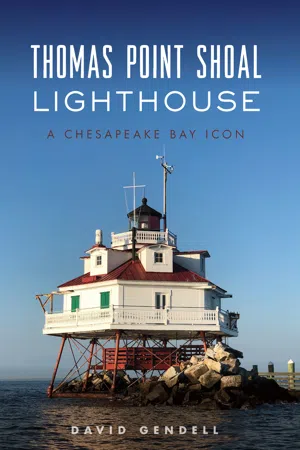
For centuries, the hard-packed shoal at Thomas Point menaced Chesapeake Bay mariners. Even after two separate stone towers were built on the shoreline, sailors continued to request a light at the end of the mile-long shoal. When a new lighthouse was finally approved in 1873, experts deemed its novel design too fragile for the location--it was built anyway. Long overdue and of an inappropriate design, the iconic Thomas Point Shoal Lighthouse was lit in November 1875 and continues to serve mariners. Thomas Point is the last Chesapeake Bay screwpile-style lighthouse in its original location and one of only twelve American lighthouses designated as a National Historic Landmark. Join Annapolis sailor David Gendell as he explores Thomas Point.
Trusted by 375,005 students
Access to over 1.5 million titles for a fair monthly price.
Study more efficiently using our study tools.
Information
Subtopic
Architecture GeneralIndex
HistoryBUILDING THE LIGHTHOUSE ON THE SHOAL
I can think of no other edifice constructed by man as altruistic as a lighthouse. They were built only to serve.
—George Bernard Shaw
In April 1875, as the ambitious tower project on the North Carolina coast soaked up money, attention and newspaper ink, workers at the Malster & Donnell iron foundry, in the heart of Baltimore’s Fells Point, were completing ironwork for a pair of new Chesapeake screwpile lighthouses: one destined for Tangier Sound and the other for Virginia’s York River. Nearby, at the Lighthouse Board’s Lazaretto Depot, sections of the cottages that would sit atop the iron bases were prebuilt. Once the entire kits were inspected and approved, they were loaded aboard the Lighthouse Board’s steam-powered tender Tulip and moved to their final destinations, where they were assembled. It was an efficient new method of construction, and as Baltimore’s port expanded, any method of improving the lighting system along the Chesapeake and its approaches was welcomed by shipping interests.
In early 1875, with site and funding secured, the U.S. Lighthouse Board published specifications for the new screwpile lighthouse at Thomas Point, including detailed drawings of the parts required to build it. Concurrently published were specifications for a new screwpile planned for Port Tobacco Flats on the Potomac River, about fifty river miles below Alexandria, Virginia. Fifteen proposals were received for the metalwork for the new screwpiles, with a high bid of $30,300 and a low bid, from the Atlantic Steam Engine Works of Brooklyn, New York, at $17,400. In late May, the Lighthouse Board announced that the Atlantic Steam Engine Works had been awarded the contracts for the ironwork at Thomas Point and Port Tobacco.

In January 1875, the Lighthouse Board published specifications for metalwork for two new screwpiles it planned to build in 1875: Thomas Point Shoal near Annapolis and one at Port Tobacco Flats on the Potomac. U.S. National Archives and Records Administration.
The General Description of the new Thomas Point Shoal Lighthouse begins, “The structure will consist of two parts—the lower, an open framework of iron, forming the foundation, and the upper a frame building, affording quarters for the keepers; the latter is to be surmounted by a lantern, in which is to be placed the illuminating apparatus.” The initial specifications are deeply detailed and include instructions all the way down to the door handles.
The specifications call for eight ten-inch piles “of the best quality of wrought-iron” to be screwed vertically into the shoal at a depth of ten feet, including one at the center of the foundation. The screws themselves were specified to be cast iron with a three-foot exterior diameter and two blades, each with a pitch of twelve inches.
Atop the foundation would be a hexagonal house constructed of wood and reachable by two sets of iron stairs, as well as by ladders from the boarding platform. The light would be placed forty-three feet above the average water height. The house would be topped by a copper roof.

Lantern room plans for the Thomas Point Shoal screwpile lighthouse, as illustrated in plans published by the U.S. Lighthouse Board in January 1875. U.S. National Archives and Records Administration.

Details of the screws for the Thomas Point Shoal screwpile lighthouse, as illustrated in plans published by the U.S. Lighthouse Board in January 1875. U.S. National Archives and Records Administration.

Overview of the plans for the hexagonal screwpile lighthouse at Thomas Point Shoal, as published by the U.S. Lighthouse Board in January 1875. U.S. National Archives and Records Administration.

Half section showing the complete structure, above and below water, to be built at Thomas Point Shoal, as illustrated in plans published by the U.S. Lighthouse Board in January 1875. U.S. National Archives and Records Administration.
IN 1863, THE LIGHTHOUSE Board established a depot at Baltimore on a five-acre plot that had formerly housed a smallpox hospital and alongside John Donahoo’s 1831 Lazaretto Lighthouse tower. The plans to build out the Lazaretto Depot were delayed by the Civil War, but after the war, the depot buzzed with activity. Buoys were assembled and maintained at the site, as were lighthouse sections. The metal for the Thomas Point structure likely came through this depot, where it was assembled and coated with hot linseed oil. Representatives from the Lighthouse Board then inspected and approved the ironwork. After inspection, the iron received two coats of paint and was then greased with a coat of tallow and lead. Small parts such as nuts and bolts were boxed for travel. Only then was the whole package ready for transport out to the shoal.
As specified in a January 1875 document produced by the Lighthouse Establishment for prospective contractors, the Thomas Point Lighthouse kit included 126 metal pieces:
8 Wrought-iron periphery and outstanding piles.
1 Wrought-iron center pile.
9 Cast-iron screws.
16 Double-channel iron struts.
8 Cast-iron struts.
1 Center socket.
2 Sockets with flanges for three struts.
4 Sockets with flanges for four struts.
2 Sockets for outstanding piles.
1 Center column.
6 Periphery columns.
1 Central upper socket.
6 Upper sockets.
24 Tension-rods.
6 Radial beams.
6 Periphery beams.
6 Cast-iron double-shoes and bolts for gallery beams.
12 Gallery tie-rods.
4 Davits with cast iron steps and wrought-iron upper bearings, with struts and bolts.
1 Lantern with cast-iron parapet.
2 Sets of ladders with platforms.

Cast-iron screw on display beneath the relocated Hooper Strait screwpile lighthouse at the Chesapeake Bay Maritime Museum in St. Michaels, Maryland. Photo by the author.
Before construction at Thomas Point began, the sister screwpile originally planned for the Port Tobacco Flats was moved across the Potomac to Mathias Point. It was set about three miles away from the first planned location and in a much better position to aid traffic to and from Washington and Alexandria. The Mathias Point Lighthouse was eventually completed in 1876 and closely resembled the Thomas Point Shoal screwpile, although the lighthouse on the Potomac was adorned with additional decorative detail. The Mathias Point screwpile, a true sister to the Thomas Point Shoal screwpile, was automated in 1951 and its cottage dismantled in 1961. A beacon is now mounted atop the original foundational structure, forty-four feet off the surface of the Potomac.
Prior to its construction, the location of the Thomas Point screwpile was also moved, but in a more subtle manner.
FILED SAFELY AT THE National Archives in Washington, D.C., and available for public review, is an undated, uncredited chart labeled “Site of Thomas’ Point Shoal LH.” The chart was drawn in, or prior to, 1875 for the purpose of illustrating the location of the new lighthouse at the end of the Thomas Point Shoal that would stand offshore compared to its shore-bound predecessor.
The chart features soundings of the water depth, and the markings crowd together as they approach the site of the lighthouse project. A few place names and nearby buoys are called out in detail: Cat Hole Creek, Tally’s Point, South River, Greenbury’s Point and, of course, Thomas’ Point. The then-existing tower lighthouse on the peninsula is also marked. A thin blur of pale blue watercolor marks the shoreline.
The central focus of the chart is drawn roughly in the center of the sheet: the site of the new lighthouse. In the absence of contextual information, it is impossible to know if this rendering was a simple illustration used to show elected officials and members of the public the general location of the new lighthouse, or if it was the official chart provided to the crew who were to build the lighthouse. Noteworthy, however, is the specificity of the new lighthouse location as shown on the chart, including a description of the site prescribed in degrees, minutes and seconds of longitude and latitude.
The latitude and longitude of the site as described in the original deed conveying the Bay bottom from Maryland to the federal government and on the chart reads:
38 54 ' 03" North Latitude
76 25 ' 35" West Longitude
A pair of red dashed lines extend toward the center of the chart from these listings. The red lines converge at the tip of the Thomas Point Shoal, where a cartographer penciled in the circular “sun” symbol the Lighthouse Board used to denote its lighthouses. A second of latitude covers about ninety feet. A second of longitude, in the vicinity of Annapolis, is about seventy-nine feet. The chart and the original deed depict a lighthouse that was to be built at a very specific location.
The water depth at the listed location is actually about forty feet deep, not the six or seven feet depicted on the chart. It is well offshore of the end of the shoal, closer to the shipping channel. The actual position of Thomas Point Shoal Lighthouse, as built and standing today, is about one thousand feet farther south and about half a mile farther west than the position initially described in the deed and on the chart.
The work crew charged with locating the Thomas Point lighthouse likely arrived at or near the prescribed location and then moved slowly and carefully around the end of the shoal, taking soundings and investigating the characteristics of the bottom. The location they selected is at the tip of the shoal, in about eight feet of water, where the top layer of the bottom is soft sand and mud, studded with oyster shells, that quickly turns into hard-packed sand. The bottom drops away quickly to forty feet below the surface just a few hundred yards east of the site.
Thomas Point Shoal Lighthouse stands at:
38 53 ' 56 " North Latitude
76 26 ' 09 " West Longitude
The material and men required to build Thomas Point Shoal Lighthouse traveled south from Baltimore, all likely aboard Tulip, the Lighthouse Board’s steam-powered tender. They might have stopped at Annapolis and waited for an appropriate weather window. It is likely that smaller workboats accompanied Tulip to the site. Once the site was selected and marked, a staging barge was anchored in place, and the hard work began.
The first step at the lighthouse site was drilling the wrought-iron piles and their cast-iron screws into the Bay’s bottom. Precision was key. Typically, the center pile was set first and a specially built jig was then fitted to the center pile and used to precisely measure the distance out to each of the six surrounding pilings. In the case of Thomas Point, the center of each surrounding piling was twenty-one feet from the center of the center piling. A hexagon was formed with sixty-degree angles at the center. The seven screwpiles at the central hexagon were augmented by additional pilings driven to the north and south of the central hexagon and des...
Table of contents
- Front Cover
- Half Title
- Title Page
- Copyright
- Contents
- Acknowledgements
- Introduction
- The Shoal
- First Encounters
- War Arrives at the Shoal
- Baltimore Rising
- Towers on the Shore
- Lenses, Lamps and Lanterns
- A New Lighthouse Authority
- Screwpiles on the Shoals
- The Right Spot, the Wrong Lighthouse
- Building the Lighthouse on the Shoal
- Lemuel Mitchell and the Oyster Navy
- The First Keeper on the Shoal
- The Ice Emergency
- The Oyster Wars Turn Deadly
- Living Aboard: 1800s
- A Keeper Mysteriously Disappears
- Tongers Trespass at the Light
- The Point Breaks Up and Is Sold Off
- 1933 Hurricane at Thomas Point
- Living Aboard: 1900s
- Reprieve in the 1970s
- The Last Keepers
- Automation in the 1980s
- Structure, Current and Depth: Fish at Thomas Point
- Transition at Thomas Point
- New Life at Thomas Point
- The Lighthouse Today
- Screwpiles on the Chesapeake
- Thomas Point Timeline
- Bibliography
- About the Author
Frequently asked questions
Yes, you can cancel anytime from the Subscription tab in your account settings on the Perlego website. Your subscription will stay active until the end of your current billing period. Learn how to cancel your subscription
No, books cannot be downloaded as external files, such as PDFs, for use outside of Perlego. However, you can download books within the Perlego app for offline reading on mobile or tablet. Learn how to download books offline
Perlego offers two plans: Essential and Complete
- Essential is ideal for learners and professionals who enjoy exploring a wide range of subjects. Access the Essential Library with 800,000+ trusted titles and best-sellers across business, personal growth, and the humanities. Includes unlimited reading time and Standard Read Aloud voice.
- Complete: Perfect for advanced learners and researchers needing full, unrestricted access. Unlock 1.5M+ books across hundreds of subjects, including academic and specialized titles. The Complete Plan also includes advanced features like Premium Read Aloud and Research Assistant.
We are an online textbook subscription service, where you can get access to an entire online library for less than the price of a single book per month. With over 1.5 million books across 990+ topics, we’ve got you covered! Learn about our mission
Look out for the read-aloud symbol on your next book to see if you can listen to it. The read-aloud tool reads text aloud for you, highlighting the text as it is being read. You can pause it, speed it up and slow it down. Learn more about Read Aloud
Yes! You can use the Perlego app on both iOS and Android devices to read anytime, anywhere — even offline. Perfect for commutes or when you’re on the go.
Please note we cannot support devices running on iOS 13 and Android 7 or earlier. Learn more about using the app
Please note we cannot support devices running on iOS 13 and Android 7 or earlier. Learn more about using the app
Yes, you can access Thomas Point Shoal Lighthouse by David Gendell in PDF and/or ePUB format, as well as other popular books in History & Architecture General. We have over 1.5 million books available in our catalogue for you to explore.