Foreword INDIES 2021 Finalist for Religion
Religious faith reduces the risk of suicide for virtually every American demographic except one: LGBTQ people. Generations of LGBTQ people have been alienated or condemned by Christian communities. It's past time that Christians confronted the ongoing and devastating effects of this legacy.
Many LGBTQ people face overwhelming challenges in navigating faith, gender, and sexuality. Christian communities that uphold the traditional sexual ethic often unwittingly make the path more difficult through unexamined attitudes and practices. Drawing on her sociological training and her leadership in the Side B/Revoice conversation, Bridget Eileen Rivera, who founded the popular website Meditations of a Traveling Nun, speaks to the pain of LGBTQ Christians and helps churches develop a better pastoral approach.
Rivera calls to mind Jesus's woe to religious leaders: "They tie up heavy burdens, hard to bear, and lay them on the shoulders of others; but they themselves are unwilling to lift a finger to move them" (Matt. 23:4). Heavy Burdens provides an honest account of seven ways LGBTQ people experience discrimination in the church, helping Christians grapple with hard realities and empowering churches across the theological spectrum to navigate better paths forward.
eBook - ePub
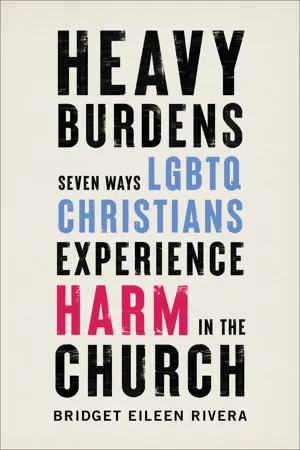
Heavy Burdens
Seven Ways LGBTQ Christians Experience Harm in the Church
- 240 pages
- English
- ePUB (mobile friendly)
- Available on iOS & Android
eBook - ePub
About this book
Information
Topic
Theology & ReligionSubtopic
Christian MinistryBurden 1: Sex . . . err . . . Celibacy Is Great!
1. The Protestant Sexual Revolution
STEPHEN
Growing up in a conservative, evangelical context, Stephen learned that gay sex was an abomination. If he messed up now and again, it might not be the end of the world, as long as he repented. But with eternal damnation ever looming in the background, he could never be sure if he had repented enough.
“My theology was a form of slow suicide,” Stephen recalled. “It didn’t matter how hard I tried, and it didn’t matter how many things I did right, it still tortured me.” He found himself spiraling in and out of anguish and suicidal thoughts, his sexuality consuming his life. “It was like this cut in my mouth that I just couldn’t stop feeling. Even on good days, it was still there eating away at me. I lost a good portion of my life to it.”
Stephen dropped out of high school. Though he eventually returned to complete his education and enrolled in college classes, he failed multiple courses each semester and took eight years to finally graduate. Over time, he developed a network of Christian friends who were okay with him as long as he was celibate. But he didn’t know if he could honestly be celibate for the rest of his life.
Friends suggested he look to Henri Nouwen, a “hero of gay celibacy,” for inspiration. One article in particular described Nouwen as “choosing to live the wound,” as Stephen put it. “Again and again and again,” Stephen recalled, “he just chose to embrace and live the wound.” Stephen was in his early twenties at the time, and the article filled him with despair.
“I’m looking at the rest of my life, and this is what I’m being told is the best that I can look forward to. It just destroyed me. It just crushed me.” But he couldn’t budge on gay celibacy because “to do so would be to live in mortal error.” It was grin and bear it or go to hell. But he found himself getting to the point where he didn’t know if he could bear it any longer.
“I thought, ‘I might as well just kill myself now. If this is all I have to look forward to in life, I don’t think I can do it.’”

During the early years of the culture wars in twentieth-century America, a kind of righteous fervor gripped the faithful in countless evangelical churches. Christian leaders cast their followers as valiant soldiers in a grandiose battle for the soul of their country, a struggle in which sex, marriage, and the nuclear family took center stage. Sexual liberation threatened the very fabric of society. Fornication, adultery, serial monogamy, divorce, abortion, pregnancy out of wedlock, homosexuality—all of it loomed large in the evangelical imagination. Sexual autonomy threatened the building blocks of Western civilization. Apart from drastic Christian action, society itself would crumble.1
Among the most prominent theologians of this era was Carl F. H. Henry, who published a scathing indictment of American liberalism titled Twilight of a Great Civilization. Writing in the late 1980s, he argued that shifting norms of immorality and “sexual libertinism”2 in particular sounded the death knells of not only the United States but ultimately Western culture. Describing a showdown of cosmic proportions, he called for Christians to band together against the forces of secular humanism, political leftism, and sexual liberation “before hell breaks out.”3 “A half-generation ago the pagans were still largely threatening at the gates of Western culture,” he said. “Now the barbarians are plunging into the oriental and occidental mainstream.”4
As a result of this “barbarian” invasion, Christians had no choice but to fight back. Henry enlisted imagery from Sodom and Gomorrah to summarize his battle cry, calling on Christians of every stripe to “wake up” before the sun sets: “When that great meltdown comes, where will you be? Trapped in Sodom? In the bleak twilight of a decadent culture, where will you be? Overtaken, like Lot, looking back at the citadels of sin? ‘Wake up!’ says Paul; ‘wake up!’ American culture is sinking toward sunset.”5
By linking our dystopian future of “sexual libertinism” to the forces of radical leftism, secular humanism, and the “gay agenda,” evangelical leaders created a moral panic in the Christian imagination. We faithful Christians stood as the vanguards of biblical morality against them, the leftist agents and sexual deviants who will destroy the nuclear family and civilization as we know it. “We’re living in the outpouring of the wrath of God in the category of His abandoning a culture,” John MacArthur said in 2012, “and we’re living in the sequence that is here: a sexual revolution, a homosexual revolution, a reprobate mind that unleashes everything, including murder on a massive scale and hate toward God.”6
But a deep irony lies at the bottom of this panic. Despite decades of rhetoric blaming the “secular left” for the explosion of sexual liberation in the twentieth century, the basic ideology behind sexual autonomy didn’t originate in leftist propaganda. It didn’t begin with the gay agenda or even the sexual revolution of the 1960s. It began with a movement far deeper in the history of Western civilization—a sexual revolution with far greater consequences than anything accomplished in the 1960s. One that continues to shape how we think about sexuality and, ultimately, what we believe to be true about the most fundamental aspects of human identity.
It was the Protestant Reformation. And it changed everything.
A History of the Revolution
Martin Luther exploded onto the scene of Western Christianity with a radical new idea that would alter the course of history: Sex is a necessary good. Sex is “not a matter of choice or decision but a natural and necessary thing,” Martin Luther said. “It is just as necessary as the fact that I am a man, and more necessary than sleeping and waking, eating and drinking, and emptying the bowels and bladder.” He argued for an understanding of not just human sexuality but sex itself as “innate” to human existence.7
Luther’s message stood in contrast to the prevailing beliefs about human sexuality at the time. Catholic doctrine about sex and marriage had dominated the religious landscape for over a millennium, teaching that holiness required a renunciation of sexual desire, even in the context of marriage. Chastity, particularly celibate virginity, was the ideal. Marriage was a lesser calling for those too weak to abstain. Anyone who carried a position of spiritual authority was expected to be celibate, and church governance regulated all aspects of married life in an effort to limit sexual expression to procreative purposes alone.
Medieval historian James Brundage describes the situation in his book Law, Sex, and Christian Society in Medieval Europe. Even marital intercourse was “always impure, and always sinful”8 unless accomplished without the faintest hint of sexual desire, a requirement difficult to fathom. Sex came to be seen in Christian teaching as the vehicle through which original sin passed from parent to child—a fundamental expression of human depravity, necessary only for procreation. Chastity in marriage became nearly impossible, as any hint of sexual desire betrayed sinful motivations.
The resulting ascetic atmosphere cast human sexuality itself as the root of all evil, the cause of original sin, and the reason why every last man, woman, and child was tainted by iniquity. Penitential writers developed such a complex web of limitations on marital sexual activity that it became difficult to discern just when sex was permissible, if ever. Pious couples who attempted to observe the prohibitions, says Brundage, “would have found the process of deciding whether or not they could in good conscience have intercourse at any given moment a complex, perhaps even frightening, process.”9
Not surprisingly, mandated celibacy was a natural requirement for the priesthood. Celibacy was the only surefire way to pursue true and lasting holiness. By the time of the Reformation, this approach to human sexuality had become so institutionalized within Christian teaching that few could imagine the Bible teaching otherwise.
Until Luther.
Undergirding Luther’s rejection of clerical celibacy was a rejection of the idea that human sexuality was inherently sinful. It was tainted by sin, Luther argued, just as all aspects of humanity are, but sexuality was a good thing created by God nevertheless. In one sermon, Luther humorously observed that even eating and drinking are tainted by sin, but eating and drinking are no more inherently evil than anything else innate to the human condition, including when people “purge themselves and pick and blow their noses.”10 He continued, “Why do you only look at the impurity that exists in marriage? If you want to talk about the kind of purity and chastity that the angels have, you will find it nowhere, neither in marriage nor out of it in the unmarried condition. Purity does not exist; even children are not pure.”11
Having rejected the medieval Catholic belief that human sexuality is inherently evil, Luther argued that celibacy is a “special gift” that few possess.12 “It is a devilish tyranny to require it.”13 “This is a matter of nature and not of choice.”14 Celibacy was not just unreasonable but an affront to human nature. “No one...
Table of contents
- Cover
- Endorsements
- Half Title Page
- Title Page
- Copyright Page
- Dedication
- Contents
- Introduction
- Burden 1: Sex . . . err . . . Celibacy Is Great!
- Burden 2: Sinners Saved by Grace
- Burden 3: Folk Devils
- Burden 4: The Bible Is “Clear”
- Burden 5: “Real” Men, “Good” Ladies
- Burden 6: Made in the Image of God Sex
- Burden 7: Jesus Saves Damns
- A Better Way
- Acknowledgments
- Notes
- Author Bio
- Back Cover
Trusted by 375,005 students
Access to over 1.5 million titles for a fair monthly price.
Study more efficiently using our study tools.
Frequently asked questions
Yes, you can cancel anytime from the Subscription tab in your account settings on the Perlego website. Your subscription will stay active until the end of your current billing period. Learn how to cancel your subscription
No, books cannot be downloaded as external files, such as PDFs, for use outside of Perlego. However, you can download books within the Perlego app for offline reading on mobile or tablet. Learn how to download books offline
Perlego offers two plans: Essential and Complete
- Essential is ideal for learners and professionals who enjoy exploring a wide range of subjects. Access the Essential Library with 800,000+ trusted titles and best-sellers across business, personal growth, and the humanities. Includes unlimited reading time and Standard Read Aloud voice.
- Complete: Perfect for advanced learners and researchers needing full, unrestricted access. Unlock 1.5M+ books across hundreds of subjects, including academic and specialized titles. The Complete Plan also includes advanced features like Premium Read Aloud and Research Assistant.
We are an online textbook subscription service, where you can get access to an entire online library for less than the price of a single book per month. With over 1.5 million books across 990+ topics, we’ve got you covered! Learn about our mission
Look out for the read-aloud symbol on your next book to see if you can listen to it. The read-aloud tool reads text aloud for you, highlighting the text as it is being read. You can pause it, speed it up and slow it down. Learn more about Read Aloud
Yes! You can use the Perlego app on both iOS and Android devices to read anytime, anywhere — even offline. Perfect for commutes or when you’re on the go.
Please note we cannot support devices running on iOS 13 and Android 7 or earlier. Learn more about using the app
Please note we cannot support devices running on iOS 13 and Android 7 or earlier. Learn more about using the app
Yes, you can access Heavy Burdens by Bridget Eileen Rivera in PDF and/or ePUB format, as well as other popular books in Theology & Religion & Christian Ministry. We have over 1.5 million books available in our catalogue for you to explore.