eBook - ePub
Available until 11 May |Learn more
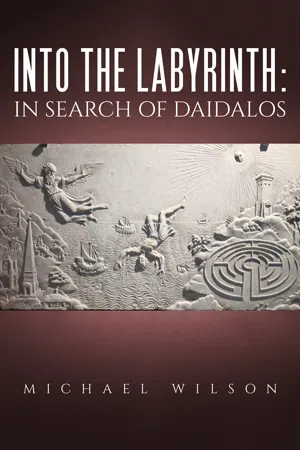
Into the labyrinth: in search of Daidalos
This book is available to read until 11th May, 2026
- 298 pages
- English
- ePUB (mobile friendly)
- Available on iOS & Android
eBook - ePub
Available until 11 May |Learn more
Into the labyrinth: in search of Daidalos
About this book
Daidalos was a polymath who foreshadowed Leonardo da Vinci by 3,000 years and was famed as an artist, inventor, scientist and engineer. Despite his many talents and his contributions to the advancement of humanity, his interactions with those he knew resulted in mayhem, and this is what makes his life so fascinating. First of all, he was responsible for the death of three close relatives - his son, his sister and his nephew. Secondly, his actions resulted in the death of King Minos who was a son of Zeus. Thirdly, he was involved in both the creation and destruction of the monstrous bull-human hybrid known as the minotaur. Finally, the lives of two of the most important women of Crete, Queen Pasiphae (the daughter of the sun god, Helios) and her daughter, Ariadne, were devastated by his interventions. It could be argued that his actions contributed to the downfall of the Minoan civilization and its subjugation by the Mycenaeans. This book is the story of his fascinating life, the times in which he lived and the legacy he has left us.
Frequently asked questions
Yes, you can cancel anytime from the Subscription tab in your account settings on the Perlego website. Your subscription will stay active until the end of your current billing period. Learn how to cancel your subscription.
No, books cannot be downloaded as external files, such as PDFs, for use outside of Perlego. However, you can download books within the Perlego app for offline reading on mobile or tablet. Learn more here.
Perlego offers two plans: Essential and Complete
- Essential is ideal for learners and professionals who enjoy exploring a wide range of subjects. Access the Essential Library with 800,000+ trusted titles and best-sellers across business, personal growth, and the humanities. Includes unlimited reading time and Standard Read Aloud voice.
- Complete: Perfect for advanced learners and researchers needing full, unrestricted access. Unlock 1.4M+ books across hundreds of subjects, including academic and specialized titles. The Complete Plan also includes advanced features like Premium Read Aloud and Research Assistant.
We are an online textbook subscription service, where you can get access to an entire online library for less than the price of a single book per month. With over 1 million books across 1000+ topics, we’ve got you covered! Learn more here.
Look out for the read-aloud symbol on your next book to see if you can listen to it. The read-aloud tool reads text aloud for you, highlighting the text as it is being read. You can pause it, speed it up and slow it down. Learn more here.
Yes! You can use the Perlego app on both iOS or Android devices to read anytime, anywhere — even offline. Perfect for commutes or when you’re on the go.
Please note we cannot support devices running on iOS 13 and Android 7 or earlier. Learn more about using the app.
Please note we cannot support devices running on iOS 13 and Android 7 or earlier. Learn more about using the app.
Yes, you can access Into the labyrinth: in search of Daidalos by Michael Wilson in PDF and/or ePUB format, as well as other popular books in History & Greek Ancient History. We have over one million books available in our catalogue for you to explore.
Information
Chapter 5
The legacy of Daidalos
Daidalos is deeply embedded in the European consciousness. His name is a powerful “brand”, to use the modern commerce-infatuated vernacular, and is currently associated with a large number of scientific and technological projects as well as being used in an emblematic fashion by many organisations and companies. His life and works have also been an inspiration to painters, sculptors, storytellers, playwrights, poets, opera-writers and film-makers over the centuries. In this chapter, some of the ways in which his name has been perpetuated will be described.
Daidalos as a challenger of the gods
It is important to appreciate just how significant Daidalos was to ancient philosophers and artists. As someone who was capable of making such lifelike statues, Daidalos and his creations were the subject of great debate as to what was “permissible” and “not-permissible”. His ability to imitate life dominates all classical references to his works. For example, in a fragment of Euripides’ play Eurystheus an old man is comforted after, apparently, being frightened by a lifelike statue: “Don’t be afraid old man, its nothing. All the statues of Daidalos appear to move and see, so clever is the man”1.
Daidalos’ art and inventions were at the boundary of what was deemed to be permissible and what was not. His realistic statues, being not quite real but then again not quite inert, may have been acceptable as just being on the right side of that boundary. But, then again, others may have regarded them as being blasphemous. As Pausanias said of Daidalos’ statues “All the works of this artist…… have a touch of the divine in them”2. This is getting dangerously close to a display of hubris i.e. a disregard for the divinely fixed limits on human action in an ordered cosmos.
Figure 5.1. Virgil’s Tomb by Moonlight, with Silius Italicus Declaiming by Joseph Wright (Wright of Derby), 1779 CE. Metropolitan Museum of Art, New York. Virgil’s tomb in Naples has been a popular touristic site for many years. Silius Italicus was a great admirer of Virgil and each year, on the anniversary of the poet’s death, he read aloud some of his verses at the tomb.

Some of his other works – for example, his flight-enabling wings and the artificial cow that facilitated sex between Pasiphae and a bull – would have been judged to have definitely crossed over the boundary into what was not permissible. Euripides expressed this beautifully. In a fragment of his lost play The Cretans, Minos says to Daidalos, with reference to the artificial cow: “You are a builder but what you did was not carpentry”3. That his skills may have offended the gods is suggested by Silius Italicus (a Latin poet and orator of the 1st century CE; Figure 5.1): “He dared to ascend the sky on wings not his own and to reveal to mankind the art of flying. Keeping his body poised amid the clouds, he floated on, and the strange winged creature alarmed the gods”4
Horace, the famous Roman poet (Figure 5.2) also implied that Daidalos had gone too far: “Daring enough for anything, the human race deals in forbidden sin……Daidalos tried the empty air on wings that were never granted to men: Hercules’ labours shattered Acheron. Nothing’s too high for mortal men: like fools, we aim at the heavens themselves”5. This ...
Table of contents
- Preface
- Who was Daidalos?
- The Mediterranean world in the time of Daidalos
- Daidalos’ story
- The works of Daidalos
- The legacy of Daidalos
- Image credits