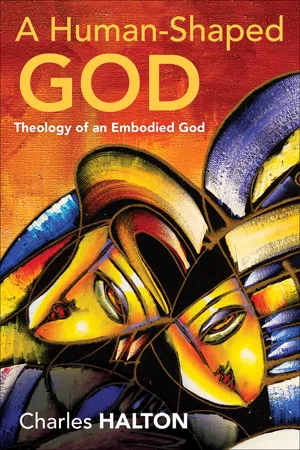
A Human-Shaped God approaches the humanlike accounts of God in the Old Testament as the starting places for theology and uses them to build a picture of the divine. This understanding of God is then brought into conversation with traditional conceptions that depict God as a being who knows everything that happens, is at every place at the same time, is constant and unchanging, and does not ultimately have material form. But instead of pitting the Old Testament's humanlike view of God against traditional theology and assuming that only one of these understandings is correct, A Human-Shaped God posits that theologians should embrace both of these constructions simultaneously. This is a new way of theological inquiry that embraces both the humanlike characteristics of God and the transcendence of God in traditional theology. By seeing and understanding the humanlike depictions of God in the Old Testament and by using the rich language of traditional theology together in tandem, the reader acquires a much deeper and meaningful understanding of God.
- 300 pages
- English
- ePUB (mobile friendly)
- Available on iOS & Android
eBook - ePub
About this book
Information
Topic
Theology & ReligionSubtopic
Biblical Studies1
Imagining a Human-Shaped God
Say you enter your friend’s office. The first thing you notice is the mess. There are papers everywhere, and stacks of books line the walls. As you stand in the doorway, surprised at the disarray, you notice a brown table by the window. You comment on its beautiful construction and remark that its chestnut color is particularly striking.
“Chestnut?” your friend replies. “It’s not chestnut, it’s tobacco brown.”1
A debate about the precise color of a desk might seem trivial, but the question of whether two people see the same thing when they perceive an object has preoccupied philosophers from antiquity to today. What we think about this topic has far-reaching implications. If two people see different colors when they look at the same object, can we say that they actually see the same things? And if people see different things when they look at objects in the world they can touch, what happens when we contemplate a god who exists beyond the material plane?
It turns out, I hope to show, that no two people imagine God in the same way. Our understandings of God might agree at substantial points, but they will never be identical. Our perceptions of the divine come to us through our bodies and are interpreted in light of the total experience of our inner lives. Since everyone’s inner life is unique, our picture of God will be unique as well.
This is not the way people have traditionally understood their thoughts, religious and otherwise. Most people in European-influenced cultures assumed the idea of God they held in their heads matched the God of the reality outside their bodies. When they interpreted the Bible they assumed they understood its correct meaning. And when they looked out at the world they assumed that what they saw was identical to what the objects really were. Most philosophers and scientists no longer have this confidence.
Scholars now know that each person sees something slightly different when they look at the world. Instead of looking at our friend’s desk and assuming they see the same chestnut brown that we do, we must assume that our friend perceives something similar but by no means exactly the same as what we see. If this is true, and from what follows I think you will agree it is, the ways we think about God and engage with Scripture must radically change. The humanlike portrayals of God in the Old Testament can help us with this. But before we turn to biblical accounts of God, we should examine more closely a long-running debate regarding the colors humans see. Unless we understand how humans see the world with their eyes, we will not understand how we apprehend God in our minds.
THE REAL GOD VS. THE GOD OF OUR IMAGINATION
The Greek philosopher Democritus (born ca. 460 BCE) observed that there is only one reality. However, Democritus believed that this one reality is present in at least two places at the same time—in outer space and inside an individual’s mind.2 When we look at a star in the night sky we know the star exists millions of miles away, but an image of that star also appears inside our minds as our brains reconstruct its appearance from the sensations our minds receive through our eyes.
Later philosophers noticed there was slippage between these two iterations of reality. They discovered that the world we perceive in our heads never fully matches up with the reality that is outside of our skin. At the most obvious level, our eyes occasionally trick us. We think we see a pool of water in the desert, then discover it is only a mirage. This is an exceptional situation, but in some ways our eyes trick us all the time. For instance, we take an apple in our hands and believe it to be solid when, on an atomic level, it is almost entirely empty space. And, as we saw above, different people see different things when they look at the same object. One person sees a greenish apple while another considers it pale yellow. What explains the difference between the one reality out there and the many images of reality inside our heads?
Mediated Sensations
The eighteenth-century philosopher Immanuel Kant said that when humans interact with something, they do not experience the object in itself. Instead, we perceive things through the sensations of our bodies and then our minds reconstruct inside our heads the objects we experience out in the world.3 Nerves in my hand send signals to my brain that the apple I am holding is exerting pressure on my skin, but my mind itself never comes in contact with the apple. Every experience, in Kant’s line of thought, is a mediated one. That is to say, we do not directly experience anything, including the feeling I get when I hold an apple. My brain receives signals sent by nerves in my skin and my eyes receive the light refracted by the apple’s surface, but my brain does not directly apprehend it. Every sensation my brain uses to construct an understanding of the apple is a derivative and secondary sensation.
We do not even have direct experience of the status of our own bodies. If we are hungry, nerves in our stomach send impulses to our brain that signal unease. Our brain then interprets this signal in light of the totality of our experience. Perhaps we recall the times when our discomfort dissipated after we ate. Our mind then assumes that our present state of unease signals hunger. Through all of this our frontal cortex does not split off from the rest of our brain, travel down our spinal column, and meet up with our stomach for a direct encounter. Information is relayed between the nerves in our stomach and our head. Our brain takes this information and creates a thought or an image out of it.4 But our brain never directly encounters anything.
In any case, we need to return to the analogy of the table in our friend’s office. The twentieth-century philosopher Bertrand Russell was the first person to use this analogy. Russell imagined that if someone visited his office and looked at his table, his guest would see a slightly different color than he would:
Although I believe that the table is “really” of the same colour all over, the parts that reflect the light look much brighter than the other parts, and some parts look white because of reflected light. I know that, if I move, the parts that reflect the light will be different, so that the apparent distribution of colours on the table will change. It follows that if several people are looking at the table at the same moment, no two of them will see exactly the same distribution of colours, because no two can see it from exactly the same point of view, and any change in the point of view makes some change in the way the light is reflected.5
Russell’s point is that each person will see something slightly different when they look at the same object. Again, this is because people do not see objects themselves; our brains create images of what they see based on the sensations they receive as light enters the eye.
The standard human eye contains three types of cone receptors. Each type of receptor is able to detect different wavelengths of light that correspond to the colors we perceive as blue, green, and red. When light hits the eye, the receptors transmit to the brain the intensity of the light they detect, and the brain interprets these signals in various ways. Some of these interpretations are physiological. For instance, the brain tries to correct for variations in light so that colors appear fairly uniform to us even when viewed under different circumstances, such as dim or bright light. The brain makes other interpretations based upon our life experience. For example, we classify the colors we see based upon delineations we are taught. We see a color and might label it green. Classifications of color are a product of one’s culture. Delineations of color are, for the most part, learned instead of being intrinsic to the strict physiology of the eye and brain (remember, human receptors detect only three different wavelengths). Different societies interpret colors differently. Ancient Mesopotamians thought that grass and gold were the same color—the color we call green.6 And even within our own society there is no consensus as to which wavelength corresponds to real green, a green without tinge of yellow or blue.7 From the eye’s physiological capabilities and a person’s cultural experience, the mind constructs a composite mental picture of what is before a person’s eyes.8 I should note that this is the current theory of how humans see. As with every theory, it may change or become more refined in the future.
In Bertrand Russell’s example, he and his guest are standing in different parts of the room and so their eyes receive different qualities of light reflecting from the table’s surface. Light enters their eyes at different angles and one person may see a shady refraction while the other receives the full force of the sun coming through the open window. This creates a different perception of color within each of their minds. Furthermore, the foreground and background in a person’s field of vision will also change their perception of the table’s color. If one person sees the table against a white wall their perception of brown will be quite different from that of someone who views the table against a dark gray or checkered backdrop. This is because our brains interpret the color of a particular object within the entire environment the object is in. We do not perceive the color of one specific object in isolation from all the other things in our field of view.9 Every single variation in our immediate environment contributes to the way colors appear to us.
God is similar to Bertrand Russell’s table, in that each person contemplates God from a different point of view. We don’t see God directly with our eyes, but we think about God in various ways and from particular stances. We might read about God in sacred texts, we could observe the works of God in the natural world, and we may feel the presence of God during a meditation sit. It is crucially important to understand that all of these ways of apprehending God are mediated. That is, none of the ways we perceive God are direct. Like Russell’s guest who saw the light bouncing off the table’s surface, our bodies mediate our experiences of God.
Even the experiences we think are the most direct are, nonetheless, mediated. This is always true even in practices like contemplative prayer that try to silence the mind so that the body may experience full union with God.10 But even in this act, humans are never able to escape their bodies. As Thomas Aquinas observed when he often quoted Aristotle, “Nothing in the mind if not first in the senses.” Even when a person empties themself of conscious thought and has what they interpret as sensations of the divine presence, these feelings come to that person through their sensory systems and are interpreted by their brain. The experience of emptiness is a product of this. How does human emptiness feel? Maybe we read about this in a book or heard someone talk about it. We then took this cultural information and meshed it with how our particular meditation sit felt to our sensory system. This is a constructed reality. Part of it arises from the set of expectations we bring to meditation, and another part from the state of our bodies, and another part from the processing of our mind. If we experience God’s mystical presence, we sense it through these channels. There simply is no other way for us to be. Every apprehension is interpreted from our particular point of view and from the life experience we have had.
Interpreted Ideas
Some might object to this by asserting that God is more of an idea than an object. That is, God is not like Bertrand Russell’s desk because Russell’s guest could walk across the room and touch the desk if she wanted. It is not like this with God, some might argue. Rather, humans create ideas about God from teachings they hear, religious texts they read, and rituals they perform. God resides in our heads as a concept and within our emotions as a feeling, but since God is not a physical object to us, it could be argued, our ideas of God are not open to the same interpretive dimensions as Russell’s table. We read a religious text that was authored by someone who had a direct experience of God, and in doing so we imagine that we share in their direct experience. In this way, our perception of God is immediate and direct even if it is simultaneously borrowed.
This proposal may be attractive on some level, but if the apprehension of God is so free of interpretation, w...
Table of contents
- Cover
- Endorsements
- Half Title
- Title Page
- Copyright
- Dedication
- Contents
- Acknowledgments
- A Short Note to the Reader
- 1. Imagining a Human-Shaped God
- 2. God, Humanlike and Not
- 3. God’s Body
- 4. God’s Mind
- 5. God’s Emotions
- 6. God’s Character
- 7. Embracing a Humanlike God
- Index of Biblical References
- Index of Subjects
Trusted by 375,005 students
Access to over 1.5 million titles for a fair monthly price.
Study more efficiently using our study tools.
Frequently asked questions
Yes, you can cancel anytime from the Subscription tab in your account settings on the Perlego website. Your subscription will stay active until the end of your current billing period. Learn how to cancel your subscription
No, books cannot be downloaded as external files, such as PDFs, for use outside of Perlego. However, you can download books within the Perlego app for offline reading on mobile or tablet. Learn how to download books offline
Perlego offers two plans: Essential and Complete
- Essential is ideal for learners and professionals who enjoy exploring a wide range of subjects. Access the Essential Library with 800,000+ trusted titles and best-sellers across business, personal growth, and the humanities. Includes unlimited reading time and Standard Read Aloud voice.
- Complete: Perfect for advanced learners and researchers needing full, unrestricted access. Unlock 1.5M+ books across hundreds of subjects, including academic and specialized titles. The Complete Plan also includes advanced features like Premium Read Aloud and Research Assistant.
We are an online textbook subscription service, where you can get access to an entire online library for less than the price of a single book per month. With over 1.5 million books across 990+ topics, we’ve got you covered! Learn about our mission
Look out for the read-aloud symbol on your next book to see if you can listen to it. The read-aloud tool reads text aloud for you, highlighting the text as it is being read. You can pause it, speed it up and slow it down. Learn more about Read Aloud
Yes! You can use the Perlego app on both iOS and Android devices to read anytime, anywhere — even offline. Perfect for commutes or when you’re on the go.
Please note we cannot support devices running on iOS 13 and Android 7 or earlier. Learn more about using the app
Please note we cannot support devices running on iOS 13 and Android 7 or earlier. Learn more about using the app
Yes, you can access A Human-Shaped God by Charles Halton in PDF and/or ePUB format, as well as other popular books in Theology & Religion & Biblical Studies. We have over 1.5 million books available in our catalogue for you to explore.