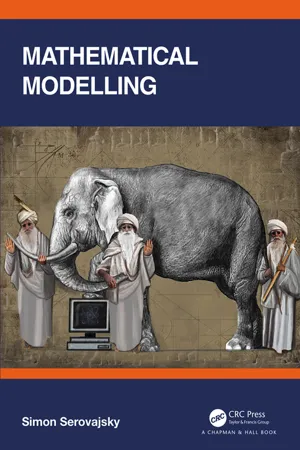
Mathematical Modelling
eBook - ePub

Mathematical Modelling

  1. 442 pages
  2. English
  3. ePUB (mobile friendly)
  4. Available on iOS & Android
eBook - ePub

Mathematical Modelling

About this book

Mathematical Modelling sets out the general principles of mathematical modelling as a means comprehending the world. Within the book, the problems of physics, engineering, chemistry, biology, medicine, economics, ecology, sociology, psychology, political science, etc. are all considered through this uniform lens.

The author describes different classes of models, including lumped and distributed parameter systems, deterministic and stochastic models, continuous and discrete models, static and dynamical systems, and more. From a mathematical point of view, the considered models can be understood as equations and systems of equations of different nature and variational principles. In addition to this, mathematical features of mathematical models, applied control and optimization problems based on mathematical models, and identification of mathematical models are also presented.

Features

  • Each chapter includes four levels: a lecture (main chapter material), an appendix (additional information), notes (explanations, technical calculations, literature review) and tasks for independent work; this is suitable for undergraduates and graduate students and does not require the reader to take any prerequisite course, but may be useful for researchers as well
  • Described mathematical models are grouped both by areas of application and by the types of obtained mathematical problems, which contributes to both the breadth of coverage of the material and the depth of its understanding
  • Can be used as the main textbook on a mathematical modelling course, and is also recommended for special courses on mathematical models for physics, chemistry, biology, economics, etc.

Frequently asked questions

Yes, you can cancel anytime from the Subscription tab in your account settings on the Perlego website. Your subscription will stay active until the end of your current billing period. Learn how to cancel your subscription.
No, books cannot be downloaded as external files, such as PDFs, for use outside of Perlego. However, you can download books within the Perlego app for offline reading on mobile or tablet. Learn more here.
Perlego offers two plans: Essential and Complete
  • Essential is ideal for learners and professionals who enjoy exploring a wide range of subjects. Access the Essential Library with 800,000+ trusted titles and best-sellers across business, personal growth, and the humanities. Includes unlimited reading time and Standard Read Aloud voice.
  • Complete: Perfect for advanced learners and researchers needing full, unrestricted access. Unlock 1.4M+ books across hundreds of subjects, including academic and specialized titles. The Complete Plan also includes advanced features like Premium Read Aloud and Research Assistant.
Both plans are available with monthly, semester, or annual billing cycles.
We are an online textbook subscription service, where you can get access to an entire online library for less than the price of a single book per month. With over 1 million books across 1000+ topics, we’ve got you covered! Learn more here.
Look out for the read-aloud symbol on your next book to see if you can listen to it. The read-aloud tool reads text aloud for you, highlighting the text as it is being read. You can pause it, speed it up and slow it down. Learn more here.
Yes! You can use the Perlego app on both iOS or Android devices to read anytime, anywhere — even offline. Perfect for commutes or when you’re on the go.
Please note we cannot support devices running on iOS 13 and Android 7 or earlier. Learn more about using the app.
Yes, you can access Mathematical Modelling by Simon Serovajsky in PDF and/or ePUB format, as well as other popular books in Mathematics & Applied Mathematics. We have over one million books available in our catalogue for you to explore.

Information

Table of contents

  1. Cover Page
  2. Half-Title Page
  3. Title Page
  4. Copyright Page
  5. Dedication Page
  6. Contents
  7. Preface
  8. List of Figures
  9. List of Tables
  10. 1 Foundations of mathematical modeling
  11. I Systems with lumped parameters
  12. II Systems with distributed parameters
  13. III Other mathematical models
  14. IV Additions
  15. Epilogue
  16. Bibliography
  17. Index