The historical narrative which unfolds in the following pages is almost completely unknown to Western readers.
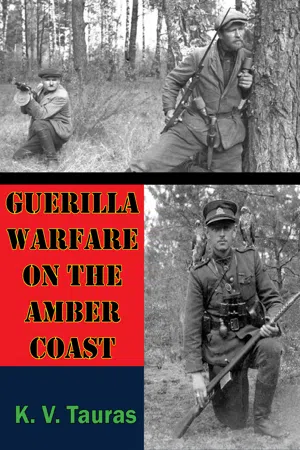
Guerilla Warfare on the Amber Coast is an authentic, factual history of Lithuanian resistance against Soviet and Nazi oppressors between 1940-1952. This report is based on first-person accounts supplied by people who lived in Lithuania and who were able to reach the West; on statements by defected Soviet officials and military personnel, on articles of the Lithuanian underground press; and on items which have appeared openly in official Communist releases. For the most part, the report concentrates on Lithuanian guerilla operations against the Soviet colonial administration in Lithuania between 1944 and 1952.
Most of the first-hand experiences in this narrative were brought to the West by Juozas Luksa, a special emissary from the Lithuanian Freedom Army to Lithuanian institutions in the free world. As a freedom fighter he had used the aliases of Skrajunas, J. Daumantas, and Miškinis. In 1950 he returned to Soviet-occupied Lithuania to rejoin the LFA. According to Soviet sources, the NKVD captured and executed him in about October, 1951.
This narrative is published for the record and in the belief that it may serve a useful purpose at this particular juncture in world affairs. Interested readers will find extensive documentation and first-hand accounts of guerilla operations of the Lithuanian Freedom Army in the publications listed at the end of this report.
- 86 pages
- English
- ePUB (mobile friendly)
- Available on iOS & Android
eBook - ePub
Guerilla Warfare On The Amber Coast
About this book
Information
Subtopic
European HistoryIndex
HistoryVI. THE TARGETS OF THE LITHUANIAN FREEDOM ARMY
“Ƭyranny, like hell, is not easily conquered.”—THOMAS PAINE
GENERAL ATTITUDE OF THE LFA
The command of the Lithuanian Freedom Army never considered as its task the expulsion of the Soviet Army from Lithuania. Therefore all LFA units received strict orders to avoid clashes with the regular army of the USSR. The task the LFA set for itself did not directly affect the presence of the Soviet front army in Lithuania, where it stood as a result of the war between Germany and the USSR.
The operations of the LFA were directed against the Soviet organs engaged in the destruction of Lithuania’s independence: the administrative apparatus, the Moscow-manipulated Lithuanian branch of the Communist Party, and the NKVD secret police and its armed forces.
At the same time, the Soviets, in their efforts against the LFA, were anxious not to attract world public opinion to events on the Amber Coast or to create eventual international complications; therefore they attempted to rely solely on the NKVD forces. Only on very few occasions were regular Soviet Army units thrown into the battle.
It must be recalled here that before the liquidation of Beria, the NKVD force in the USSR was divided into the NKVD territorial units, i.e., intelligence personnel, and NKVD troops used by the Soviet government simply as an armed force. The latter had many subdivisions; internal, border-guards, railroad, convoy, operational, or special assignment units. The main adversaries of the LFA were the NKVD intelligence personnel, as well as the operational or special troops.
LFA AGAINST THE NKVD
The war between the LFA and the USSR can therefore be more accurately described as a war between the freedom fighters and the NKVD, one arm of the Soviet power. One of the main and permanent aims of the LFA was to weaken the fighting capacity of the NKVD and to demoralize NKVD soldiers in every possible way. Since it was impossible to fulfill this task peacefully, destructive measures were the only means available. According to data of the LFA command, the losses of the NKVD in its war against the LFA, during 19454949, were in the vicinity of 80,000 men. Most of these were killed in NKVD attacks against LFA units.
Nor did the LFA itself let pass many occasions to assault and destroy NKVD forces. One such major raid occurred in February 1948, in eastern Lithuania. LFA detachments, led by Perkunas and Viesulas, devised a plan to attack and destroy the NKVD garrison in the town of U. LFA patrols had ascertained that the local militia would not. interfere in any fighting between the LFA and the NKVD, but would instead surrender to the LFA. The NKVD garrison numbered 250 men, against whom the LFA mustered some 120 guerillas. The initial phase of the attack was successful. But when the main NKVD force retreated into their brick headquarters, the guerillas met unexpected obstacles. Anti-tank grenades, meant to destroy the building, failed to explode. Equally unsuccessful was the use of gasoline containers to ignite the building, since these had been punctured by bullets early in the battle. The freedom fighters continued their machine-gun and automatic fire for three hours, but were not able to seize the NKVD building.
Another LFA detachment in eastern Lithuania, led by B., had so demoralized the NKVD units with its continuous attacks that for several months the local Soviet administration was completely inactive.
The LFA avoided attacking sizeable NKVD detachments in larger Lithuanian cities. Instead, groups of two or three freedom fighters would stage surprise raids. By these means they inflicted considerable damage on NKVD forces and, even more, kept them in a state of continuous insecurity. A German, prisoner of war of the Soviets, describes his experiences in 1947 with the LFA as follows:
“Once we were taken to a forest to prepare firewood, in the Shiauliai region. (Shiauliai is the fourth largest Lithuanian city.) At the outskirts of the forest, Russian soldiers stopped us, giving us cigarettes and complimenting us, saying: “Deutscher Kamerad ist gut.”
Then they left us to enter the forest alone, themselves retiring to the buildings at the edge of the forest. This Russian behavior was very puzzling to us. But some of our comrades, who had worked frequently in the forest, explained that there were Lithuanian Partisans there. The Russians, fearing them, never ventured into the forest in small groups. There had been instances when Lithuanian partisans seized Germans working in the forests, armed them and forced them to fight against the Russians. In the Summer of 1946 there was a great explosion in Shiauliai. We later learned that Lithuanian partisans had blown up the NKVD office.”{4}
NO MERCY FOR THE COMMUNIST ACTIVISTS
Although NKVD units were the principal targets in the field of battle, they were not the main enemies. Most Lithuanians considered them as merely blind tools of the Kremlin and, except for the Communist party members among them, did not hold them directly responsible for the Kremlin’s crimes in Lithuania. Therefore most of the non-Communist NKVD men taken prisoner were released after an indoctrination period and harsh admonitions.
No pity was shown and no justification granted, however, to Russian and Lithuanian Communist activists who were carrying out the Soviet policy of oppression and genocide. From 1945 to 1952, the year of the demobilization of armed resistance,{5} the LFA put to death about 4000 Communist activists.
Punitive attacks against Communist activists in villages or towns did not usually present many difficulties. It was different with those who lived and worked in the larger towns and cities, under constant NKVD protection. Action there was risky and required some imaginative planning. The following are two operations that succeeded.
Communist activists in the town of M., protected by a large NKVD garrison, felt wholly secure and were notorious for their ruthlessness in carrying out Soviet orders. The LFA command weighed many plans to strike a blow against the most vicious among them. At last the task was entrusted to freedom fighter M. and Miss P., the LFA agent in the town.
Miss P. was employed in an office of the Soviet administration. Her good looks and attractive personality had made her quite popular among the leading Communist activists. The plan called for a mock engagement to be staged between freedom fighter M. and herself. The leading Communist activists would then be invited to an engagement party at Miss P.’s apartment.
On the appointed day, M. changed into a new suit obtained especially for the occasion, thoroughly rechecked his two pistols, consumed a large portion of lard to acquire immunity against alcohol and, accompanied by his cousin, left for the town of M. to meet his “fiancée.” Several Communist youths were already in the apartment waiting for the party to begin. M. introduced himself as a sports instructor from the city of Kaunas and mimed a happy “bridegroom-to-be” quite convincingly. But the top officials failed to appear at the agreed time, and he began to worry. Finally, three of the four expected important guests arrived, including the Secretary of the CP and the commander of the NKVD garrison. Their lateness had been the result of a previous celebration. Although they had obviously already consumed some vodka, they were quite alert and showered the “bride-groom-to-be” with questions about his work, as well as allegedly mutual acquaintances. It was then that the first shadow of suspicion fell. One of the Komsomol girls at the party had a basketball-playing brother in Kaunas, who kept her up-to-date on sports events and people in that city. She apparently could not recall ever having heard the name of the “bridegroom-to-be.” M. noticed a slight shift in the atmosphere. The Komsomol girl began to whisper to the important guests. M. thought he heard the snap of a pistol latch in the NKVD commander’s pocket. Quick action was called for. The “bridegroom-to-be” feigned a headache as the result of a surfeit of alcohol, and stepped out into the kitchen. Meanwhile the “bride” invited the guests to pose for a group photograph. She placed the leading Communist activists, as guests of honor, in the center, and left space for herself and the “bridegroom.”
The “bridegroom” did not wait long. He returned from the kitchen with automatics in both hands, and opened fire. There was no time for his targets even to move. He hastily collected the weapons of the fallen and fled from the apartment, together with his cousin and his “bride,” leaving several Communist youths motionless with fright. Despite the noise of the shooting, no militiamen appeared, and the three conspirators were able to reach their pre-selected place of concealment.
Unfortunately, however, not all raids against the Communists came off so smoothly. In 1950, four freedom fighters were killed in an attempt to liquidate three Communist activists.
In the event that an official of the Soviet administration, not himself a Communist party member, should act to bring special or unusual harm to the population, the case was referred to a special LFA court for a decision. For example, Prosecutor V. in the region of R. had, in his seal, deported several hundred Lithuanians to remote regions in Russia, and had executed a dozen civilians as LFA collaborators. At the beginning of 1948 such a court passed a verdict for the liquidation of Prosecutor V. Freedom fighters G. and L. were charged by the LFA court with the execution of the task, but their attempts to reach a position close to the Prosecutor were unsuccessful. Some months later, however, about one thousand passport forms were stolen from a bailiff’s office in region R. The Prosecutor decided to investigate personally at the scene of the “crime.” The two freedom fighters learned when he was scheduled to arrive at the bailiff’s office and disguised themselves as farmers and began to mow the grass in a ditch beside a road where the Prosecutor would pass. Along the road itself they scattered broken glass, so that punctures would force the investigating party to get out of the car.
The plan went off perfectly. Since the punctures occurred within a few hundred yards of the bailiff’s office, the Prosecutor and his NKVD guard continued on foot. Their walk led them past the “harvesters,” who attacked so swiftly and silently that the driver, left behind to repair the tires, noticed nothing. Only when he finally arrived at the office and discovered his superiors missing, did he sound the alarm. The corpses of the Prosecutor and his guard were found in the roadside ditch, covered with freshly mown grass.
Of course, not all punitive attacks were as successful as these. Many claimed the lives of the freedom fighters who engaged in them.
THE STRUGGLE AGAINST POLITICAL FRAUD
Moscow made its first attempt in 1940 to disguise its aggression against Lithuania as a legal act. The next important move in this masquerade was the announcement of the “election” of the country to the Supreme Soviet of the USSR in 1946. The mock election (see p. 21) was necessary for the Communist propaganda machine in its efforts to mislead world public opinion, which still associates the word “election” with legality.
The LFA opposed the mock elections to the Supreme Soviet because they were a parody of democratic suffrage and a falsification of the people’s will. The LFA underground press therefore launched an anti-election campaign to explain the political background of the situation. The population was urged to boycott the election proceedings. LFA units received instructions to prevent Communist activists from terrorizing the inhabitants during the “election campaign.” But their most extensive activity was reserved for the eve of the “election,” when freedom fighters had orders to:
(a) collect passports from the population, so that those whose passports had not been stamped because of failure to vote could excuse themselves by saying their passports had been seized;
(b) keep NKVD garrison buildings under constant fire, so that they would be less active the next day, because of exhaustion;
(c) cut telephone wires and destroy local traffic bridges so that on “election” day “electoral commissions” and Communist activists would find themselves isolated from the centers and would be unable to visit individual farms with voting boxes or otherwise to terrorize the inhabitants into voting.
Let us take a closer look at some typical election episodes. In district B., an LFA unit took up a convenient roadside position a week prior to the “elections.” Several freedom fighters disguised in Red Army uniforms and equipped with binoculars observed traffic on the road. Whenever they spotted an “election” truck or automobile covered with posters and slogans, they stopped it, disarmed those inside, and diverted it, passengers and all, from the road into the forest. During a four-hour period, seven cars with thirty-eight agitators and NKVD men were held up and diverted in this way. The freedom fighters then burned all the “election” propaganda and four of the cars. The Communist activists were executed, while three other cars and non-Communist NKVD men were set free to go their way.
Visiting Communist activists were expected at a pre-election meeting held in the town of K. They were accompanied by a dozen NKVD men. Three miles outside the town they were met by machine-gun crossfire. Their cars ignited, and only a few NKVD men managed to crawl to safety along roadside ditches. Communist activists were largely passive in that district for a long time thereafter.
On the eve of the “election,” the clatter of machine-guns and automatics, punctuated by muffled grenade explosions, was heard throughout all Lithuania. The entire country resembled a front line. The Soviet administration, aware of the moods governing the country, threw in all its available forces to make the “election” a success. The entire body of Communist activists was mobilized and an NKVD army, 60,000 strong, was put on a war footing. The territory of Lithuania was divided into 2277 electoral districts. Each district was assigned to a number of Communist activists and between 20 and 30 NKVD men. The polling places were covered with sandbags. Each person entitled to vote received in advance an announcement saying that it was his duty to do so. Special transportation for the conveyance of sick and old people to the polling places was organized in each village. Communist propaganda began spreading the rumor that those who voted before 10 a.m. would be rewarded with vodka and sausage, while those who failed to vote would be deported to Siberia.
Despite the threats and promises, on “election” day most Lithuanian villages were as empty and silent as cemeteries. By noon, not even one per cent of the electorate had cast their vote in most of the districts. As a result, groups of between 5 and 15 NKVD men were sent to the villages to gather votes during the afternoon. As the villagers saw them approach, they would either conceal themselves or quickly leave their homes. Some brave people bluntly told the NKVD men that as Lithuanians they could not vote for a Moscow-contro...
Table of contents
- Title page
- TABLE OF CONTENTS
- AUTHOR’S PREFACE
- INTRODUCTION
- I. LITHUANIA BEFORE WORLD WAR II
- II. LITHUANIA-VICTIM OF THE NAZI-SOVIET CONSPIRACY
- III. LITHUANIA RESISTS SOVIET AGGRESSION
- IV. LITHUANIA RESISTS INTEGRATION INTO HITLER’S EMPIRE
- V. LITHUANIA FREEDOM ARMY (LFA) AGAINST SOVIET POWER
- VI. THE TARGETS OF THE LITHUANIAN FREEDOM ARMY
- VII. SOVIET MEASURES TO ANNIHILATE THE LFA
- VIII. THE LITHUANIAN FREEDOM ARMY AND THE WEST
- IX. ENDURING RESISTANCE
- X. THE EXAMPLE OF LITHUANIAN RESISTANCE
- CHRONOLOGY
- BIBLIOGRAPHY
Trusted by 375,005 students
Access to over 1.5 million titles for a fair monthly price.
Study more efficiently using our study tools.
Frequently asked questions
Yes, you can cancel anytime from the Subscription tab in your account settings on the Perlego website. Your subscription will stay active until the end of your current billing period. Learn how to cancel your subscription
No, books cannot be downloaded as external files, such as PDFs, for use outside of Perlego. However, you can download books within the Perlego app for offline reading on mobile or tablet. Learn how to download books offline
Perlego offers two plans: Essential and Complete
- Essential is ideal for learners and professionals who enjoy exploring a wide range of subjects. Access the Essential Library with 800,000+ trusted titles and best-sellers across business, personal growth, and the humanities. Includes unlimited reading time and Standard Read Aloud voice.
- Complete: Perfect for advanced learners and researchers needing full, unrestricted access. Unlock 1.5M+ books across hundreds of subjects, including academic and specialized titles. The Complete Plan also includes advanced features like Premium Read Aloud and Research Assistant.
We are an online textbook subscription service, where you can get access to an entire online library for less than the price of a single book per month. With over 1.5 million books across 990+ topics, we’ve got you covered! Learn about our mission
Look out for the read-aloud symbol on your next book to see if you can listen to it. The read-aloud tool reads text aloud for you, highlighting the text as it is being read. You can pause it, speed it up and slow it down. Learn more about Read Aloud
Yes! You can use the Perlego app on both iOS and Android devices to read anytime, anywhere — even offline. Perfect for commutes or when you’re on the go.
Please note we cannot support devices running on iOS 13 and Android 7 or earlier. Learn more about using the app
Please note we cannot support devices running on iOS 13 and Android 7 or earlier. Learn more about using the app
Yes, you can access Guerilla Warfare On The Amber Coast by K. V. Tauras in PDF and/or ePUB format, as well as other popular books in History & European History. We have over 1.5 million books available in our catalogue for you to explore.