- 144 pages
- English
- ePUB (mobile friendly)
- Available on iOS & Android
eBook - ePub
About this book
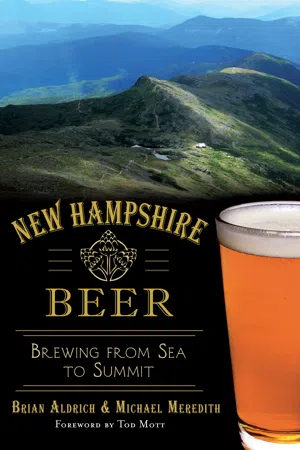
In 1859, the legendary Frank Jones Brewery was founded in Portsmouth, paving the way for the booming craft beer scene of today. The surge of budding breweries is bringing exciting styles and flavors to thirsty local palates and neighborhood bars from the White Mountains to the seacoast. Join beer scholars and adventurers Brian Aldrich and Michael Meredith as they explore all of the tastes New Hampshire beer has to offer. They've scoured the taps at Martha's Exchange, peeked around the brew house at Smuttynose and gotten personal with the brewers behind Flying Goose and Moat Mountain. Discover, pint for pint, the craft and trade of the state's unique breweries, from the up-and-comers like Earth Eagle and Schilling to old stalwarts like Elm City and Portsmouth Brewery.
Trusted by 375,005 students
Access to over 1.5 million titles for a fair monthly price.
Study more efficiently using our study tools.
Information
1
FRANK JONES BREWERY
In 1858, Frank Jones began working at John Swindell’s Brewery in Portsmouth. A few short years later, he bought out the shares and renamed it Frank Jones Brewery. In 1865, a local newspaper ran this story on Jones, describing the brewing process and future plans of growth:
In connection with this brewery, Mr. Jones has, within a year or two, erected a large building for a malt house, and here the process of brewing (malting) commences. In the bins, lay [sic] immense piles of pure Canada barley, 25,000 to 33,000 bushels, certainly, good looking enough to eat as ale does to drink after the batch is made. About 500 bushels of grain is [sic] thrown into the great circular wooden water tank, the sides of which are higher than your head, located in the lower room, and soaked for a couple of days. Then, having been winnowed of all bad kernels, peas, other grains, weed seeds, etc., by dipping off these extraneous matters, which all float on the top of the water, and which are sold at a price for light food for horses, and for pigs, hens and etc…the soaked and perfect barley are [sic] spread on the smooth, clean floor to the depth of six inches or so, and there lies for a few days to swell and sprout, heat and ferment. There are three of these piles or beds of barley, of 500 bushels each, spread over the floor, in different stages of preparation.
From here the grain goes into the drying room, the floor of which is iron, punctured with innumerable little holes, like a strainer or sieve, and the coal fires in the furnaces which are never allowed to go out, day or night, the year round. When entirely dry, the grain, which is now malt, or malted barley, is conveyed to the brewery proper, and cracked in a mill, then soaked again, this time in hot water, pure from the Portsmouth Aqueduct, and placed on another sieve or strainer, and the liquid caught below, which, as extract of barley, is all of the grain which is wanted. The residue is the “Brewers Grain” which is sold for food for animals, and is a valuable manure.
Hops are now added to this liquid extract in such quantities as to produce ale of desired strength and quality, whether stock, amber or cream; and, after fermenting to the proper point, is barreled for use. In pure ale there is no other ingredient besides these, water and hops. But adulteration by means of “quassis” (the wooden bark of tropical trees) instead of hops, may be made at greatly reduced prices…We understand that Mr. Jones’ accommodations, spacious and complete as they are, are by no means sufficient for his increasing business; and he has extensive stables and sheds already in the course of erection, and contemplates considerable additions to his brewery and malt house.
Frank Jones was a jack of all trades, owning businesses from hotels and restaurants to utilities companies and banks. Jones also was elected mayor of Portsmouth twice during the time he was operating the brewery. In the years leading up to Prohibition, Jones made extensive additions to his brewery, adding a barrel house, malt house, bottling line and clock tower. At its peak, the Frank Jones Brewery was producing 250,000 barrels of beer a year, the most of any brewery in the United States. After Prohibition, Jones sold the equipment from the brewery, but the brand continued to be circulated by the Eldridge Brewing Company of Portsmouth, Jones’s old competition. Eldridge produced the beer at the old Frank Jones Brewery for a number of years, stopping in 1950 when the brewery closed. If you take a walk through Portsmouth, you will see a number of buildings and businesses that Frank Jones had a hand in creating. The largest of Jones’s contributions is, of course, the brewery, the building of which remains standing on Islington Street.
2
ANHEUSER-BUSCH
221 DANIEL WEBSTER HIGHWAY, MERRIMACK
(603) 595-1202 | WWW.ANHEUSER-BUSCH.COM | FOUNDED 1970
The Anheuser-Busch Brewery is the oldest brewery still active in the state of New Hampshire. This facility, located at 221 Daniel Webster Highway in historic Merrimack, New Hampshire, was established in 1970. This facility has been going strong in the Granite State for over forty years and services the New England landscape, including Maine, Vermont, New Hampshire, Massachusetts, Connecticut and Rhode Island. Just think, there are over fourteen million people that reside in the New England region, and this one facility is designated to service all of them. Most craft breweries distribute on a small scale in a few states. Being a part of the largest brewing organization on the planet allows Anheuser-Busch Brewery the benefit of reaching more consumers on a daily basis. It has helped it establish its name as a staple in the beer world for decades and has made it a household name.
Their facility is nestled on a sprawling 294 acres of land filled with hop gardens, stone paths and, of course, horse stables that house a team of legendary Budweiser Clydesdales. Spanning over 865,000 square feet, this location produces eight beers in the AB lineup. These beers include Budweiser, Bud Light, Natural Light, Busch, Busch Light, Michelob Light, Michelob ULTRA and Redbridge. They have redefined what it means to produce beer in terms of quality and sheer quantity. Pumping out approximately one hundred trucks per day (that’s a lot of beer), this brewery has become a cornerstone in the brewing landscape in New Hampshire.
The Anheuser-Busch Brewing company was founded in 1852 in St. Louis, Missouri. Over the years, it has grown to be one of the largest brewers of beer in history. Owning and operating thirteen large capacity breweries in the United States, the brewery is, as of 2008, under the AB InBev company, which is the largest producer of beer in the world. The company as a whole employs over 150,000 people in twenty-four countries around the globe. The Anheuser-Busch Brewery has worked to establish its home-grown roots. Although the brewery is a part of a large international body, it hires, trains and develops people in its plants’ local communities. Many amazing brewers work at the Merrimack, New Hampshire facility, and these people work to create brews for the people of New Hampshire and the entire New England region.

Anheuser-Busch facility in Merrimack, New Hampshire. Photo courtesy of Scott Louis Photography, http://swlouis.com.

Anheuser-Busch Hop Garden on display at the Merrimack, New Hampshire location. Photo courtesy of Scott Louis Photography, http://swlouis.com.

A pint being poured for the patrons touring the Anheuser-Busch facility in Merrimack, New Hampshire. Photo courtesy of Scott Louis Photography, http://swlouis.com.
The tour at the brewery is an outstanding education in brewing on a large scale. We recommend you carve out an afternoon to see what brewing on the macro level is all about. Overall, the brewing experience at any brewery—whether it be a small one-barrel system or a large, macro facility like the one located in Merrimack—is a beer lover’s dream. The dedication and precision it takes to brew beer of the same quality day in and day out is not an easy task for any operation. The Anheuser-Busch Brewery prides itself on the quality and consistency of its brews each day. Overall, the brewing community in New Hampshire applauds the operations of the Anheuser-Busch Brewery. The entire community prides itself on quality and consistency, and the brewery has authored the book on it. Personally, any brewery that takes the time to brew consistent beer on a daily, monthly and yearly basis gets a thumbs up in our eyes.
THE TOUR
Nestled in the scenic New England countryside, the Anheuser-Busch Brewery in Merrimack, New Hampshire, offers complimentary tours throughout the year that allow guests to see how some of the world’s best beers are brewed by talented brew masters. In addition to the history of Anheuser-Busch and the Merrimack brewery, the tour includes information about the company’s extraordinary local and national initiatives to help protect and preserve the environment. Visitors can also get up close with the world-famous Budweiser Clydesdales at the Merrimack Clydesdale Hamlet. The gentle giants have appeared in wildly popular television commercials over the years and represent a special part of Anheuser-Busch’s history. At the conclusion of the tour, free samples of freshly brewed Anheuser-Busch beers are offered to guests twenty-one years and older.

Anheuser-Busch Tour Center interior in Merrimack, New Hampshire. Photo courtesy of Scott Louis Photography, http://swlouis.com.
3
PORTSMOUTH BREWERY
56 MARKET STREET, PORTSMOUTH
(603) 431-1115 | WWW.PORTSMOUTHBREWERY.COM | FOUNDED 1991
There are two smells that best describe Portsmouth—the smell of roasting coffee from Breaking New Grounds on Market Square and the smell of beer being brewed at Portsmouth Brewery. There is no escaping that giant golden mug of beer that hangs outside on Market Street. Peter Egelston is the man responsible for opening New Hampshire’s first brewpub following Prohibition. Peter opened the Northampton Brewery in Massachusetts with his sister, Janet, in 1987 before leaving that brewpub to her and heading to the Granite State. Following the country’s craft beer revolution started by Anchor Steam’s Fritz Maytag, New Albion’s Jack McAuliffe and Sierra Nevada’s Ken Grossman, Peter and Janet Egelston were at the forefront of the New England craft beer revival.
There wasn’t much of a beer scene in New England in 1987. In 1986, Karen and David Geary opened the D.L. Geary Brewing Company, and Steve Mason opened Catamount Brewing Company in Windsor, Vermont. Dan Kenary and Rich Doyle opened the Harpoon Brewery in the summer of 1987 in Boston, Massachusetts, and Sam Adams’s Boston Lager was beginning to make the rounds at bars. Because the concept of a brewpub was new in New England, Peter and Janet Egelston were making the rules as they went along. “No one knew what we were doing. Beer at that time was still beer with a lowercase b, all the same,” Peter says.
The Egelstons opened the doors at Northampton Brewery in 1987 with Amber Lager and Golden Lager. “In those days, people just wanted a beer and didn’t understand the concept that beer could be made in the same place you eat and drink,” Peter explains. The difference between then and now is that first beer. An introduction to beer for you today may not necessarily be the same as others from the ’80s. There were no local double IPAs or imperial stouts.

Portsmouth Brewery logo. Photo courtesy of Portsmouth Brewery.
Peter and Janet’s first task was justifying their existence. People wanted to know why they were making beer in a small building when the bigger breweries were making beer in bigger facilities in the middle of the country. Because the concept was new, they could afford to make a lot of mistakes and get away with them, both with beer and food. “People’s standards were lower back then because the concept of a brewpub was so new. Nowadays, making really good beer today just gets you a seat at the table,” Peter says. He combed through resources such as Charlie Papazian’s book The Complete Joy of Homebrewing and David Line’s Brewing Beers Like Those You Buy to gain ideas for his own formulas.
After operating Northampton Brewery for years, Peter wanted a second location. He began scouting in an unfriendly legal climate. After searching for locations in many New England states, Egelston ended up in Portsmouth, New Hampshire. Peter had called the liquor commissioner and got an encouraging response. “We were wondering when someone was going to come open a brewpub here,” Peter recalls the commissioner saying. “They were very welcoming.” At the time, Market Street in Portsmouth wasn’t considered the prime real estate it is today. The center of the tourist attractions was one street over on State Street. Peter left the Northampton Brewery to Janet, and after holding the position from 1987 to 1991, Peter had to give up the reigns as brewer. The job went to his former assistant brewer, Rick Quackenbush, who held the position for years. The first brewer at the Portsmouth Brewery was Paul Murphy.
“We would have built the brewery very differently if we had twenty years of hindsight. You will find brewpubs of a certain age are built around seven barrels as a standard due to the abundance of grundy tanks—or British cellar tanks, which hold seven barrels of beer.” Around the early to mid-’90s, many small British breweries were going out of business. There was value in selling their equipment to new breweries that were starting up in the United States. When you walk into the brewery today, you will have an array of seating options. From the “fishbowl” in the front of the brewery that has a window looking out on busy Market Street, the side restaurant, main area, bar area, upper area and downstairs lounge. “The feeling of Portsmouth Brewery is a series of little neighborhoods,” Pete says. The upper area of the pub was a “happy accident to solve an architectural problem.” The fourteen-barrel fermenters were too tall to fit in the space to begin with, so Peter had to raise the roof. Now you can look down on the brewers as you eat lunch. Those “neighborhoods” make the three-hundred-seat brewpub much more intimate.
Getting off the ground, Peter and brewer Paul took the path of least resistance and cloned beers that were successful at Northampton Brewery. Portsmouth Pale Ale was Northampton Pale Ale with a different name. This beer lives on today through the beer sold exclusively to Common Man restaurants. It was a real simple beer with two different kinds of malts and two different kinds of hops. Other beers included the Weizenheimer and the Black Cat Stout. Those be...
Table of contents
- Front Cover
- Half Title
- Title Page
- Copyright
- Dedication
- Contents
- Foreword
- Introduction
- 1. Frank Jones Brewery
- 2. Anheuser-Busch
- 3. Portsmouth Brewery
- 4. Martha’s Exchange Restaurant & Brewery
- 5. Milly’s Tavern
- 6. Smuttynose Brewing Company
- 7. Elm City Brewing Company
- 8. Seven Barrel Brewery
- 9. Woodstock Inn Station & Brewery
- 10. Redhook Ale Brewery
- 11. Flying Goose Brew Pub
- 12. Tuckerman Brewing Company
- 13. Moat Mountain Smokehouse & Brewing Company
- 14. White Birch Brewing
- 15. The Prodigal Brewery
- 16. Throwback Brewery
- 17. Earth Eagle Brewings
- 18. 603 Brewery
- 19. Henniker Brewing Company
- 20. Great Rhythm Brewing Company
- 21. The Future of New Hampshire Beer
- Appendix I: Additional Resources
- Appendix II: New Hampshire Beer Bars and Stores
- Bibliography
- About the Authors
Frequently asked questions
Yes, you can cancel anytime from the Subscription tab in your account settings on the Perlego website. Your subscription will stay active until the end of your current billing period. Learn how to cancel your subscription
No, books cannot be downloaded as external files, such as PDFs, for use outside of Perlego. However, you can download books within the Perlego app for offline reading on mobile or tablet. Learn how to download books offline
Perlego offers two plans: Essential and Complete
- Essential is ideal for learners and professionals who enjoy exploring a wide range of subjects. Access the Essential Library with 800,000+ trusted titles and best-sellers across business, personal growth, and the humanities. Includes unlimited reading time and Standard Read Aloud voice.
- Complete: Perfect for advanced learners and researchers needing full, unrestricted access. Unlock 1.5M+ books across hundreds of subjects, including academic and specialized titles. The Complete Plan also includes advanced features like Premium Read Aloud and Research Assistant.
We are an online textbook subscription service, where you can get access to an entire online library for less than the price of a single book per month. With over 1.5 million books across 990+ topics, we’ve got you covered! Learn about our mission
Look out for the read-aloud symbol on your next book to see if you can listen to it. The read-aloud tool reads text aloud for you, highlighting the text as it is being read. You can pause it, speed it up and slow it down. Learn more about Read Aloud
Yes! You can use the Perlego app on both iOS and Android devices to read anytime, anywhere — even offline. Perfect for commutes or when you’re on the go.
Please note we cannot support devices running on iOS 13 and Android 7 or earlier. Learn more about using the app
Please note we cannot support devices running on iOS 13 and Android 7 or earlier. Learn more about using the app
Yes, you can access New Hampshire Beer by Brian Aldrich,Michael Meredith in PDF and/or ePUB format, as well as other popular books in History & North American History. We have over 1.5 million books available in our catalogue for you to explore.