Fairly or unfairly, the stalemate on the First World War's Western Front is often attributed to the intellectual stagnation of the era's military officers. This paper traces the development (or absence of development) of combined arms and fire & maneuver tactics and doctrine in the period prior to WW I, focusing on the Russo-Japanese War.
The Western armies that entered the Great War seemingly ignored many of the hard-learned lessons and observations of pre-war conflicts. Though World War I armies were later credited with developing revolutionary wartime tactical-level advances, many scholars claim that this phase of tactical evolution followed an earlier period of intellectual stagnation that resulted in the stalemate on the war's Western Front. This stalemate, they claim, could have been avoided by heeding the admonitions of pre-war conflicts and incorporating the burgeoning effects of technology into military tactics and doctrine. Some go even further and fault the military leadership with incompetence and foolishness for not adapting to the requirements of modern war.
The Russo-Japanese War showed the necessity for combined arms techniques and fire and maneuver tactics on the modern battlefield. Specifically, the war showed the need for: (1) the adoption of dispersed, irregular formations; (2) the employment of fire and maneuver techniques and small unit-tactics, including base of fire techniques; (3) the transition to indirect-fire artillery support to ensure the survivability of the batteries, and; (4) the necessity for combined arms tactics to increase the survivability of assaulting infantry and compensate for the dispersion of infantry firepower.
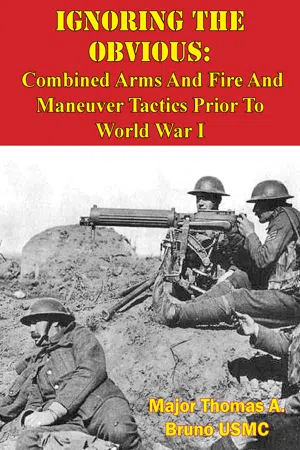
eBook - ePub
Ignoring The Obvious: Combined Arms And Fire And Maneuver Tactics Prior To World War I
- 124 pages
- English
- ePUB (mobile friendly)
- Available on iOS & Android
eBook - ePub
Ignoring The Obvious: Combined Arms And Fire And Maneuver Tactics Prior To World War I
About this book
Information
Subtopic
British HistoryIndex
HistoryBIBLIOGRAPHY
NAPOLEONIC SKIRMISHER TACTICS
Catton, Bruce. Grant takes Command, 3rd ed. New York, NY: Little, Brown and Co., 1994.
Chandler, David G. The Campaigns of Napoleon: The Mind and Method of History’s Greatest Soldier. New York, NY: Scribner, 1966.
Elting, John R. Swords Around a Throne: Napoleon’s Grand Armée New York, NY: Da Capo Press, 1997.
Paret, Peter. “Napoleon and the Revolution in War,” in Makers of Modern Strategy from Machiavelli to the Nuclear Age, ed. Peter Paret. Princeton, NJ: Princeton University Press, 1986.
Rothenberg, Gunther E. The Art of War in the Age of Napoleon. Bloomington, IN: Indiana University Press, 1978.
CIVIL WAR
Alexander, Bevin. Lost Victories: The Military Genius of Stonewall Jackson, 2nd ed. Edison, NJ: The Blue & Grey Press, 1996.
Ambrose, Stephen E. Upton and the Army, 2nd ed. Baton Rouge, LA: Louisiana State University Press, 1992.
Griffith, Paddy. Battle Tactics of the Civil War. New Haven, CN: Yale University Press, 1989.
Jaynes, Gregory and the editors of Time-Life Books. The Killing Ground: Wilderness to Cold Harbor, 2nd rev. ed., The Time-Life Civil War Series. Alexandria, VA: Time-Life Books, Inc., 1987.
Upton, Emory, Major General, USA. Infantry Tactics, Double and Single Rank, adapted to American Topography and Improved Firearms. New York, NY: Greenwood Press, 1968; reprint of 1874 original by D. Appleton & Co.
——-Armies of Asia and Europe Embracing Official Reports on the Armies of Japan, China, India, Persia, Italy, Russia, Austria, Germany, France, and England. New York. NY: Greenwood Press, 1968; reprint of 1878 original by D. Appleton & Co.
WARS OF GERMAN UNIFICATION/PRUSSIAN DOCTRINE
Addington, Larry H. The Blitzkrieg Era and the German General Staff, 1865-1941. New Brunswick, NJ Rutgers, 1971.
Balck, Wilhelm, Lieutenant General, German Army. Development of Tactics—World War, trans. Harry Bell. Fort Leavenworth, KS: The General Service Schools Press, 1922.
—— Tactics, vol. I-II, trans. Lt Walter Krueger. Fort Leavenworth, KS: U.S. Cavalry Association, vol. I, 1915; vol. II, 1914.
Barnett, Correlli. The Swordbearers: Supreme Command in the First World War. Bloomington, IN: Indiana University Press, 1963.
von Boguslawski, Albrecht. Tactical Deductions From the War of 1870-71, trans. Col. Lumley Graham. London: Henry S. King & Co., 1872.
Corum, James S. The Roots of Blitzkrieg: Hans Von Seeckt and German Military Reform. Lawrence, KS: University Press of Kansas, 1992.
Craig, Gordon A. The Politics of The Prussian Army, 1640-1945. New York, NY: Oxford University Press, 1955.
Dupuy, T. N., Colonel, USA. A Genius For War: The German Army and General Staff, 18071945. Englewood Cliffs, NJ: Prentice Hall, 1977.
Gudmundsson, Bruce I. Stormtroop Tactics: Innovation in the German Army, 1914-1918. Westport, CT: Praeger Publishers, 1989.
Howard, Michael. The Franco-Prussian War: The German Invasion of France, 1870-1871. New York, NY: Routledge, 1961.
Hughes, Daniel J. ed. Moltke on the Art of War: Selected Writings. Novato, CA: Presidio Press, 1993.
Lupfer, Timothy T., Captain, USA. The Dynamics of Doctrine: The Changes in German Tactical Doctrine During the First World War. Fort Leavenworth, KS: U.S. Army Command and General Staff College, 1981.
Meyer, Bradley J. Operational Art and the German Command System in World War I. Dissertation for Degree Doctor of Philosophy in the Graduate School of the Ohio State University, Columbus, OH: Ohio State University, 1988; Advisor: Prof. Williamson Murray.
—— “Storm Troop Tactics.” SAW 7123: School of Advanced Warfighting Selected Readings for Defense in Depth: The Breakthrough Battle. Quantico, VA: Marine Corps University, School of Advanced Warfighting (AY 2001-02), 2001, pp. 1-49 (original document page numbering; [section 4 of 5 selected readin...
Table of contents
- Title page
- TABLE OF CONTENTS
- EXECUTIVE SUMMARY
- I. INTRODUCTION
- II. BACKGROUND: TECHNOLOGY, TACTICS, AND THE CHANGING NATURE OF WAR
- III. A BAPTISM BY FIREPOWER:
- IV. THE SIEGE OF PORT ARTHUR:
- V. CONCLUSION
- APPENDIX A: THE END OF AN ERA
- APPENDIX B: BREAKING THE LINES
- APPENDIX B: PART II-THE RISE OF THE CAPTAIN
- APPENDIX B: PART III-LEADERSHIP BY DIRECTIVE
- APPENDIX C: VICTORY THE HARD WAY
- APPENDIX C: PART II-INTERPRETATIONS OF THE BOER WAR
- APPENDIX D: TERMS AND DEFINITIONS
- BIBLIOGRAPHY
Trusted by 375,005 students
Access to over 1.5 million titles for a fair monthly price.
Study more efficiently using our study tools.
Frequently asked questions
Yes, you can cancel anytime from the Subscription tab in your account settings on the Perlego website. Your subscription will stay active until the end of your current billing period. Learn how to cancel your subscription
No, books cannot be downloaded as external files, such as PDFs, for use outside of Perlego. However, you can download books within the Perlego app for offline reading on mobile or tablet. Learn how to download books offline
Perlego offers two plans: Essential and Complete
- Essential is ideal for learners and professionals who enjoy exploring a wide range of subjects. Access the Essential Library with 800,000+ trusted titles and best-sellers across business, personal growth, and the humanities. Includes unlimited reading time and Standard Read Aloud voice.
- Complete: Perfect for advanced learners and researchers needing full, unrestricted access. Unlock 1.5M+ books across hundreds of subjects, including academic and specialized titles. The Complete Plan also includes advanced features like Premium Read Aloud and Research Assistant.
We are an online textbook subscription service, where you can get access to an entire online library for less than the price of a single book per month. With over 1.5 million books across 990+ topics, we’ve got you covered! Learn about our mission
Look out for the read-aloud symbol on your next book to see if you can listen to it. The read-aloud tool reads text aloud for you, highlighting the text as it is being read. You can pause it, speed it up and slow it down. Learn more about Read Aloud
Yes! You can use the Perlego app on both iOS and Android devices to read anytime, anywhere — even offline. Perfect for commutes or when you’re on the go.
Please note we cannot support devices running on iOS 13 and Android 7 or earlier. Learn more about using the app
Please note we cannot support devices running on iOS 13 and Android 7 or earlier. Learn more about using the app
Yes, you can access Ignoring The Obvious: Combined Arms And Fire And Maneuver Tactics Prior To World War I by Major Thomas A. Bruno USMC in PDF and/or ePUB format, as well as other popular books in History & British History. We have over 1.5 million books available in our catalogue for you to explore.