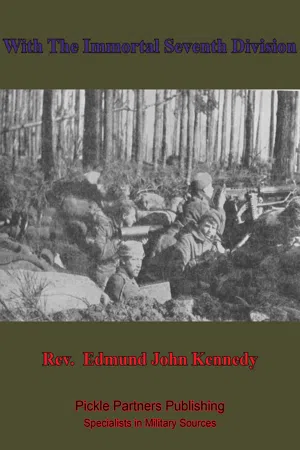
Even among the highly-trained and professional soldiers of the B.E.F in 1914 the men of the Seventh division stood apart for their bearing and training, for the contained no reservists; all were full-time soldiers. Accompanying these uncompromising men, was Reverend Kennedy, assigned to the 20th Brigade, which was to see much action during the opening months of the First World War.The Padré and his beloved soldiers trekked into Belgium to take part in the First Battle of Ypres, to find the local inhabitants welcoming but the atmosphere filled with apprehension. As the Seventh finally clashed with the invading Germans the author found his role turned from an observer to participant in offering comfort and even absolution to the wounded and dying. A man of committed faith he continued to minster to his men as they fought in the desperate action around Ypres.After a year with the troops the Reverend returned to England and composed his memoirs of the period but did not survive long enough to see their publication.Author — Rev. Edmund John Kennedy d. 1915.Preface — Right Reverend the Lord Bishop of Winchester.Text taken, whole and complete, from the edition published in London, Hodder and Stoughton, 1916.Original Page Count – x and 193 pages
- 84 pages
- English
- ePUB (mobile friendly)
- Available on iOS & Android
eBook - ePub
With The Immortal Seventh Division
About this book
Trusted by 375,005 students
Access to over 1.5 million titles for a fair monthly price.
Study more efficiently using our study tools.
Information
Subtopic
Military BiographiesIndex
HistoryCHAPTER I
THE SEVENTH DIVISION
‘TELEGRAM, sir!‘ and a mounted orderly who had ridden over from Larkhill, stood outside my tent at the Bustard’s Camp, Salisbury Plain, at 5 a.m., on September 17, 1914. In that remote part of the world so removed from the benefits of ordinary life, we were yet in receipt of our daily papers at that early hour in the morning, and I was enjoying a twenty-four hours’ history of the world, at the moderate price of a penny, when the brief tones of the orderly aroused me from its perusal. Its contents were startling: ‘You have been selected for immediate foreign service. Report yourself early to-morrow morning at the War Office.’
For some days past I had been doing duty with my Territorial Battalion, the 7th Hants; but daily I had been hoping that I might be able to throw in my lot with the great mass of men, who had volunteered at the call of King and country.
During the month of August I had been shut up at the Riffel Alp with some seventy other unfortunates; kicking our heels in enforced ignorance when we would fain have been near the centre of information, if not of service. Unable to travel owing to the railways of Switzerland and France being required for the mobilization of troops, we could only possess our souls in patience. It was a time never to be forgotten, for although our English blood was stirred by the rumours that reached us of an expeditionary force being landed in France, under General Sir John French, and of even greater significance, the mobilization of the English Fleet, yet our only source of information was derived from the Corrière della Sera, the communiqués of which were supplied by the Wolff Agency. Our state of mind can be readily imagined when I mention such points of reliable news as the ‘Destruction of the English Fleet; Death of Sir John French; Invasion of England; London taken; Bank of England in flames.’ Of course we knew that this was false, and yet there was no possibility of rebutting the statements.
For nearly a month we alternated between hope and fear. The effect of the bright Swiss sunshine would at times render us optimistic, and then the fall of night would once more see us plunged into the depths of a helpless pessimism. However, the time came when the little English colony struggled through the difficulties of railway transport, and arrived once more in the region of authentic information. The journey home, which occupied three days, was full of interest, for France was throbbing with ‘la guerre‘ and ‘la gloire‘; train after train with troops bound for the Front, swept by us; while at Lyons we encountered an ambulance train full of wounded, and another of German prisoners. My party had the advantage of travelling with the wife and son of a Cabinet Minister, and through Sir E. Grey’s kind solicitude for his colleague’s people, the best possible accommodation was provided for us, but even that powerful interest was not always sufficient to prevent delay and discomfort. On reaching Creil, the junction for Belgium, we found the station full of English troops in their retreat from Mons, and many were the stirring stories gathered from our retiring, but not disheartened men. The spirit of the French troops much impressed us; unaccompanied, my ladies went among them with confidence, and on every hand were treated with the consideration of gentlemen. I remarked on this to a French gentleman who was travelling with us, and he said with warranted pride, ‘But they are gentlemen, monsieur’ Some of the wounded French took the greatest interest in describing to us the circumstances under which they had been hit,—some, as the manner of soldiers is, displayed the bullet or piece of shrapnel which had laid them low.
Nearly all the troop trains going to the Front were decorated with flowers and evergreens, whilst the stations and villages were alive with enthusiastic people assembled to cheer their men onward to their glorious and dangerous task.
It was with thankful hearts and very travel-stained persons that we finally reached home, heartily agreeing after our exciting experiences that a little goes a long way.
I had at the earliest moment possible volunteered my services to the Army Chaplains Department, but was informed that there was no prospect at that time of my being called upon; accordingly I joined my Territorial Battalion, under Colonel Park, and was awaiting a summons to service, here, there, or anywhere, when, as I have described, the call came. I have often wondered why the War Office always springs upon one with such alarming suddenness; possibly it is the way of the Army; it is certainly disconcerting, although it is educational, for it teaches one to be always ready and alert for any emergency.
And now the order had come, and there was hurrying to and fro; a rapid dash home; a putting together of kit which would be required in the unknown life about to be entered upon. A last night at home; and then the reporting of oneself at the War Office; the signing of a contract for twelve months’ service; a medical examination as to physical fitness; an hour or two’s shopping at Harrods (where one developed a tendency to think of everything not wanted, and to forget what was really useful); and finally Waterloo Station, that scene of many farewells. ‘Good-bye‘ has so many significations. It may be uttered at the parting for a couple of hours; it may be uttered, and often is, in these days as the final word on earth to much loved ones. Oh, [these partings! how they pull a man’s heart to pieces; and yet, with that remarkable insularity which characterizes our race,—or should I say races—it is one of the things seldom or never mentioned among men on service; and yet I suppose it is always uppermost in a man’s mind. Again and again I have lit upon men in out of the way corners, reading a well-worn letter, or perchance gazing at a photograph, every facial lineament of which was already well stamped upon the mind of the gazer. It is one of the mental attitudes which go to form a spirit of comradeship; the feeling that it is all part of the game, and we are most of us tarred with the same brush.
I had received my orders at the War Office, to join the Seventh Division then mobilizing at Lyndhurst.
The Seventh Division! that meant very little to me, and indeed to the public generally at that time, but what it signified to the nation will be more fully appreciated when the history of this war is written.
It may be interesting to give particulars of the composition of that, which I believe is the first Division ever to march out of an English camp fully equipped.
Under the command of Major-General T. Capper{1}, C.B., D.S.O., now Sir Thomson Capper, K.C.M.G., C.B., D.S.O., it represented the very flower of our Army, possessing a Staff of most capable officers.
It consisted of:—
Divisional Signal Company;
Divisional Mounted troops;
Northumberland Hussars;
Cycle Company;
Four Brigades of Artillery (R.H.A., R.F.A., R.G.A.);
Two Batteries R.G.A.
Divisional Ammunition Column;
Divisional Engineers,
two Field Companies;
20th Infantry Brigade,—
Brig.-General H. G. Ruggles Brise, M.V.O.;
Brigade-Major A. B. E. Cator.
2nd Scots Guards;
1st Grenadier Guards;
2nd Border Regiment;
2nd Gordon Highlanders;
21st Infantry Brigade,—
Brig. H. E. Watts, C.B.;
Brigade-Major Captain W. Drysdale.
2nd Bedford Regiment;
2nd Yorks;
2nd Royal Scots Fusiliers;
2nd Wiltshire Regiment;
22nd Infantry Brigade.—
Brig. S. T. B. Lawford;
Brigade-Major Captain G. M. James,
The Buffs.
2nd The Queens;
2nd Royal Warwick Regiment; 1st Royal Welsh Fusiliers; 1st South Staffs Regiment.
Divisional Train;
Four Companies Divisional Medical Units;
21st Field Ambulance;
22nd Field Ambulance;
23rd Field Ambulance;
The mobilization of a Division for Active Service is a vast business; everything has to be thought of and provided; there must be a thorough equipment for the men, horses, and transport; medical stores, saddlery, farriery, etc., etc., not a thing must be forgotten, for in those early days of the war there was no well-equipped Ordnance Department on the other side. Each field Ambulance is a dispensary on wheels, comprising the hundred and one field comforts which warfare rightly provides for the lamentable wrecks that pass through the hands of the R. A. M. C.
The question of horses is no slight undertaking, and certainly gives rise to no little heartburning, as every mounted officer naturally tries to secure a good mount. To me it was a specially serious matter; when a man walks 15.8 and rides another two stone at least, considerable care has to be exercised in the selection of his equine friend, who has to bear with him the fatigues, trials and risks of a campaign. I shall ever feel the deepest obligation to Captain Kennedy Shaw, O.C., Remounts Department, Salisbury, for supplying me with one of the best horses I have ever ridden; a big upstanding bay, with black points; deep chested; good quarters; with the most perfect manners...
Table of contents
- Title page
- PREFACE
- EDITOR’S NOTE
- CHAPTER I
- CHAPTER II
- CHAPTER III
- CHAPTER IV
- CHAPTER V
- CHAPTER VI
- CHAPTER VII
- CHAPTER VIII
- CHAPTER IX
- CHAPTER X
Frequently asked questions
Yes, you can cancel anytime from the Subscription tab in your account settings on the Perlego website. Your subscription will stay active until the end of your current billing period. Learn how to cancel your subscription
No, books cannot be downloaded as external files, such as PDFs, for use outside of Perlego. However, you can download books within the Perlego app for offline reading on mobile or tablet. Learn how to download books offline
Perlego offers two plans: Essential and Complete
- Essential is ideal for learners and professionals who enjoy exploring a wide range of subjects. Access the Essential Library with 800,000+ trusted titles and best-sellers across business, personal growth, and the humanities. Includes unlimited reading time and Standard Read Aloud voice.
- Complete: Perfect for advanced learners and researchers needing full, unrestricted access. Unlock 1.5M+ books across hundreds of subjects, including academic and specialized titles. The Complete Plan also includes advanced features like Premium Read Aloud and Research Assistant.
We are an online textbook subscription service, where you can get access to an entire online library for less than the price of a single book per month. With over 1.5 million books across 990+ topics, we’ve got you covered! Learn about our mission
Look out for the read-aloud symbol on your next book to see if you can listen to it. The read-aloud tool reads text aloud for you, highlighting the text as it is being read. You can pause it, speed it up and slow it down. Learn more about Read Aloud
Yes! You can use the Perlego app on both iOS and Android devices to read anytime, anywhere — even offline. Perfect for commutes or when you’re on the go.
Please note we cannot support devices running on iOS 13 and Android 7 or earlier. Learn more about using the app
Please note we cannot support devices running on iOS 13 and Android 7 or earlier. Learn more about using the app
Yes, you can access With The Immortal Seventh Division by Rev. Edmund John Kennedy in PDF and/or ePUB format, as well as other popular books in History & Military Biographies. We have over 1.5 million books available in our catalogue for you to explore.