As the German army moved swiftly into its start positions at the beginning of the First World War, efficiently and seamlessly forming up for the hammer blow that was to fall on France it must have been with some pride that General Ludendorff would look upon the first grand strategical plan that he had a hand in. A cool, calculating planner dedicated to ensuring that chance played as little a part in war as possible General Erich Ludendorff was the product of the prestigious German Kriegsakademie. His memoirs on the First World War are an excellently detailed account of the planning and execution of the ambitious German High command and their thirst for VictoryAlthough known primarily as staff officer his initial service, in the German army, during the war, was at the siege of Liège for which he was awarded the coveted Pour La Mérite by the Kaiser himself. He was rushed to the embattled Eastern Front as Chief of Staff to General von Hindenburg, and the two made an impressive team winning that battles of Tanneburg and the Masurian Lakes. Once again Ludendorff, this time was his chief Hindenburg, was drafted in as a replacement to ensure the fortunes of the German forces, this time on the Western front in 1916. He operated as the prime mover in the German empire from this point until the end of the war; masterminding the 1918 offensives as the last throw of the dice before capitulation.This first volume covers his early career until 1917 and is enriched with maps of the campaigns of the First World War.Author — General Erich Friedrich Wilhelm Ludendorff, 1865-1937.Translator — Anon.Text taken, whole and complete, from the edition published in New York and London, Harper & Brothers, 1919.Original Page Count – 477 pages
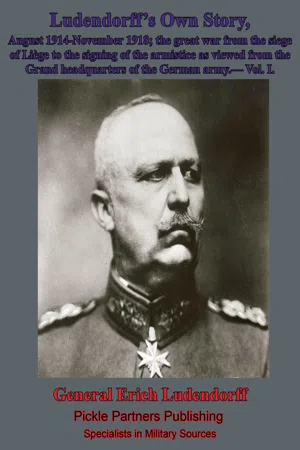
eBook - ePub
Ludendorff's Own Story, August 1914-November 1918 The Great War - Vol. I
from the siege of Liège to the signing of the armistice as viewed from the Grand headquarters of the German army
- 314 pages
- English
- ePUB (mobile friendly)
- Available on iOS & Android
eBook - ePub
Ludendorff's Own Story, August 1914-November 1918 The Great War - Vol. I
from the siege of Liège to the signing of the armistice as viewed from the Grand headquarters of the German army
About this book
Trusted by 375,005 students
Access to over 1.5 million titles for a fair monthly price.
Study more efficiently using our study tools.
Information
Subtopic
Military BiographiesIndex
HistoryTHE REASONS FOR THE FURTHER PROSECUTION OF THE WAR, AND THE CONDITION OF THE FORCES
The Auxiliary Service Law—The Hindenburg Program—The Supplies of Raw Material—The Question of Food-supplies—The Importance of Rumania in the Conduct of the War—The Fight Against the Home Front—The Deterioration of the People’s Morale and the Control of the Press—Propaganda—The Troops and Their Leaders —The Polish Question.
I
THE war called upon us to gather together and throw into the scale the last ounce of our strength, either in the fighting line or behind the lines, in munitions work or other work at home or in Government service. Each citizen could serve his country only in one post, but in some way his strength should be used to that end. Service to the State was the important thing. In general the distribution of forces among the army; the navy, and home services was carried out by the Supreme Army Command in co-operation with the civil officials concerned. The former alone could supervise the whole matter in detail, for even the Prussian Minister of War had but an insufficient and partial view of the forces at the enemy’s disposal and of the needs of the situation.
Up to this time the army in the field had received adequate reinforcements from returned wounded (of whom, thanks to our admirable medical service, a very high proportion came back to the line), from the yearly classes as they were called up, and from re-examinations and comb-outs. We were forced to send men of nineteen to the front; younger men could not be sent. The medical standards were reduced, and the vast majority of the available men called up. It was still necessary, however, not merely to send into the army all the men then available, but also to find some new source of supply beyond these; in particular it was vital to reduce the numbers of exemptions. At the same time, we had to find the labour needed for the work behind the lines, where the construction of positions was of simply incalculable importance, and to keep up the war industries at home.
“Fit for garrison duty only” was always a thorn in my side. When everything was at stake, why should not the garrison duty man, who was employed at the front, carry a rifle as much as the “general service” man? The men, however, looked upon their garrison duty classification as a sort of passport to safety. The Supreme Army Command never succeeded in adjusting this conception to the urgency of the army’s needs or in getting rid of the ill effects of this classification. An order of the Minister of War, issued in the autumn of 1918, was too late to do any good. In the meantime, the standard of fitness for general service had been again revised, and below the class of “garrison duty in the field or at home” there was created another, “labour duty.”
The system of re-examination and control generally at home seemed to me to be defective. Complaints of the most incredible shirking were always being made. I urged the War Ministry to act energetically, which was only bare justice. I never, however, was able to feel that in this respect things were as they should be for the sake of morale in the field and at home.
The (Auxiliary Service) law left untouched labour that should have been devoted to the State. The duty of service was laid only on men between seventeen and forty-five. I regarded this limitation as quite inappropriate in view of the iron necessities of the war.
As early as September 1916 the Chancellor received the first demands of the Supreme Army Command for the unsparing application of all forces. We insisted emphatically on the point of view that in war the strength of every citizen belongs to the State, and that accordingly every German from fifteen to sixty should be under an obligation to serve, an obligation which, with certain limitations, lay on women, too. The duty could be fulfilled by service at the front, or by work, in the widest sense, at home, and was in no sense limited to workmen in the ordinary meaning of the word, although it, of course, fell mainly upon them.
The introduction of compulsion for war services was of the greatest moral importance, placing, as it did, every German at the service of the State in these anxious times, in accordance with the oldest principles of German law. It should also have had the great practical advantage of giving the Government the control over rates of wages. It was one of the most crying injustices of the war—and must have been so felt by the troops—that they, who were risking their lives daily, were much worse off than any of the workmen who lived in safety. While the soldier was fighting for himself, his wife and children, he could think only with anxiety of his future and the maintenance of his family. The separation allowances were in no way sufficient. The longing to get back home, which could be sufficiently explained by the desire for personal safety, had also a higher motive in family affection. The same feeling kept many a man at home, and gave to service in the face of the enemy an air of punishment. This was a thoroughly unsatisfactory position.
The pay of the fighting men should have been raised —and I attempted, without any real success in the face of official opposition at home, to have it raised—and the wages of workmen should have been kept down to a reasonable level. This would have, of course, involved considerable reductions in war profits, for wages and profits necessarily stand in close interrelation. Such a course would have saved considerable sums, thus easing our budget and conserving our capital. I was not unaware of the difficulties of the problem, having regard for the universal rise in prices due to the shortage of raw materials, but I hoped that it would be solved and that the way to a sound position would be discovered. A law establishing the general duty of service would have shown the way to the solution.
The introduction of general conscription, coupled with that of compulsory civilian service, was not of itself sufficient. It was essential, too, to see that the labour thus obtained was profitably used, and that the State did not lose the benefit of it.
It was clear to me that measures of this sort would involve far-reaching interference with administration, with trade, and with private life. It was also not to be forgotten that too many restrictions tend to stultify individual effort. Opposition was bound to arise, even when the demands made did no more than correspond with the iron necessity of the war. Self-seeking and profit-hunting were already firmly rooted. We had, however, to show the people the way to victory, to make them see the facts clearly and settle their own destiny. The Reichstag, and with it the whole people, had to share the responsibility. On October 30, 1916, the Chancellor was especially urged to secure this end. I hoped that the Government would be prepared to adopt the great principle of universal service, and to bring the people to consider what further strength they could devote to their country. It required an unselfish understanding on the part of the people, to shake themselves free from the self-seeking of domestic politics, to devote themselves wholly to the war, and to translate into action the proposals of the Supreme Army Command
The Government did not take these steps. I had still at that time unlimited confidence in the German people and the German working-class. The war was life or death for us all; this should be made clear to the workers, and then, as I believed, they would be certain, in their knowledge of the great danger threatening them and their country, to range themselves behind the Supreme Army Command and to give even more than they had already given. The German workman had already done wonders, but he could still do more. Just as troops, in the hour of peril, are enabled to do their utmost through patriotism inculcated by discipline, so in a long war the people are held together and kept on their feet by firm leadership and a clear conception of the danger threatening their country. The enthusiasm of the moment passes—that is inevitable—and it must be replaced by discipline and understanding. That this could be achieved I had no doubt.
Even without any new legislation the Government could help us. The laws dealing with a state of siege and with war services gave the necessary powers to obtain the labour required, but the Government lacked the necessary determination to apply them properly. The administration of these laws, however, would amount to a mere application of force, from which, on reflection, I saw little hope of real success. I thought that it would be better to have a law supported by the approval of the whole people, one which would make plain to the whole world our determination to hold out. This, too, I explained to the Chancellor.
At last, after two months’ delay and after much unedifying pressure from the Supreme Army Command, the Government made up its mind, in November, to introduce into the Reichstag the Auxiliary Service bill, which was’ passed on December 2. It was neither fish nor fowl and very different from what we had desired. The bill departed too far from the principle of universal liability to service, which we had laid down in September, and gave no security that the labour strength obtained would be so employed as to produce the maximum results. In practice, the law, largely owing to the manner in which it was administered, was but a shadow of the reality we desired, a reality which would have devoted the whole strength of the nation to the nation’s service, and so supplied reinforcements for the army and labour for the army and for home industries. In the whole text of the statute the first paragraph alone bears any resemblance to what the Supreme Army Command had aimed to secure.
The provisions did not cover even women, although there were many available to replace men at their work and release them for the army.
In spite of everything, I gave the law at first a warm welcome. Friend and foe alike attributed to it, as a sign of our determination, a far higher value than it really possessed. In connection with our successes in Rumania, it was bound to have considerable moral effect.
I followed the course of the discussions in the Reichstag with unmixed regret. This was the first time in the war that I had the opportunity, and also, in my position as Quartermaster-General, the duty, to do so. The Supreme Army Command obtained by this means an insight into the spirit of the population that was of decisive importance for the issue of the war. It was certain that the Government was in a very delicate position in dealing with the difficult labour questions. It should have followed a strong war policy, instead of a weak and submissive domestic policy. Why did it not boldly and clearly make the whole people share the responsibility for the result of the war? Certain parties in the Reichstag seemed unable to realize the necessity of postponing party interests for the general good in the hour of peril. The Government, the Reichstag, and a great part of the population had never yet understood the character of modern warfare, which lays claim upon all one’s resources, nor had they ever realized the importance to ultimate victory of their full cooperation in the fight. The Supreme Army Command had again and again to emphasize that the war meant life or death to Germany
It soon became clear that the Auxiliary Service law was not merely insufficient, but positively harmful in operation. It was particularly irritating to the troops to find auxiliary workers, at the same work and in the same positions, being far better paid than the men who had been called up for service under the previous legislation and were now under military command. These grievances were increased by the circumstance that exempted men were paid the same. wages as free workmen—that is to say, as the auxiliary workers. This was wholly unjust and unfair On the lines of communication there were still greater contrasts. Troops withdrawn from the heavy fighting at the front saw auxiliary workers and women workers working in peace and safety for wages far higher than their own pay. This was bound to embitter the men who had to risk their lives day by day and to endure the greatest hardships, and of necessity increased their dissatisfaction with their pay. The employment of highly paid auxiliaries on the lines of communications was thus a two-edged sword. There was something fundamentally unsound in such conditions.
The measures introduced in September with a view to bringing up all possible man-power had thus had but a very scanty result. The latent strength among the people had not been properly brought out; in part it had escaped control, and in part it was being wasted. Too many men who should have gone to the army were left at home. The efforts of the Supreme Army Command had failed; the conviction was forced upon us that the German people were no longer sound at heart.
To increase the esteem in which war work and auxiliary service were held I proposed the institution of the Auxiliary Service Cross. Later on I was one of the first to receive it, and, having regard for the tremendous importance I attributed to the carrying out of the work demanded by the Supreme Army Command, wore it as proudly as my other decorations, even if with a certain melancholy. I was thinking of the working of the Auxiliary Service law, which disappointed me more and more heavily as time went on.
To obtain the necessary skilled workers for the increased production of war material the Supreme Army Command had to draw heavily upon the resources of the army in man-power, weakening the fighting forces correspondingly. In the winter of 1916-17 alone 125,000 men were sent back home, to be returned to the army as soon as they could again be spared. I pressed persistently for arrangements to be made as rapidly as possible between the military and the industrial world for the formation of a body of substitute skilled labour, and for the employment of disabled men and of women in such work. It is true that a great deal was done, but nowhere was the energy used that our position demanded.
It came in the end to this, that the exempted men formed a privileged class, and it was no longer possible to exercise any control over them.
The increase in war industries, no doubt, brought enormous material reinforcement to the army, but it also cost us a heavy price in man-power. The more acute this situation became, and the greater the need of increased man-power owing to the constantly increasing strength of the enemy, the more did the Supreme Army Command hold it to be its duty to the country, to the army, and to each individual soldier fighting at the front to insist on the men at home really working hard. No more men could be withdrawn or withheld from the army. The fall in labour output which could not be wholly explained by working and living conditions, and the strikes, were each deadly and direct blows against the country’s capacity for the fight. They were a sin against the man at the front, and also, according to the Supreme Court of the Empire, an act of high treason against the country. Without political guidance, and infatuated by agitators, some of the members of the German working-class have precipitated their country, their fellows, and themselves into immeasurable misery; this will always remain as a terrible indictment against them.
The Government should have made especial endeavours to influence the working-class by full explanation of the seriousness of our position, and should also not have hesitated to use force if the end could not otherwise have been achieved.
The Supreme Army Command knew only too well that in questions of the return of troops to civil life there were cases of favouritism, which of necessity had the same embittering effects as the shirking at home. Often and often I begged the Ministry of War to put a stop to this.
It was inevitable that, in our difficult position, we had recourse to the occupied territories. The Ministry of War had already tackled this question, and the employment of Belgian workmen in Germany had actually begun. The Supreme Army Command requested the Governor-General to comply with the wishes of the War Ministry and of the industries generally, and did this all the more earnestly because at that time the Government had not met even the army’s demands for additional man-power to the extent of passing the Auxiliary Service law.
The conscription of workmen for Germany was in the interest of the Belgians themselves, since the number of unemployed had reached a high figure. This conscription, after discussion with the officials in Berlin, was extended. With these extended enlistments, which at first were carried too far, there were cases of hardship which it would have been better to avoid. They were in the main brought about by the Belgians themselves, who often denounced their fellow-countrymen, for one reason or another, as being out of work, when this was not the case. The Governor-General pu...
Table of contents
- Title page
- TABLE OF CONTENTS
- DEDICATION
- PREFACE
- MY THOUGHTS AND ACTIONS
- LIÈGE
- AS CHIEF OF THE GENERAL STAFF, EASTERN FRONT-From August 22, 1914, to August 18, 1916
- THE CAMPAIGN IN POLAND, AUTUMN 1914
- THE WINTER CAMPAIGN IN MASURIA, FEBRUARY-MARCH 1915
- THE SUMMER CAMPAIGN AGAINST RUSSIA, 1915
- THE HEADQUARTERS OF THE COMMANDER-IN-CHIEF ON THE EASTERN FRONT IN KOVNO, OCTOBER 1915 TO JULY 1916
- UNITY OF COMMAND ON THE EASTERN FRONT, AUGUST 1916
- MY APPOINTMENT AS FIRST QUARTERMASTER-GENERAL-From August 29, 1916, to October 26, 1918
- THE SITUATION AT THE END OF 1916
- THE REASONS FOR THE FURTHER PROSECUTION OF THE WAR, AND THE CONDITION OF THE FORCES
Frequently asked questions
Yes, you can cancel anytime from the Subscription tab in your account settings on the Perlego website. Your subscription will stay active until the end of your current billing period. Learn how to cancel your subscription
No, books cannot be downloaded as external files, such as PDFs, for use outside of Perlego. However, you can download books within the Perlego app for offline reading on mobile or tablet. Learn how to download books offline
Perlego offers two plans: Essential and Complete
- Essential is ideal for learners and professionals who enjoy exploring a wide range of subjects. Access the Essential Library with 800,000+ trusted titles and best-sellers across business, personal growth, and the humanities. Includes unlimited reading time and Standard Read Aloud voice.
- Complete: Perfect for advanced learners and researchers needing full, unrestricted access. Unlock 1.5M+ books across hundreds of subjects, including academic and specialized titles. The Complete Plan also includes advanced features like Premium Read Aloud and Research Assistant.
We are an online textbook subscription service, where you can get access to an entire online library for less than the price of a single book per month. With over 1.5 million books across 990+ topics, we’ve got you covered! Learn about our mission
Look out for the read-aloud symbol on your next book to see if you can listen to it. The read-aloud tool reads text aloud for you, highlighting the text as it is being read. You can pause it, speed it up and slow it down. Learn more about Read Aloud
Yes! You can use the Perlego app on both iOS and Android devices to read anytime, anywhere — even offline. Perfect for commutes or when you’re on the go.
Please note we cannot support devices running on iOS 13 and Android 7 or earlier. Learn more about using the app
Please note we cannot support devices running on iOS 13 and Android 7 or earlier. Learn more about using the app
Yes, you can access Ludendorff's Own Story, August 1914-November 1918 The Great War - Vol. I by General Erich Friedrich Wilhelm Ludendorff, Anon, Anon in PDF and/or ePUB format, as well as other popular books in History & Military Biographies. We have over 1.5 million books available in our catalogue for you to explore.