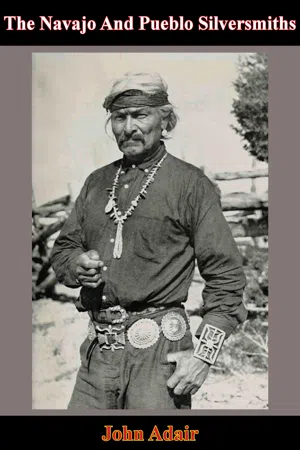
Probably no native American handicrafts are more widely admired than Navajo weaving and Navajo and Pueblo silver work. This book contains the first full and authoritative account of the Indian silver jewelry fashioned in the Southwest by the Navajo and the Zuni, Hopi, and other Pueblo peoples. It is written by John Adair, a trained ethnologist who has become a recognized expert on this craft.
"A volume conspicuously pleasing in its format and so strikingly handsome in its profuse illustrations as to rivet your attention once it chances to fall open. With the care of a meticulous and thorough scholar, the author has told the story of his several years' investigation of jewelry making among the Southwestern Indians. So richly decorative are the plates he uses for his numerous illustrations showing the jewelry itself, the Indians working at it and the Indians wearing it—that the conscientious narrative is surrounded by an atmosphere of genuinely exciting visual experience."—The Dallas Times Herald
The Navajo and Pueblo Silversmiths provides a full history of the craft and the actual names and localities of the pioneer craftsmen who introduced the art of the silversmith to their people. Despite its present high stage of development, with its many subtle and often exquisite designs, the art of working silver is not an ancient one among the Navajo and Pueblo Indians. There are men still living today who remember the very first silversmiths.
- 218 pages
- English
- ePUB (mobile friendly)
- Available on iOS & Android
eBook - ePub
The Navajo And Pueblo Silversmiths
About this book
PART I—THE NAVAJO
CHAPTER 1—History of Navajo Silver: From its Origin to 1880
SILVERSMITHING is not an ancient art among the Navajo. They did not learn the craft until after the middle of the nineteenth century, although they had been wearing silver for many years. They acquired knowledge of the art from the Mexican plateros (silversmiths) who lived in villages in the upper Rio Grande valley and at the southeastern edge of the present Navajo reservation. It is not surprising that they did not learn to make silver earlier, for they were continually at war with the Mexicans and made frequent raids into their villages. Hostility such as this was not conducive to the learning of an art which requires instruction over a period of time. Furthermore, the Navajo had no tools. Even if a man had wanted to learn the craft and had watched one of the plateros at work, he would not have been able to produce any work of his own without a hammer, an anvil, and files.
Today the older men of the tribe remember the Navajo who was apparently the very first member of their tribe to learn the art. His name was Atsidi Sani, which in English means Old Smith.{1} To the Mexicans he was known as Herrero, the Iron Worker. One of the Navajo who learned the craft directly from him lives today at Sunrise Springs, not far from Ganado, Arizona. This man, known as Grey Moustache, is close to eighty years of age and no longer works at the craft, for he is totally blind. Grey Moustache told the following story of how Atsidi Sani learned the art from the Mexicans.
“Atsidi Sani was my father’s uncle by marriage; he married my grandmother’s sister. He was the first Navajo to learn how to make silver, and my grandmother told me that he had learned how to work with iron before that. He learned how to do this from a Mexican by the name of Nakai Tsosi [Thin Mexican] who lived down near Mt. Taylor. He thought that he could earn money by making bridles. In those days the Navajo bought all of their bridles from the Mexicans, and Atsidi Sani thought that if he learned how to make them the Navajo would buy them from him. So he went down to the region of Mt. Taylor, and there he watched this Mexican smith at work. Nakai Tsosi also knew how to work silver, but Atsidi Sani didn’t learn to do that until some years later.
“Nakai Tsosi and Atsidi Sani became good friends. He used to go down and stay with the Mexican, and the Mexican used to come up and stay with him, at his hogan near Crystal. This smith didn’t charge him anything for teaching him how to work iron. I remember watching Atsidi Sani make bridle bits out of pieces of scrap iron. He made them with jingles hanging from the bottom. Some of these he exchanged for buffalo hides with the Utes.
“Atsidi Sani had four sons. All of these boys learned how to work iron from their father, before they were taken to Fort Sumner in 1864. The names of these sons were: Big Black, who was the oldest and the first one to learn, Red Smith, Little Smith, and Burnt Whiskers. At this time Atsidi did not yet work with silver. It was not until the Navajo came back from Fort Sumner that he learned how to make silver jewelry. It is not true that the Navajo learned silversmithing from the Mexicans while they were there. They did wear some silver at that time, mostly rings and bracelets, which they bought from the Mexican smiths, but most of their jewelry was made of copper and brass.
“After Atsidi Sani learned to make silver, he taught his sons how to work it. He told them that silver was very easy to work. He never made very much silver, but spent most of his time making iron bits. His sons made lots of silver, especially Red Smith. They told the Navajo to wear jewelry of silver because it was much nicer looking than that made of brass.
“It was ten years after I returned from Fort Sumner [1878] that I learned how to make silver from Atsidi Sani. At that time I was fourteen years old. We lived near his hogan and I used to watch him at work. I decided that I wanted to learn how to make jewelry. I first learned by making conchas [plaques of silver, worn on a belt].{2} Then I learned to make bridles and bracelets. Some other men who also learned the craft from Atsidi Sani were Smith Who Walks Around, Big Smith, Crying Smith, and Red Smith. All of these men were great craftsmen.
“Atsidi Sani was a great man. He was a leader and spokesman of his people. He was also a medicine man, and he knew the Mountain Chant and the Shooting Chant.”
Chee Dodge, a well-known Navajo, who for many years has been a leader of his people, lives near Crystal, Arizona, close to the place where Atsidi Sani used to live. Of him Chee said: “I knew Atsidi Sani well. He used to live over near Washington Pass, just a short way from my house. When he was an old man he used to come over here and talk with me. He was blind at that time, and I used to lead him around by a cane. He died some twenty years ago [c. 1918], and at that time he must have been over ninety years old. He told me that he learned how to work iron when he was a young man, I guess he must have been about twenty-five then. He didn’t learn that up in this country. He used to go down to the south where there were Mexicans living, and it was there that he learned it from a Mexican blacksmith.
“The Navajo didn’t make any silver of their own while they were at Fort Sumner [1864-68]. How could they? The Navajo were locked up there just like sheep in a corral. They had only a very little silver in those days, which they bought from the Mexicans. But they had lots of copper and brass which was pounded up into bracelets. They used to gamble for those bracelets.”{3}
From these statements of Grey Moustache and Chee Dodge, we learn that the Navajo knew the art of blacksmithing before they were taken as captives by the United States government to Fort Sumner. According to Chee, Atsidi Sani, who may well have been the first Navajo to work iron, learned the trade from a Mexican about eighty-five years ago. That would have been about 1853. According to Grey Moustache, Atsidi Sani learned this art twenty years before he first worked silver, which was not until after his return from Fort Sumner. That could not have been before 1868, and was possibly several years after that date. Therefore, he must have learned blacksmithing about 1850. This information checks with Chee’s statement.
The year in which Atsidi first made silver is not so clearly established. These informants say that he did not learn the art until after the return from Fort Sumner.{4} However, Arthur Woodward has evidence that Atsidi Sani learned the art prior to Fort Sumner, and that the Navajo had some knowledge of the art when they were at the fort.{5} Because of the conflicting evidence, the origin of silversmithing cannot be accurately dated, nor is it likely that it will be in the future. At this time the facts are vague in the memory of the oldest members of the tribe, and the written accounts which mention the subject are meager. All that we can say is that the art may have been taken over from the Mexicans as early as 1850 or as late as 1870.
A subject of greater interest, and about which more information is available, is the early development of the art following 1870. Grey Moustache continued his story, telling of the early history of the craft.
“Some of the silver that the Navajo made they traded to the Utes. Before that we used to trade iron bits and blankets to them for buckskin or mountain lion and buffalo hides. Sometimes we got beaded buckskin shirts and trousers. Those Utes wore bracelets and rings of a yellowish color. They also had ornaments on their bridles of that same metal. It wasn’t like our silver; I know because I got some of it from a Ute one time, and I tried to melt it up, but no matter how hot I got my charcoal, I couldn’t do it.

PLATE 1—MABLE BURNSIDES, NAVAJO
“When I was a young man [1880-90] the silversmiths made some things that they don’t make today. We used to make silver bells out of quarters. [Plate 2A]. We took these quarters and hammered them down into a cup-shaped hollow made in the log which held the anvil. The quarter was hammered into the hollow with a piece of scrap iron that had a rounded end which just fitted the hole in the wood. These pieces of silver were thinned around the edges, a small loop was soldered inside at the top, and a small bit of silver or copper was tied to this loop. It made a fine bell. The Navajo learned to make these from the Mexicans many years ago, when they first learned to work silver. We sold these to both the men and the women. The older women wore them attached to their sashes, so their sons-in-law would know when they were coming. The men wore them tied to their garters when they danced in the Yeibichai, and both men and women wore them at the war dances.
“The smiths also made small silver tobacco cases shaped like canteens. Before the Navajo knew how to make silver, the Mexicans made these and sold them to the Navajo. They were very expensive, and there were only a few Navajo who had enough money to buy them. But after we learned how to use the metal, we made them for ourselves. We never carried anything but tobacco in these canteens; we had other things to carry corn pollen and medicine in. The tobacco cases were carried in the leather pouches every man wore by his side. The medicine men wore these on their right side, other men wore them to the left. I made several of those tobacco canteens and was paid a horse or a calf for each one that I made. Some people think that we used to carry gunpowder in these canteens, but they were too small to hold much, and it would take too long to open the leather pouch, take out the canteen, and pour out the powder. No, the powder was carried in regular powder horns which were made out of cow’s horn. These were carried by the right side, held by a strap which passed over the left shoulder. The powder was poured out of these into silver measures [Plate 2B], which were worn on the strap of the leather pouches. There they could get at them quickly and measure out the powder and pour it into the gun.
“In those days I used to make many silver-mounted bridles. You don’t see many of those today except on the pawn racks in the trading posts. At that time every Navajo who could afford a silver headstall had one on his horse. They cost lots of money. A good bridle was worth at least sixty dollars, and one with lots of silver would cost a hundred dollars. That is about what they were worth in cash, but it was seldom that cash was paid for one, because the Navajo didn’t have as much cash in those days as they do now. I used to pawn my bridle for eighty dollars in the trading post. I remember selling one bridle for a good horse, with a saddle-blanket and saddle. In the early days we made these headstalls, and all the other silver, out of American dollars and other American coins. I used to make silver for old man Hubbell at Ganado.{6} He used to get the American pesos for us, and he supplied us with them for twenty years. Then the government sent out an order telling us that we were not to melt up any more silver money [c. 1890]. From that time on Mr. Hubbell got Mexican silver for us to work. It was softer than the American money, and easier to melt up and pound out.
“Many years ago the Navajo used to make lots of cast silver. We learned how to do this from the Mexicans. They used clay molds for casting the metal. The first Navajo smiths used rock for casting. The rock wasn’t soft and powdery like that we use now but was hard, and darker in color. In fact I had never seen the soft, powdery kind until forty years ago [1898] when I made a trip up to Sunrise Springs. I saw some white rock on the side of a hill and I thought that it might make good molds for my silver, so I got some of it and made a cast for a ketoh [bow-guard, frequently spelled gato]. But that stone was too soft and cracked all to pieces. Then I went back a second time and got some more, and this time the stone was just hard enough, and I made a good ketoh in that mold.
“My brother-in-law, Atsidi Chon, saw this stone, and he asked me where I got it. I told him and he went over to that same place and got some for himself. After that time we always used that stone for our molds.
“Atsidi Chon was a very good silversmith. He used to live over near Klagetoh. He was the first silversmith to set turquoise in silver. The first piece that he set was in a ring. That was at the time when I was learning how to make silver from Atsidi Sani [c. 1878]. This ring had just one stone in it. At that time the only rings that the Navajo had were of silver with some designs filed into the metal. I remember when this ring was finished, many Navajo gathered around to see it, and all of them thought that it was very pretty. After he finished making that first piece, he made some more jewelry with turquoise in it. He made a najahe [crescent-shaped pendant, frequent spelled naja] and several bracelets. Young fellows used to come up to him and say, ‘I want to learn how to make silver; I want to learn how to make jewelry like that.’ He used to say to them, ‘You have two eyes, you can see; watch me and you will learn how for yourselves.’
“The Hopi and the Zuñi used to trade the Navajo turquoise and shell beads for silver work. I used to make ketohs for the Zuñi, and I would trade one of those for a necklace of shell beads. I went down to Zuñi several times each year to sell my silver. I had several friends there in the village with whom I used to stay at Shalako time. I think that those Zuñi Indians got their turquoise out of old ruins. They had dark blue stones that were finer than the stones you see nowadays.
“It was twenty years ago [c. 1918] when the Navajo women first began to make silver. In those days money was falling down just like rain, and everyone went crazy. The women began to make silver for money and put sacred things on blankets. When I first heard about some women over near Gallup making silver, I felt sort of silly. I thought that I was better than a woman because I could make silver jewelry and they couldn’t. But when I heard this, I had to admit that women were just as good as I was. I think that it is all right if women make silver. They can earn good money that way.
“I taught many men how to make silver. Most of them were either friends or relatives. I didn’t ask them for anything in payment, but every once in a while one of these fellows would give me fifty cents or so.
“I used to dream about silver. I didn’t dream about the designs that I was going to put on. But one time I dreamed that my tools were all around me. My anvil, my bellows, and my hammer were all right there. I dreamed that I was going to start work on another bracelet. In my dream someone told me that I was going to go blind because I was using bellows like that.
“The next day I thought that it was strange to dream that. So I had someone perform motion-in-the-hand over me.{7} I wanted to find out why I had that dream. This man told me that I must have a sing. He said that I must have Navajo Wind Way Chant, and that if I didn’t I would get sore hands, and then I would go blind. I didn’t believe what this man said, so I made some more silver. I felt perfectly all right, so I didn’t have that sing, but later on my hand began to itch. Then it got sore on both sides and blistered all over. I wasn’t able to sleep. When I put my hand under the blanket it was hot, and it pained. My eyes began to go bad, and I couldn’t see things clearly. They got worse and worse, until I c...
Table of contents
- Title page
- Table of Contents
- INTRODUCTION
- DEDICATION
- PREFACE
- SOURCES
- PLATES
- TABLES
- MAP & CHART
- FOREWORD
- PART I-THE NAVAJO
- PART II-THE PUEBLOS
- APPENDIX I-IMPORTANT DATES IN THE HISTORY OF SOUTHWESTERN SILVER
- APPENDIX II-SILVERSMITHS
- APPENDIX III-NOTE ON STANDARDS AND QUALITY OF INDIAN JEWELRY
- APPENDIX IV-ADDITIONAL MATERIAL ON THE ECONOMICS OF SILVER
- APPENDIX V-VOCABULARY OF NAVAJO WORDS PERTAINING TO SILVERSMITHING
- BIBLIOGRAPHY
Trusted by 375,005 students
Access to over 1.5 million titles for a fair monthly price.
Study more efficiently using our study tools.
Information
Publisher
Normanby PressYear
2015Topic
Social SciencesSubtopic
Social Science BiographieseBook ISBN
9781786256706
Index
Social SciencesFrequently asked questions
Yes, you can cancel anytime from the Subscription tab in your account settings on the Perlego website. Your subscription will stay active until the end of your current billing period. Learn how to cancel your subscription
No, books cannot be downloaded as external files, such as PDFs, for use outside of Perlego. However, you can download books within the Perlego app for offline reading on mobile or tablet. Learn how to download books offline
Perlego offers two plans: Essential and Complete
- Essential is ideal for learners and professionals who enjoy exploring a wide range of subjects. Access the Essential Library with 800,000+ trusted titles and best-sellers across business, personal growth, and the humanities. Includes unlimited reading time and Standard Read Aloud voice.
- Complete: Perfect for advanced learners and researchers needing full, unrestricted access. Unlock 1.5M+ books across hundreds of subjects, including academic and specialized titles. The Complete Plan also includes advanced features like Premium Read Aloud and Research Assistant.
We are an online textbook subscription service, where you can get access to an entire online library for less than the price of a single book per month. With over 1.5 million books across 990+ topics, we’ve got you covered! Learn about our mission
Look out for the read-aloud symbol on your next book to see if you can listen to it. The read-aloud tool reads text aloud for you, highlighting the text as it is being read. You can pause it, speed it up and slow it down. Learn more about Read Aloud
Yes! You can use the Perlego app on both iOS and Android devices to read anytime, anywhere — even offline. Perfect for commutes or when you’re on the go.
Please note we cannot support devices running on iOS 13 and Android 7 or earlier. Learn more about using the app
Please note we cannot support devices running on iOS 13 and Android 7 or earlier. Learn more about using the app
Yes, you can access The Navajo And Pueblo Silversmiths by John Adair in PDF and/or ePUB format, as well as other popular books in Social Sciences & Social Science Biographies. We have over 1.5 million books available in our catalogue for you to explore.