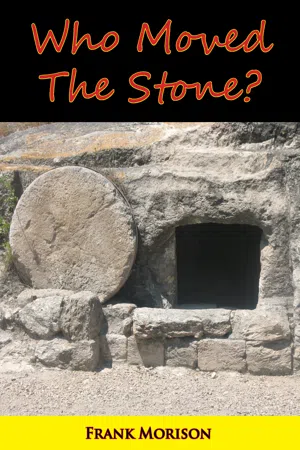
English journalist Frank Morison had a tremendous drive to learn of Christ. The strangeness of the Resurrection story had captured his attention, and, influenced by skeptic thinkers at the turn of the century, he set out to prove that the story of Christ's Resurrection was only a myth. His probings, however, led him to discover the validity of the biblical record in a moving, personal way. Who Moved the Stone? is considered by many to be a classic apologetic on the subject of the Resurrection. Morison includes a vivid and poignant account of Christ's betrayal, trial, and death as a backdrop to his retelling of the climactic Resurrection itself.—Print Ed.
Reviews:
"It is not only a study on the Resurrection account as the title seems to suggest, but it retells the whole passion of Jesus Christ. Because the author does not concern himself with textual criticism, he is able to impress on the reader a consistent picture of the events of Passion and Resurrection. For this reason the book will perform a helpful service to everyone who wants a reconstruction of those events."—Augustana Book News
"A well-arranged summary of events relating to the resurrection of Christ and the pros and cons in the debate over their acceptance with emphasis on the latter."—Watchman Examiner
"The story Mr. Morison has told of the betrayal and the trial of Christ is fascinating in its lucid, its almost incontrovertible, appeal to the reason. For me, he made those scenes live with a poignancy and vividness that I have found in no other account, not even in the various attempts that have been made to present the same facts in the guise of a novel."—J. D. Beresford
- 168 pages
- English
- ePUB (mobile friendly)
- Available on iOS & Android
eBook - ePub
Who Moved The Stone?
About this book
Information
Topic
Theology & ReligionSubtopic
ReligionCHAPTER I—THE BOOK THAT REFUSED TO BE WRITTEN
I suppose that most writers will confess to having hidden away somewhere in the secret recesses of their most private drawer the first rough draft of a book which, for one reason or another, will never see the light of day.
Usually it is Time—that hoary offender—who has placed his veto upon the promised task. The rough outline is drawn up in a moment of enthusiasm and exalted vision; it is worked upon for a time and then it is put aside to await that leisured ‘tomorrow’ which so often never comes. Other and more pressing duties assert themselves; engagements and responsibilities multiply, and the treasured draft sinks further and deeper into its ultimate hiding-place. So the years go by, until one day the writer awakens to the knowledge that, whatever other achievements may be his, this particular book will never be written.
In the present case it was different.
It was not that the inspiration failed, or that the day of leisure never came. It was rather that when it did come the inspiration led in a new and unexpected direction. It was as though a man set out to cross a forest by a familiar and well-beaten track and came out suddenly where he did not expect to come out. The point of entry was the same; it was the point of emergence that was different.
Let me try to explain briefly what I mean.
When, as a very young man, I first began seriously to study the life of Christ, I did so with a very definite feeling that, if I may so put it, His history rested upon very insecure foundations.
If you will carry your mind back in imagination to the late ‘nineties you will find in the prevailing intellectual attitude of that period the key to much of my thought. It is true that the absurd cult which denied even the historical existence of Jesus had ceased to carry weight. But the work of the Higher Critics—particularly the German critics—had succeeded in spreading a very prevalent impression among students that the particular form in which the narrative of His life and death had come down to us was unreliable, and that one of the four records was nothing other than a brilliant apologetic written many years, and perhaps many decades, after the first generation had passed away.
Like most other young men, deeply immersed in other things, I had no means of verifying or forming an independent judgment upon these statements, but the fact that almost every word of the Gospels was just then the subject of high wrangling and dispute did very largely colour the thought of the time, and I suppose I could hardly escape its influence.
But there was one aspect of the subject which touched me closely. I had already begun to take a deep interest in physical science, and one did not have to go very far in those days to discover that scientific thought was obstinately and even dogmatically opposed to what are called the miraculous elements in the Gospels. Very often the few things the textual critics had left standing Science proceeded to undermine. Personally I did not attach anything like the same weight to the conclusions of the textual critics that I did to this fundamental matter of the miraculous. It seemed to me that purely documentary criticism might be mistaken, but that the laws of the Universe should go back on themselves in a quite arbitrary and inconsequential manner seemed very improbable. Had not Huxley himself declared in a peculiarly final way that ‘miracles do not happen’, while Matthew Arnold, with his famous gospel of ‘Sweet Reasonableness’, had spent a great deal of his time in trying to evolve a non-miraculous Christianity?
For the person of Jesus Christ Himself, however, I had a deep and even reverent regard. He seemed to me an almost legendary figure of purity and noble manhood. A coarse word with regard to Him, or the taking of His name lightly, stung me to the quick. I am only too conscious how far this attitude fell short of the full dogmatic position of Christianity. But it is an honest statement of how at least one young student felt in those early formative years when superficial things so often obscure the deeper and more permanent realities which lie behind.
It was about this time—more for the sake of my own peace of mind than for publication—that I conceived the idea of writing a short monograph on what seemed to me to be the supremely important and critical phase in the life of Christ—the last seven days—though later I came to see that the days immediately succeeding the Crucifixion were quite as crucial. The title I chose was ‘Jesus, the Last Phase’, a conscious reminiscence of a famous historical study by Lord Rosebery.
I took the last seven days of the life of Jesus for three reasons:
1. This period seemed remarkably free from the miraculous element which on scientific grounds I held suspect.
2. All the Gospel writers devoted much space to this period, and, in the main, were strikingly in agreement.
3. The trial and execution of Jesus was a reverberating historical event, attested indirectly by a thousand political consequences and by a vast literature which grew out of them.
It seemed to me that if I could come at the truth why this man died a cruel death at the hands of the Roman Power, how He Himself regarded the matter, and especially how He behaved under the test, I should be very near to the true solution of the problem.
Such, briefly, was the purpose of the book which I had planned. I wanted to take this Last Phase of the life of Jesus, with all its quick and pulsating drama, its sharp, clear-cut background of antiquity, and its tremendous psychological and human interest—to strip it of its overgrowth of primitive beliefs and dogmatic suppositions, and to see this supremely great Person as He really was.
I need not stay to describe here how, fully ten years later, the opportunity came to study the life of Christ as I had long wanted to study it, to investigate the origins of its literature, to sift some of the evidence at first hand, and to form my own judgment on the problem which it presents. I will only say that it effected a revolution in my thought. Things emerged from that old-world story which previously I should have thought impossible. Slowly but very definitely the conviction grew that the drama of those unforgettable weeks of human history was stranger and deeper than it seemed. It was the strangeness of many notable things in the story which first arrested and held my interest. It was only later that the irresistible logic of their meaning came into view.
I want to try, in the remaining chapters of this book, to explain why that other venture never came to port, what were the hidden rocks upon which it foundered, and how I landed upon, to me, an unexpected shore.
Chapter II—THE REAL CASE AGAINST THE PRISONER
In attempting to unravel the tangled skein of passions, prejudices, and political intrigues with which the last days of Jesus are interwoven, it has always seemed to me a sound principle to go straight to the heart of the mystery by studying closely the nature of the charge which was brought against Him.
I remember this aspect of the question coming home to me one morning with new and unexpected force. I tried to picture to myself what would happen if some two thousand years hence a great controversy should arise about one who was the centre of a criminal trial, say, in 1922. By that time most of the essential documents would have passed into oblivion. An old faded cutting of The Times or Telegraph, or perhaps some tattered fragment of a legal book describing the case, might have survived to reach the collection of an antiquary. From these and other fragments the necessary conclusions would have to be drawn. Is it not certain that people living in that far-off day, and desiring to get at the real truth about the man concerned, would go first to the crucial question of the charge on which he was arraigned? They would say: ‘What was all the trouble about? What did his accusers say and bring against him?’ If, as in the present instance, several charges appear to have been preferred, they would ask what was the real case against the prisoner?
Directly we set this question in the forefront of our inquiry, certain things emerge which throw new and unexpected light upon the problem. It will help us to an understanding of what these significant things are if we consider first the very singular character of the trial itself. For not only did it take place at an unprecedented hour for such proceedings, but it was marked throughout by peculiarities of a special kind. Consider in the first instance the vital element of time.
All the historians agree that the arrest of Jesus took place in the Garden of Gethsemane at a late hour on the evening immediately preceding the day of the Crucifixion, and there is strong justification for believing that it could not possibly have been earlier than eleven-thirty.
This estimate is based upon the amount of time required by the recorded events between the breaking up of the Supper Party, probably in a house in the Upper City, and the arrival of the armed band in the garden at the foot of Olivet. There are three things which point irresistibly to the hour being late:
1. The disciples were manifestly tired, and even the sturdy fisherman Peter, accustomed to lonely vigils on the deep, could not keep awake.
2. Both St. Matthew and St. Mark refer to three separate periods of slumber, broken by the periodical return of Christ from His prolonged communing under the neighbouring trees.
3. The fact that it was quite dark, and that owing to the use of torches, Christ was able to discern the approach of the arrest party a considerable distance off (see St. Mark xiv. 42: ‘Arise, let us be going: behold, he that betrayeth me is at hand.’).
No one can read the records of this extraordinary episode without realizing that this particular sojourn in the garden was different from any of those previous visits to the same spot hinted at by St. John. These men were being held there by the will of Christ long after the time when they would ordinarily have been in their beds at Bethany. They were waiting at His bidding for something for which He also was waiting, and which was an unconscionably long time in coming. Assuming the supper to have been over at nine-thirty and the Garden itself reached so early as 10 p.m., the arrest could hardly have been effected much before eleven-thirty. This fixes for us with some certainty the hour of the preliminary trial.
It is generally agreed by archaeologists and students of the topography of ancient Jerusalem that an old flight of steps descended from the Upper City to the gate leading to the pool of Siloam at the south-eastern angle of the City wall. It is mentioned by Nehemiah (Chap. iii. 15): ‘The stairs that go down from the city of David’; and again (Chap. xii. 37): ‘By the fountain gate, and straight before them, they went up by the stairs of the city of David, at the going up of the wall.’
There were thus two routes open to the arrest party. One was to follow the course of the Kedron Valley to the foot of these steps, and thence to the High Priest’s house. The other was to take the main Bethany road into the new town and thence by the Tyropœan Valley to the Priestly quarter. Even if tradition had not strongly indicated the former, it is clear that to have conducted Jesus through the populous quarter of the Lower City would not only have been inexpedient, but would have necessitated a detour by which valuable time would have been lost. And in this strange nocturnal business time was a very important factor.
If, therefore, by some magic reversal of the centuries we could have stood at some vantage-point in old Jerusalem about midnight or shortly afterwards on that memorable 14 Nizan, we should probably have witnessed a small party of men leading a strangely unresisting figure through the darkness, along the rocky defile which skirted the precipitous eastern face of the Temple wall, up the historic causeway at the south-eastern angle of the City wall to the headquarters of His avowed and inveterate enemies.
How did it come about that the most distinguished Hebrew of His generation found Himself in this dangerous and menacing situation, at the dead of night, on the eve of one of the most solemn of the Jewish Festivals? What were the secret and hidden forces which precipitated His arrest? Why was this particular and highly inconvenient moment chosen? Above all, what was the gravamen of the charge which was brought against Him?
It will require very much more than this chapter to answer these questions, to which indeed the whole book is a very partial and inadequate reply. But there are two things which stand out very sharply from the records of this trial and which call for the closest study. The first is the peculiar nature of the only definite charge which was brought against Jesus. The second is the admission upon which His conviction was based.
Now it seems to me that we shall make a very grievous mistake if we assume (as has so often been done by Christian writers) that everything that the priests did that night was ultra vires and illegal. Of course, there are aspects of the affair which, on any reading of the case, must be considered definitely, and even flagrantly, to be at variance with the Jewish Law. That, I think, is conceded by every competent student of the Mischna and of Jewish institutions as they existed at the time.
It was illegal, for example, for the Temple Guard, acting officially as the instrument of the High Priest, to effect the arrest. That should have been left to the voluntary action of the witnesses. It was illegal to try a capital charge (Trial for Life) by night. Only ‘trials for money’ could be conducted after sunset. It was illegal, after the testimony of the witnesses had broken down, for the judges to cross-exam...
Table of contents
- Title page
- ABOUT THIS BOOK
- PREFACE
- CHAPTER I-THE BOOK THAT REFUSED TO BE WRITTEN
- Chapter II-THE REAL CASE AGAINST THE PRISONER
- CHAPTER III-WHAT HAPPENED BEFORE MIDNIGHT ON THURSDAY
- CHAPTER IV-A PSYCHOLOGICAL PARALLELOGRAM OF FORCES
- CHAPTER V-THE SITUATION ON FRIDAY AFTERNOON
- CHAPTER VI-THIRTY-SIX HOURS LATER
- CHAPTER VII-ON THE BEHAVIOUR OF TWO SISTERS AND THE MEN WHO FLED IN THE NIGHT
- CHAPTER VIII-BETWEEN SUNSET AND DAWN
- CHAPTER IX-THE HISTORIC CRUX OF THE PROBLEM
- CHAPTER X-THE EVIDENCE OF THE PRINCIPAL FISHERMAN
- CHAPTER XI-THE EVIDENCE OF THE PRISONER’S BROTHER
- CHAPTER XII-THE EVIDENCE OF THE MAN FROM TARSUS
- CHAPTER XIII-THE WITNESS OF THE GREAT STONE
- CHAPTER XIV-SOME REALITIES OF THAT FAR-OFF MORNING
- CHAPTER XV-THE SERVANT OF THE PRIEST
Trusted by 375,005 students
Access to over 1.5 million titles for a fair monthly price.
Study more efficiently using our study tools.
Frequently asked questions
Yes, you can cancel anytime from the Subscription tab in your account settings on the Perlego website. Your subscription will stay active until the end of your current billing period. Learn how to cancel your subscription
No, books cannot be downloaded as external files, such as PDFs, for use outside of Perlego. However, you can download books within the Perlego app for offline reading on mobile or tablet. Learn how to download books offline
We are an online textbook subscription service, where you can get access to an entire online library for less than the price of a single book per month. With over 1.5 million books across 990+ topics, we’ve got you covered! Learn about our mission
Look out for the read-aloud symbol on your next book to see if you can listen to it. The read-aloud tool reads text aloud for you, highlighting the text as it is being read. You can pause it, speed it up and slow it down. Learn more about Read Aloud
Yes! You can use the Perlego app on both iOS and Android devices to read anytime, anywhere — even offline. Perfect for commutes or when you’re on the go.
Please note we cannot support devices running on iOS 13 and Android 7 or earlier. Learn more about using the app
Please note we cannot support devices running on iOS 13 and Android 7 or earlier. Learn more about using the app
Yes, you can access Who Moved The Stone? by Frank Morison in PDF and/or ePUB format, as well as other popular books in Theology & Religion & Religion. We have over 1.5 million books available in our catalogue for you to explore.