The German General Staff launched Operation Barbarossa in June 1941 assuming the eastern campaign would last only three months. However, within six months after the initiation of hostilities the Red Army blunted the Wehrmacht's attack outside the gates of Moscow, Operation Barbarossa had failed. Although a long standing and professional organization the German General Staff failed to achieve strategic success, despite significant success during the early stages of the campaign. Adolf Hitler's national goal of Russian extermination exceeded the German Army's capabilities. The war lasted nearly four years and resulted in the devastation of western Russia, millions dead and the destruction of Germany. This thesis examines how the divergence between the Wehrmacht's capabilities and Hitler's ideological national objectives affected Operation Barbarossa.
Through examination of the historical role the German General Staff held during military operations, this study addresses the linkage between German political and military relations during war. It begins with an analysis of the Prussian General Staff system under Moltke the elder. It follows the staff's development through the wars of German unification, prelude to World War I and, the interwar period leading up to Hitler's rise to power. It concludes with an analysis of Operation Barbarossa and the German General Staff's efforts to achieve strategic victory on the eastern front. Finally, it concludes with lessons modern military leaders should learn from the General Staff's mistakes.
eBook - ePub
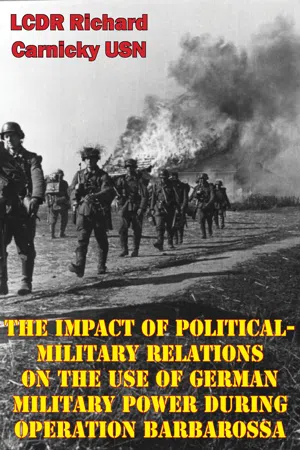
The Impact Of Political-Military Relations On The Use Of German Military Power During Operation Barbarossa
- 75 pages
- English
- ePUB (mobile friendly)
- Available on iOS & Android
eBook - ePub
The Impact Of Political-Military Relations On The Use Of German Military Power During Operation Barbarossa
About this book
Information
Subtopic
European HistoryIndex
HistoryCHAPTER 1 — INTRODUCTION
“Bock said that it was clear to him how to force the Red Army to give battle and defeat it but how, asked the field marshal, can the Russians be forced to make peace?”{1} — Oscar Pinkus, The War Aims and Strategies of Adolf Hitler
Field Marshal Von Bock of Army Group Center asked Hitler this question six months prior to Operation Barbarossa. Army Group Center had the responsibility as the main effort in Hitler’s war against the Soviet Union. Bock’s question illustrates a fundamental divergence between Hitler and his generals concerning their views on war on the eastern front. The nature of war and the military’s role in shaping a political outcome is at the heart of Bock’s question. Why did Germany’s strategic leadership begin an ideological war against the Soviet Union when their military’s tactical doctrine predicated short decisive campaigns? At the center of this question lie the differences between the theories of limited and total warfare and the role of the military in achieving national objectives. This thesis focuses on these different theories to answer the following question: How did the divergence between the Wehrmacht’s capabilities and Hitler’s desire for ideological campaign objectives impact the Army’s effect against the Soviet Union at the strategic level?
Several writers, such as David Glantz, Matthew Cooper, and Albert Seaton to name a few, have attempted to analyze the German-Russian war in order to determine the cause of the German defeat. Numerous theories and suppositions on the causes of Barbarossa’s operational failure have been suggested. However, there are two factors consistently cited in most analysis of the war. The first identifies Germany’s poor logistical planning and inability to sustain forces over great distances.{2} The second factor recognizes Hitler’s micromanagement of the war effort and his failure to define adequately his strategic objectives.{3}
Logistically, the German Army could not provide the required supplies, ammunition, and spare parts needed by the panzer forces to achieve their operational encirclements. The Soviet Union consisted of 850,000 miles of road networks, only about 150,000 were suitable roads with an additional 40,000 classified as all weather, hard surfaces.{4} The poor transportation infrastructure took a heavy toll on the Germans’ logistics. After action reports between November 1941 and March 1942 indicate Germans losses in transportation vehicles at 75,000 with only 7,500 replacements.{5} Maintenance losses and the fact that logistical transportation competed with the motorized infantry division’s requirements for mobility meant the German supply train suffered severe shortages in vehicles as the war moved further into the Soviet Union.
Arguably, even if the infrastructure network had been adequate to support Germany’s logistical traffic, the nation lacked the strategic resources necessary to sustain a long war. The 1939-1940 campaigns depleted German war stocks and prior to Barbarossa the Germans still relied on foreign shipments of oil, bauxite, tin, copper, lead and zinc to sustain their military.{6} Germany’s resource shortages convinced Hitler the Caucasus region, with its oil and grain producing areas, should be the primary objective during the German 1942 Summer Offensive, Operation Blau.{7} German consumption of 176 million gallons of motor fuel and 390,000 tons of ammunition in 1941 reduced stocks to such a degree that it affected Germany’s follow-on campaigns after 1941. Although logistics certainly hampered the success of Barbarossa, it cannot be solely blamed for its failure.
The German Army fielded a modern force in 1941 that required fuel, ammunition, and spare parts for the maneuver units. Yet the economy needed to produce the war material and the system required to distribute it could not satisfy the logistical requirements of an armored force operating over 700 miles from its supply base. Mobilization of the economy for war required Hitler’s approval; therefore the German Army’s logistical short falls are just a smaller component of the larger problem. The problem stemmed from Hitler’s understanding of the nature of war which differed from that of his military leadership. Logistically the Wehrmacht supported themselves for decisive engagements designed to force a decision quickly not long battles of attrition. Their 1939-1940 campaigns taxed their logistical system but was able to support the Wehrmacht’s operational plans. Operation Barbarossa, however, illustrated the deficiencies in the German logistical system with respect to campaigns with increased duration and over greater distances.
The second most popular theory on Barbarossa’s failure in 1941 addresses Hitler’s increased desire to micromanage the war effort as the campaign lengthened. He curtailed his subordinate commander’s freedom of maneuver and independent decision making abilities by directing the movement of specific units on the battlefield. His relief of Field Marshal Brauchitsch, the Commander-in-Chief of the Army, in December 1941 allowed him to assume the vacated position and direct combat forces with reduced military interference. As the war progressed Hitler filled key leadership positions with individuals who demonstrated great loyalty to him despite their military experience. General Halder notes in his diary of 7 December 1941:
“The occurrences of the day have again been heartbreaking and humiliating. ObdH is now no more than a messenger boy, if that. The Führer, over the head of ObdH, gets in direct touch with the Cs-in-C of Army Gps.”{8}
Hitler’s meddling in Army tactical and operational matters led to the diversion of Army Group Center’s thrust from Moscow.
Following the end of World War II in Europe, the prominent military historian B. H. Liddell Hart had the opportunity to interview captured German officers in order to gather their accounts relating to the conflict. During one of those interviews General Blumentritt, Chief of Staff of Kluge’s 4th Panzer Army, credited Hitler’s micromanagement of the war as the primary reason the German Army failed to take Moscow in 1941.{9}
However, Hitler cannot bear sole blame for Barbarossa’s failure because of his management style. Hitler directly interfered with the Army’s operations due to a growing dissatisfaction with his generals. This attitude stemmed from numerous disagreements between Adolf Hitler and military leadership as to the direction of the war effort. Hitler rarely interfered with operations on the west front during 1939-1940, but did so almost on a daily basis starting in 1941. This fact lends itself to suggest the political and military leadership views on warfare shifted between the campaigns in the west and Russia.
Traditionally, the German General Staff had attempted to isolate the organization from political vacillations and opinions. The staff believed after the politicians made the decision to mobilize the army for war, the operational maneuver fell to the General Staff to prepare, plan, and conduct. Hitler on the other hand did not follow this traditional viewpoint and frequently interfered with his generals and their operations. In Liddell Hart’s interviews with the German generals after the war, General Blumentritt stated that:
“After we had reached Smolensk there was a stand still for several weeks on the Desna. This was due partly to the need of bringing up supplies and reinforcements, but even more to a fresh conflict of views within the German command about the future course of the campaign. There were endless arguments.”{10}
The conflict Blumentritt refers to is Hitler’s decision, against the advice of his senior commanders, to advance on Moscow late in the year with the threat of winter setting in before the operation could be successfully completed.
The German generals were not prepared for this level of friction between the political and military systems and were not equipped to deal with it effectively. The German Army had to rely on the personalities of its senior commanders Brauchitsch and Halder in order to influence Hitler. However, they allowed him to erode their positional responsibilities over time to the point that they became ineffective.
Brauchitsch’s influence over Hitler decreased as the dictator’s popularity increased after the successes against Austria and Czechoslovakia. His arguments against Hitler’s decisions did little to sway matters. Eventually Hitler would accept Brauchitsch’s resignation in 1941 and appointed himself as Commander in Chief of the Heer. Halder’s impact on operational matters as the Chief of the German General Staff also had a decreasing trend as Hitler reduced the staff officer to that of an “advisor, helper and executive, but [one that] did not participate in the Commander’s responsibility.”{11} These changes set the conditions allowing Hitler to become increasingly involved in operational military affairs.
Although these theories point to contributing factors in Germany’s defeat in 1941, they do not answer several important questions. Primarily, why such a professional military organization overlooked logistics, or why the political leadership supplanted military experience with increased micromanagement and fanaticism? Prior to Barbarossa Hitler and his Generals held the belief that they could win a war against the Soviet Union in a matter of months.{12} However, six months after the campaign began the reality of the operation and the nature of war on the eastern front took its toll on the German Army.{13} The fulfillment of Hitler’s vision for German lebensraum (living space) would have to wait.
A third possible conclusion is that the General Staff lacked the necessary skill sets to comprehend and adapt to warfare on the eastern front. It is unlikely that the German military leadership failed to prepare adequately for combat operations in Russia due to its history and efforts in military transformation since World War I. The successful campaigns in 1939-1940 directly resulted from the efforts of the German General Staff to prepare their forces for combat. The staff had pride in military professionalism and possessed a long standing history of refining German tactical doctrine, increased modernizing and reorganizing the army to suit Germany’s threats.
Even after the disastrous consequences of the Great War and the restrictions enforced through the Treaty of Versailles the German military continued to demonstrate a willingness to adapt its organization. The limitations placed on the German Army to cap its end strength at 100,000 men and ten divisions seriously hampered the Reichswehr’s ability to publicly develop a military force. Additionally, the treaty disbanded the German General Staff in an attempt to prevent Germany from planning another war in Europe. This further complicated any German effort to develop its forces and prepare for future military operations.{14} Yet through determination and inventiveness, the staff persevered and maintained their level of commitment to the defense of the German nation.
Through study and analysis under the General Staff’s guidance, the German Army began to war game new and revolutionary tactics, such as conducting breakthrough and exploitation attacks using armored and mechanized forces. Due to the treaty’s limitations it had to develop the concept using mock tanks fabricated by attaching wooden skirts to the chassis of a truck. Inventiveness and initiative became the bedrock of the German officer corps when preparing for tactical warfare.{15}
This focus on maneuvers produced an officer who was tactically unmatched by the European powers of Poland, Czechoslovakia, France, and Great Britain during Germany’s opening offensives of World War II. Even the Red Army, which eventually succeeded in breaking the German war machine and regaining the strategic initiative in 1943, could not stem the tide of German forces from reaching the gates of Moscow. It had to rely on the country’s unpredictable summer rains and severe winters to halt the German advance. Yet the General Staff’s focus on the tactical level of war came at the cost of significant examination of the strategic and operational levels.
Logistics, Hitler’s mismanagement of the war, and the General Staff’s approach to war did not individually cause the failure of Operation Barbarossa. Collectively, they did have an impact on the Wehrmacht’s efforts against the Soviet Union. An undersupplied and poorly reinforced army which Hitler increasingly micromanaged could not adapt to warfare on the eastern front. However, the shortfalls in logistics, national leadership, and operational doctrine originated from a bigger issue between the German military and political establishments. The issue was the gap between Hitler’s desired political objectives and the Wehrmacht’s capabilities which stemmed from their differing approaches to waging war.
On the eve of Barbarossa the German Army leadership and Hitler agreed on three objectives. The first objective dictated the Red Army’s destruction in western Russia. The second objective sought to deny the Russians the ability to bomb Germany’s infrastructure. The third and final objective in 1941 identified the line from Archangel to the Volga River in order to isolate Asiatic Russia for follow-on operations (see figure 2).{16} However, even though the military and political leadership shared the same views on the objectives their views on the nature of warfare differed significantly. Hitler’s plan for an ideological war sharply contrasted tha...
Table of contents
- Title page
- TABLE OF CONTENTS
- ABSTRACT
- ACRONYMS
- CHAPTER 1 - INTRODUCTION
- CHAPTER 2 - THE GERMAN NATURE OF WAR
- CHAPTER 3 - HITLER’S WAY OF WAR
- CHAPTER 4 - OPERATION BARBAROSSA
- CHAPTER 5 - BARBAROSSA’S FALLOUT
- ILLUSTRATIONS
- GLOSSARY
- BIBLIOGRAPHY
Trusted by 375,005 students
Access to over 1.5 million titles for a fair monthly price.
Study more efficiently using our study tools.
Frequently asked questions
Yes, you can cancel anytime from the Subscription tab in your account settings on the Perlego website. Your subscription will stay active until the end of your current billing period. Learn how to cancel your subscription
No, books cannot be downloaded as external files, such as PDFs, for use outside of Perlego. However, you can download books within the Perlego app for offline reading on mobile or tablet. Learn how to download books offline
Perlego offers two plans: Essential and Complete
- Essential is ideal for learners and professionals who enjoy exploring a wide range of subjects. Access the Essential Library with 800,000+ trusted titles and best-sellers across business, personal growth, and the humanities. Includes unlimited reading time and Standard Read Aloud voice.
- Complete: Perfect for advanced learners and researchers needing full, unrestricted access. Unlock 1.5M+ books across hundreds of subjects, including academic and specialized titles. The Complete Plan also includes advanced features like Premium Read Aloud and Research Assistant.
We are an online textbook subscription service, where you can get access to an entire online library for less than the price of a single book per month. With over 1.5 million books across 990+ topics, we’ve got you covered! Learn about our mission
Look out for the read-aloud symbol on your next book to see if you can listen to it. The read-aloud tool reads text aloud for you, highlighting the text as it is being read. You can pause it, speed it up and slow it down. Learn more about Read Aloud
Yes! You can use the Perlego app on both iOS and Android devices to read anytime, anywhere — even offline. Perfect for commutes or when you’re on the go.
Please note we cannot support devices running on iOS 13 and Android 7 or earlier. Learn more about using the app
Please note we cannot support devices running on iOS 13 and Android 7 or earlier. Learn more about using the app
Yes, you can access The Impact Of Political-Military Relations On The Use Of German Military Power During Operation Barbarossa by LCDR Richard Carnicky USN in PDF and/or ePUB format, as well as other popular books in History & European History. We have over 1.5 million books available in our catalogue for you to explore.