"The difference between a religion of mere letter and form and one of life and power lies in knowing the Holy Spirit."—Dr. R. A. Torrey
Can you, or can any Christian go far in the Christian life without giving time and thought to the third Person of the Godhead? Obviously not, for the Holy Spirit takes the things of Christ and shows them to us, and makes the practical application of Bible knowledge obvious to us. He alone can transform Christian theory into life and deeds.
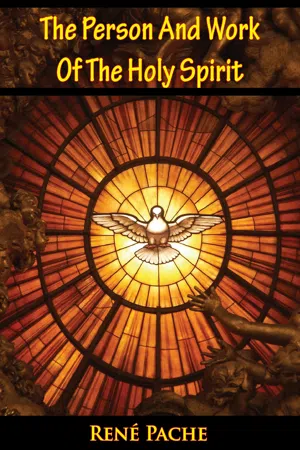
Through this book, Dr. Pache will direct us into thinking again about who the Holy Spirit is, what He did before Pentecost, and what He has been doing since then in the lives of men. What place does the Holy Spirit have in the service of the Christian worker, and what will be His ministry in the future? THE PERSON AND WORK OF THE HOLY SPIRIT answers this question and others concerning conviction, baptism, filling, indwelling, and gifts of the Spirit.
RENE PACHE was principal of Emmaus Bible School at Lausanne. He was the founder of the Inter-Varsity Christian Fellowship in Switzerland and France and gave much time to that organization. His published works include The Future Life and The Inspiration and Authority of Scripture.
- 178 pages
- English
- ePUB (mobile friendly)
- Available on iOS & Android
eBook - ePub
The Person And Work Of The Holy Spirit
About this book
Information
Topic
Theology & ReligionSubtopic
ReligionPART I—WHO IS THE SPIRIT?
CHAPTER 1—THE PERSONALITY OF THE HOLY SPIRIT
WHO IS THE HOLY SPIRIT? If we consider only Acts 1:8, “Ye shall receive power, after that the Holy Spirit is come upon you,” we might think that the Spirit is merely a power, strength coming from God, a blessing which He grants us. However, it is easy to demonstrate that the Holy Spirit is more than this. He is a person.
I. THE HOLY SPIRIT ACTS AS A PERSON
Let us note some of the actions which are attributed to Him and cannot be the expression of a power or of a thing.
1. He dwells in believers (John 14:17)
2. He teaches; He brings to remembrance (John 14:26)
3. He testifies (John 15:26)
4. He convicts of sin (John 16:8)
5. He guides into all truth; He hears, He speaks, He shows (John 16:13)
6. He inspires Scripture and speaks through it (Acts 1: 16; II Peter 1:21)
7. He spoke to Philip (Acts 8:29)
8. He calls to the ministry (Acts 13:2)
9. He sends forth His servants (Acts 13:4)
10. He forbids certain actions (Acts 16:6, 7)
11. He intercedes, etc. (Rom. 8:26)
II. HE POSSESSES THE ESSENTIAL ATTRIBUTES OF PERSONALITY
The Spirit is endued with
1. A will. He bestows His gifts upon every man as He will (I Cor. 12:11)
2. Thought. God knows what is the mind of the Spirit (Rom. 8:27)
3. Knowledge. The Spirit knows and searches the things of God (I Cor. 2:10, 11)
4. Language. “We speak, not in words which man’s wisdom teacheth, but which the Spirit teacheth, comparing spiritual things with spiritual” (I Cor. 2:13)
5. Love. Paul exhorts the Romans for the love of the Spirit, to strive together with him in their prayers (Rom. 15:30)
6. Goodness. “Thou gavest...thy good Spirit to instruct them” (Neh. 9:20)
III. The Names Which Are Given Him Reveal Both His Personality and His Divinity
1. He is called
a. My Spirit (Gen. 6:3)
b. The Spirit of God (II Chron. 15:1)
c. The Spirit of the Lord (Isa. 11:2)
d. The breath of the Almighty (Job 32:8)
e. The Spirit of the Lord God (Isa. 61:1)
f. The Spirit of your Father (Matt. 10:20)
g. The Spirit of (Acts 16:7, A.S.V.)
h. The Spirit of Christ (Rom. 8:9)
i. The Spirit of His Son (Gal. 4:6)
Since the three divine Persons are one, it is not surprising that the Holy Spirit should receive without distinction one or the other of these appellations.
2. His other names completely demonstrate His qualities He is the Spirit
a. Of holiness—the Holy Spirit (Psa. 51:11; Rom. 1:4)
b. Of wisdom (Isa. 11:2)
c. Of counsel (Isa. 11:2)
d. Of understanding (Isa. 11:2)
e. Of supplications (Zech. 12:10)
f. Of worship (John 4:23)
g. Of truth (John 14:17)
h. Of comfort (John 14:26—the Comforter)
i. Of life (Rom. 8:2)
j. Of adoption (Rom. 8:15)
k. Of faith (II Cor. 4:13)
1. Of love (II Tim. 1:7)
m. Of might (II Tim. 1:7)
n. Of sound judgment (II Tim. 1:7, Weymouth)
o. Of revelation (Eph. 1:17)
p. Of power (Eph. 3:20; Rom. 15:13—the power of the Holy Ghost)
q. Of eternity—the eternal Spirit (Heb. 9:14)
r. Of grace (Heb. 10:29)
s. Of glory (I Peter 4:14)
IV. THE SPIRIT CAN BE TREATED LIKE A PERSON
He can be
1. Lied to (Acts 5:3)
2. Tempted (Acts 5:9)
3. Resisted (Acts 7:51)
4. Grieved (Eph. 4:30)
5. Outraged (Heb. 10:29)
6. Blasphemed against (Matt. 12:31)
7. Called upon (Ezek. 37:9)
V. IN SPEAKING OF THE HOLY SPIRIT, JESUS USES THE MASCULINE, NOT THE NEUTER PRONOUN
In the original Greek text, the neuter word Spirit should be followed by the neuter pronoun. However, contrary to grammatical rules, the pronoun is masculine (e.g., John 16:7, 8, 13, 14, etc.) to emphasize the fact that the Holy Spirit is a person and not a thing.
CHAPTER 2—THE DIVINITY OF THE HOLY SPIRIT
THE SCRIPTURES do not limit themselves in emphasizing the personality of the Holy Spirit; at the same time, they affirm His divinity in a most positive way.
I. THE SPIRIT BEARS DIVINE NAMES
When He is called “the Spirit of God,” that means that He is the very Person of God. I Corinthians 2:11 clearly shows that as man and his spirit make one and the same being, so God and His Spirit are only one: “For who among men know-eth the things of a man save the spirit of the man which is in him? Even so, the things of God none knoweth, save the Spirit of God.”
II. THE SPIRIT POSSESSES DIVINE ATTRIBUTES
1. Omniscience. “The Spirit searcheth all things, yea, the deep things of God” (I Cor. 2:10, 11).
2. Omnipresence. “Whither shall I go from thy Spirit?” (Psa. 139:7). The Spirit dwells at the same time in the hearts of all believers (see John 14:17).
3. Omnipotence. “Not by might nor by power, but by my Spirit.. .” (Zech. 4:6). It is in fact the Spirit which creates. “The Spirit of God hath made me” (Job 33:4); “Thou sendest forth thy Spirit, they are created” (Psa. 104:30).
4. The Truth. Jesus can say, “I am the truth” because He is God. In the same manner, in I John 5:6, the Spirit is declared to be the Truth.
5. Unsearchable greatness. “Who hath directed the Spirit of the Lord, or being his counselor hath taught him?” (Isa. 40:13).
Many other divine qualities are attributed to the Spirit by the very names that He bears.
6. He is the Spirit of life (Rom. 8:2) as God is the living God.
7. He is the Spirit of love (II Tim. 1:7) as God is love.
8. He is the Spirit of sound judgment (II Tim. 1:7, Weymouth) as God alone is wise (Rom. 16:27, etc.).
III. THE SPIRIT IS THE THIRD PERSON OF THE TRINITY
First of all, let us underline the fact that the Spirit is associated with the Father and the Son, and placed on the same level as They are (Matt. 28:19); the disciples must baptize in the name of the Father, of the Son and of the Holy Spirit, as the blessing is given by all three (II Cor. 13:14).
On the other hand, Jesus calls the Spirit “another” Comforter, thus referring to Him as to another Self (John 14:16). It is with the same meaning that He declares to His disciples that it is expedient for them to lose His bodily presence and to receive the Spirit in themselves (John 16:7). According to Romans 8:9-10, to receive the Spirit is to have Christ dwelling in us.
The unity between the three divine Persons is so great that Paul can declare with equal truth:
“Your body is a temple of the Holy Ghost which is in you” (I Cor. 6:19).
“Ye are a temple of God” (I Cor. 3:16).
“Christ in you” (Col. 1:27).
Indeed, God is indivisible, and it is impossible either to conceive of, or to receive one of the three Persons of the Trinity without the other two. This unity in plurality is incomprehensible to many people, and even becomes a pretext for unbelief. However, we must not forget that man himself is formed of three elements, the intimate union of which forms his personality: spirit, soul, and body (I Thess. 5:23). That which appears to be admissible with regard to man is far more so concerning the Deity. The latter is also one, although composed of three elements.
The unity of the three Persons of the Trinity does not prevent Them from each playing a particular part. The Father is greater than all (John 10:29). The Son does only what He sees the Father doing and fulfills His will (John 5:19, 30). The Holy Spirit is sent by the Father and by the Son (John 14:26 and 16:7); He is given in answer to the prayer of the Son and in His name; and His role is to glorify the Son by putting His presence in the hearts of His disciples (John 14: 16, 26 and 16:14).
On the other hand, the unity between the Son and the Spirit is marked by the fact that the attitude adopted by men toward the on...
Table of contents
- Title page
- TABLE OF CONTENTS
- INTRODUCTION
- PART I-WHO IS THE SPIRIT?
- PART II-THE WORK OF THE HOLY SPIRIT BEFORE PENTECOST
- PART III-THE WORK OF THE HOLY SPIRIT IN THE HEART OF MAN SINCE PENTECOST
- PART IV-THE HOLY SPIRIT AND SERVICE
- PART V-THE WORK OF THE SPIRIT IN THE FUTURE
Trusted by 375,005 students
Access to over 1.5 million titles for a fair monthly price.
Study more efficiently using our study tools.
Frequently asked questions
Yes, you can cancel anytime from the Subscription tab in your account settings on the Perlego website. Your subscription will stay active until the end of your current billing period. Learn how to cancel your subscription
No, books cannot be downloaded as external files, such as PDFs, for use outside of Perlego. However, you can download books within the Perlego app for offline reading on mobile or tablet. Learn how to download books offline
Perlego offers two plans: Essential and Complete
- Essential is ideal for learners and professionals who enjoy exploring a wide range of subjects. Access the Essential Library with 800,000+ trusted titles and best-sellers across business, personal growth, and the humanities. Includes unlimited reading time and Standard Read Aloud voice.
- Complete: Perfect for advanced learners and researchers needing full, unrestricted access. Unlock 1.5M+ books across hundreds of subjects, including academic and specialized titles. The Complete Plan also includes advanced features like Premium Read Aloud and Research Assistant.
We are an online textbook subscription service, where you can get access to an entire online library for less than the price of a single book per month. With over 1.5 million books across 990+ topics, we’ve got you covered! Learn about our mission
Look out for the read-aloud symbol on your next book to see if you can listen to it. The read-aloud tool reads text aloud for you, highlighting the text as it is being read. You can pause it, speed it up and slow it down. Learn more about Read Aloud
Yes! You can use the Perlego app on both iOS and Android devices to read anytime, anywhere — even offline. Perfect for commutes or when you’re on the go.
Please note we cannot support devices running on iOS 13 and Android 7 or earlier. Learn more about using the app
Please note we cannot support devices running on iOS 13 and Android 7 or earlier. Learn more about using the app
Yes, you can access The Person And Work Of The Holy Spirit by René Pache, J. D. Emerson in PDF and/or ePUB format, as well as other popular books in Theology & Religion & Religion. We have over 1.5 million books available in our catalogue for you to explore.