THE PURPOSE of this book is to provide some basic psychiatric information about human hostility. It is also a call to the relevant sciences and to intelligent men and women everywhere to turn their attention to the world's most important and urgent danger: man's hostility to man, in the hope of helping to handle, control and alleviate the great suffering it creates.
As this is written, the newspapers report that plans for a rocket trip to the moon are being discussed, that a scientist has devised a reasonable and practical way to travel to Mars and back. What was unthinkable yesterday becomes tomorrow's reality.
The fact that great strides are daily being made in the understanding of human nature rarely makes headlines. But it is true that the dream of man maturing fully, living peacefully with his fellow men, and achieving his real nature of goodness and strength is now as much within our reach theoretically as is the dream of space travel. What makes criminals and great men, what makes the loftiest achievements of the human spirit and what makes the destruction, chaos and unutterable bestiality and misery of war—this is now known. To apply such knowledge is a vast and enormously difficult task in human engineering, but it is only a practical task. To show that this is so and to focus attention upon it is the goal of this book.
- 140 pages
- English
- ePUB (mobile friendly)
- Available on iOS & Android
eBook - ePub
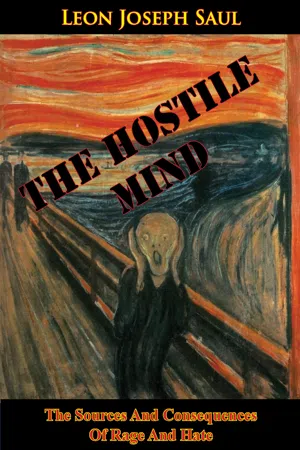
The Hostile Mind: The Sources And Consequences Of Rage And Hate
About this book
Information
Topic
PsicologíaSubtopic
Historia y teoría en psicologíaPART ONE—BIOLOGICAL ORIENTATION
On Seeing Weather-beaten Trees
“Is it with us as clearly shown
By slant and twist, which way the wind hath blown?”
—ADELAIDE CRAPSEY
1—What Hostility Is
ALL WORDS signifying emotion present difficulties of definition. They require not merely intellectual comprehension but emotional realization; that is, they have to be felt as well as understood. We have all had the experience of reading something easily, simply, and then years later understanding what it really was all about, what it really meant. And anyone who has had some psychoanalysis knows the dramatic differences between the first intellectual awareness of some psychological force and the later, emotional impact of true insight into and appreciation of it.
As to hostility, happy is he who has suffered so little from his own hates and angers and from the attacks of his fellow men that he requires a “feeling” definition. What we mean by hostility in this book is the tendency of an organism to do something harmful to another organism or to itself. It is not just aggression: aggression (from the Latin, meaning moving actively) may have a constructive meaning (as in getting a good job done); it need not be hostile, and, conversely, hostility need not be aggressive; it may be passively expressed.
Nor is hostility anger, necessarily, for anger reflects a transient feeling which can be compatible with love. One can fully, without interruption and alteration, love someone despite periods of anger, as every husband, wife, child, parent and friend knows.
Hostility can be hate; hate expresses hostility and something deeper than anger. Hate, like hostility, implies hurt to others, expresses enmity and seeks directly no socially constructive end. There can be hostility without hate. Hate is one kind of hostility.
Hostility can take almost limitless forms, can be used for every sort of purpose, and can range in intensity from a glance or a breath of gossip to vindictiveness, violence, brutality and murder.
For hostility is the essential evil in people. Wrongness in personal and social behavior might well be judged by this touchstone: Is it for life, for the development, adjustment, happiness and fulfillment of society and its individuals, or is it against it?
As a technical definition one might hazard the following: Hostility is a motivating force—an impulse, urge, tendency, intent, motivation or reaction—toward injury or destruction of some kind or degree, toward an object which can be animate (including oneself) or inanimate, usually accompanied in humans by the feeling or emotion of anger; the hostility can be conscious or unconscious. As we shall see, even a single-celled animal, like the amoeba, can have hostility in the sense of a reaction of destructiveness against threats and irritants to it.
It has always been important to understand the motives by which we live, love, reproduce—and hate. But today, with the finding of new, unlimitable forces of energy, it is particularly important. For today we stand at an historic crossroads; in one discovery—the discovery of nuclear energy—we have found the means by which we can, on the one hand, destroy ourselves as a species, or, on the other, literally create a land of milk and honey, of health and happiness, a veritable heaven on earth the like of which man has never seen before.
Which choice we make depends on each of us. Human behavior has become the key to survival or to total destruction. Each individual in our society is activated by strong asocial and antisocial motivations, as well as by social ones. Only by understanding these two sets of motives, the one against life, and the other for it, can we implement those that are pro-human and reduce those that are antihuman; only in this way can we avoid the terror, tyranny, war and want that threaten us all.
All this seems clear enough on the surface, but there will be those who will resist understanding it none the less. For as well as the difficulty of understanding emotional terms in general, there is a special controversial difficulty about hostility that makes it hard to consider it calmly. Just as discussions of sex, dependency, prestige and like motivations arouse passionate feelings in most people, so does hostility, and true detachment in dealing with it is rare indeed.
Some of this stems from prejudice and rationalization. Many people like to believe that hostility is inherited, and therefore should be dismissed as something about which nothing, for the present at least, can be done. Others believe, falsely, that hostility is a strength, that without it men and women would be left defenseless in a world all too ready to attack and exploit the weak. And some will resist the study of hostility just from the tendency of mankind to resist any new idea. The great physician William Harvey feared to make known what is now accepted as a commonplace fact—the circulation of the blood. “I not only fear injury to myself from the envy of a few, but I tremble lest I have mankind at large for my enemies, so much does wont and custom become second nature,” he said. “Doctrine once sown strikes deeply at its root and respect for antiquity influences all men. Still the die is cast and my trust is in the love of truth and the candor of cultivated minds.”
Besides such general reasons for shunning the problem of hostility, there are others more individual and deep-seated. Some people balk at accepting hostility as a psychological force because of hostile reactions within themselves. A friend of mine, hearing of this study, reacted quite unsympathetically. Because he was basically a man of good will, his reaction aroused my interest. He was one of those people whose hostilities were overinhibited when he was a child and as a result he felt that his wings were clipped, that he lacked the capacity of self-defense even for proper purposes. In shunning this unpleasant conflict within himself, he reacted like an ostrich, put his head in the sand and maintained that the less said about hostility the better.
Guilt for one’s own known hostile reactions and deeds may also impair objective understanding, for the feeling of guilt brings conscience reactions and a need for punishment. Some people may even prefer punishment to cure and suffering to happiness. Indeed, in psychoanalytical practice it is not uncommon to see patients who truly feel that they do not deserve to be cured. This masochism, this need for suffering, is so widespread that it often extends to society in general, with a resulting feeling, usually unconscious, that mankind deserves its miseries and should not be helped toward a better life.
Freud himself started his study of the neuroses by focusing on the sexual drives and did not face squarely the vital importance of hostility until late in life, when he was unable to give it the detailed clinical attention which he gave to the libidinal impulses. However, he expanded his instinct theory into a broad dualistic view of life as fundamentally an interplay between the forces of destruction and death (Thanatos) and of creativity (Eros).
“I know that we have always had before our eyes manifestations of the destruction instinct fused with eroticism, directed outwards and inwards in sadism and masochism, but I can no longer understand how we could have overlooked the universality of non-erotic aggression and destruction and could have omitted to give it its due significance in our interpretation of life,” he wrote in Civilization and Its Discontents, published in 1931, some eight years before his death at 83.
“I can remember my own defensive attitude,” he went on, “when the idea of an instinct of destruction first made its appearance in psychoanalytical literature and how long it took until I accepted it. That others should have shown the same resistance, and still show it, surprises me less. Those who love fairy tales do not like it when people speak of the innate tendencies in mankind toward aggression, destruction and, in addition, cruelty.”
He discusses this further and then forthrightly declares:
“In all that follows I take up the standpoint that the tendency toward aggression...constitutes the most powerful obstacle to culture.”
What can we do about this “tendency toward aggression,” this hostility (to label it more accurately)?
Each of us can focus attention upon the problem and then discern what his contribution is—and try to make it.
I believe man’s hostility to man is the central problem in human affairs. I also believe it is recognizable in its various forms, that it is a disease to be cured and prevented like cancer, tuberculosis or smallpox, and that its cure will result in healthier, better living—not only for society in general but for each individual in particular.
2—How Hostility Arises Biologically
IF WE observe an individual member of any species—a goldfish, a mosquito, a python or a person—we see two activities predominating: the effort to survive and the effort to fulfill the life cycle. Chickens are first eggs; frogs are first tadpoles; butterflies were caterpillars. But whatever the variations, and changes in form, the basic plan is the same: first, development to maturity, then reproduction, with some care or provision for the young, then decline and death.
This cycle of life is not a remote scientific concept; it is a fundamental biological force that operates, willy-nilly, upon all of us, and any lack of surrender to it, any attempt to deviate from it or any failure to fulfill it, brings difficulty and pain.
We all know this; we meet it face to face every day in our own lives, in those of our children, in the problems of our friends and business acquaintances.
To find aid and comfort, let us look at ourselves biologically, historically and psychologically. Only in this way will we discover our true role in life, what forces impede us and how we can conquer them.
Biologically, we are, in essence, not very much. On this tiny planet of a tiny solar system, there has developed a combination of molecules in a jelly-like substance, about 85 per cent water, which the chemists call a colloidal suspension. One form of colloid we know as living matter or protoplasm. The earth’s surface teems with this colloid, life, directly visible, microscopic and sub-microscopic. The waters swarm with it; the sand and earth beneath our feet are filled with it. The air about us contains myriad living particles. Man is only one form of the biological life on this planet.
Why, a million years ago, did this human form of protoplasm appear on earth? Neither scientists, philosophers nor men of religion have an agreed-upon, verified answer. But we do know how it has survived—because of its adaptation to the conditions of life on this planet. The dinosaur, with its pea-sized brain and clumsy, lumbering body, did not survive; the ant, with its social organization, has existed for longer than man, probably for 50 million years. But the fact that the human race exists today does not mean that it will automatically, ipso facto, be on earth on some tomorrow. Most of us, for ourselves and our children, would not relish participation in its decay.
It is popularly believed that physical force, coupled with cunning and a dog-eat-dog attitude, is the best mechanism for survival of individuals and species. But scientific research does not bear this out. As more and more work is done on this subject it becomes clear that each form of life uses at least two major mechanisms of adaptation: the fight-flight reflex and cooperation.
According to the eminent biologist, Warder C. Allee, a leading authority in this field, cooperation not only serves animals as a protection, but also as an aid to development. His lifetime study of the simpler plants and animals reveals that the animal living in association with others increases in size, swiftness and the ability to recover from damage more quickly than his isolated brothers—the isolated animal is much more susceptible to poisons and retardation and will suffer more often from hunger and the attacks of other animals.
It is his conclusion that “no free living animal is solitary throughout his life history,” and he declares that the tendency of animals to aggregate is a primitive, unconscious drive. On its higher levels, these aggregations attain refinements of organization. We are all familiar with the advanced social life of the bees and ants, with the way elephants gather in herds, fish in schools and birds in flocks.
Both leadership and “class” orders are found among animal organizations. Just as there is the queen-worker-drone order among bees, there is the somewhat despotic “peck order” among hens: each hen can peck those lower in the order than herself but must submit to pecks from those higher. Similarly, among lizards, there is a “nip order.” And the same type of domination-submission order is found in other species also. Witness what a new horse goes through for several months until he finds his place in an established group. There is also a type of communication used in animal organizations. Mating calls exist in almost all forms of life from mosquitoes to birds; bees dance in a certain way to inform their fellow hive-dwellers when and where honey can be found and birds are signaled toward migration by leader-birds.
When we turn to human societies, we find greater complexity, but a similar tendency to group, and to organize, for protection, production and communication. Like the animals, only through social living and sharing has man been able to protect himself against the elements, against animals of prey, against germs, and to find an adequate food and energy supply. But there is one difference that separates human organization from animal groupings; only among human beings have organization and aggregation been used not only for protection from other animals, but for attack on and destruction of their own kind. “One species of animal may destroy another,” Allee writes in Cooperation Among Animals, “and individuals may kill other individuals, but group struggles to the death between members of the same species, such as occur in human warfare, can hardly be found among non-human animals.”
Why is this so? Why are such constant features of our species as war, mass murder and hostility to one’s own not indulged among the sub-humans? This is probably the most important question confronting us as human beings.
The many forms of man’s hostility to man are understandable as symptoms of a mechanism of adaptation run rampant.
If you are alone in raw nature, in a wilderness, your life depends largely upon the speed and effectiveness of your fight and flight reflexes. You jump or dodge or strike far faster when you take no time to think than when you do. These reactions, so essential to man’s survival in cave and jungle, continue on as a sort of biological lag into our present recent living in civilizations, and may be compared to other basically normal mechanisms of the body which also overshoot themselves.
For instance, a man’s body temperature rises to combat infections. It does so without thought or will on his part; it is a biological defense against disease. But it may outstrip its controls; it may go to 106°, 107°, 108° and thus kill the individual before it kills the microorganisms against which it went into action. Similarly, the membranes of the nose swell and secrete juices in order to defend themselves against irritants. But frequently they go too far in attempting to shut out dust, fumes, pollen and the like and hay fever or asthma may result.
Observing animals closely, we find certain biological changes taking place when danger threatens. Typical ...
Table of contents
- Title page
- TABLE OF CONTENTS
- DEDICATION
- FOREWORD
- PART ONE-BIOLOGICAL ORIENTATION
- PART TWO-BASIC SOURCES OF HOSTILITY
- PART THREE-HOSTILODYNAMIC MECHANISMS
- PART FOUR-HOSTILITY AND EVERYDAY LIVING
- PART FIVE-PREVENTION AND CURE
- REFERENCES
Trusted by 375,005 students
Access to over 1.5 million titles for a fair monthly price.
Study more efficiently using our study tools.
Frequently asked questions
Yes, you can cancel anytime from the Subscription tab in your account settings on the Perlego website. Your subscription will stay active until the end of your current billing period. Learn how to cancel your subscription
No, books cannot be downloaded as external files, such as PDFs, for use outside of Perlego. However, you can download books within the Perlego app for offline reading on mobile or tablet. Learn how to download books offline
Perlego offers two plans: Essential and Complete
- Essential is ideal for learners and professionals who enjoy exploring a wide range of subjects. Access the Essential Library with 800,000+ trusted titles and best-sellers across business, personal growth, and the humanities. Includes unlimited reading time and Standard Read Aloud voice.
- Complete: Perfect for advanced learners and researchers needing full, unrestricted access. Unlock 1.5M+ books across hundreds of subjects, including academic and specialized titles. The Complete Plan also includes advanced features like Premium Read Aloud and Research Assistant.
We are an online textbook subscription service, where you can get access to an entire online library for less than the price of a single book per month. With over 1.5 million books across 990+ topics, we’ve got you covered! Learn about our mission
Look out for the read-aloud symbol on your next book to see if you can listen to it. The read-aloud tool reads text aloud for you, highlighting the text as it is being read. You can pause it, speed it up and slow it down. Learn more about Read Aloud
Yes! You can use the Perlego app on both iOS and Android devices to read anytime, anywhere — even offline. Perfect for commutes or when you’re on the go.
Please note we cannot support devices running on iOS 13 and Android 7 or earlier. Learn more about using the app
Please note we cannot support devices running on iOS 13 and Android 7 or earlier. Learn more about using the app
Yes, you can access The Hostile Mind: The Sources And Consequences Of Rage And Hate by Leon Joseph Saul in PDF and/or ePUB format, as well as other popular books in Psicología & Historia y teoría en psicología. We have over 1.5 million books available in our catalogue for you to explore.