eBook - ePub
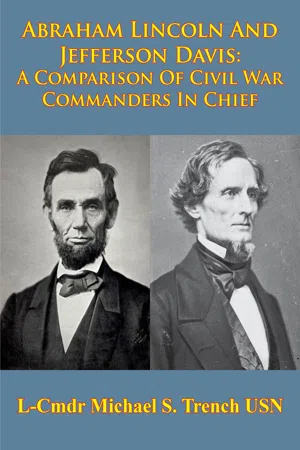
Abraham Lincoln And Jefferson Davis: A Comparison Of Civil War Commanders In Chief
- 97 pages
- English
- ePUB (mobile friendly)
- Available on iOS & Android
eBook - ePub
Abraham Lincoln And Jefferson Davis: A Comparison Of Civil War Commanders In Chief
About this book
This is a study of the effectiveness of Abraham Lincoln and Jefferson Davis as Commanders in Chief during the Civil War. It begins by comparing their backgrounds prior to assuming the Presidency; then comparing their military strategies and command structures. The final area of comparison is their involvement in the first military draft in American history. Davis had extensive government and military experience, but exhibited personality traits early on that later hampered his performance as a war-time Commander in Chief. Lincoln had very little experience, but excelled at dealing with people. Lincoln tried several staff arrangements before finally appointing Grant as General in Chief. Davis changed his structure very little throughout the war. Although he appointed Lee as General in Chief in the first year, he lost his services by placing him in command of a field army. Both faced strong challenges from a powerful governor over the draft. Davis first tried to win over the governor, then appealed directly to the people. Lincoln publicly kept distant from the draft and worked behind the scenes.
Information
Subtopic
19th Century HistoryIndex
HistoryCHAPTER ONE — INTRODUCTION
When the Civil War began in 1861, the Confederacy seemed to hold one very definite advantage over the Union, its Commander in Chief. A graduate of West Point and commander of a regiment in the Mexican War, Jefferson Davis had led more men in combat than most generals on either side. Additionally, he compiled a distinguished record in the House of Representatives and Senate and served as Secretary of War under Franklin Pierce. His military and political records were matched by few men in the country when the war broke out.
The Union, on the other hand, was led by Abraham Lincoln. A lawyer from Illinois, Lincoln brought a total of three months' military experience to the White House. He had served only one term in the House of Representatives and four in the Illinois State Legislature. While the two seemed incredibly mismatched to lead their governments into war, the war itself proved otherwise. From their different backgrounds, each brought different strengths and weaknesses into office. Neither man wanted a war; but once it began, both had their own ways of dealing with the multitude of problems they faced.
Of the many functions a President performs, the role of Commander in Chief during war is arguably the most difficult. Clausewitz agreed; in On War, he said "the demands for intellectual and moral powers are vastly greater . . . a commander in chief must also be a statesman, but he must not cease to be a general."{1} Lincoln and Davis struggled to maintain this balance for four years. While both had successes and failures, there would be only one victor. How effective were Lincoln and Davis as Commanders in Chief?
Two assumptions were necessary to begin this study. First, in order to compare the job performance of any two individuals, the jobs they perform must either be the same or equivalent enough to provide a worthwhile means of comparison. The United States Constitution uses the following description: "The President shall be Commander in Chief of the Army and Navy of the United States and of the Militia of the several states when called into actual service of the United States."{2} The Confederate Constitution, which borrowed heavily from that of the United States, used the same definition. A strong argument can be made that Davis's position was considerably more difficult than Lincoln's because of the Confederacy's commitment to states' rights. While this is true, Lincoln also had to contend with states' rights; the Republican platform in 1860 specifically addressed the conservation of states' rights. Balancing national interests against the rights and interests of the states was a difficulty both men faced throughout the war.
The second assumption is that victory in war is not the sole qualifier of an effective Commander in Chief. Once it was assumed the comparison could be done, the next step was to decide what categories would be used to measure the performance of the two Presidents. If victory is the only real measure of effectiveness, then it is pointless to continue. It must be assumed that Jefferson Davis could have been an effective Commander in Chief, or could have been effective in some aspects and still lost the war.
The Civil War is probably the most well-documented war in American history. A large amount of literature is available on nearly every important figure. This is especially true regarding Abraham Lincoln. Every aspect of his presidency has been analyzed; his leadership style alone has been the source of several books. These works are almost unanimous in their praise of his character and abilities, and most authors consider him a model as President and Commander in Chief.
The opposite is true regarding his counterpart, Jefferson Davis. While many works have been written about him, he has not inspired the same volume of works or respect as Lincoln. Authors vary widely on their opinion of Davis, most tending to think he was an ineffectual leader. This is especially true of books written in the first thirty-to-forty years after the Civil War; most authors blamed Davis for all the ills of the Confederacy. Since then, a few have tried to present a more balanced picture of the President of the Confederacy.
A possible problem area then, is the bias in most works dealing with these two men. Some works on Lincoln take on an almost reverent tone. Many recollections of people of the time are likely colored by their grief over his assassination. Davis presents a different case; he was blamed for everything from starting the war to plotting the assassination of Lincoln. The plan to work around this bias is to use primary sources and recent works as much as possible. The main source of information for this study is the Official Records of the Union and Confederate Armies. Another possible source is the papers of both men. Each has an extensive collection, but these are not a primary focus of research due to the difficulty in gaining access to them. While these are no doubt the best source of information, time constraints will not allow efficient use of these documents.
A necessary limitation of the study of wartime Presidents is the lack of clear-cut standards of effectiveness. Of the many who have served during times of war, no two approached the job in the same manner. Each had their own interpretation of the role of Commander in Chief. Levels of personal involvement in routine decisions, staff and command structures varied widely. The first task was to review existing works dealing with the President as Commander in Chief. These were mostly collections of biographies, but more than sufficient for the purposes of this study. Three books were especially useful: James R. Arnold's Presidents Under Fire: Commanders in Chief in Victory and Defeat, Warren W. Hassler's The President as Commander in Chief, and Ernest R. May's The Ultimate Decision. These cover every war-time President up to and including George Bush. While none of them broke out specific areas of performance and applied them to each President, they did provide some common areas of performance to use in this study. Each of these books included a chapter on Lincoln; and although only James R. Arnold discussed Davis, he devoted a significant portion of his book to him. He points out several crucial errors by Davis, but presents one of the most unbiased pictures of him as Commander in Chief. All three books also deal extensively with James Polk and his role as Commander in Chief during the war with Mexico. Polk's interpretation is crucial to the views of both Lincoln and Davis as they were both in Congress at the start of the war. Polk kept a firm grasp on all operations during the war, sending orders to generals in the field as well as tracking the most minute details of the war effort. It was a marked departure from previous administrations and set the precedent for all subsequent Presidents, including Lincoln and Davis.
This paper will focus on three areas of comparison: background, military strategy and command structure, and the draft and how each man handled challenges from one of their governors. These are necessarily subjective, but representative of the duties of Commander in Chief.
Examining the backgrounds of each man is particularly important in this case. The education, military experience, and political experience of both men were drastically different. Judging by any standard, Davis was far more qualified for the position than Lincoln. Examining their backgrounds can give some insight into how they arrived in office, and what strengths and weaknesses each brought with him.
The Commander in Chief is responsible for the overall military strategy in times of war. The system we use today to develop and implement national military strategy is based on experiences of the past. Lincoln inherited a structure when he took office, and Davis was forced to build one from the ground up. A comparison of their systems to our current one can show what lessons were learned during that war, and how they influenced the way the American military system operates today. The two sides in the Civil War had very different national goals, and the proper use of military power to achieve them was the primary responsibility of the Commander in Chief. The strategies they developed were different, and changed throughout the war in response to changes in the military and political situation. Their military strategies can be examined considering their different goals, and effectiveness measured by how well they addressed these goals. Examination of the strategies themselves is not sufficient, however; the methods they used to communicate this down the chain of command are equally important if not more so. Each man tried different combinations of staffs and command structures throughout the war; examining this process is important to determining their effectiveness as Commanders in Chief. A fundamental measure of effectiveness is "whether the commander in chief's strategic vision can still be recognized at the sharp end."{3}
The final area of study is their relationship with the governors of the states concerning the drafting of men into federal service. Although the Confederacy was dedicated to states' rights, both men had to deal with the problems of the states. The states had to be protected; no governor would sit idly by while enemy troops were allowed to march unchallenged through his state. Both men presided over a military growth unprecedented in American history, and relied on their states to supply the manpower. As the number of volunteers dropped, both instituted a system of conscription. This was an unpopular measure, and each faced a strong challenge from a powerful governor. The methods used by Lincoln and Davis to work with these governors was another important part of their role as Commander in Chief.
The study of any President in times of war is worthwhile. The role of Commander in Chief of the United States Armed Forces is unique. While the legislative branch of the government retains the power to declare war, the President holds supreme command over all the armed forces. Every President has very definite ideas of the limits of his power, and most of these are formed by the actions of his predecessors. The role of Commander in Chief today is interpreted very differently than it was when Lincoln and Davis took office. Since the definition in the Constitution has not changed, any differences reflect the attitudes and interpretations of the men who have held the job.
The Civil War was an especially important period in the expansion of the powers of the Commander in Chief. Abraham Lincoln faced challenges unlike any of his predecessors, and took unprecedented measures to perform his duties as he understood them. His counterpart, Jefferson Davis, faced many of the same challenges. Both men were elected officials and could not deal with problems as a monarch or dictator. They were required to work within the laws of their governments, and were often accused of subverting those laws. The Civil War offers a rare opportunity to study two leaders of similar governments and how they dealt with the problems of command of their Armed Forces.
CHAPTER TWO — BACKGROUNDS
The two men who led the United States into civil war began their lives in much the same manner. Abraham Lincoln and Jefferson Davis were both born in log cabins in Kentucky, separated by eight months and less than one hundred miles. From these similar beginnings, their lives went in completely different directions. Davis's family moved and became more prosperous, Lincoln's family also moved but did not. Davis attended various schools from the age of eight to twenty-one, Lincoln attended about one full year of formal school during his entire life. Davis was very familiar with federal government, Lincoln served only one term in Congress. Understanding the experiences that shaped them on their way to assuming the Presidency is critical to understanding their approach to the problems they faced.
Jefferson Davis
Jefferson Davis was born in Christian County, Kentucky on 3 June 1808, the youngest of a large and very close farm family. His father, Samuel Davis, was a moderately successful tobacco farmer and horse breeder. The family lived in one of the better log cabins in the area; two cabins connected by a breezeway with glass windows.{4} As the youngest, he was the favorite of the family, and he wrote often of the great affection he received as a child.
The family moved when Davis was two, briefly to Louisiana, then to Mississippi. His father became a cotton farmer and the family began to prosper. His father owned a few slaves, but worked in the field with them. Since there were few good schools in Mississippi, Samuel decided to send Jefferson to Kentucky when he was old enough to attend school. At the age of eight, he enrolled him at St. Thomas Aquinas, a Catholic school run by Dominican priests. Davis was the youngest student at the school, and the only Protestant. Davis attended St. Thomas for two years, until his mother could convince his father to allow him to attend a local school in Mississippi. Jefferson returned home alone on a steamboat at the age of ten.
Back in Mississippi, Jefferson briefly attended Jefferson College near Natchez before entering Wilkinson Academy. It was here that he first displayed the temperament that would be a trademark later in his life. When the teacher assigned a piece to be memorized, Davis considered it too long and refused. The next day, when threatened with a whipping for his failure, Davis left the school and walked home. His father, rather than forcing him to return, told him if he was not in school he would have to work in the field. Davis did this for one day, before deciding that school was better than work and returned.{5}
In 1823, at the age of fifteen, Davis enrolled in Transylvania University in Lexington, Kentucky. This was one of the best schools in the country at the time, with a law school, medical school, and a larger enrollment than Harvard.{6} Little is recorded of his time at Transylvania, only that he belonged to a debating society and gave the commencement address on "Friendship," which was praised by the local papers.{7} Lexington was a much more sophisticated environment than the region of Mississippi where Davis grew up. The city was prosperous, and the surrounding countryside was home to fine race horses. This was Davis's first experience with the Southern aristocracy and society, but one can only speculate on its influences on him. He never kept a diary during this time, nor did he write much about the school later. He appeared, however, to acquire some expensive tastes, evidenced by later letters to his brother asking for money as a cadet at West Point.
While at Transylvania, Davis was surprised to find that his father and brother Joseph had obtained an appointment for him at West Point. Davis had never expressed a desire to attend West Point or to join the military; he planned to graduate from Transylvania and attend law school at the University of Virginia. He would have refused the appointment, but his brother convinced him to try West Point for a year. After that, he could leave and enroll at the University of Virginia if he still wished to. He accepted the appointment on 7 July 1824.
Davis entered West Point on 30 September 1824 at the age of seventeen. Here he first met some of the men who later held key roles in the Confederate Army, Albert Sidney Johnston, Leonidas Polk, and later Robert E. Lee and Joseph Johnston. Davis was not a model cadet at West Point. He was arrested and court-martialed his first year for being in Benny Haven's tavern. He was sentenced to dismissal, but the court recommended exoneration due to his previous good conduct. Davis was arrested again on Christmas Eve, 1826, for attending an eggnog party. There was a riot after the party by a group of cadets against the officers, but Davis was not part of this. For attending the party, he was confined to his quarters until 8 February. He also accumulated an impressive amount of demerits, including such offenses as:
visiting during study hours, having long hair at inspection, failing to keep his room in order, spitting on the floor, absence from reveille, absence from class, making unnecessary noise during study hours, firing his musket from the window{8}
Davis graduated West Point ranked twenty-three of thirty-two cadets. He was commissioned a brevet second lieutenant of infantry in January 1829. He was assigned to Fort Winnebago in the Michigan Territory, where he served as assistant quartermaster. He contracted pneumonia during his first winter there, very nearly dying. This was his first episode of poor health, a problem that plagued him later in life. Davis's wife Varina wrote that Davis and Robert Anderson (who later defended Fort Sumter) actually swore in Abraham Lincoln as a captain of the militia during the Black Ha...
Table of contents
- Title page
- TABLE OF CONTENTS
- ABSTRACT
- CHAPTER ONE - INTRODUCTION
- CHAPTER TWO - BACKGROUNDS
- CHAPTER THREE - DAVIS: MILITARY STRATEGY AND COMMAND STRUCTURE
- CHAPTER FOUR - LINCOLN: MILITARY STRATEGY AND COMMAND STRUCTURE
- CHAPTER FIVE - THE DRAFT
- CHAPTER SIX - CONCLUSIONS
- REQUEST FROM THE PUBLISHER
- BIBLIOGRAPHY
Trusted by 375,005 students
Access to over 1.5 million titles for a fair monthly price.
Study more efficiently using our study tools.
Frequently asked questions
Yes, you can cancel anytime from the Subscription tab in your account settings on the Perlego website. Your subscription will stay active until the end of your current billing period. Learn how to cancel your subscription
No, books cannot be downloaded as external files, such as PDFs, for use outside of Perlego. However, you can download books within the Perlego app for offline reading on mobile or tablet. Learn how to download books offline
Perlego offers two plans: Essential and Complete
- Essential is ideal for learners and professionals who enjoy exploring a wide range of subjects. Access the Essential Library with 800,000+ trusted titles and best-sellers across business, personal growth, and the humanities. Includes unlimited reading time and Standard Read Aloud voice.
- Complete: Perfect for advanced learners and researchers needing full, unrestricted access. Unlock 1.5M+ books across hundreds of subjects, including academic and specialized titles. The Complete Plan also includes advanced features like Premium Read Aloud and Research Assistant.
We are an online textbook subscription service, where you can get access to an entire online library for less than the price of a single book per month. With over 1.5 million books across 990+ topics, we’ve got you covered! Learn about our mission
Look out for the read-aloud symbol on your next book to see if you can listen to it. The read-aloud tool reads text aloud for you, highlighting the text as it is being read. You can pause it, speed it up and slow it down. Learn more about Read Aloud
Yes! You can use the Perlego app on both iOS and Android devices to read anytime, anywhere — even offline. Perfect for commutes or when you’re on the go.
Please note we cannot support devices running on iOS 13 and Android 7 or earlier. Learn more about using the app
Please note we cannot support devices running on iOS 13 and Android 7 or earlier. Learn more about using the app
Yes, you can access Abraham Lincoln And Jefferson Davis: A Comparison Of Civil War Commanders In Chief by L-Cmdr Michael S. Trench in PDF and/or ePUB format, as well as other popular books in History & 19th Century History. We have over 1.5 million books available in our catalogue for you to explore.