- 69 pages
- English
- ePUB (mobile friendly)
- Available on iOS & Android
eBook - ePub
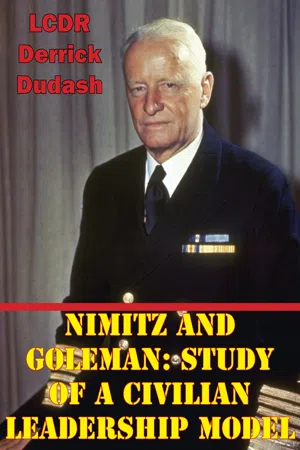
Nimitz And Goleman: Study Of A Civilian Leadership Model
About this book
Within a couple of weeks after the attacks on Pearl Harbor in 1941, selected over 28 other senior admirals, Admiral Nimitz took command of the Pacific Fleet and held that command until the Allied Forces won the war in the Pacific almost four years later. He went on to hold the highest office in the U.S. Navy, the Chief of Naval Operations. Nimitz's ability to lead effectively throughout his career proves that his style of leadership can be a model for any military officer. Even since 1941, the requirement to lead personnel in the Armed Forces has not changed. However, with the advent of information sharing on a global scale, today's military officers are exposed to a wide range of leadership styles such as one presented by Dr. Daniel Goleman derived from the civilian sector. This study examines in detail Goleman's leadership model and compares it to Fleet Admiral Nimitz's style to see if it is feasible for use in the military environment.
Information
Subtopic
European HistoryIndex
HistoryCHAPTER 1 — INTRODUCTION
This study examines Dr. Daniel Goleman’s civilian leadership model and compares it to the actions and exercise of leadership by Fleet Admiral Chester W. Nimitz during his naval career. In today’s joint professional military education institutions, like the U.S. Army’s Command and General Staff College (CGSC), the students, who are military officers from all branches of the U.S. service and many international countries, explore a curriculum that introduces them to multiple leadership models. Leadership is a cornerstone of any military institution; the same holds true in the civilian sector. However, some military leaders are cautious about accepting a civilian leadership model for fear that its application will not succeed in military culture. This study examines a prominent civilian leadership model against a well-known World War II naval leader to see if a civilian model is appropriate in the military.
Background
Regardless of which branch of the U.S. military young men or women enter to become a military officer, immersion into service culture and tradition begins immediately. Along with their immersion comes their introduction to leadership styles and doctrine. Some services follow large, in-depth leadership manuals while others have smaller, generalized publications. For instance, the U.S. Army’s doctrinal Field Manual (FM) 6-22, Army Leadership is more than 115 pages long while the U.S. Air Force’s Doctrine Document (AFDD) 1-1 is also of comparable length at eighty-two pages. The U.S. Navy differs in that it only addresses the topic of leadership within its seventy pages doctrinal publication titled Naval Doctrine Publication 6 (NDP-6): Naval Command and Control as part of the overarching idea of command and control. This paper is not an area for parochial discussion as to which service has better leadership doctrine. The Army’s and Air Force’s more in-depth manuals provide their officers a more focused approach to leadership, while the Navy’s manual may allow an officer more flexibility in learning and practicing leadership. Each service has its own particular way of handling day-to-day operations. However, as military officers reach field-grade rank and begin working more with other services, interagency, multinational, government, and nongovernment organizations, sticking rigidly to one’s own service leadership doctrine may or may not be a good idea.
Since this thesis compares Goleman’s leadership model to Nimitz, a closer look at today’s naval leadership doctrine, dated 1995, provides a baseline for analyzing Goleman and Nimitz. NDP-6, published by the U.S. Naval Doctrine Command, officially addresses the subject of leadership as it relates to U.S. Navy. In chapter 1, it discusses the elements of command and control, the principal element of which is command (Department of the Navy 1995, 7). It defines command as a “function of authority, responsibility and accountability . . . lawfully exercise[d] over subordinates by virtue of rank or assignment” and confirms, “[leadership is the cornerstone of effective command” (Department of the Navy 1995, 7).
NDP-6 also discusses the important relationship between the commander’s functions of authority, responsibility and accountability. Commanding is an “intensely human activity” and “the element of personal leadership in a naval command should never be discounted” (Department of the Navy 1995, 8). Two sources give a commander his power to exercise command: official and personal (Department of the Navy 1995, 8). Officially, a commander can derive his power from his lawful rank or position. Personally, a commander’s power comes from his “influence, charisma, experience, reputation, character and personal example” (Department of the Navy 1995, 8). In addition, “responsibility and accountability for results are natural corollaries of authority; where there is authority, there must also be responsibility and accountability” (Department of the Navy 1995, 8). Simply put, if an individual is responsible and accountable for results then that person must have the authority to execute action to obtain those results. Therefore, officers can delegate authority but not responsibility and accountability.
Another reference to leadership in the NDP-6 relates to the factors of uncertainty and time in combat operations. NDP-6 defines uncertainty as the difference between what a commander knows and does not know in the strategic, operational or tactical environment (Department of the Navy 1995, 12). Time is a crucial factor for commanders for three reasons: (1) gathered knowledge is perishable as time moves forward, (2) time affects each side of the fight equally, and (3) today’s high-tempo operations limit the commander’s time needed to reduce uncertainty (Department of the Navy 1995, 12). The more time a commander spends trying to reduce uncertainty, the slower the operational tempo, and thus, his assets become more vulnerable to the enemy (Department of the Navy 1995, 13). NDP-6 highlights even before combat operations begin, a commander has the power to “mitigate the factors of uncertainty and time through professional leadership, teamwork, realistic training, flexibility in organization and equipment and cohesive doctrine” (Department of the Navy 1995, 13). Overall, NDP-6 gives the fundamentals a naval leader must possess. Any student of military leadership will find that NDP-6 does not proscribe a specific leadership style; whether such flexibility is an advantage or disadvantage for today’s naval leaders is a separate topic altogether. However, because the U.S. Navy does not specifically delineate a set leadership style, a naval leader is free to experiment with various leadership styles as long as the styles adhere to the NDP-6 fundamentals. Such independence allows U.S. Naval officers to choose from a panoply of leadership styles; the applicability of so- called civilian leadership models forms the basis for this thesis.
During the academic 2009 year, the U.S. Army CGSC’s leadership syllabus introduced students to a civilian leadership model developed by Goleman. Often, instructors referred back to Goleman’s model in the course, thus making it a de facto foundation for the course. As a reminder, the U.S. Army, who taught this course at a post-graduate level, already has a dedicated doctrinal leadership manual. Since the CGSC is a joint military school, it is important to highlight that officers from other services may also consider Goleman’s model for their own use. U.S. Army officers can simply compare their service’s leadership doctrine with Goleman’s model and form their own opinions. Other service officers can do the same, but for those with more flexible leadership doctrine, the model presented in the CGSC curriculum may look inviting. Less convinced officers may doubt the validity of applying a civilian model to the military. Such doubt welcomes examination and comparison between Goleman’s civilian leadership model and a well-known, highly-successful naval leader, in this study, Admiral (Adm.) Nimitz.
The Leader
Naval historians and leaders recognize Chester W. Nimitz for his tour as Commander-in-Chief, Pacific (CINCPAC) during World War II. How did Nimitz, without even a day of combat, joint, or inter-service experience, lead the U.S. Navy out from the pains of defeat after December 7, 1941? The answer lies in how he led. To understand how he developed his own leadership style a summary of his career is essential.
Nimitz’s military career began on September 7, 1901, when he entered the U.S. Naval Academy as a Naval Cadet; at that time, the rank of midshipman came with graduation (Driskill 1983, 55). In Nimitz’s case, graduation came early on January 30, 1905 (Driskill 1983, 64). Ranking seventh out of 114, promotion to the rank of Midshipman was automatic, and Nimitz began his career as a surface naval officer (Driskill 1983, 65). Of note, while stationed in the Far East the following summer, he met Adm. Heihachiro Togo, a famous Japanese commander in the Russo-Japanese war, at a party held by the Japanese Emperor honoring Togo and other famous Japanese leaders. Nimitz respected Adm. Togo deeply and in 1934 attended both his public and private funerals. In 1906, after completing the required two years at sea and then commissioned an Ensign, Nimitz, in rapid succession, took command of various small ships. His command of the United States Ship (USS) Decatur stood out among them. While sailing through the poorly charted waters of Batangas Harbor near Olongapo, Philippines, the Decatur ran aground on a mud bank. The night of the incident Nimitz slept peacefully having thought of what his grandfather, a former German merchant marine, said about life at sea: “Don’t worry about things over which you have no control” (Driskill 1983, 78). The next day a small steam ship pulled the Decatur off the bank and an investigation began. The grounding of a ship is usually career-ending for any naval officer. A court-martial did convict Ensign Nimitz, but only sentenced him to receive a letter of reprimand for hazarding his ship. Nimitz survived his court-martial because of his impeccable service record, the poor accuracy of the charts, and because the ship sustained relatively no damage and Nimitz remained mindful of this experience for the rest of his life (Driskill 1983, 79). From that time on, Nimitz believed in honest mistakes and second chances.
In 1909, Nimitz transitioned to submarines despite his request for a battleship assignment (Potter 1966, 37). In the early days of the submarine, this new marvel of naval warfare operated on engines fueled by dangerous, highly flammable gasoline. Therefore, in early 1913, the U.S. Navy sent Nimitz to Germany and Belgium to learn about maritime diesel engines as an alternative; ultimately, he returned stateside to supervise the U.S. fleet’s first experimental diesel powered tanker (Driskill 1983, 90). At the start of World War I, Nimitz served on Adm. Samuel S. Robinson’s staff, Commander Submarine Force U.S. Atlantic Fleet, and later would become his chief of staff (Driskill 1983, 94). Following World War I, Nimitz worked as a senior member on the Board of Submarine Design and afterwards took command of the USS South Carolina and later the USS Chicago (Potter 1966, 37). Afterwards, he attended the Naval War College followed by his return to the staff of his mentor Adm. Robinson, now Commander Battle Fleet and later Commander-in-Chief, United States Fleet (Potter 1966, 37).
In 1926, Commander Nimitz had mixed feelings about orders to implement a new recruiting concept at the University of California, Berkley--the Naval Reserve Officers’ Training Corps. This type of assignment did not typically advance a naval officer’s career, but it could attract a lot of attention if the new program was a success (Potter 1976, 143). Nimitz became the school’s first Professor of Naval Science and the program became a resounding success (Driskill 1983, 96). Following Berkley, he commanded Submarine Division 20 and then advanced to command the flagship of the Asiatic Fleet, the USS Augusta. Next, for shore duty, he assumed the duties as Assistant Chief of the Bureau of Navigation, which controlled placement for all naval personnel--today called the Bureau of Naval Personnel (Driskill 1983, 99). Nimitz excelled at this position because of his ability to accurately judge character and communicate clearly with all types of people. Plus, he possessed a great memory for recalling competencies of each officer he came to know (Potter 1966, 38). After serving at the Bureau, Captain Nimitz returned to sea duty as Commander Cruiser Division Two and then as Commander Battleship Division One, Battle Force (Driskill 1983, 101-102). In June 1939, Rear Adm. Nimitz returned to Washington again, this time as the Chief of the Bureau of Navigation; he remained in that position until the United States entered World War II on December 7, 1941 (Driskill 1983, 102).
After the Japanese Imperial Navy attacked Pearl Harbor, U.S. President Franklin D. Roosevelt had two serious issues with which to contend: (1) the decimation of America’s Pacific naval fleet left the west coast of the United States exposed to attack, and (2) according to Secretary of the Navy, Frank Knox, the naval leadership in the Pacific had to change. Roosevelt and Knox wanted a capable leader who embodied the characteristics necessary to take on the enemy with a damaged, demoralized fleet. After a quick trip to Hawaii to survey the damage, Knox returned to Washington and, with Roosevelt’s approval, he appointed Nimitz as the new CINCPAC, a job that came with the rank of Admiral, a four-star billet (Driskill 1983, 107,109). A stunned Nimitz knew of twenty-eight other possible flag officers ahead of him for the job (Driskill 1983, 109). Nevertheless, Roosevelt and Knox wanted Nimitz to command the Pacific Fleet. For security reasons, Nimitz left Washington by train, in plain clothes, under the assumed name of Mr. Wainwright (Lewis 1945, 406). He took over the Pacific fleet on the last day of 1941 (Lewis 1945, 406). In answering a letter from his wife congratulating him on his recent promotion to CINCPAC, he stated that half of the fleet was on the bottom of the ocean (A&E Biography 1996). It was to be an arduous command tour. Nimitz became one of only three major U.S. theater campaign leaders in World War II, the other two being General (Gen.) Douglas MacArthur and Gen. Dwight Eisenhower. The biggest difference between Nimitz and the two Army generals was that Nimitz’s odds versus those of the Japanese, for much of the war, were at best less than those facing the ground commanders (A&E Biography 1996). Facing an enemy who clearly outnumbered his fleet, Nimitz embarked on one of the greatest naval campaigns ever recorded in history with, initially, a broken and devastated fleet. Nimitz’s command would soon encompass an area covering sixty-five million square miles and include two and half million men, and thousands of ships and planes (A&E Biography 1996). Nimitz did exactly what Roosevelt and the Navy wanted him to do. He and his subordinate commanders won back the Pacific from the Japanese through a campaign of fierce battles like Coral Sea, Midway, Eastern Solomons, Guadalcanal, Tarawa, Marianas, Philippine Sea, Leyte Gulf, Iwo Jima, and Okinawa. In late December 1944, before the start of the Iwo Jima operation, the U.S. Senate and President Franklin Roosevelt passed and appointed, respectively, Nimitz to Fleet Admiral, a lifetime, five-star billet (Driskill 1983, 213).
On September 2, 1945, in Tokyo Bay on the deck of the battleship USS Missouri, Fleet Adm. Nimitz signed for the United States after the Japanese signed the instrument of surrender (Driskill 1983, 228). Shortly afterward, a grateful nation honored Nimitz in Washington, D.C., on Nimitz Day, October 5, 1945. Less than two months later Nimitz relinquished his command of the Pacific to Adm. Raymond Spruance and assumed the duties of Chief of Naval Operations. For the next two years, Nimitz worked to demobilize the forces, and develop the Department of Defense and the National Military Establishment (Driskill 1983, 263). Finally, after over forty years of service in December 1947, Nimitz retired to become the Special Assistant to the Secretary of the Navy in the Western Sea Frontier, a position he held for the remainder of his life (Potter 1966, 53). He continued to influence the U.S. Navy but only when queried directly. For example, when asked by Congress in 1948, he gave his opinion on the U.S. Air Force’s B-36 bomber and United States aircraft carrier debate (Potter 1966, 53). Nimitz was content with his retired life, but always refused to write an autobiography or memoirs about his experiences even though many asked him to do so. He did not want to seem self-serving to others nor did he inadvertently want to hurt those with whom he served.
Nimitz briefly worked for the United Nations (UN) when the UN Secretary Gen. Trygve Lie nominated him to administer a plebiscite for India and Pakistan in regards to the Kashmir region (Potter 1966, 53). When the two nations reached a stalemate, Nimitz requested to be relieved of his duties vowing to return if India and Pakistan agreed to come to terms (Driskill 1983, 274). He continued to work for the UN as a good-will ambassador (Driskill 1983, 276). After working for the UN, Nimitz bought a home near Berkeley, California because of fond memories from his previous tour as a Naval Reserve Officers’ Training Corps professor (Potter 1966, 54). While living near Berkeley, he consulted for history books for authors from around the nation. As the years passed and his health began to fail Nimitz decided to leave Berkeley and move to Naval Station Treasure Island in San Francisco, California where he resided until his death on Feb...
Table of contents
- Title page
- TABLE OF CONTENTS
- ABSTRACT
- CHAPTER 1 - INTRODUCTION
- CHAPTER 2 - LITERATURE REVIEW
- CHAPTER 3 - RESEARCH METHODOLOGY
- CHAPTER 4 - ANALYSIS
- CHAPTER 5 - CONCLUSIONS AND RECOMMENDATIONS
- REFERENCE LIST
Trusted by 375,005 students
Access to over 1.5 million titles for a fair monthly price.
Study more efficiently using our study tools.
Frequently asked questions
Yes, you can cancel anytime from the Subscription tab in your account settings on the Perlego website. Your subscription will stay active until the end of your current billing period. Learn how to cancel your subscription
No, books cannot be downloaded as external files, such as PDFs, for use outside of Perlego. However, you can download books within the Perlego app for offline reading on mobile or tablet. Learn how to download books offline
Perlego offers two plans: Essential and Complete
- Essential is ideal for learners and professionals who enjoy exploring a wide range of subjects. Access the Essential Library with 800,000+ trusted titles and best-sellers across business, personal growth, and the humanities. Includes unlimited reading time and Standard Read Aloud voice.
- Complete: Perfect for advanced learners and researchers needing full, unrestricted access. Unlock 1.5M+ books across hundreds of subjects, including academic and specialized titles. The Complete Plan also includes advanced features like Premium Read Aloud and Research Assistant.
We are an online textbook subscription service, where you can get access to an entire online library for less than the price of a single book per month. With over 1.5 million books across 990+ topics, we’ve got you covered! Learn about our mission
Look out for the read-aloud symbol on your next book to see if you can listen to it. The read-aloud tool reads text aloud for you, highlighting the text as it is being read. You can pause it, speed it up and slow it down. Learn more about Read Aloud
Yes! You can use the Perlego app on both iOS and Android devices to read anytime, anywhere — even offline. Perfect for commutes or when you’re on the go.
Please note we cannot support devices running on iOS 13 and Android 7 or earlier. Learn more about using the app
Please note we cannot support devices running on iOS 13 and Android 7 or earlier. Learn more about using the app
Yes, you can access Nimitz And Goleman: Study Of A Civilian Leadership Model by LCDR Derrick A. Dudash USN in PDF and/or ePUB format, as well as other popular books in History & European History. We have over 1.5 million books available in our catalogue for you to explore.