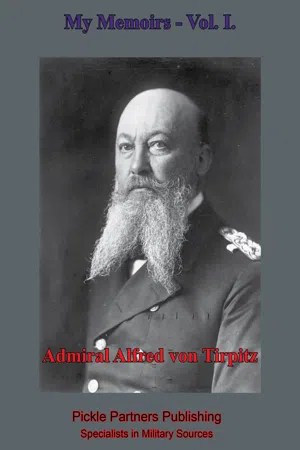
When Prussia, with her German allies, went to war with the French Empire under Napoleon III, her navy sat with tons of barnacles on the hulls of her battleships. Her navy was small, ineffective, without doctrine and destitute of funding. As nascent Germany struggled to become a 'Great Power', the navy was to be thoroughly updated. The man who took on this challenge was Grand Admiral Alfred von Tirpitz, a seasoned sailor who was given huge power as the Secretary of State for the Imperial Navy Office to ring the changes and produce a force that would be a political weapon on the World Stage.Tirpitz and his officers set to work without any of the preconceptions that hamstrung their only obvious opponent, the Royal Navy, and advanced the idea of submarines and torpedoes as critical weapons of Naval importance. The fruits of his labours produced a potent navy which sought to antagonize the Royal Navy into conflict, and during the only major engagement of the First World War at Jutland, their superior gunnery caused much damage to the British Fleet. He was, however, hoisted by his own petard in 1916, brought down by his own restless advocacy of unrestricted submarine warfare.Author — Grand Admiral Alfred von Tirpitz, 1849-1930.Text taken, whole and complete, from the edition published in New York, Dodd, Mead, and company, 1919.Original Page Count – x and 377 pages
- 244 pages
- English
- ePUB (mobile friendly)
- Available on iOS & Android
eBook - ePub
My Memoirs. Vol. I.
About this book
Information
Subtopic
Military BiographiesIndex
HistoryMY MEMOIRS
CHAPTER I—IN THE PRUSSIAN NAVY
1. Entering the Service. Prussian Navy and Prussian politics, 1866-1870. Warfare then and now.—2. Foreign political currents. Relations with England. More at home in Plymouth than in Kiel. The superiority of the English. “But you are not a sea-going nation.”
I
WHEN I was a boy there was scarcely any trace left of the enthusiasm for the navy which the Revolution of ‘48 aroused in Germany, although it flickered up once more in the year 1864 after the Battle of Jasmund. My going into the navy was not the result of a passionate fondness for it, but was the unintentional product of my father’s educational ideal, which was ahead of his time. As my father felt in himself the lack of a knowledge of the exact sciences, he sent my brother and me to the Realschule of our native town Frankfort-on-the-Oder, instead of to the Gymnasium, intending to let us change schools when we reached the top form. But in view of the slight undeveloped state of the realschule at that time, this school proved inadequate; I have felt the effects of this all my life. Our teachers were so old-fashioned that they spoke a language which we really did not understand. As a scholar I was very mediocre, and at Christmas, 1864, my certificate was “Moderate.” My school friend Maltzahn had expressed his intention of entering the navy, and so it occurred to me that it might mean a certain relief for my parents if I too were to take up the idea. At first my proposal was received in complete silence at home, but after some weeks my father called me to him and told me that my depressed state of mind had been noticed. My mind seemed to be set on the navy, he said, and if I wanted to go, no obstacle would be placed in my way. Nobody could have been more surprised than I; but what was I to do? I kept to my word, and in the spring of 1865 I presented myself at the age of sixteen for the entrance examination at the Naval Cadets’ Institute of those days in Berlin, passed, to everybody’s surprise, fifth on the list, and became a sailor.
The attractions of the navy were, as I have said, slight at that time. In 1861 the corvette Amazone had gone down with almost all the cadets on board who constituted the supply of officers for many years to come. This event reduced the applications for naval cadetships to three the following year, and compelled the conditional acceptance even in my year of several candidates who had failed, in addition to the ten aspirants who were successful. The grasp of naval affairs possessed by the Prussian intelligentsia of those days, as well as the hereditary German tendency to regard everything from the standpoint of domestic party politics, is indicated by an article which appeared at the time in the Gartenlaube. It described in novelistic form how the Prussian Junker party attempted to destroy the liberal institution of the navy by bribing a Danish captain to ram the Amazone. The author of this malicious piece of foolery seemed to overlook the fact that the majority of the cadets who were drowned were themselves “Junkers“; Prince Adalbert was very careful in his choice of prospective officers.
Moreover, I occasionally found in my earlier presentations of the Navy Estimates to Parliament that certain Conservative circles distrusted the idea of a fleet. It was not considered to be in keeping with the Prussian tradition, it competed in some degree with the army, it seemed too closely related with industry and commerce in view of the agricultural distress of that time and the great economic conflicts of the parties. Individual members of the extreme Right even voted against the Second Navy Bill of 1900, against the “horrible Fleet,” as a Conservative leader called it,—whilst overwhelmingly sympathetic support was to be found from the outset among the Liberal bourgeoisie, side by side with some of the bitterest opposition to the Bill.
The immediate result of the sinking of the Amazone was to increase still further the confusion of personalities in our Naval Officers Corps in 1864. Portions of this corps had been previously transferred from the army, whence cavalrymen in particular brought with them the youthful independence necessary for naval service; others came from the German or Danish navies: others again had been trained in England, America, or Holland. In addition the so-called Dantzig stuerkes were enlisted from the merchant sailing ships in order to fill the gaps which the war with Denmark had revealed in the Officers’ Corps. Indeed Dantzig was still our real port. These seamen usually only sailed on the short voyage between Dantzig and England, whilst the better sorts went up into the North Sea. The influx of these uneducated sea-dogs from the merchant service of those days brought many a joke into our mess; we called them Hilfsbarone, and they included some remarkable characters who were removed after 1870, several of them after proceedings had been taken by a court of honour. Their authority was often not recognized by the crews, whilst the officer from the Cadet Institute always remained the master, although he was in a certain sense more of a comrade to the ordinary sailor. Washington’s principle of only taking gentlemen for his officers proved its wisdom to us also. It is only bravery in face of the enemy that can make up for lack of education. In general, the naval cadets of those days were short of teachers who could be considered educators. According to the good Prussian tradition, there was no lack of drudgery: we were dragged from one course to another until we obtained officers’ rank after four and a half years. But the teachers had little idea of handling this human material. Many of the old Prussian naval officers therefore went their own way or became cranks; at the best they were self-taught. My year, however, was favoured: we had excellent superiors, to whom I look back with gratitude. Admiral Batsch was our commander at that time. It is said with some justice that it depends upon the way cadets are handled in the first year whether the crew turns out well or not.
Duty centred in the main in learning how to handle rigging. The art of navigation as evolved through the centuries required long training for officers and ratings. As was usual in the days of sailing ships, we had adventures on many occasions during our training voyages, which made us understand the days of Marryat and Nelson as though we had seen them ourselves.
It was seldom that the paths of the Prussian Navy crossed those of Prussian politics. When it did happen, it was generally in the way related to us by those who took part in the voyage of the Gazelle to Japan in 1864. A German ship had gone ashore in the neighbourhood of Yokohama, and had been looted. The commander of the Gazelle, Captain von Bothmer, went thither with a landing party to protect it. On the way he met a daimio who demanded kowtow. Our commander refused. The daimio was surrounded by 3,000 Japanese knights in steel armour, with lowered heads, and arms crossed over their swords. Finally the captain got out of the difficulty by offering the salute which is given to a royal prince in Prussia. An agreement was made on the formula: a march past at the double with rifles at the slope.
The ships were also used for reprisals against exotic states. As a rule, however, in those days we went on instructional voyages with no other end in view than that of training the Fleet.
There was an atmosphere of the Middle Ages about our actions in war-time too. The Niobe had to reckon with meeting the Austrian steam corvette Erzherzog Friedrich in the Channel in 1866, and, being a sailing-ship, had to avoid a fight. I was then No. 3 at the muzzle-loading gun, and it was my duty to put in the cannon balls; by my side lay my pike, ready to hand in case the enemy should grapple and press through the port-hole. Other people stood ready with poleaxes which they were to strike into the hull of the enemy vessel, and use as steps. Off the Scilly Islands we sighted a ship lying-to, resembling the Austrian in build. It got under way and was evidently bearing down upon us; it then hoisted up its funnel and pursued us under steam. Fog separated us during the night. When it lifted near Plymouth, and we stood by, cleared for action, the frigate hoisted the Norwegian flag, and we youngsters were disappointed in our joyful anticipation of a fight. Later we lay at Kiel with loaded guns off the streets of the old town, which lead down to the water-side, when the Prussians under Manteuffel were advancing across the canal at Holtenau, and it seemed questionable whether the Austrians under Gablentz would put up a resistance or not. Gablentz, however, entrained and went off, our band playing meanwhile. The Austrian officers had been very much liked in Kiel; their many promises were now broken, but they had won all hearts, whilst the Prussians, who looked as though they had swallowed their ram-rods, came to disturb the desired formation of an independent little state of Slesvig-Holstein. In spite of the existing state of war we rejoiced at Tegetthoff’s sea victory at Lissa almost as though he were one of ourselves. In 1864, the Austrian fleet had fought very valiantly at our side in the heavy engagement near Heligoland, and Austria was still looked upon by us as a German brother-country; in those days Austria’s Czechs and Poles were completely overlooked.
Our reputation abroad increased considerably in 1866. Once before we had felt humiliated at the way we had been looked down upon in Cadiz when the Spanish officer kept us waiting for the quay-side inspection. But in Marseilles in 1867 the people came rushing on board to see the Prussians. In Nice needle-guns were exhibited in the fair-booths. To be sure the French officers gave us a foretaste of 1870 partly by their arrogance and partly by ill-concealed vexation.
In the spring of 1870 our first armoured squadron was formed of four different ships, and I was a sub-lieutenant on board the flagship König Wilhelm.
Prince Adalbert, who had begged to be allowed to command the squadron, was no longer in the zenith of his power, but after some hesitation the King granted his request—to celebrate his resignation, so to speak —and we went to the Azores. Instruction on these armoured ships was still influenced by the customs of the sailing-ships: we even tried to sail on this voyage, but the hulks refused to move. The position of the Prussian Navy at that time is characterized by the fact that we had no dockyards for big ships in German harbours. When the ships were commissioned sufficient weight was not given to the fact that an iron ship must be docked every year to be cleaned. When the war with France began to smoulder, our squadron had not been docked for several years; we calculated later that the König Wilhelm had over sixty tons of mussels on its sides which had reduced its speed from fourteen to ten knots. An engine defect compelled us to run into Plymouth for a lengthy period of repair and the English admiral offered us his dock. It is still not clear to me why we did not accept it; it was stated in the officers’ mess at the time that the Prince was the difficulty, because he could not stay all the time in the dockyard. However that may be, we steamed back through the Channel in the middle of July, without having been into dock, and in daily expectation of being attacked by the French, against whom our only defence would have been practice shot (filled with peas) and a fuse which misfired at every opportunity.
On July 16th we arrived in Wilhelmshaven, where the mobilization was in full swing, but we could not enter the harbour because the locks were not yet completed; so we remained in the roads. The dangers of being without a dockyard crippled the squadron; any damage to the ship’s bottom was irreparable and meant incapacity for battle. We now went through a hard time in the outer roads. We were to be thrown into the fight if Hamburg or any other place on the North Sea was attacked. We also put out to sea twice; once as far as the Dogger Bank to watch the two new French armoured vessels which had been sent to reinforce the French Eastern Squadron; and the second time when we expected to find the French fleet scattered after a storm, to the leeward of Heligoland. On neither occasion did we come to blows. The army reproached us for not attacking the whole French fleet when it suddenly appeared off Wilhelmshaven on its way home. We youngsters were also indignant at not being let loose on the enemy, but this caution was correct. We were three armoured ships to their eight, and we could only do 10 knots; and even if Captain Werner had advertised the König Wilhelm in the Gartenlaube as the strongest ship in the world, this was not sufficient to counterbalance a threefold superiority. In view of the lack of any possibility of refitment we should have had to expect the loss of our whole fleet, without reaping any advantage thereby. It was also difficult for the lay mind to understand why we did not at least attempt a raid. An engagement begun at sea, however, cannot be broken off if the enemy has the greater speed. In any case the navy was blamed for its inactivity, and we were not even allowed to count these years as war service.
In 1870 we had some excellent Lloyd steamers which we could have armed for privateering warfare. We kept, however, to the declaration which we had made at the beginning of the war, that we would not privateer. When the French seized our merchantmen, we ultimately changed our standpoint, but it was then too late for the necessary preparations.
The maritime law of these days, based on the Paris Convention of 1856, prevented the French from bombarding open towns; though if they had done so we could have taken reprisals. Any disarming of our warships lying in foreign waters was also against the law. Our ships coaled in Vigo whilst the French ships lay outside the harbour, and a French sloop was actually within the harbour watching us. In the open roads of Fayal in the Azores the French armoured vessel Montcalm circled round our sloop Arcona which was lying at anchor there, without doing it any harm. In short, it was a naval war without the English. In the later world-war the lawyers of the Foreign Office and the Reichstag still placed the greatest hopes in the niceties of maritime law, whilst the English passed them over with sovereign power, and will strive after the war for a new maritime law which will stabilize their police control of the seas.
The campaign which had been so glorious for the army lay heavy on the navy. In addition, our inactive war service in the outer roads had been a heavy strain. We were prepared for an attack at any time under unfavourable conditions. Our mine barrier troubled us more than the enemy; the bad mines broke loose in a heavy sea and drifted about in the roads. For months I went on the watch for four hours every night on the projecting ram of the König Wilhelm, to look out for our own mines, although this would have been just as useless for catching loose mines in the misty autumn weather as the floating wooden barricade attached to the bowsprit of the ship.
The greatest achievement of our squadron, however, was its entry into the locks of Wilhelmshaven when the winter compelled us to leave the outer roads. The harbour was unfinished; sheep were still grazing on the bottom of the basins on July 16th. The fairway into the harbour had not yet been dredged sufficiently; therefore in order to enter we had to abandon munitions and coal to lighten the vessel. During a lull in the weather on December 22nd, a heavy ice-drift set in and the floes rose as high as the batteries and cut the anchor chains. It was impossible for coal-barges to come into the roads. The entry had to be attempted, for apart from the fact that the exit from the roads at Wangeroog was dangerous, we had no more fuel on board to take us to Norway.
The entry was effected with great difficulty: on December 23rd everything that we possessed lay in the harbour basin, and therewith the war ended as far as we were concerned.
But it was not in keeping with the Prussian character to allow us to enjoy our irresponsible existence in idleness. Partly in order to maintain discipline, and partly because it was thought that the navy ought to be tackled in a more military manner and brought up to a more soldierly standard, a tremendous amount of infantry drill was carried out in the winter months. The Stosch era was casting its shadow before.
II
My feelings towards England were determined by my family and my profession. The milieu in which I grew up was steeped in memories of the Wars of Liberation; my great-uncle had been orderly officer to York von Wartenburg; and even in my childhood’s days patriotic sentiment pointed out anybody whose behaviour in ‘13 had not been above suspicion. There was still a strong preference for our old ally, England. That had not been permanently dimmed even by Palmerston’s much-resented rejection of Germany’s naval aspirations, nor by the reconnoitring services which the British performed round Heligoland for the Danes, against Tegetthoff in 1864. At all events my father, who inclined to liberal views in home politics, shared the resentment which was growing up in the Gneisenau circle against selfish Great Britain, and cherished his own youthful memories of the other allies of Prussia’s regeneration, the Russians. The difference of opinion among the great ones at home naturally reacted upon us children, and I can remember acting in a little play at a party at home in which my sister played the Englishman, my brother (who inherited the disposition of our two refugee grandmothers) played the Frenchman, and I as the Russian received the blows which represented the Crimean War.
A...
Table of contents
- Title page
- TABLE OF CONTENTS
- PREFACE
- CHAPTER I-IN THE PRUSSIAN NAVY
- CHAPTER II-THE STOSCH ERA
- CHAPTER III-THE CAPRIVI ERA
- CHAPTER IV-TECHNICAL MATTERS
- CHAPTER V-THE NEW COURSE
- CHAPTER VI -TACTICAL WORK
- CHAPTER VII-NAVAL SCHEMES
- CHAPTER VIII-TSINGTAO
- CHAPTER IX-AT THE ADMIRALTY
- CHAPTER X-WITH BISMARCK
- CHAPTER XI-THE NAVY BILLS
- CHAPTER XII-BUILDING THE FLEET
- CHAPTER XIII-UNDER THE KAISER
- CHAPTER XIV-ADMIRALTY AND FOREIGN POLICY
- CHAPTER XV-ENGLAND AND THE GERMAN FLEET
- CHAPTER XVI-THE OUTBREAK OF THE WAR
Trusted by 375,005 students
Access to over 1.5 million titles for a fair monthly price.
Study more efficiently using our study tools.
Frequently asked questions
Yes, you can cancel anytime from the Subscription tab in your account settings on the Perlego website. Your subscription will stay active until the end of your current billing period. Learn how to cancel your subscription
No, books cannot be downloaded as external files, such as PDFs, for use outside of Perlego. However, you can download books within the Perlego app for offline reading on mobile or tablet. Learn how to download books offline
Perlego offers two plans: Essential and Complete
- Essential is ideal for learners and professionals who enjoy exploring a wide range of subjects. Access the Essential Library with 800,000+ trusted titles and best-sellers across business, personal growth, and the humanities. Includes unlimited reading time and Standard Read Aloud voice.
- Complete: Perfect for advanced learners and researchers needing full, unrestricted access. Unlock 1.5M+ books across hundreds of subjects, including academic and specialized titles. The Complete Plan also includes advanced features like Premium Read Aloud and Research Assistant.
We are an online textbook subscription service, where you can get access to an entire online library for less than the price of a single book per month. With over 1.5 million books across 990+ topics, we’ve got you covered! Learn about our mission
Look out for the read-aloud symbol on your next book to see if you can listen to it. The read-aloud tool reads text aloud for you, highlighting the text as it is being read. You can pause it, speed it up and slow it down. Learn more about Read Aloud
Yes! You can use the Perlego app on both iOS and Android devices to read anytime, anywhere — even offline. Perfect for commutes or when you’re on the go.
Please note we cannot support devices running on iOS 13 and Android 7 or earlier. Learn more about using the app
Please note we cannot support devices running on iOS 13 and Android 7 or earlier. Learn more about using the app
Yes, you can access My Memoirs. Vol. I. by Admiral Alfred von Tirpitz, Anon. in PDF and/or ePUB format, as well as other popular books in History & Military Biographies. We have over 1.5 million books available in our catalogue for you to explore.