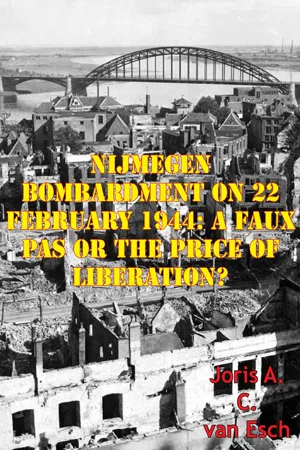
eBook - ePub
Nijmegen Bombardment On 22 February 1944: A Faux Pas Or The Price Of Liberation?
- 84 pages
- English
- ePUB (mobile friendly)
- Available on iOS & Android
eBook - ePub
Nijmegen Bombardment On 22 February 1944: A Faux Pas Or The Price Of Liberation?
About this book
A steadfast misbelief in precision bombing evolved into the leading concept for US Army Air Force during the Second World War. This concept envisioned the destruction of the German industrial and economic system as the swiftest path to victory. However, the belief in survivability of bombers through self defense proved incorrect, and the Allies realized that the Luftwaffe had to be defeated first, by attacking the German aircraft industry. On 22 February 1944, Eighth Air Force conducted a mission as part of this offensive. During this mission, the bombers were recalled because of severe weather. On the return trip, the airmen decided not to abandon the mission outright, but to attack targets of opportunity. Because of navigational errors a section of 446 Bombardment Group misidentified the Dutch city Nijmegen as in Germany, and bombed it. Due to aiming errors, the greater part of the bombs missed the designated marshalling yards by a kilometer, and hit the city center instead. The bombardment caused chaos on the ground. It surprised the citizens, ignorant by earlier faulty alarms, and damage caused great difficulties for the provision of aid relief. As a result, the bombardment killed about 800 citizens and destroyed the historic city center.
Trusted by 375,005 students
Access to over 1.5 million titles for a fair monthly price.
Study more efficiently using our study tools.
Information
Subtopic
European HistoryIndex
HistoryCHAPTER 1 — INTRODUCTION
Introducing a Footnote in History
On 22 February 1944, the United States (US) Eighth Air Force conducted a mission to bomb the German aircraft factory at Gotha, as part of Operation Argument, the offensive against the German aircraft production. During this mission, the bombers were recalled because the weather above the target area was not conducive to the doctrine of daylight precision bombing. On the return trip to England, the formation decided to attack targets of opportunity in Nazi-Germany. However, they bombed the Dutch city of Nijmegen, close to the German-Dutch border. Furthermore, instead of hitting the rail yard in Nijmegen, the bombs fell on the city center, killing about 800 Dutch citizens. Major General James Hodges, Commander of the 2nd Bombardment Division of the US Eighth Air Force later reported this bombardment as “at least a faux pas.”{1}
Despite the number of casualties, the bombardment of Nijmegen ended up as a footnote in history. Most authoritative books on the history of the US Army Air Force (USAAF) hardly mention the bombardment. The official combat chronology of the USAAF only tacitly mentions “154 Heavy Bombers attack various Targets of Opportunity (Nijmegen, Arnhem and Enschede), 6 aircraft are lost.”{2} One of the authoritative books about the Eighth Air Force by Gerald Astor does not discuss this bombardment specifically, but Operation Argument and Big Week are discussed extensively.{3} One of the planners of the American concept of strategic air warfare in the
Second World War, Haywood Hansell, describes 22 February 1944 as: “the Eighth put forth another maximum effort. However, adverse weather plagued the Eighth and . . . (they) had to abandon their primary targets.”{4} Finally, one of the best known histories of the Eighth Air Force by Roger Freeman mentions briefly “one of the targets of opportunity brought also tragedy. A B-24 group bombed Nijmegen in error for a German town and caused 850 Dutch civilian casualties.”{5} So why did this bombardment become a footnote in history? This question can be approached from three different angles: the Eighth Air Force’s perspective, the history of Nijmegen in the Second World War, and the civilian perspective.
From the perspective of the Eighth Air Force it is quite natural and reasonable that the Nijmegen bombardment was overlooked. The air war above Europe during the Second World was not only a grueling and bitter battle; it was also complicated and extensive. For instance, during the weeks Operation Argument took place, Allied air forces launched 3,800 bomber sorties, dropping 10,000 tons of bombs. Casualties were high, as the Eighth Air Force lost 137 bombers. The Fifteenth Air Force lost 89 bombers and about 2,600 Allied airmen were killed.{6} In comparison to these numbers the small group of fourteen bombers that attacked Nijmegen is easily overlooked, regardless the devastating consequences. Furthermore, reliable assessments about the number of casualties and the damage were not readily available for the Eighth Air Force. Neither free news media nor independent reports existed in occupied countries. Despite how tragic and terrible the bombardment was, this attack was considered by the Allied Forces as an unavoidable mistake or even an expectable consequence of a terrible, total war.
Finally, the bombardment was not an episode to be proud of. Only the 446th Heavy Bombardment Group’s history described the bombardment as a “tragic flight.”{7} Especially after the war, the official Eighth Air Force history extols a heroic battle, where it almost wins the war by itself. Such a history provides little room for discussing the usefulness and necessity of strategic bombing, let alone such history discusses a relatively small bombardment.{8}
The second reason why this bombardment was overlooked is the complicated and tragic history of the city itself during the last year of the Second World War. The bombardment was one of four major battles which struck Nijmegen during 1944. Seven months after the devastating bombardment in February 1944, Nijmegen added a new chapter to the dramatic year. During Operation Market Garden the city was on the frontline again for more than six months. The US 82nd Airborne Division conducted an airborne landing to seize the bridges across the Waal River. After three days of fierce fighting, the bridge was captured and the city was liberated by American soldiers. However, German soldiers set fire to hundreds of houses in a desperate attempt to defend the city, and the fierce fighting killed hundreds of civilians and further destroyed the city.{9}
Although successful in Nijmegen, Operation Market Garden failed at the city of Arnhem, only fifteen kilometers north. It was “the proverbial bridge too far.”{10} However, the Allies successfully occupied the area just north of Nijmegen. For the Germans, this removed the strategic necessity to recapture the bridges across the river Waal. Therefore, the German regional commander, Field Marshall Walter Model decided to deny the Allies the use of the bridges. As a result, the fierce shelling and bombardment of both the bridges and Nijmegen by the Wehrmacht and Luftwaffe caused significant casualties during October and November 1944.{11}
Finally, Nijmegen became the scene of battle for a fourth time. At the end of January 1945, the Allies again initiated an offensive. After recovering from the Battle of the Bulge, the Allies launched Operation Veritable to regain the initiative and seize the German Rhineland. Nijmegen was the starting point of this operation. Almost 470,000 soldiers, most British and Canadian, formed the biggest concentration of Allied troops in the Second World War on the Western front. As expected, the Germans reacted on the attack, and the city was shelled and bombed again.
Although exact numbers are not available, the number of civilians killed in those three operations probably exceeds the number of civilians killed during the bombing on 22 February 1944. According to the city’s official figures, the total infrastructural damage of 182 days on the frontline is 1,400 destroyed houses, 900 with severe damage and 2,300 with light damage.{12} Figure 1 illustrates the ruins in the city a few days after the bombardment of 22 February 1944.

Figure 1. Ruins in Nijmegen after the Bombardment, February 1944.
Source: Alfons Brinkhuis, De Fatale Aanval, 22 Februari 1944: Opzet of Vergissing? De Waarheid over de Mysterieuze Amerikaanse Bombardementen op Nijmegen, Arnhem, Enschede en Deventer [The fatal attack: Intention or mistake? The truth about the mysterious bombardments] (Weesp, The Netherlands: Van Hoorn, 1984), 107.
The civilian perspective is a third explanation why this bombardment received little attention. First, the surviving inhabitants of Nijmegen had mixed emotions, because it was obviously a bombardment by Allied friends. Therefore, the Nazi-propaganda quickly tried to exploit this attack (as seen in figure 2). Such an event does not easily evolve into a heroic story people discuss. More likely, people tend to forget or even suppress it. Subsequently, it will fall into oblivion. To illustrate the contrary: the history of the heroic river Waal crossing in September 1944 (also in Nijmegen) by the US Army’s 504th Parachute Regiment is both famous and well known.

Figure 2. Nazi propaganda
Source: Joost Roosendaal, Nijmegen '44: Verwoesting, Verdriet en Verwerking [Nijmegen 1944: Devastation, distress and acceptance] (Nijmegen, Netherlands: Vantilt, 2009), 90.
Note: The Nazi propaganda reacted as swift as an arrow to the bombardment: already three days later this suggestive poster was posted [Translation: “with friends like that, who needs enemies; Nijmegen, Enschede, Arnhem.”].
Second, for years the inhabitants of Nijmegen were also uncertain why the bombardment happened: both the cause and the responsibility were unclear. Although the Dutch Government in exile officially protested to the Allied Supreme Command, they never received the results of the inquiry completed by the Eighth Air Force, nor continued their protest. The reason for this, was that the government was hesitant to risk affronting the Americans.{13} Additionally the Eighth Air Force’s inquiry was not released publicly, but was put away safely in the National Archives in Washington. For decades, conspiracy theories and tall stories were told in Nijmegen. Some people made wrong causal connections in between the February bombardment and Operation Market Garden. Others suggested that the Allies tried to bomb the German headquarters in the city.{14}
All these uncertainties and conspiracy theories raised lingering questions about what really happened at Nijmegen and why. Furthermore, people embarked on the post-war reconstruction of the city. The country was devastated and the inhabitants focused their energy to rebuild the city and its economy. Of course there were commemorations, but investigations and research into the bombardment were very limited. Eventually, the first comprehensive book about the bombardment was only published in 1984 by Alfons Brinkhuis.{15} Additionally, as the survivors pass away, several books with their personal reminiscences have been published.{16} These accounts brought increased speculation and rumors of the details of the bombardment again. These rumors, uncertainty and questions caused the local authority to commission new research projects twice: the first by a freelance researcher in 2005 and the second to be conducted by the University of Nijmegen in 2007, of which Joost Roosendaal’s book is the extensive account.{17}
Research Question and Design
Having this historic background in mind, the central research question of this thesis is: What factors led to the bombardment of Nijmegen and what happened on 22 February 1944? To answer this question, there are five research questions, respectively:
1. What was the foundation of the USAAF thought with regard to strategic bombing prior to the Second World War?
2. What were the most important events which led to The Big Week?
3. Why and did the Eighth Air Force bomb Nijmegen?
4. How was the bombardment executed?
5. What were the consequences of the bombardment?
This thesis will approach the events thematically, rather than a chronological de...
Table of contents
- Title page
- TABLE OF CONTENTS
- ABSTRACT
- ACRONYMS
- CHAPTER 1 - INTRODUCTION
- CHAPTER 2 - THE AIR PERSPECTIVE PRIOR TO THE SECOND WORLD WAR
- CHAPTER 3 - THE BUILD-UP TO BIG WEEK-THE AIR WAR IN 1943 AND 1944
- CHAPTER 4 - THE AIR PERSPECTIVE
- CHAPTER 5 - THE GROUND PERSPECTIVE
- CHAPTER 6 - CONCLUSIONS
- BIBLIOGRAPHY
Frequently asked questions
Yes, you can cancel anytime from the Subscription tab in your account settings on the Perlego website. Your subscription will stay active until the end of your current billing period. Learn how to cancel your subscription
No, books cannot be downloaded as external files, such as PDFs, for use outside of Perlego. However, you can download books within the Perlego app for offline reading on mobile or tablet. Learn how to download books offline
Perlego offers two plans: Essential and Complete
- Essential is ideal for learners and professionals who enjoy exploring a wide range of subjects. Access the Essential Library with 800,000+ trusted titles and best-sellers across business, personal growth, and the humanities. Includes unlimited reading time and Standard Read Aloud voice.
- Complete: Perfect for advanced learners and researchers needing full, unrestricted access. Unlock 1.5M+ books across hundreds of subjects, including academic and specialized titles. The Complete Plan also includes advanced features like Premium Read Aloud and Research Assistant.
We are an online textbook subscription service, where you can get access to an entire online library for less than the price of a single book per month. With over 1.5 million books across 990+ topics, we’ve got you covered! Learn about our mission
Look out for the read-aloud symbol on your next book to see if you can listen to it. The read-aloud tool reads text aloud for you, highlighting the text as it is being read. You can pause it, speed it up and slow it down. Learn more about Read Aloud
Yes! You can use the Perlego app on both iOS and Android devices to read anytime, anywhere — even offline. Perfect for commutes or when you’re on the go.
Please note we cannot support devices running on iOS 13 and Android 7 or earlier. Learn more about using the app
Please note we cannot support devices running on iOS 13 and Android 7 or earlier. Learn more about using the app
Yes, you can access Nijmegen Bombardment On 22 February 1944: A Faux Pas Or The Price Of Liberation? by Joris A. C. van Esch in PDF and/or ePUB format, as well as other popular books in History & European History. We have over 1.5 million books available in our catalogue for you to explore.