eBook - ePub
Tactical Intelligence In The Army Of The Potomac During The Overland Campaign
- 75 pages
- English
- ePUB (mobile friendly)
- Available on iOS & Android
eBook - ePub
Tactical Intelligence In The Army Of The Potomac During The Overland Campaign
About this book
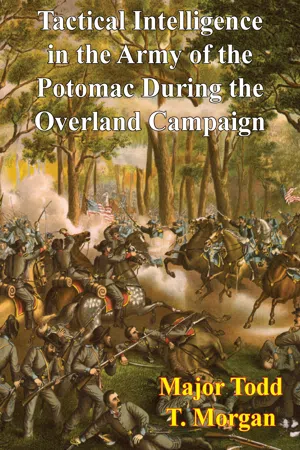
This study examines how Lieutenant General Ulysses S. Grant and the Army of the Potomac used tactical intelligence during the Overland Campaign. Although Grant did not achieve his operational objective to defeat General Robert E. Lee in the field, tactical intelligence allowed him to continue the operational maneuver of the Army of the Potomac, which later contributed to the eventual defeat of Lee in April of 1865. The examination of tactical intelligence in the Army of the Potomac covers the period of 4 May to 12 June 1864. It encompasses campaign planning and preparation, as well as the battles of the Wilderness, Spotsylvania Court House, North Anna River, and Cold Harbor. The study combines a general contextual overview of the campaign and battles with a focused discussion and analysis of tactical intelligence collection and use. The study also includes background discussion of influences that contributed to the lack of intelligence functions in the War Department and the Union Army, the intelligence organizations that emerged in the Army of the Potomac, and description of the primary forms and methods of tactical intelligence collection used during the campaign.
Information
Subtopic
19th Century HistoryIndex
HistoryCHAPTER 1 — INTRODUCING THE OVERLAND CAMPAIGN
“From the earliest times, military leaders have always sought information of the enemy, his strengths, his weaknesses, his intentions, his dispositions.”{1} — John Keegan, Intelligence in War
“The necessity of procuring good intelligence is apparent and need not be further argued.”{2} — General George Washington
Introduction
The Overland Campaign lasted approximately forty days and at the end, the troops of the Army of the Potomac were tired but triumphant while General Robert E. Lee’s Army of Northern Virginia remained undefeated. For the Army of the Potomac this was its sixth campaign and the bloodiest month since the start of the war.{3} Horace Porter, then a captain and aide-de-camp on Lieutenant General Ulysses S. Grant’s staff wrote:
“From the 4th of May until the end of June there had not been a day in which there was not a battle or skirmish. The record of continuous and desperate fighting had far surpassed any campaign in modern or ancient military history.”{4}
The Overland Campaign, which occurred from 4 May to 12 June 1864, was the first part of a series of battles and movements that eventually lead to the defeat of Lee in April of 1865. It stands out from other campaigns of the Civil War because those who fought it received little rest, marched continually in both night and day, conducted night attacks, used little artillery preparation before assaults, and constantly used entrenchments.{5}
When planning the Overland Campaign, both Grant and the Army of the Potomac faced the fact that Lee and his Army of Northern Virginia had not lost a single battle fought in Virginia. Despite his smaller force, Lee had the advantage of interior lines, knew the terrain, and could assume a nearly constant defensive posture with troops that could entrench quickly. Even so, Lieutenant General James Longstreet cautioned an over confident subordinate officer about Grant when he said, “I will tell you that we cannot afford to underrate him and the army he now commands … for that man will fight us every day and every hour till the end of this war.”{6} Grant, unshaken by Lee’s reputation and the Army of the Potomac’s mediocre history, commenced the campaign that he hoped would end the war. The battles of the Overland Campaign depleted both soldiers and resources but not the resolve of either side.{7} In the end, Grant proved Longstreet correct.
Intelligence in the Union Army
The US Civil War marked a period of development and implementation for new technology, weapons, concepts and ideas for employment on the battlefield. In The Evolution of Weapons and Warfare, Colonel T. N. Dupuy described the Civil War as one of the most important conflicts in the 1800 to 1875 period. He added, “many historians have termed the American Civil War the last of the old and the first of the modern wars.”{8}
One of the Civil War contributions to modern warfare that did not take root in the US Army until World War I was the function of intelligence. In the history of the US Army before the Civil War, commanders had used various means and methods to collect intelligence to assist their decision-making. When General George Washington commanded the Continental Army, he served as his own intelligence chief.
Not until after the Civil War had begun did organized and dedicated intelligence functions appear in the Union field armies. The two most noted intelligence organizations both appeared in the Army of the Potomac. Major General George C. McClellan, who organized and served as the Army of the Potomac’s first commander, used a hired civilian detective service that proved ineffective. Later, Major General Joseph Hooker commanded the Army of the Potomac and created the Bureau of Military Information (BMI). Organized in the early spring of 1863, the BMI also provided intelligence to Hooker’s successor, Major General George Gordon Meade, and continued to do so until the end of the war. In the planning and preparation for the Overland Campaign, the BMI played a pivotal role in aiding Grant to make the decision to cross the Rapidan River on Lee’s right in the east. When the campaign began, however, the BMI found itself minimized in its role to provide intelligence to Meade and Grant.
From 4 May to 12 June 1864, Grant and Meade conducted the operational maneuver of the Army of the Potomac and fought the battles of the Wilderness, Spotsylvania Court House, North Anna River and Cold Harbor. Though the planning for the campaign involved intelligence at an operational level, once it began the difference between operational and tactical intelligence quickly blurred. The Army of the Potomac used various forms and methods of tactical intelligence throughout the campaign, but each battle ended indecisively with Lee remaining undefeated. These two facts provide the following thesis statement for this study.
Although Grant did not achieve his operational objective to defeat Lee in the field, tactical intelligence allowed Grant and Meade to continue the operational maneuver of the Army of the Potomac, which later contributed to the eventual defeat of Lee in April of 1865. Therefore, how did Grant, Meade, and the Army of the Potomac use tactical intelligence during the Overland Campaign?
Defining Intelligence
The question posed is significant because at the outset of the Civil War intelligence was not a formalized function in the Union Army. No techniques, procedures, manuals, or doctrine existed for commanders in the field to reference. Those commanders that created and implemented intelligence functions within their commands did so on their own initiative.
To provide clarity for the thesis, the terms “intelligence” and “information” need defined. Using Military Intelligence, 1870-1991: A Research Guide, Jonathan M. House defined intelligence as “the product of systematic efforts to collect, confirm, evaluate, and correlate information from a variety of sources.”{9} House defined information with the following: “Information is … unevaluated reports of every description. [R]arely if ever does a single source or single piece of information provide perfect intelligence.”{10}
During the Civil War, the word intelligence did not have today’s meaning and its use described or referred to new information on any subject. It is interesting to note that during the Revolutionary War, General George Washington’s definition of intelligence closely resembled today’s meaning. The reason for the disparity in terminology at the time of the Civil War is unknown. Additionally, no name or description existed for the combined efforts of intelligence activities. The title “secret service” came closest in reference to what we describe today as an intelligence unit or organization.{11} During the Civil War, secret service generally referred to non-military related detective work, but with the advent of the BMI, it also included that organization within the Army of the Potomac.
Thesis Methodology
The presentation, discussion, and analysis of tactical intelligence in the Army of the Potomac covers the period of 4 May to 12 June 1864 during the Overland Campaign. The primary focus concerning the use of tactical intelligence is on Grant, and to a lesser extent Meade. The choice of the Overland Campaign for an examination of tactical intelligence provides a succinct period, characterized by maneuver, which has an appropriate breadth of events and actions from which to discuss and analyze its use.
In order to examine the use of tactical intelligence during the Overland Campaign, the thesis provides a background discussion of what influenced the Union Army and why intelligence operations was not a developed function. Included is a brief discussion on the two intelligence organizations that emerged in the Army of the Potomac at different times before the Overland Campaign. This provides context for understanding how the Army of the Potomac grappled with creating its own intelligence functions without guidance or example from the War Department. Additionally, the thesis gives a description and discussion of the primary forms and methods of intelligence collection in the Army of the Potomac. This includes an overview of intelligence terms and definitions in relation to the Civil War, which helps prepare for the discussion of tactical intelligence during the Overland Campaign.
The preface to the use of tactical intelligence by the Army of the Potomac during the Overland Campaign encompasses a description of the terrain as well as the initial disposition and organization of the opposing armies. A general contextual overview of the campaign and battles, combined with a discussion of the collection and use of intelligence by the Army of the Potomac follows. It starts with planning and preparation for the campaign and ends with Cold Harbor.
The conclusion of the thesis provides an overview of the Overland Campaign’s end state in relation to Grant’s intended objective. A summary of the forms and methods of tactical intelligence used facilitates the analysis and conclusions drawn, which answers the primary question and concludes the thesis.
General Background
As of January 1861, the Regular Army had an authorized strength of 18,000 with an actual strength of 1,098 officers and 15,304 enlisted that totaled an overall strength of 16,402. Approximately one third of the southern born officer corps resigned their commissions and joined the Confederacy. Upon the decision to respond to the rebellion militarily, the recruitment of volunteers began and the Union Army formed. Instead of becoming a cadre, the Regular Army units integrated with the volunteer force of the Union Army.
Because the US Army conducted either frontier duty or coastal defense along the Atlantic, it entered the Civil War unprepared in many ways. It lacked a sizable force, an adequate system of command and control, as well as any intelligence functions in the War Department or in the field armies. Though the latter of these inadequacies persisted, the Union Army entered the war after several months of preparation.
The initial strategy of the Union Army developed terrain-oriented operational objectives that specifically focused on key southern cities such as Richmond, Virginia, the capitol of the Confederacy. Despite the desire to quickly end the rebellion and restore the Union through use of the North’s manpower and resources, an end state many northerners thought simple, the Confederacy thwarted any quick conclusion to the situation.
The defense-based strategy of the Confederacy, combined with the will of protecting the homeland and a way of life, negated the Union’s attempt for speedy success. As a result, the war became protracted and two major theaters of operations evolved, western and eastern. In the east, Virginia was a significant area of Confederate operations and became the predominate battleground of the Civil War, which included the Overland Campaign.
Army of the Potomac
The History of Military Mobilization in the United States Army, 1775-1945 states, “during the winter of 1861-62, the Army of the Potomac was built.”{12} McClellan was the first of six commanders through 1865. During the first two years of its existence, the Army of the Potomac endured bloody fighting, heavy losses, and a steady succession of commanders. When Lee began the second Confederate invasion of the North in June of 1863, Meade relieved Hooker from command of the Army of the Potomac on 28 June on orders from President Lincoln. Up to this time, the Army of the Potomac had not known success. Within days ...
Table of contents
- Title page
- TABLE OF CONTENTS
- ABSTRACT
- ACKNOWLEDGMENTS
- ACRONYMS
- CHAPTER 1 - INTRODUCING THE OVERLAND CAMPAIGN
- CHAPTER 2 - THE ABSENCE OF UNION ARMY INTELLIGENCE FUNCTIONS AND ARMY OF THE POTOMAC TACTICAL INTELLIGENCE COLLECTION DURING THE OVERLAND CAMPAIGN
- CHAPTER 3 - INTELLIGENCE IN THE ARMY OF THE POTOMAC DURING THE OVERLAND CAMPAIGN
- CHAPTER 4 - CONCLUSIONS ON THE USE OF TACTICAL INTELLIGENCE BY THE ARMY OF THE POTOMAC DURING THE OVERLAND CAMPAIGN
- GLOSSARY
- BIBLIOGRAPHY
Trusted by 375,005 students
Access to over 1.5 million titles for a fair monthly price.
Study more efficiently using our study tools.
Frequently asked questions
Yes, you can cancel anytime from the Subscription tab in your account settings on the Perlego website. Your subscription will stay active until the end of your current billing period. Learn how to cancel your subscription
No, books cannot be downloaded as external files, such as PDFs, for use outside of Perlego. However, you can download books within the Perlego app for offline reading on mobile or tablet. Learn how to download books offline
Perlego offers two plans: Essential and Complete
- Essential is ideal for learners and professionals who enjoy exploring a wide range of subjects. Access the Essential Library with 800,000+ trusted titles and best-sellers across business, personal growth, and the humanities. Includes unlimited reading time and Standard Read Aloud voice.
- Complete: Perfect for advanced learners and researchers needing full, unrestricted access. Unlock 1.5M+ books across hundreds of subjects, including academic and specialized titles. The Complete Plan also includes advanced features like Premium Read Aloud and Research Assistant.
We are an online textbook subscription service, where you can get access to an entire online library for less than the price of a single book per month. With over 1.5 million books across 990+ topics, we’ve got you covered! Learn about our mission
Look out for the read-aloud symbol on your next book to see if you can listen to it. The read-aloud tool reads text aloud for you, highlighting the text as it is being read. You can pause it, speed it up and slow it down. Learn more about Read Aloud
Yes! You can use the Perlego app on both iOS and Android devices to read anytime, anywhere — even offline. Perfect for commutes or when you’re on the go.
Please note we cannot support devices running on iOS 13 and Android 7 or earlier. Learn more about using the app
Please note we cannot support devices running on iOS 13 and Android 7 or earlier. Learn more about using the app
Yes, you can access Tactical Intelligence In The Army Of The Potomac During The Overland Campaign by Major Todd T. Morgan in PDF and/or ePUB format, as well as other popular books in History & 19th Century History. We have over 1.5 million books available in our catalogue for you to explore.